Project 1 - Design and Development of Crutch ( Medical Technology)
DESIGN AND DEVELOPMENT OF CRUTCH:
Crutches are a type of walking aid that serve to increase the size of an individual's base of support. They transfer weight from the legs to the upper body and are often used by people who cannot use their legs to support their weight (from short-term injuries to lifelong disabilities).
There are three types of crutches: axilla crutches, elbow crutches and gutter crutches.
- Axilla or underarm crutches: They should be positioned with 2 fingers of distance between the axilla and the axilla pad with the elbow flexed between 20-30 degrees.The design includes an axilla bar, a handpiece and double uprights joined distally by a single leg. They are adjustable in height; both the overall height and handgrip height can be adjusted (adjustable approximately 48 to 60 inches / 12 to 153 cm).
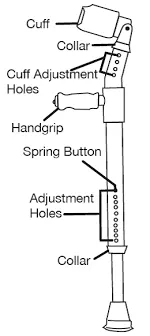
- Forearm crutches: (or lofstrand, elbow or Canadian crutches). Their design includes a single upright, a forearm cuff and a handgrip. The height of forearm crutches is indicated from handgrip to the floor (adjustable from 29 to 35 inches / 74 to 89 cm).
- Gutter Crutches: (or adjustable arthritic crutches, forearm support crutches) An additional type of crutch, which is composed of a padded forearm support, made up of metal, a strap and adjustable handpiece with a rubber ferrule. These crutches are used for patients who are partial weight bearing, and are particularly useful for clients with rheumatoid conditions.
Task 1
Market Analysis:
The global medical crutches market size was valued at USD 727.4 million in 2022 and is expected to expand at a compound annual growth rate (CAGR) of 6.5% from 2023-2030. This growth can be attributed to the high number of surgeries performed worldwide which is contributing to the demand for medical crutches. Moreover, there is a high prevalence of osteoporosis and other bone-related disorders globally. This further propels the demand for medical crutches globally.
Market players are undertaking various strategic initiatives such as the launch of new product partnerships, collaborations, mergers and acquisitions, geographic expansion, aiming to strengthen their product portfolio, and provide a competitive advantage.
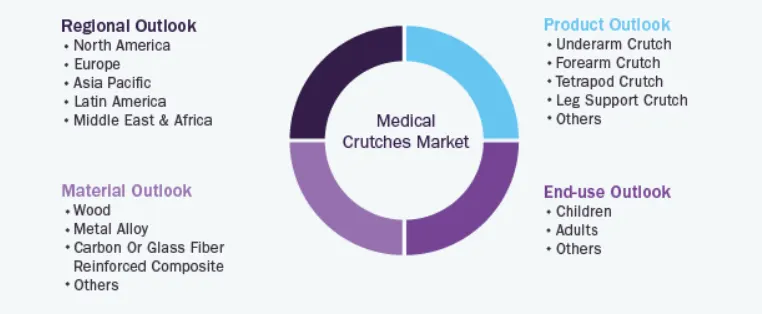
Some prominent players in the global medical crutches market include: Sunrise Medical, Nova Medical Products, Millennial Medical, Chinesport, IWALKFree, Cardinal Health, Home Medical Products, New York Millennium Pharmaceutical, AMG Medical, Breg, Inc., Valley Tool Die, Inc.
Task 2
The general design requirements of a crutch are:
- That they are easily adjustable, strong and durable
- Have a low deformation risk and high abrasion resistance
- Be made from a lightweight material
- The tips of the crutch should be durable, non-slip and replaceable
- Parts must be replaceable and made from materials that withstand the environment of use
The design includes a single upright, a forearm cuff and a handgrip. The height of forearm crutches is indicated from handgrip to the floor (adjustable from 29 to 35 inches / 74 to 89 cm).
Crutches should be appropriate for local terrain and conditions such as sand, rocky terrain, rain, ice and snow, the guide advises. WHO says that each crutch should last for at least for five years, provided they are properly looked after in line with product instructions.
Task 3
Concept generation based on feedback:
The people wish for a crutch that doesn't slip even on a slippery surface. They also want the crutch to have a robust design. This means that the design should not break easily under pressure. The crutch should also not deteriorates overtime. In a survey it was seen that the crutches are bought in a pair, people do not tend to buy more of an expensive pair, thus the product should be cheap but not compromise with the quality at the same time. In the design of crutches people seem to prefer modular architecture over the integral architecture. Since finding an integral architecture based crutch is not easy to find for the height of the patient, thus patient looks for a modular architecture one. Modular architecture gives the user freedom to choose whatever they wish for in a product, thus modular ones are on the rise. Also the demand for no slipping ones is also there the design would more like represent a foot but with some suction blobs on the surface that would come in contact with the earth. This would make the thing non slippery.
Concept of operation:
Operating Scenarios: Now let us take a normal example that if you are full weight-bearing there are no risks, but if you are partial or non-weight bearing you will be putting extra pressure/weight through your arms which could result in hand, arm or shoulder pain and the elbow crutch which you are using can slip easily. therfore good quality rubber tip of high strength and durability should be used.
The risk of slip and fall accidents can increase with slippery floors, uneven walkways, clutter on the floor and other such hazards. It is therefore important to consider a number of safety measures when using crutches. Clear away rugs, cords or any other objects in the home that can cause one to trip or slip and fall. Use nonslip bath mats and install grab bars in the bathroom. Crutch users should also be extra cautious during slick weather conditions and avoid slippery stairways. They should also try to walk only in well-lit areas. Ensure the crutch’s rubber tips are clean and in good condition so that they have traction on various surfaces.
Operating Conditions: The crutch should support the normal travelling, getting up and down the stairs and not slip on slippery surafces. The crutch should also be mad of rust-repellant material so it does not catch any rust if used in rain a lot. The crutch should have a comfortable handle to begin with along with an elbow rest and it should give comfort and strong grip to the user.
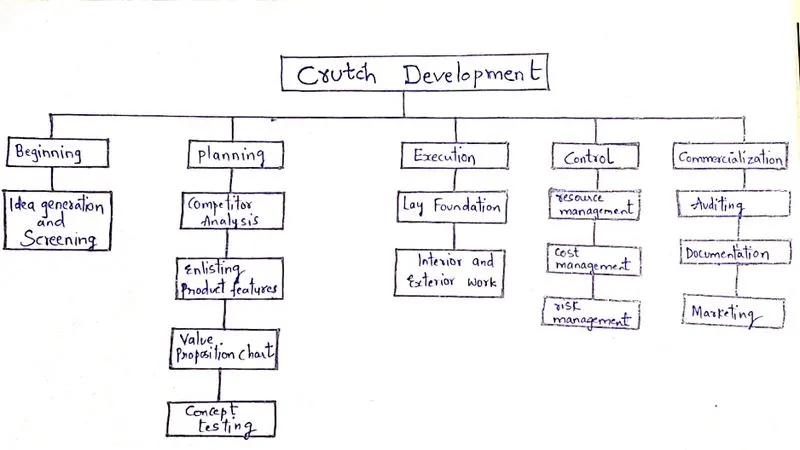
Work Breakdown Structure:
Product Architecture:
Modular architecture
- Modular architecure will suit better for these products as they are used continuously, which sometimes results in damage of the product. So modular architecture will help in replacing the parts whenever needed.
- We can use different cushion fabric, color and replace the existing parts in modular structure.
- can replace any damaged part immediately
- Easy to manufacture
- Easy to operate and handle
- Understandable
Architecture schematic of an elbow crutch:
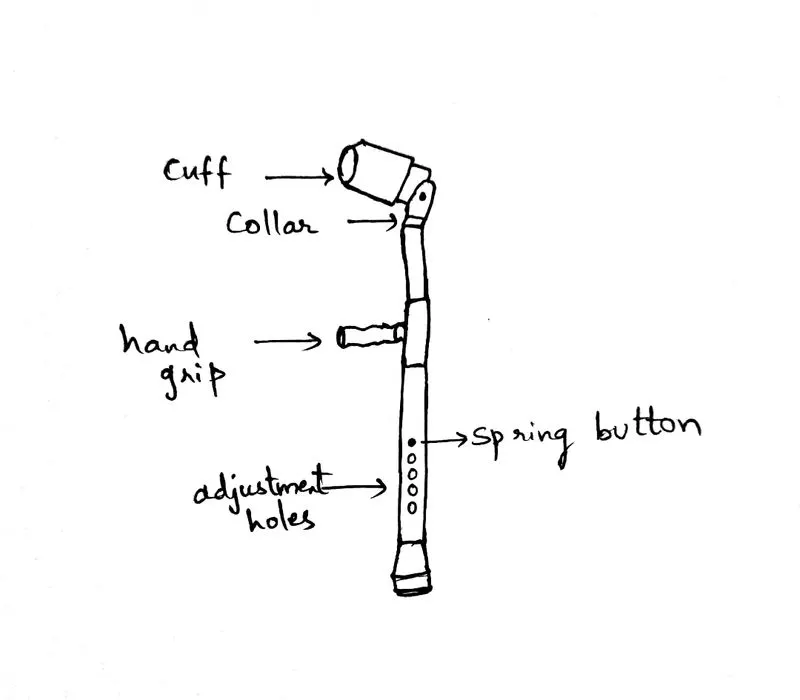
Elbow Crutch
Interface Control Documents:
Mechanical Interface
The crutch is a mechanical device in itself without having any electrical connection to move around. The parts will be assemble before use and the usage of the device is not a big hassle.
Electrical Interface - NIL
Information-flow Interface - NIL
Human-machine Interface - NIL
Task 4
Product development roadmap:
| Q1 '22 | Q2'22 | Q3'22 | Q4'22 | Q1'23 |
|
|
|
|
|
Mission Statement:
| Product Description |
|
| Benefit Statement |
|
| Buisness Objectives |
|
| Core Market |
|
| Stakeholders |
|
- Generally we require mechanical engineers to work on mechanics of the product.
- No. of staffs depends on the volume of production.
Budget requirements:
- To develop an elbow crutch, requires lot many parts and cost of these parts depends on the company that we buy from.
- The cost of the staff, depends on the volume of production, high production means requires many staff members.
- It also includes fixed cost like land, machines etc.
Product Schedule:
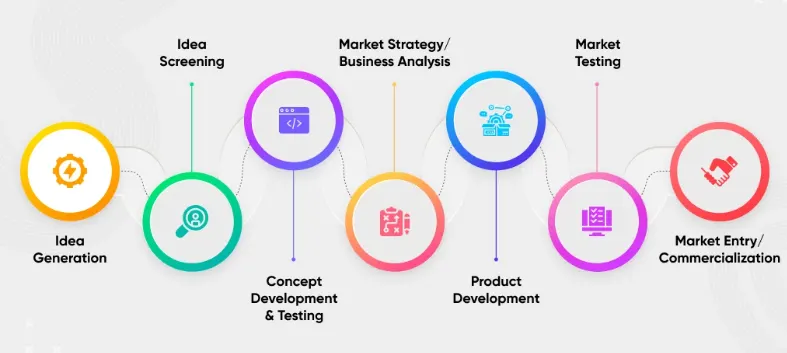
Stage 1 : Idea Generation
The goal should be to generate many worthy ideas that can form the foundation for the New Product Development strategy. The major focus for stage 1 should be to arrange brainstorming sessions where solving customer problems is given precedence.
This phase is not about generating foolproof ideas that are ready for implementation. Instead, raw and unproven ideas that can be shortlisted later should be discussed.
Stage 2 : Idea Screening
This New Product Development stage revolves around choosing the one idea with the highest potential for success. Put all the ideas available on the table for internal review. That is, turn to people with industry knowledge and experience in the field for idea screening.
A proof of concept (POC) should hold precedence for a new product development idea as it helps check the idea’s feasibility. There is no point in zeroing in on an idea that is not technically feasible to build.
SWOT ( Strengths, Weaknesses, Opportunities, and Threats) analysis can be another good practice to consider when shortlisting New Product Development ideas.
The New Product Development idea should be unique so that people do not need to be convinced to pay for it.
Stage 3 : Concept Development and Testing
1. Quantifying Gain/Pain ratio
A business needs to create an insightful picture of the product from the user’s perspective. This can be achieved by calculating the gain/pain ratio, where:
Gain = Benefits of the product for the customer. What is in it for them?
Pain = The efforts made by the customer to understand and use the product.
2. Conducting a competitor analysis
Knowing about existing market players is a critical strategic step to consider. Understanding the competition makes it easier to infer:
- Where the competitor lacks
- Where is the scope for improvement
- Existing white space in the market
3. Enlisting the major product features
The user stories involved in the New Product Development software project will make or break a business. When creating a list of such features, it is imperative to know — how is it an innovative feature, and how is it going to solve a problem?
4. Create a value proposition chart
Even after being convinced of the wisdom & the utility of an idea, being able to state it clearly to the end-user, in their context, is quite a different story altogether. The end-user needs to be given a clear picture of what the new product is capable of doing. This clean & presentable fashion can be best represented in the form of a value proposition chart.
5. Concept testing
Once the value proposition is ready, it is time to present it to the set of selected customers. How they perceive the idea is the test of the efforts so far. If the idea doesn’t look promising, it is wise to repeat the idea screening steps to develop a new product.
Stage 4 : Market Strategy/Business Analysis
Marketing strategy is all about drafting a way to reach out to the targeted audience. Perhaps the best and most straightforward method is to follow McCarMthy’s 4Ps (Product, Price, Promotion, Placement) of marketing for a New Product Development project.
This business analysis will help to determine whether the New Product Development efforts are worth the financial investment or not (i.e., will it create a continuous stream of value)?
It is important to strategize in an informed way about the selling price by identifying the base price of the product. The best way to identify the base price is:
1. Cost-Based pricing model
Here, the initial production cost is added to the markup percentage to come up with the new product’s final price.
2. Market focused pricing
This pricing is inferred after a thorough analysis of the pricing model of similar products in the target market.
Stage 5 : Product Development
When the New Product Development idea is in place, the market strategy is documented, and the business analysis is completed, it is time to move on with the product life-cycle development process.
The New Product Development starts with developing the prototype followed by MVP (Minimum Viable Product).
Stage 6 : Deployment
Once the MVP is ready, efforts shift from development to deploying the product in the live environment. This process involves embracing the DevOps culture and implementing the CI/CD pipeline.
Stage 7 : Market Entry/Commercialization
Commercialization is an umbrella term that entails varied strategies to ensure the success of the new product. Here is what commercialization includes:
If all the mentioned strategies fall right in place, nothing can stop a product from getting attention and being a product-market fit.
1. Marketing the concept over product
The idea here is simple: talk about the concept and the product’s intent instead of endlessly boasting about the product features. In short, answer how the product will make the customer’s life easier.
2. Having a brand voice
A unique mindset and a unique voice always gain an all-ears audience. This is where the marketing team plays a significant role. They need to establish an effective communication style that represents the brand in the best manner.
Be it blogs, emails, or even the website content, all of these elements need to be well thought out and clear in their message. In the end, these elements should hold the power to intrigue the target audience.
3. Conducting Intriguing webinars
Webinars are one way to attract quality leads. Conduct webinars that talk about how the new product will benefit the audience and describe the features that are being introduced.
Webinars can also help promote findability and discoverability:
- Findability: It is easy to find and use features that the customer is aware of.
- Discoverability: It is easy to find and use features that the customer has no knowledge about.
Now that remote work is gaining traction, webinars are an even more effective way to reach a target audience. Talk about the product, describe its features, and witness a positive impact on the bottom line.
Refining the Design:
Simplicity
- The product is foldable, so it is portable and light in weight also ready to fit wherever and whenever required.
- It has an excellent grip, so it does not slips in wet conditions.
- Its structure provides you comfort and easy to handle.
Immediate intuition
- FOLDABLE , PORTABLE, LIGHTWEIGHT AND COMFORTABLE.
Aesthetics
- Crutches with in a wide range of styles, colors, and designs.
Ergonomics
- Crutches allow users to achieve good balance, while keeping their backs straight when they are fitted, and using them properly.
- This helps to minimize back pain, promote good posture, and improve upper body gait (and even lower leg walking gait if a user is able to use one leg).
Industrial design drawing: