Project 1 - Design and Development of Crutch ( Medical Technology)
Design and development of Crutch
Task 1
medical crutches are type of mobility aid that facilate the transfer of wieght form the legs to upper body of an individual.
theas are used by people who are affected with short term injuries to chronic disabilities. the growht of market is driven by factors such as increase in incidents of accidents occuring across globe that lead to disability. rise in prevalence of lifelong disabilities, and technology advancement in the area of medical crutches. however , problem associated with design of cruthces restrict the grwoth of the market.
| Aspects | details |
| by product |
|
| by end used |
|
| by material |
|
| by religion |
|
| key market players |
|
Task 2
General design requirements
- That they are easily adjustable, strong and durable
- Have a low deformation risk and high abrasion resistance
- Be made from a lightweight material
- The tips of the crutch should be durable, non-slip and replaceable
- Parts must be replaceable and made from materials that withstand the environment of use
Size and weight
- overall length
- height-adjustment range(s)
- maximum user weight
- unit weight
- handle height (axilla and elbow crutches)
- length of forearm support (forearm crutches)
- underarm pad (axilla crutches) or cuff (elbow crutches) to handle length
Environment of use and lifespan
Crutches should be appropriate for local terrain and conditions such as sand, rocky terrain, rain, ice and snow, the guide advises. WHO says that each crutch should last for at least for five years, provided they are properly looked after in line with product instructions.
Accessories and spare parts
Manufacturers should also provide tips for different environmental conditions, height adjustment mechanisms, and individual components as spare parts with each crutch. Additionally, manufacturers can also supply padded handgrip covers and cuff protectors as optional accessories.
Functional requirements
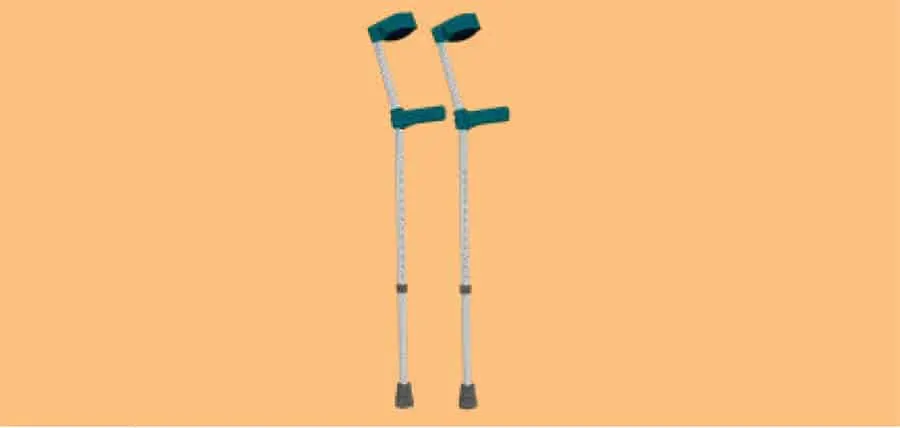
Elbow crutches
Typical user
Elbow crutches are designed for short- or long-term use. Children or adults use elbow crutches if they need support to balance or bear weight through their legs.
Specific characteristics
This type of crutch specifically features cuffs, shafts and height-adjustment mechanisms, WHO says. Cuffs should be closed/semi-circles, have a hinged/fixed attachment and an ergonomically moulded handgrip.
Shafts should be height-adjustable and fitted with a tip, while the height adjustment mechanism should be quick-release. There should be a single height adjustment for the shaft only or a double height adjustment for the cuff and shaft.
Requirements for standard configuration
Elbow crutches should come in three to four different sizes to suit paediatric and adult users, such as sizes for children, teenagers and adults. There should also be a dedicated bariatric range for individuals over 120kg.
These aids to daily living should also come completely assembled with an appropriate tip for the environment. Tips are to be securely fitted and made from durable rubber, the guide recommends.
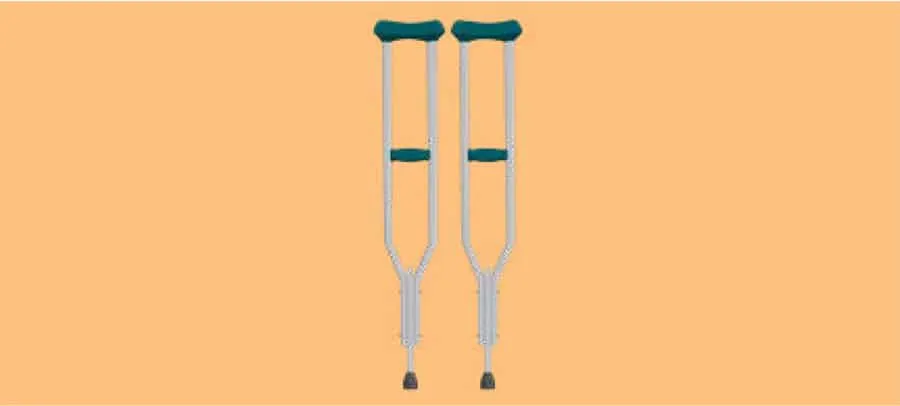
Axilla crutches
Typical user
Designed for short-term use only, axilla crutches are aimed at children or adults who need support to balance or bear weight through their legs.
Specific characteristics
Axilla crutches should come with cushioned underarm supports and ergonomically moulded handgrips. WHO says that the shaft should be height-adjustable and fitted with a tip. These crutches should feature a height adjustment mechanism that facilitates double height adjustment (handgrip and shaft).
performance Requirements
As with elbow crutches, axilla crutches should also come in three to four different sizes to suit paediatric and adult users, as well as have a plus-size range for individuals over 120kg.
Each crutch should come completely assembled with an appropriate tip for the environment, with tips securely fitted and made from durable rubber.
WHO advises that the shaft should have an adjustable height and be made from aluminium or wood. The height adjustment of the handgrip should be independent of the shaft’s adjustment, the guide underlines, with the handgrip commonly made from plastic.
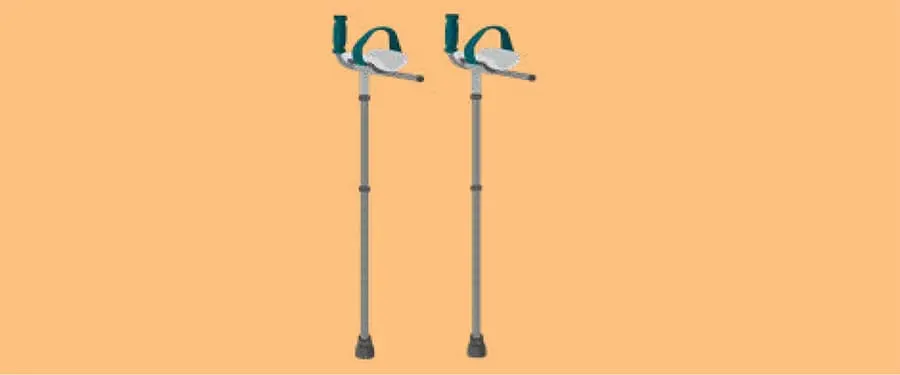
Forearm crutches
Typical user
Children or adults can use forearm crutches for short- or long-term use. They are designed for individuals who need support to balance or bear weight through their legs and are unable to use standard handgrip due to hand or arm impairment.
Specific characteristics
The forearm supports should offer horizontal support and be moulded and cushioned. They should come with a hook-and-loop fastener.
Handgrips should come with a telescopic handle that rotates through 360 °, the guide advises. The shaft should be height-adjustable and fitted with a tip.
Additionally, the height adjustment mechanism should be quick-release and the shaft should feature a single height adjustment.
Requirements for standard configuration
Like elbow and axilla crutches, forearm crutches should also come in three to four different sizes to suit paediatric and adult users, as well as have a bariatric range for individuals over 120kg.
The daily living aids should come fully assembled with an appropriate tip for the environment, with tips securely fitted and made from durable rubber.
Customer requirements :
- easily handled
- low cost
- should be available for children, adults and aged people.
- pain free
- mobility
Task 3
concept genration of the product
Concept generation based on feedback: So the people wish for a crutch that doesn't slip even on a slippery surface. They also want the crutch to have a robust design. This means the design cannot break easily under pressure. The crutch cannot also just be of a material that deteriorates overtime. Since even in a survey it was seen that the crutches since they are bought in a pair, people do not tend to buy more of an expensive pair, be it financial strain, or "oh it is just temporary" patients, thus the product should be cheap but not compromise with the quality at the same time. In the design of crutches people seem to prefer mosular architecture over the integral architecture. Since finding an integral architecture based crutch is not easy to find for the height of the patient, thus patient looks for a modular architecture one. Since modular architecture gives the user freedom to choose whatever they wish for in a product, thus modular ones are on the rise. Also since the demand for no slipping ones is also there the design would more like represent a foot but with some suction blobs on the surface that would come in contatc with the earth. This would make the thing non slippery.
Product objective and scope: Walking is the birth right of each and every individual. But due to certain circumstamnces, a person might lose their right to walk. Thus crutches, these hand-held medical devices help a person get from place to another without any issue. All the person needs to do is select the type of crutch they are comfortable with and the crutch will take the user from one place to another.
Stakeholders and Responsibilty: When it comes to the crutch the most important part is that user is comfortable with it. Also the user needs to use the crutch efficielty to move from one place to another. The crutch also needs to be anti-slip. This means that if for example the person needs to go out and once the person is outside and it begins to rain immediately and the nearest shelter being 150 metres far, the crutch should be able to take the person to the place with safety. For all of this to work properly, the mechanical team needs to work with the design. The co-ordination between the two department will define the future of the crutch.
Operating Scenarios: Now let us take a normal example of the foot part's suction. Suppose the person gets on a tile floor. If the distribution of weight is not done properly throughoughly around the crutch, the suction can either be too great and won't come off without the person falling flat on their face, also if during a rainy season, the crutch does not suck the ground, can lead to the falling of the user. Thus the weight should be distributed evenly throughout the crutch for it to happen.
Operating Conditions: The crutch should support the normal travelling, getting up and down the stairs and not slip on slippery surafces. The crutch should also be mad of rust-repellant material so it does not catch any rust if used in rain a lot. The crutch should have a comfortable handle to begin with along with an elbow rest.
work break down structure of the crutch
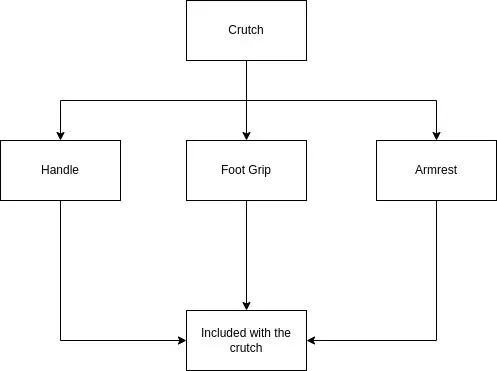
architecture schematic diagram
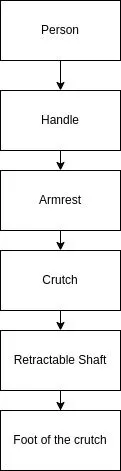
Interface Control Documents
Introduction
- Mechanical Interface
- Electrical Interface
- Information-flow Interface
- Human-machine Interface
Introduction
The crutch is a device which will help a disabled person to walk. These devices act as the legs of the person, just the part of them not being attached to the body, but make use of the arms to move the whole body.
Chapter 1: Mechanical Interface
The crutch is a mechanical device in itself without having any electrical connection to move around. The usage of the device is not a big hassle.
Chapter 2: Electrical Interface
NIL
Chapter 3: Information-flow Interface
NIL
Chapter 4: Human-machine Interface
Just before using the crutch, if it self assemble, assemble it. They put your arm in the slot and get up with the strength of the arms. Then move one crutch ahead at one time not more thna that or you might fall flat on face.
Task 4
Crutch Roadmap
| Q1 2021 | Q2 2021 | Q3 2021 | Q4 2021 | Q1 2022 | Q2 2022 | |
| Handle | Normal Grip | Customized | ||||
| Hand Grip | Plastic | Rubber Grip | Silicon Grip | |||
| Shaft | Integral | Modular | ||||
| Foot Grip | Traditional | Foot Grip | Suction Foot | |||
Mission Statement
| Product Description |
|
| Benefit Statement |
|
| Buisness Objectives |
|
| Core Market |
|
| Stakeholders |
|
Staffing Requirements: For this qork, the department would need the design workers to be working on the design as well as the mechanical engineers to work on the mechanics of the crutch. 100% of the staff would be needed in 50% for the Q2 release and 50% for Q4 release. This way if a new project comes up the engineers working on Q4 release can work on the new and urgent project.
Budget Requirements: Budgeting is something that will be decided after scouting the market. After the material is scouted from the market, budgeting will take place. How much of the material needs to be bought will be decided as soon as the design gets approved and the manufacturer is decided.
Product schedule: Since the first phase of foot design crutches will be released in Q2, thus the design and manufacturing should be completed atleast 15 days before the launch date. Initially about 10% of the decided pieces will be made to release in the market. Depending upon the response by the public, production of the crutches will go underway. For the design and manufacturing of the suction cup crutch, it should be completed by second month of the third quarter. Once the design is made, it needs to be approved by the design department. Once it gets the verification, a prototype will be made and the product needs to be validated. Once the validation is done for the prototype, validation for the manufacturer needs to be done. After both of them gets done, order goes through. By the last month of the third quarter, the marketing team should begin the campaign regarding the product. After that in 15 days the company will officially launch the product and in another 15 days it will be on sale.
Task 5
| Simplicity | The design of the crutch is not strayed much from the original design, thus bringing in a sense of familarity. Just a arm lock in which the person needs to slide the arm. |
| Immediate Intuition | The immediate intution of a crutch are two rods with a wooden piece stuck between them. |
| Approachable Innovation | The foot rubber be changed to a foot design with suction in it, the handle have some silicon in it so that the person using it does not get tired. |
| Aesthetics | The crutch should not look like a handcuff. |
| Egronomics | It should be comfortable to use and easy to move in. |
This is different from the initial concept as it would use a more foot like structure rather than a wood and rubber crutch. it will be weightless and comfortable. this crutch also painfree and adjustable.