Project 1 - Design and Development of Crutch ( Medical Technology)
Project 1
Medical crutches are medical devices that aid in ambulation by transferring body weight from legs and arms to the torso.
Types-Conventional and Smart crutches
Based on support- there are 3 types namely axillar, forearm and platform.
- Market analysis for Crutch
The global market size for medical crutches is USD 727.4 million as of 2022 and is expected to grow at CAGR (Compound Annual Growth rate) of 6.5%. The higher growth rate can be due to the number of surgeries performed worldwide. The rise in market is driven by increase in accidents, rise in prevalence of lifelong disabilities and technology advancements.
Usually, medical crutches are inexpensive. Also, it is the most preferred support system compared to wheel chairs or other walking aids. All these factors support the growth of the market.
Trends:
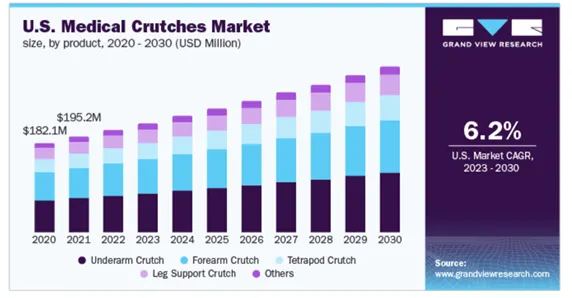
The fastest growing market is anticipated in Asia Pacific region owing to its high geriatric population. The largest market share of ~35% is of North America.
The key players in the industry for medical crutches are-
- Sunrise Medical
- Home Medical Products
- AMG Medical
- Valley Tool Die, Inc.
- Nova Medical Products
- Millennial Medical
- IWALKFree
- Cardinal Health
- New York Millennium Pharmaceutical
- Breg, Inc
State of art:
The figure below describes the design modifications implemented to the basic crutch and the timeline of improvements. Briefly, improvements can be broadly categorized into handle, shaft and tip.
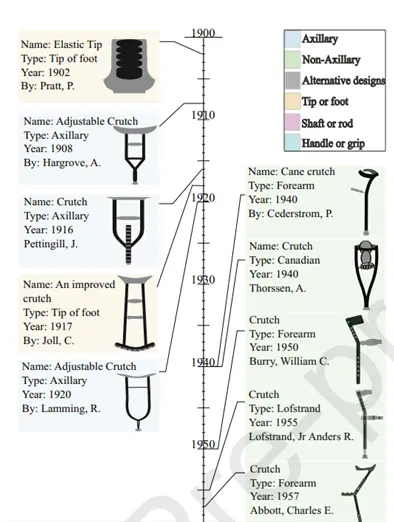
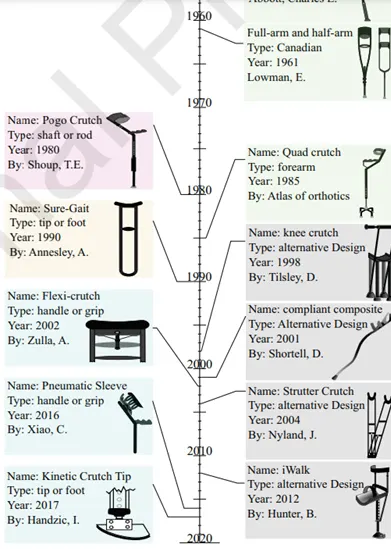
Currently, alternative design crutches, customization as per requirements are widely used. Advancements in crutch technology are ongoing. Design improvements such as softer and more pliable U-shaped padding to the shoulder rest, more grip positions in handles that allow comfortable and long-term use. The most recent advancements include user assistant features and lighter materials for crutches.
State of art medical crutches are termed as ‘Smart Crutches’ as they aim to be multifunctional with user assistant features.
Reference: https://sci-hub.se/10.1016/j.jbiomech.2019.109489
- Customer needs
Customer needs for medical crutches are described below in a descending order of importance. The scale is as -1-preference; 2-nice to have and 3- must have it or essential
|
Customer needs |
Product specifications |
Importance |
|
Ability to use for long hours |
Shall have ergonomic design to use comfortably for long hours |
3 |
|
Provide support |
Maintain balance and provide good support |
3 |
|
Should be usable in various environmental conditions like sand, wet floor, road etc., |
Environmental dexterity |
3 |
|
Should align in different positions |
Height- adjustable |
3 |
|
Stylish appearance |
Aesthetics, ability to improve the design |
2 |
|
Less weight |
Lighter materials |
2 |
|
Ability to provide information about obstacles |
Auditory feedback |
1 |
|
Hygiene |
Hygiene |
2 |
Reference: http://edge.rit.edu/edge/R13002/public/Customer%20Needs
Requirements
Customer requirements
- Lower cost
- Longevity
- Durability
- Aesthetics and
- Comfortable
- Should accommodate for heights (6 feet people)
Functional requirements
- Height-adjustable shafts
- Cuffs should have flexible attachments with ergonomically moulded handgrips
- Sizes: Should accommodate children, adults and bariatric population
- Tips should be durable
Performance requirements
- Resistant to harsh environmental conditions like hea, humidity, old
- Ability to operate irrespective of change in flooring
- Reproducibility
Design requirements
- Easily adjustable, strong and durable
- Low deformation risk
- High abrasion resistance
- Slips should be durable, non-slip and replaceable
- Replaceable parts
Requirements reference: https://thiis.co.uk/product-requirements-guidance-that-crutch-suppliers-should-follow-to-formulate-bids/
3.
Concept generation based on customer feedback:
- Customers require a sustainable, strong crutch that provides rigid support and provides perfect support and balance even on sand, countryside roads, slippery surfaces.
- It should be easy to use, ergonomically fit
- Also, it should be universally fit
- Height adjustable
Con Ops:
CONOPS is a document mentioning the product characteristics from user point-of-view. It consists of goals, statement of objectives, product description.
Product Description
Here, as an example Elbow crutch with fixed handle by Vissco is considered.
- Vissco Elbow Crutch with old type insert pulley is durable, light weight and provides firm grip to the arms.
- It provides long lasting support to the arm
- Compatible for every age group
- Enables a person to get complete hold and grip over to balance the body and walk confidently.
- Increases the support base thus making it easy to use
Specifications
- Dimensions: 15*6*110 cm
- Product weight: 1440
Stakeholders involvement
Stakeholders for medical crutch include customers, manufacturers, design team members. Customers give their requirements while manufacturers see the design feasibility for large production and material costs.
Work Breakdown structure
The work breakdown structure for components of medical crutch is as shown below
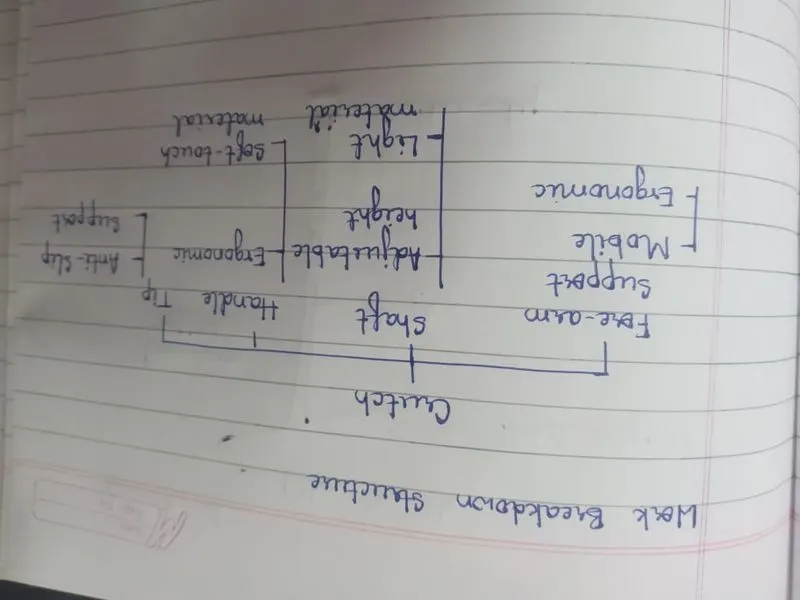
Shaft: Shaft is the long rod that runs through the height of torso and has options for height adjustment holes, spring buttons for shock absorption and collar cuff adjustments
Handle: Handle has a cuff to hold on to it. Ergonomic design for it is included in the aspect
Tip: rubber and anti-slip tip is designed here
Product architecture:
Keeping in view a simple crutch, not a smart crutch, Modular architecture is preferred
Replacing parts with newer ones will increase the life of product.
Interface control documents
- Mechanical interactions
It involves weight bearing on shaft, tip interaction with ground
- Electrical interactions-Nil
- Information-data flow-Nil
- Human-machine interface
Handle forms the human-machine interface.
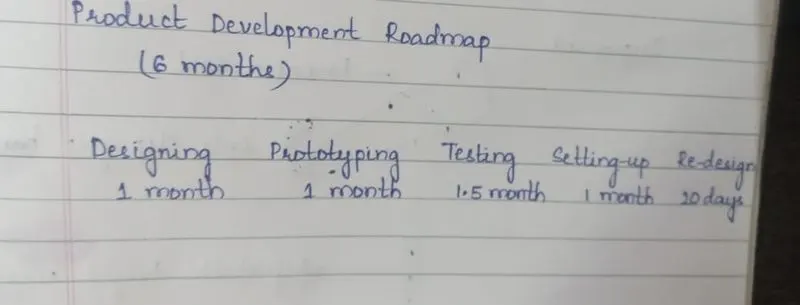
Product development roadmap
Product development
The entire project can take up to 6 months. Product development can be grouped into 5 stages like designing, prototyping, testing, setting-up and re-design
Mission statement
Elbow crutches ensures proper load-bearing and is designed for disabled, injured and elderly people.
Product development resource requirements
Staffing:
Designers-Industrial designers to review the design; Engineering designers (mechanical) to review the materials, load bearing and distribution. In the product development stages, designing and prototyping are taken care by Design team.
Manufacturing-This team tests the designed products, verifies and validates the design process and proceeds for large mass production.
Budgeting:
- Designing: 16000 EUR
- Prototyping: 18000 EUR
- Testing: 18000 EUR
- Setting up: 26000 EUR
- Re-design: 20800 EUR
Product schedule:
Concept, preliminary and final design phases: understanding customer requirements, resources and developing specifications based on them would take around 2 months. Then developing initial design and implementing and finalizing draft would take 1 month.
Product verification and validation: testing for compliance with standards and specifications would take minimum of 1 month
Product launch: going through the regulatory documentation and processes will take at least 3 months to launch the product
Use industrial design knowledge to improve the design
The aspects chosen here are simplicity, aesthetics and ergonomics
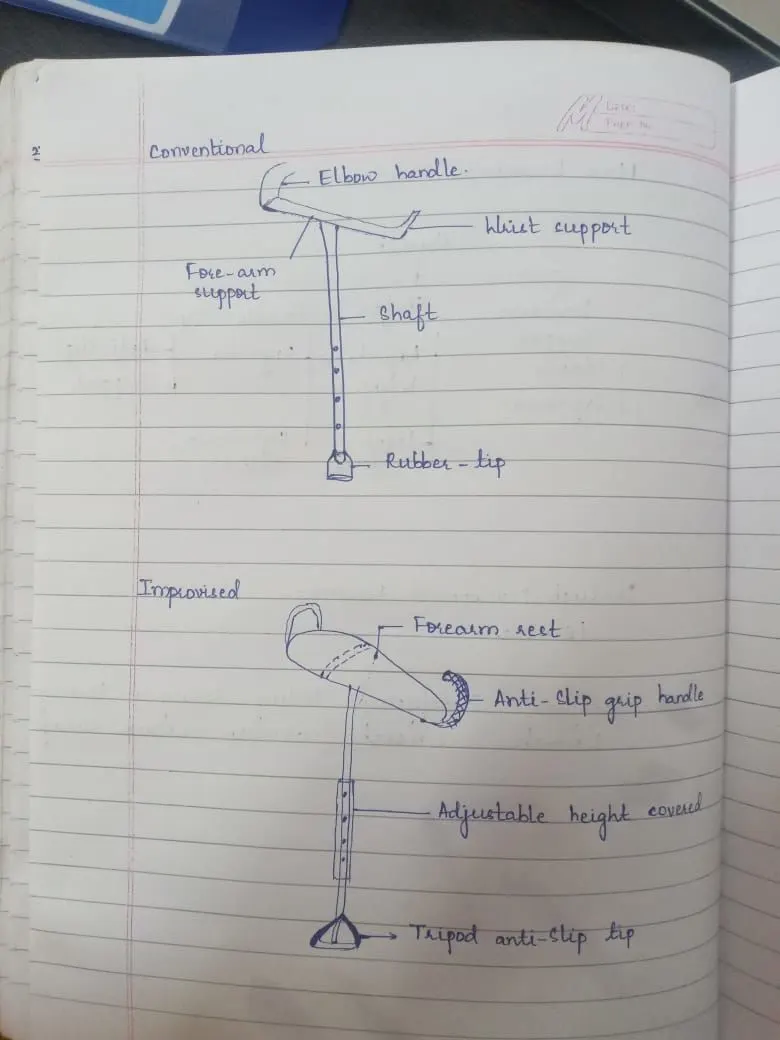
In conventional design, an open forearm support without band and single stand rubber tip are provided
In improvised design, Forearm support to rest it is provided with a band to secure it in place is provided. Handle is provided with anti-slip grip and soft material to ergonomically accommodate it for long hours without strain
Tripod anti-slip tip is provided to provide more support and design is aesthetically improved.
The push buttons for height adjustment make it simple to use.