Project 1_Comparative study of different storey buildings for Seismic forces
AIM:
Objective of the project is to model and comparison of result between the models (A-K). And to investigate the models based on the time period in modal behaviour for various effects given below,
- Effect of stiffness on Time period.
- Effect of mass on Time period.
- Effect of Building height on Time period.
- Effect of column orientation on Time period.
- Effect of Flexural stiffness of Structural Elements on mode shapes.
- Effect of Axial stiffness of Structural Elements on mode shapes.
- Effect of degree of fixity at Column base on mode shapes.
PROCEDURE:
Modelling of the building is done in Etabs for the following specification,
Sizes of Elements:
- Beam-300x400mm
- Column-400x400,600x600,550x300,300x550,800x800mm.
Material Properties:
- M30-Grade of Concrete.
- Fe415-Grade of Steel.
Loading Details:
- Dead Load-Self weight
- Imposed load- Load from infilled wall=10kNm UDL on all Beams
- Live Load -3kN/Sq.m.
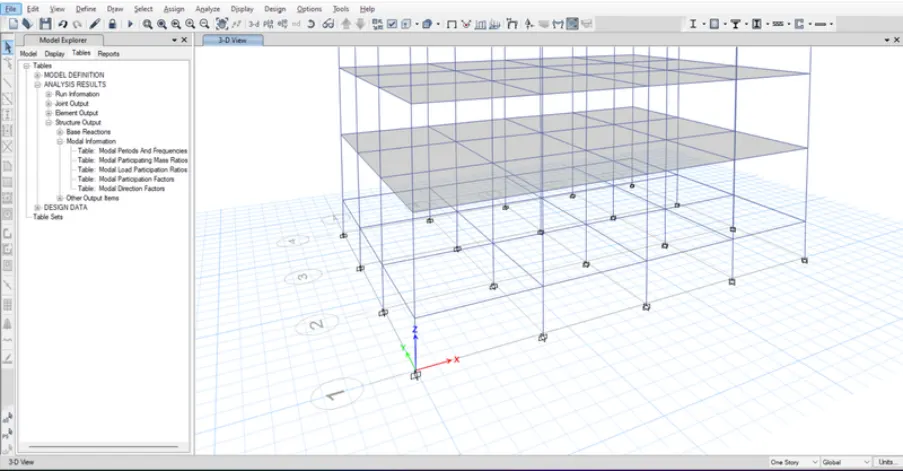
Pinned supports are considered.
Elevation:
- Plinth Beam Height=1.5m
- Storey height=3m
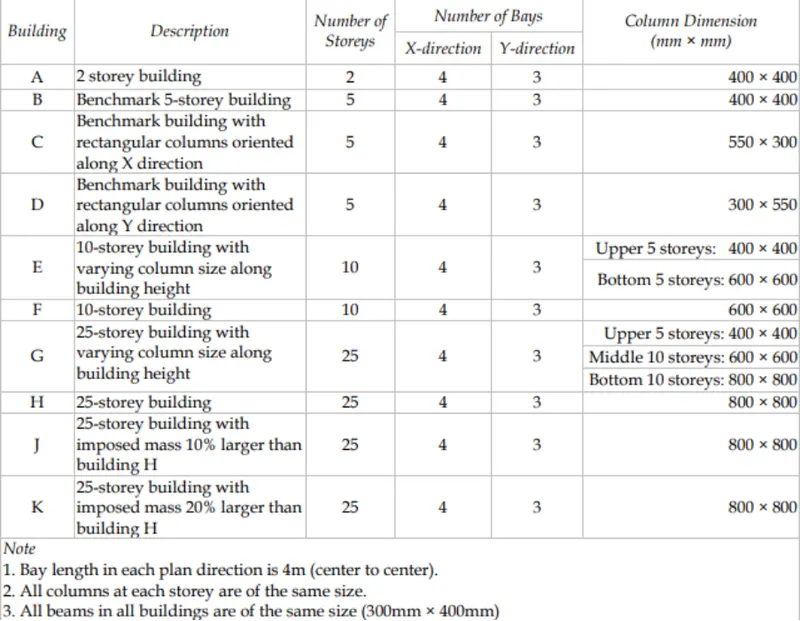
Modelling of Building-A:
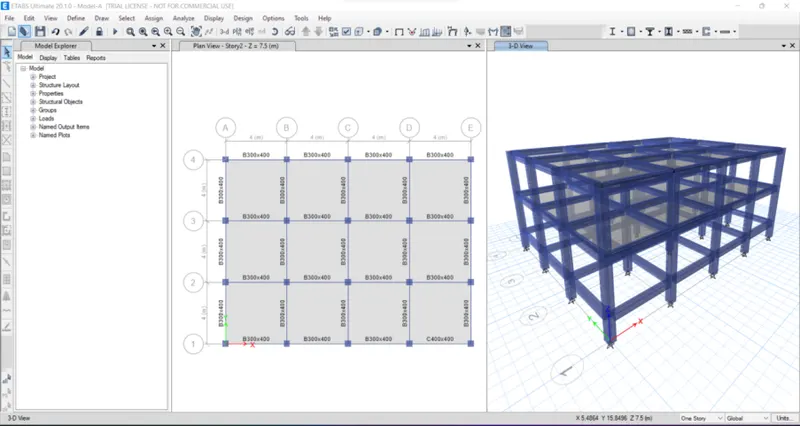
Modelling of Building-B:
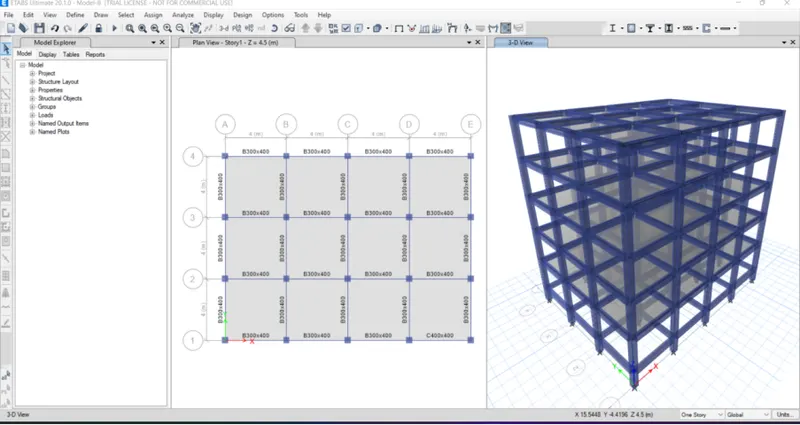
Modelling of Building-C:
Modelling of Building-D:
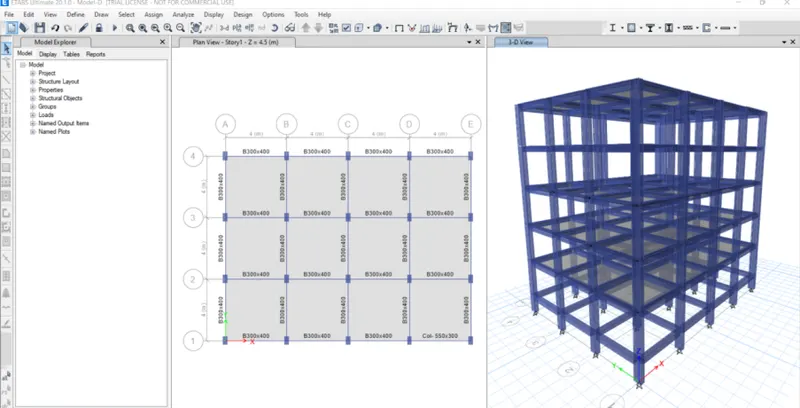
Modelling of Building-E:
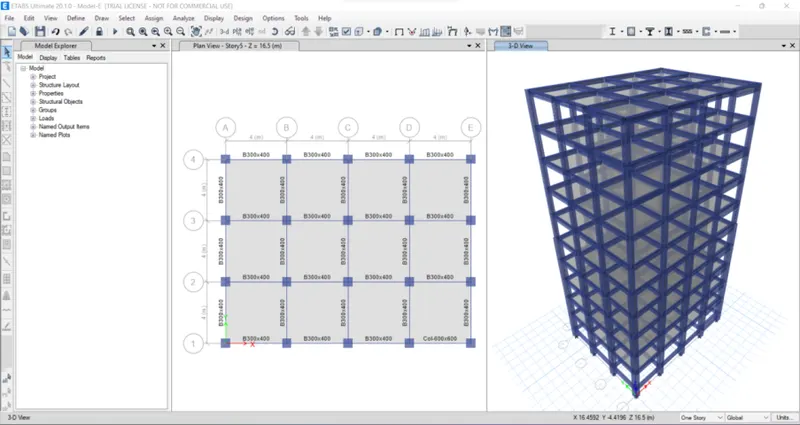
Modelling of Building-F:
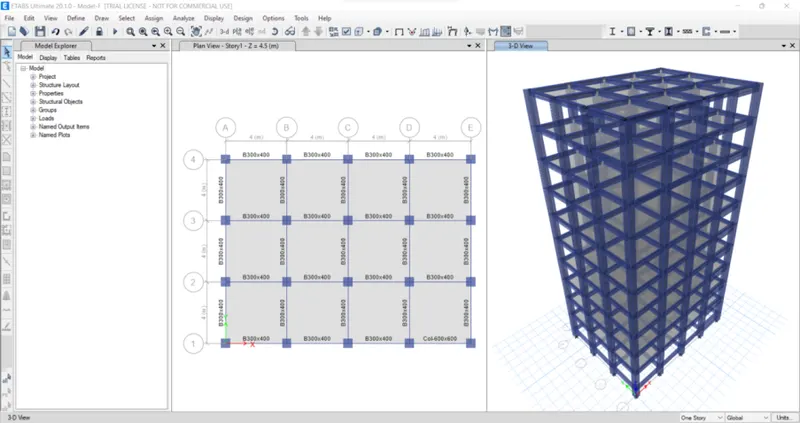
Modelling of Building-G:
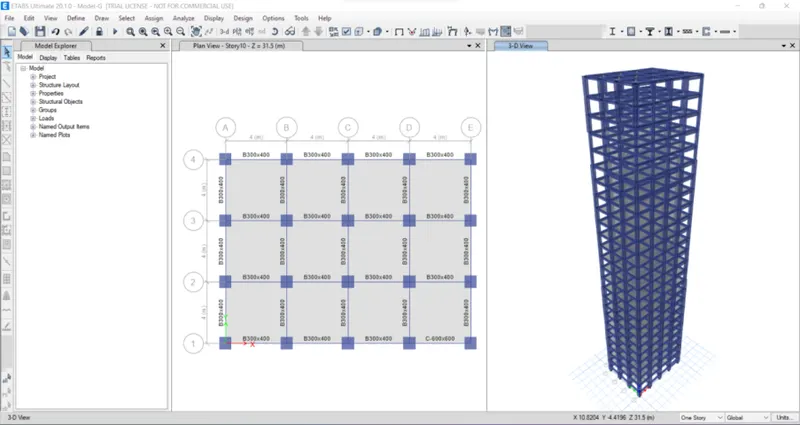
Modelling of Building-H:
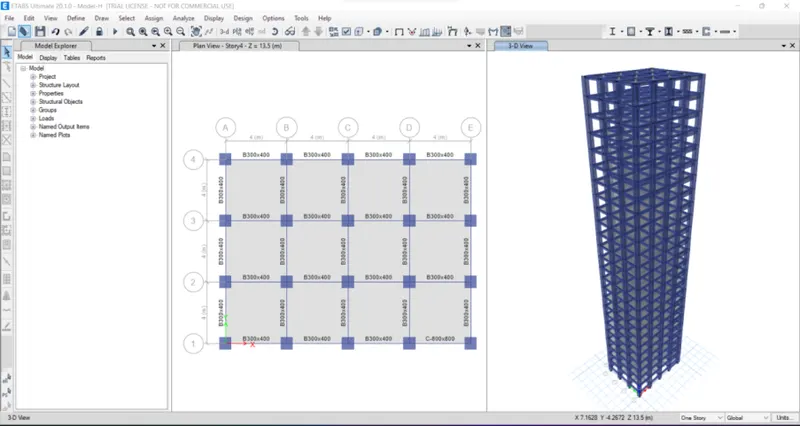
Modelling of Building-J:
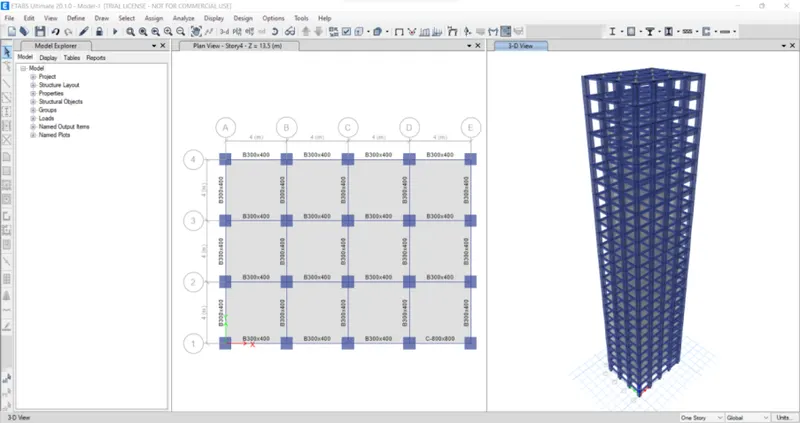
Modelling of Building-K:
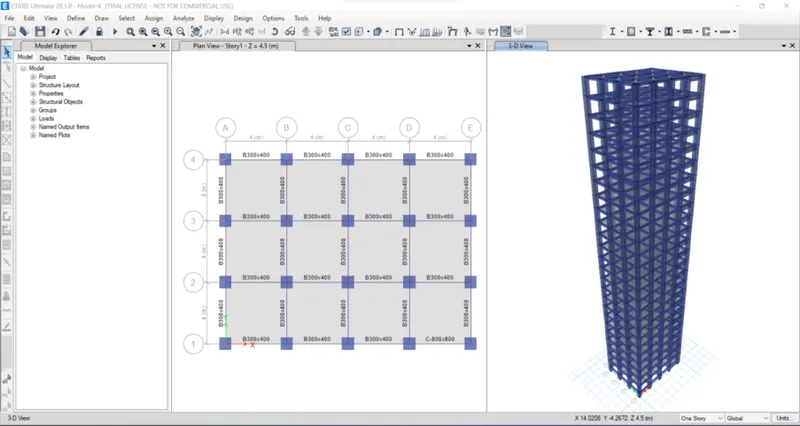
By using all the specifications different 10 models are modelled for compression of characteristics of the building for dynamic response.
Comparison of Time periods for various conditions:
Effect of stiffness on Time period.
Comparing E/F & G/H:
|
Criteria |
Model |
Analysis Result-Fundamental natural Time period |
Conclusion |
|
Effect of stiffness on
|
Building -E |
1.726 seconds |
While comparing the model with time period |
|
Building -F |
1.73 seconds |
||
|
Building -G |
4.17 seconds |
||
|
Building -H |
4.417 seconds |
We have considered uniform and varying column sizes in the model E/F & G/H, where the minor changes in the column sizes does not shows major change in the fundamental natural period of the building.
Effect of mass on Time period:
Comparing H/J/K:
|
Effect of mass on
|
Building -H |
4.417 seconds |
Variations of the mass for the same |
|
Building -J |
4.426 seconds |
||
|
Building -K |
4.436 seconds |
As per the time period formula, Time period of the system is directly proportional to the mass of the structure.
`Tundersetn()=2pi sqrtfrac{m}{k}`,
From the comparison and Time period-mass of the system relation we can understand that the increase of mass increases the time period of the system.
Effect of Building height on Time period:
Comparing A/B/F& H:
|
Effect of Building height on
|
Building -A |
0.496 seconds |
Increase of the height, increases the |
|
Building -B |
1.029 seconds |
||
|
Building -F |
1.73 seconds |
||
|
Building -H |
4.417 seconds |
In simple way, the increase of the height increases the time period of the system.
We can understand by imagining simple behaviour of the building will like vertical fixed beam with one end fixed and another end free. Then the free end will create higher deformation and vibration when the span increases. Here the span of the beam will be the height of the building.

For one end fixed and another end free stiffness formula is,`frac{3EI}(h^3}`
Stiffness of the system is inversely proportional to the height of the building. And the stiffness of the building is also inversely proportional to the time period.
`T undersetn() prop frac{1}{k}`
Effect of column orientation on Time period:
Comparing B/C& D:
|
Effect of column orientation on
|
Building -B |
1.029 seconds |
Longer direction of the column provides |
|
Building -C |
1.137 seconds |
||
|
Building -D |
1.17 seconds |
Symmetric Stiffness (Building-B):
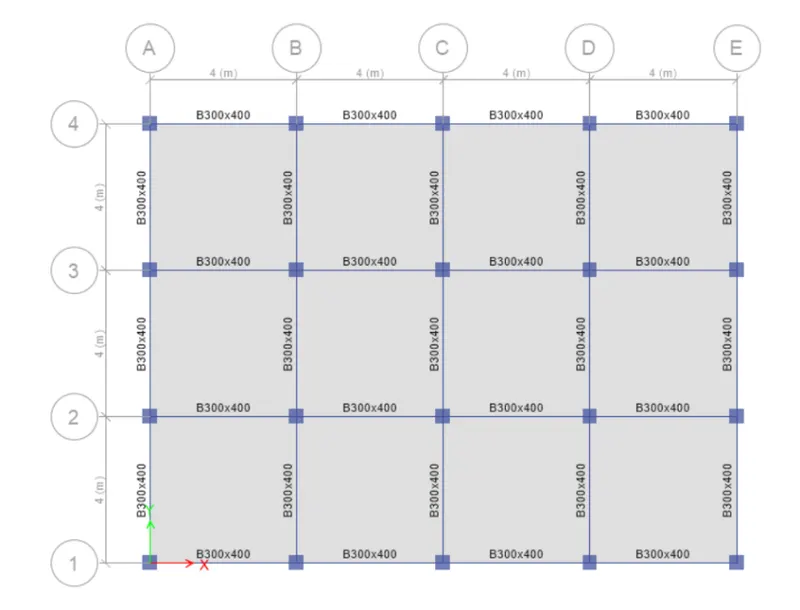
Column dimension same in all sides and stiffness similar in both direction.
Column dimension X-Direction longer (Building-C):
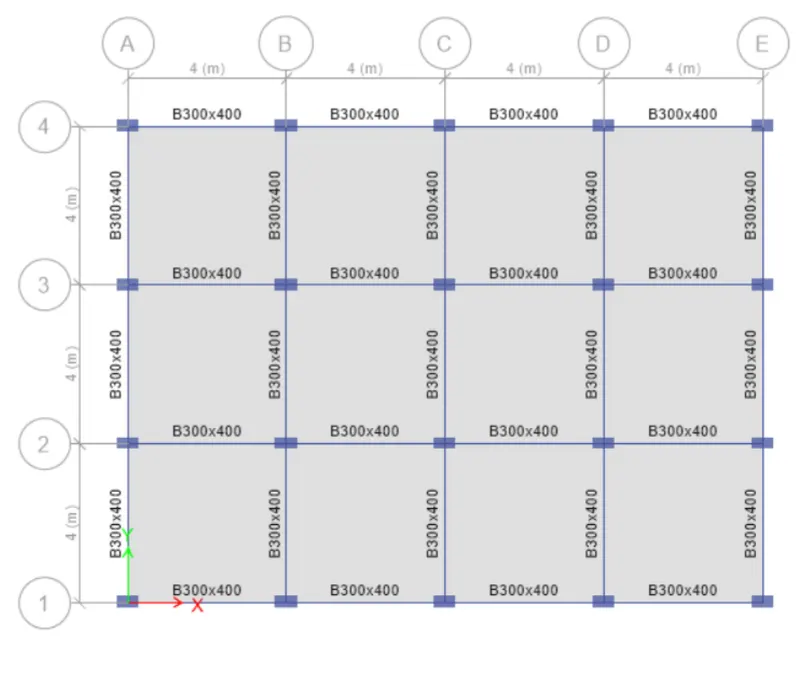
Column dimension Y-Direction longer (Building-D):
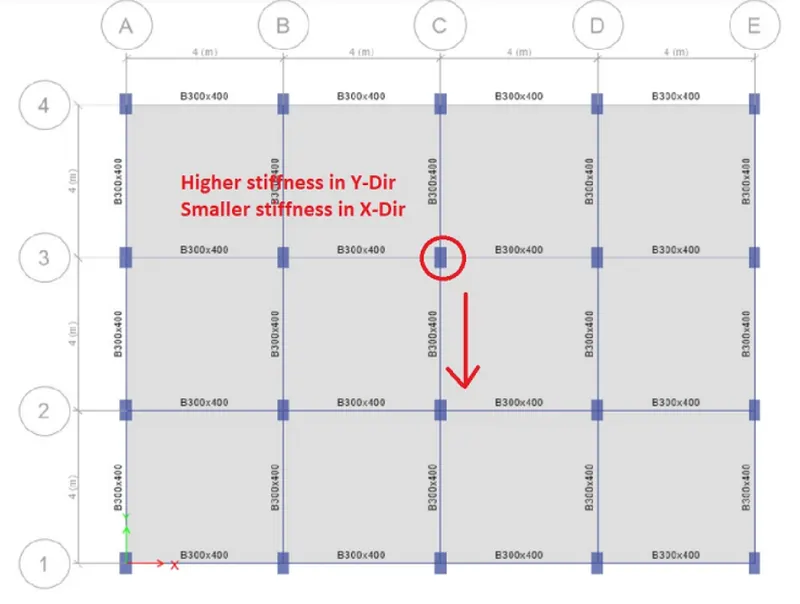
By comparing the orientations of the column, we can understand the logic that the longer direction column provides stiffness to the system which is inversely proportional to the time period of the system.
Effect of Flexural stiffness of Structural Elements on mode shapes:
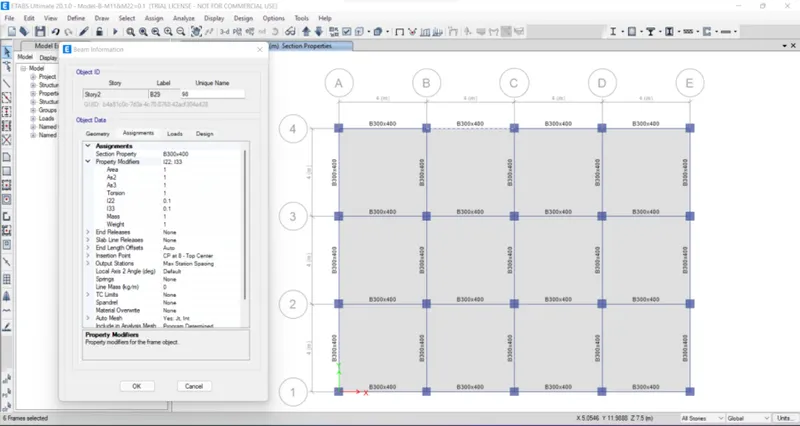
By comparing the model of Building-B with Modified same model for Stiffness of Beam as 0.1,
|
Criteria |
Model |
Cases |
Analysis Result |
Conclusion |
|
Effect of Flexural stiffness of Structural Elements on mode shapes |
Building -B |
Flexural Stiffness of beam |
2.6 seconds |
Neglecting the stifness of the |
|
Full Flexural Stiffness of Beams |
1.029 seconds |
Effect of Axial stiffness of Structural Elements on mode shapes:
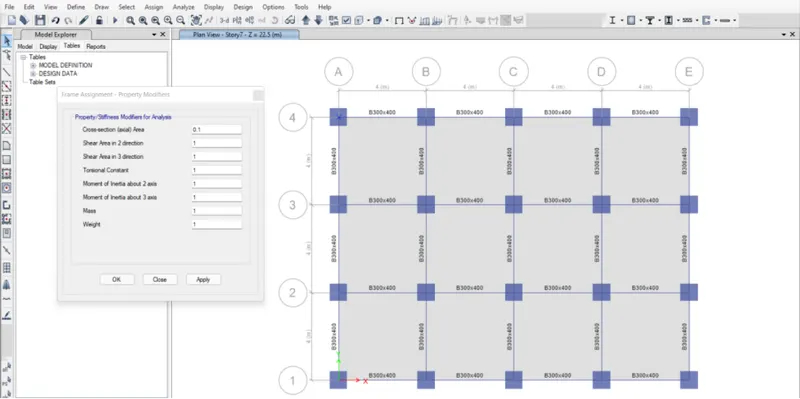
By comparing the model of Building-B with Modified same model with axial stiffness 0,
|
Criteria |
Model |
Cases |
Analysis Result |
Conclusion |
|
Effect of Axial stiffness of Structural Elements on mode shapes |
Building -H |
Axial Stiffness of Column |
5.99 seconds |
Axial stiffness play minor role in mode shapes , |
|
Full Axial Stiffness of Column |
4.389seconds |
The lateral deflection is less depnd on the vertical properties of the system.
Effect of degree of fixity at Column base on mode shapes:
|
Criteria |
Model |
Cases |
Analysis Result |
Conclusion |
|
Effect of degree of fixity at Column base on mode shapes |
Building -B |
Column Support pinned (Regular) |
1.029 seconds |
More the fixity lesser |
|
Column Support fixed |
0.935 seconds |
|||
|
|
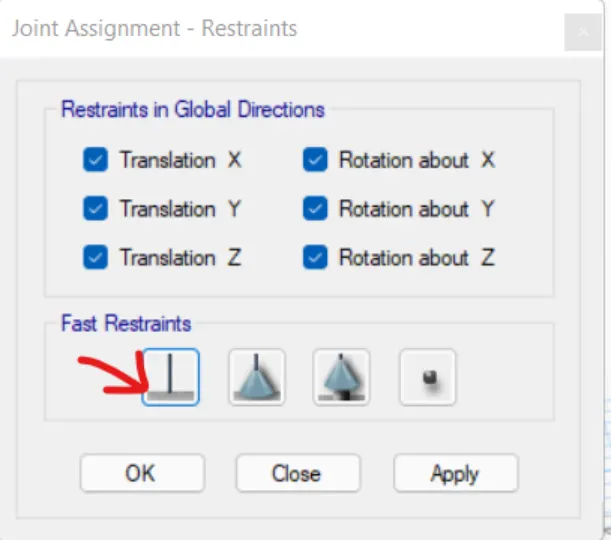
When the fixity of the column increases then the system becomes more stiffer and reduces the time period of the system.
Conclusion:
All the Etabs model are compared for different conditions and investigation is done for different characteristics effects of the system with respect to the Time period.