Project 1_Comparative study of different storey buildings for Seismic forces
Ans:1Effect of Stiffness on Natural Period of Building
| Buildings | Tn1 | Mm1(Uy) | Tn2 | Mm2(Ux) | Tn3 | Mm3(Rz) |
| E | 2.562 | 83.83% | 2.523 | 84.83% | 2.182 | 85.42% |
| F | 2.693 | 86.55% | 2.65 | 87.45% | 2.304 | 88.58% |
| G | 7.461 | 76.73% | 7.113 | 77.32% | 5.464 | 77.11% |
| H | 8.276 | 79.6 | 7.882 | 80.13 | 5.911 | 82.28 |
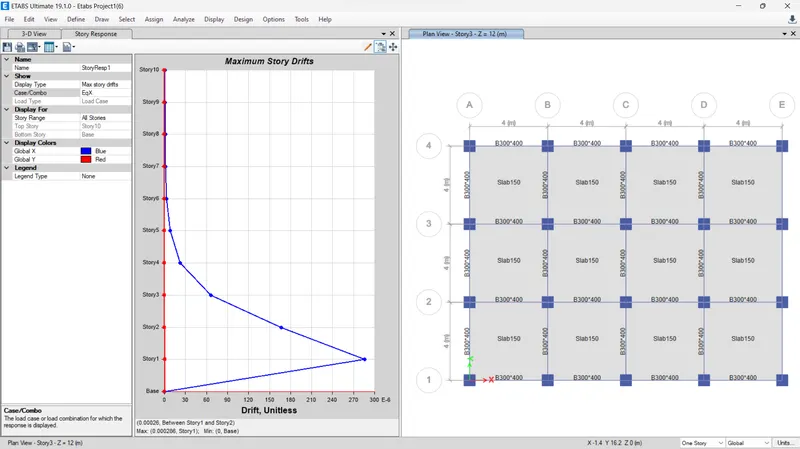
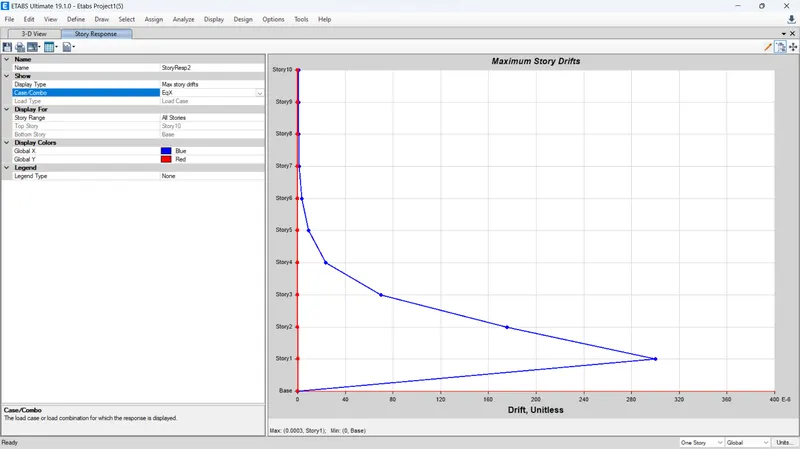
Comparing Buildings E(5) & F(6) on :
Observation:
Both Buildings are 10 storey buildings where Building E named as 5 here, has Bottam five storeys having 600*600 dimensions columns & on top five storeys havng 400*400 dimensions columns while Building E named as 6 here, have 600*600 columns running throughout.
Conclusion: Building F have slightly longer Fundamental Natural period, possessing larger modal mass participation factor than Building E(5).
As there is no significant difference b/w Tn of both Buildings, Both are coming under safe consideration on basis of Max. Drift Storey as well as on MPF(Modal Participation Factor).
Remarks: As both are safe but still on basis of Ductile R/F, Building F is more safer than E.
due to change in configuration of the columns, there will be a kink at the middle of the building whose analysis can not be traced using Linear analysis.
-----------------------------------------------------------------------------------------------------------------------------------------------------
Comparing Buildings G(7) & H(8) on :
Observation:
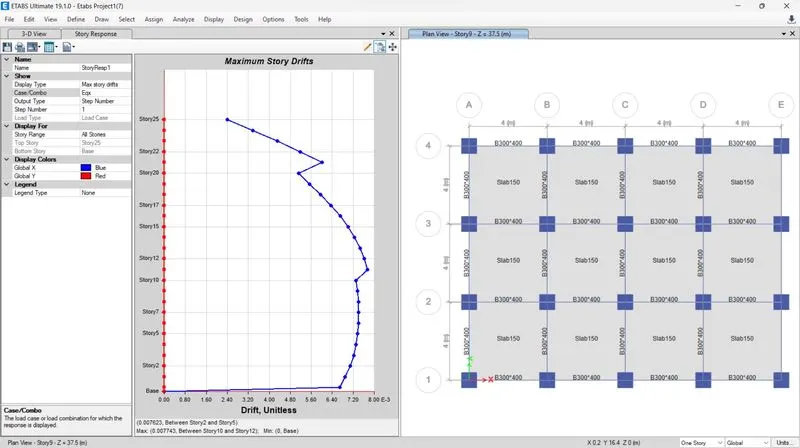
Both Buildings are of 25 storeys where G has Bottam Ten storeys having 800*800 dimensions columns, next ten stories have 600*600 Columns dimensions followed by successive five storeys having 400*400 dimensions while Building H has 800*800 dimensions throughout its height.
Conclusion:Building H have longer Fundamental Natural period, possessing larger modal mass participation factor than Building G.
Due to change in configuration of the columns of G building, there will be a kink at the middle of the building whose analysis can not be traced using Linear analysis as shown in max. drift graph attached below:
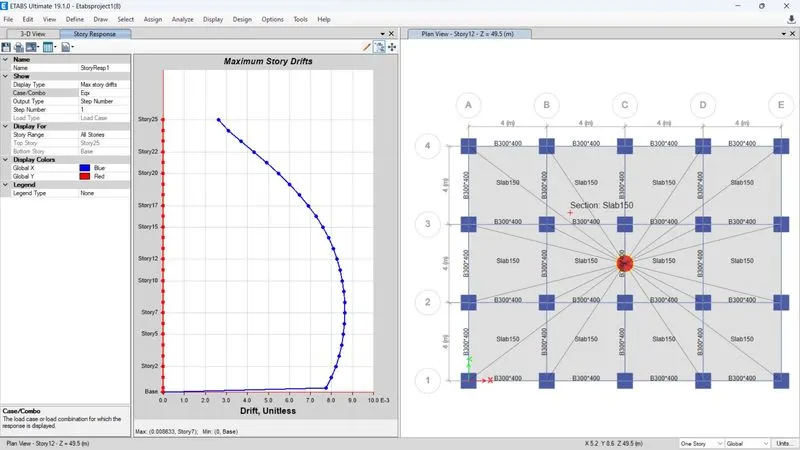
Due to smooth profile of Drift in building H resulting into more stable configuration.
Both Buildings are Unsafe on basis of two criteria mentioned under:
1. Max. Interstorey Storey drift in a building shall not be exceeded by 0.4%.
2. First three Tn should be well separated by 10% of Fundamental Natural Period of that Building.
Good Aspects:
1. Tn3 < (Tn1, Tn2), favouring
2. First Three modal mass should exceed more than 65% of Seismic Weight of the Building.
===================================================================================
Ans 2: Effect of Mass on Tn:
| Building | Live Load(KN/m^2) | Tn1 | Mm1 | Tn2 | Mm2 | Tn3 | Mm3 |
| H | 3 | 8.276 | 79.6% | 7.882 | 80.13% | 5.911 | 82.28 |
| J | 3.3 | 8.285 | 79.6% | 7.891 | 80.13% | 5.916 | 82.28 |
| K | 3.6 | 8.295 | 79.61% | 7.9 | 80.14% | 5.922 | 82.29 |
As Live load is increasing down the columns, we can easily confirm that Due to increase in Inertia of a building(Keeping equal configuration) Tn of the building also increases down the group.
-------------------------------------------------------------------------------------------------------------------------------------------------------
Ans c: effect of Height on Tn:
| Building | Storey@4 (m) | Tn1 | Mm1 | Tn2 | Mm2 | Tn3 | Mm3 |
| A | 2 storey | 1.033 | 98 | 1.018 | 98 | 0.927 | 98.2 |
| B | 5 Storey | 2.042 | 94.46 | 2.003 | 94.64 | 1.813 | 94.98 |
| F | 10 storey | 2.693 | 86.55 | 2.65 | 87.46 | 2.304 | 88.58 |
| H | 25 storey | 8.276 | 79.6 | 7.882 | 80.13 | 5.911 | 82.28 |
As Building Height increases down the Group, Tn of the building keep on increasing with significant reduction in modal mass participation Factor.
Therefore, it can be confirmed that as height of the building increses, Fundamental Natural period will keep on incresing with Reduction in Modal mass particpation in First Three modal frequency & increase in MPF in Higher Modal Frequency.
=====================================================================================Ans d:
Effect of Column Orientation on T:
| Building | Longer direc along | Tn1 | Mm1 | Tn2 | Mm2 | Tn3 | Mm3 |
| B | equivalent in both axis | 2.042(Uy) | 94.46 | 2.003(Ux) | 94.64 | 1.813(Rz) | 94.98 |
| C | Y axis | 2.349(Ux) | 95.63 | 1.771(Uy) | 93 | 1.726(Rz) | 94 |
| D | X axis | 2.384 | 95.48(Uy) | 1.827 | 0.946(Rz) | 1.729(Ux) | 93.2 |
Reading above data along the row of a particular building, it can be demonstrated that:
Beam supported on larger portion of a column or having larger bearing, have lesser modal mass as well as Natural period along the direction of longer bearing as compared to its complimenatry direction.
By providing Regular Cross/section, we are equalising the seismic action along both the direction, i.e., natural period & modal mass are equivalent.
Reduction in Seismic action along the longer direction of columns, results in comparison of that action with Torsional Mode of oscillation.
(Violating the clause: Translational Modes along two perpendicular direction should be quite larger than Torsional Mode.
===================================================================================
Ans: e
Effect Of EI Flexural Stiffness on Mode Shapes:Building B
| Ix,y of Beam | Ix,y ofColumn | Tn1 | Mm1 | Tn2 | Mm2 | Tn3 | Mm3 |
| 0.25 | 0.65 | 3.31 | 92.56(Uy) | 3.233 | 92.73(Ux) | 2.791 | 93.6(Rz) |
| 0.95 | 0.65 | 2.322 | 95.2(Uy) | 2.285 | 95.36(Ux) | 2.066 | 95.72(Rz) |
By providing Strong Column & Weak Beam, Seismic action over the frame reduces with increase in Fundamental Period of Osciallation & Vice-Versa.
By Providing Strong Beam over Weak Column, we could minimise the INTER_Storey Drift as shown below but we would get Yielding of Coulmn first followed by Beam Yielding.
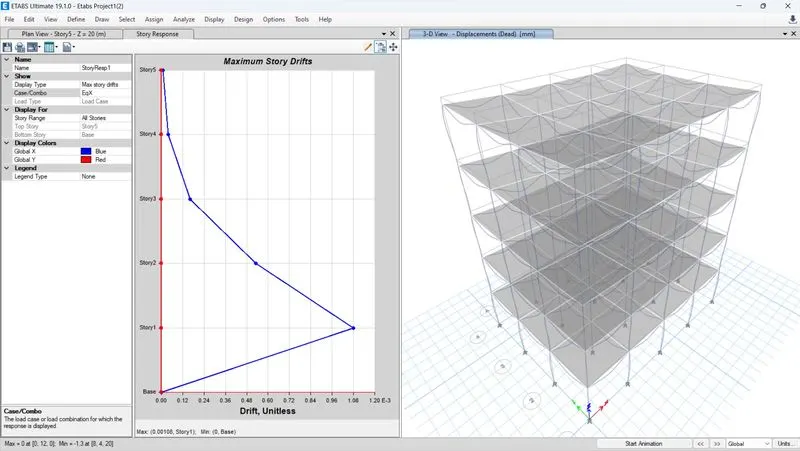
Strong Column & Weak Beam(Ix,y,beam=0.25); (Ix,y,column=0.65);
Inter storey Drift Max.= 0.108%
-----------------------------------------------------------------------------------------------------------------------------------------------------
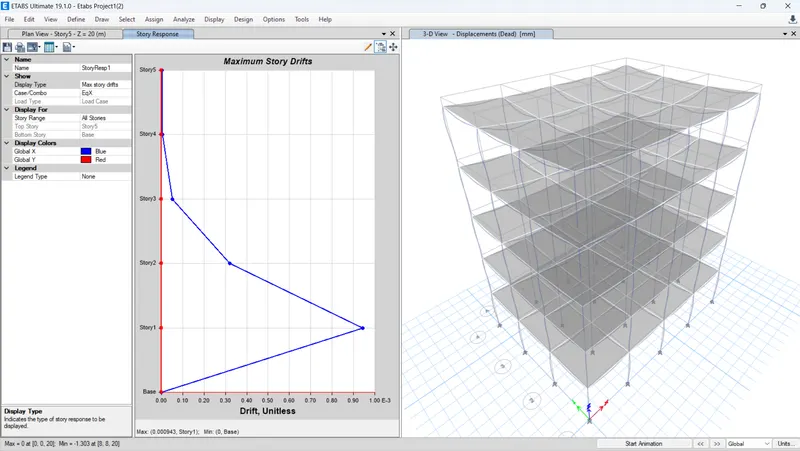
Strong Beam & Weak Column(Ix,y,Column=0.65) & (Ix,y,beam=0.95)
InterStorey Drift= 0.095%
===================================================================================
Ans 6: Effect of Axial Stiffness of Vertical members on Mode Shapes:
| Area | Tn1 | Mm1 | Tn2 | Mm2 | Tn3 | Mm3 | |
| 0.25 | 9.641 | 75.52(Uy) | 8.814 | 77(Ux) | 5.936 | 82.2(Rz) | |
| 0.95 | 8.302 | 79.51 | 7.9 | 80 | 5.912 | 82.3 |
As Column Cross-sectional area increases down the column, Natural period of oscillation decreases with increase in modal mass action.
====================================================================================
Ans 7: Fixity at base of Building B:
| MoI | Beam | Column |
| Along X | 0.35 | 0.65 |
| Along Y | 0.35 | 0.65 |
| Support | Tn1 | Mm1 | Tn2 | Mm2 | Tn3 | Mm3 | |
| Pinned | 2.974 | 93.31(Uy) | 2.91 | 93.48(Ux) | 2.6 | 94.17(Rz) | |
| Fixed | 2.221 | 82(Uy) | 2.17 | 82.26 | 1.873 | 82.74 | |
By providing Fixed Support at the base instead of pinned support, MPF decreases in first three modes of vibration leading to higher MPF in Higher Modal Frequency.
while In pinned connection at the base of a building, Higher Mass Participation Factor acts in first three modal frequency(More than 90%)
====================================================================================