CFD Meshing for Tesla Cyber Truck
AIM
To clean up the given model and perform first, surface meshing and then to perform volumetric meshing for the revelent volume.
PROCEDURE
- The first step is to import the geometry and run a geometry check.
- Using the geometry check, all the surfaces that need to be fixed (single cons, triple cons, overlapping features) are identified.
- By creating hot points and using cut, half the truck geometry is deleted. This is done because it will aid in faster geometry clean up and meshing. The other half will be recreated using symmetry.
- It is important to ensure the inside of the cybertruck will form only one volume.
- Using tools such as ‘Delete’, ‘Intersect’, ‘Cut’, and ‘New’ under the TOPO deck, the geometry is cleaned up.
- After TOPO clean up, relevant PIDs are created and assigned. Existing PIDs which are of no use are forcefully deleted using the compress tool.
- Mesh lengths are applied as follows:
Windows: 2mm
Body: 5mm
Lights: 4mm
Tyres and Rims: 2mm - For the above-mentioned mesh lengths, relevant maximum and minimum mesh.
- The truck body is meshed last and only perimeter length is applied to cons that are not connected to other PIDs. This ensures that no meshed surfaces are deleted.
- By switching to hidden mode, off meshes can be viewed. We can use reconstruct which usually reduces off meshes by a great margin.
- Using smooth and split tools, off meshes are corrected.
- Now using copy tool, we use symmetry option to recreate the other half of the truck.
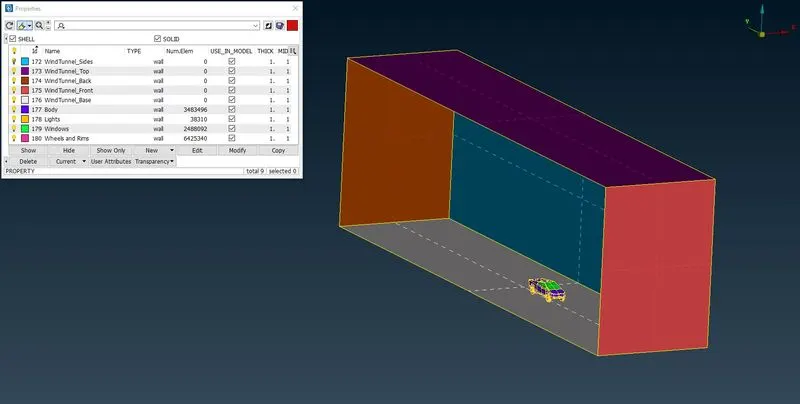
- Now, to create the wind tunnel geometry, points are created to aid creating curves which then, aid in creating the wind tunnel geometry.
- An approximate of 5900mm is calculated as the maximum length of the truck. Using this as ‘x’, the top face of wind tunnel is set to ‘3x’ distance. Similarly, the front and back faces are set ay ‘4x’ and ‘6x’ respectively. Sides are at ‘x’ distance from the cybertruck, and the bottom face is set very near to the cybertruck.
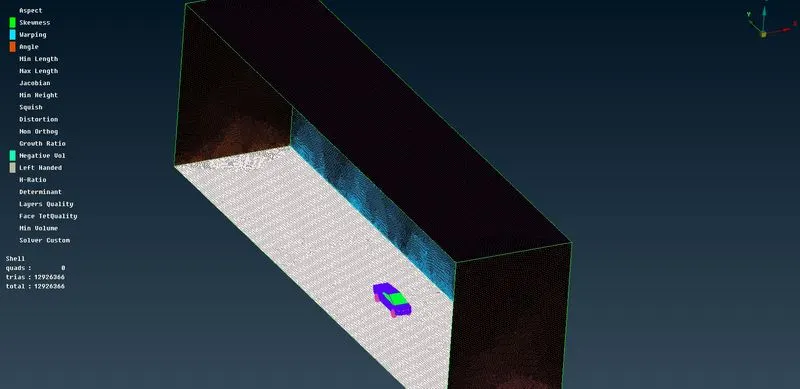
- The newly created wind tunnel is assigned PIDs and meshed with 80mm as target length at the bottom and 300mm at the top with the mesh varying from 80 to 300mm at the sides.
- Once surface mesh is performed on the wind tunnel, we move on to volumetric mesh.
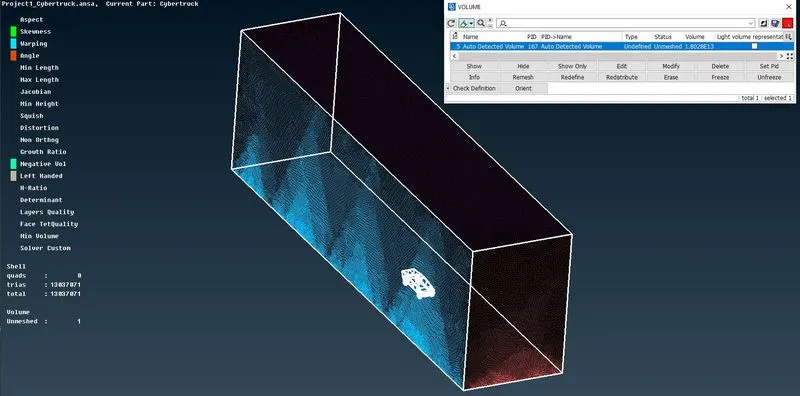
- Using automatic define, the whole database is defined for volumes. Only the volume between the wind tunnel faces and the cybertruck is required. The rest are deleted.
- Using remesh, tetra CFD is used to mesh the volume.
Note: Wind tunnel volume is not meshed as it required a lot of time and/or high computing power.
RESULTS AND PROCESS IMAGES
1. Model Opened In ANSA
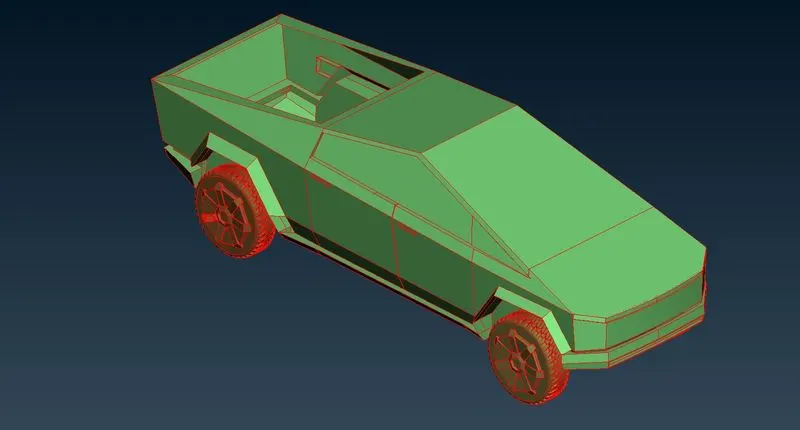
2. Model After TOPO Cleanup
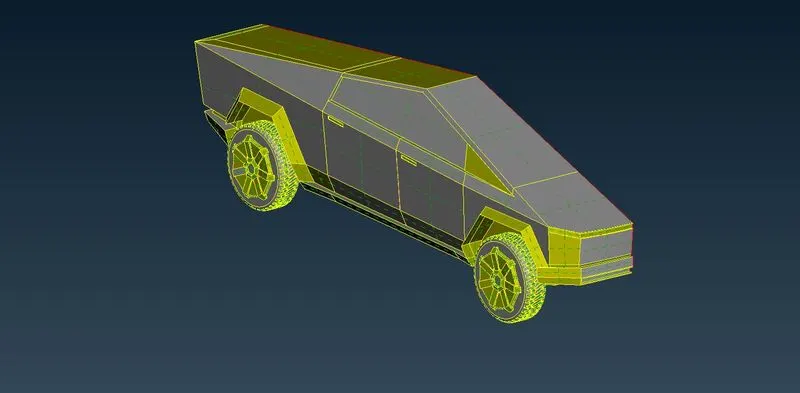
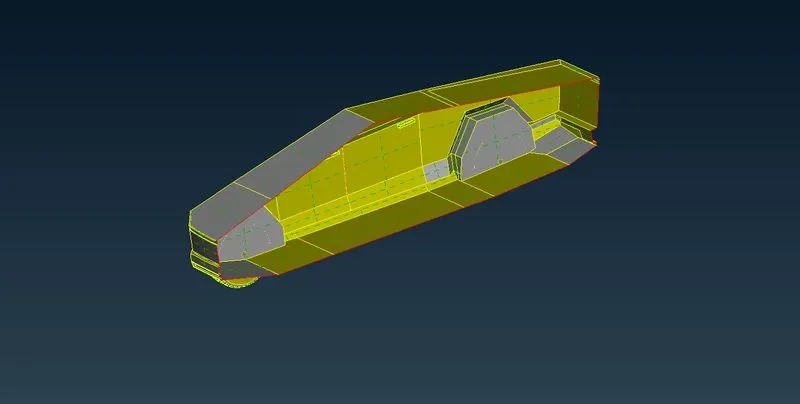
3. PIDs Assigned To Cybertruck
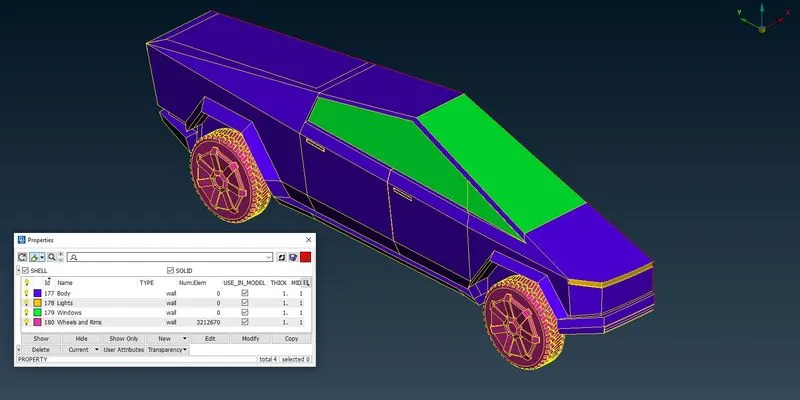
4. Cybertruck After Surface Meshing
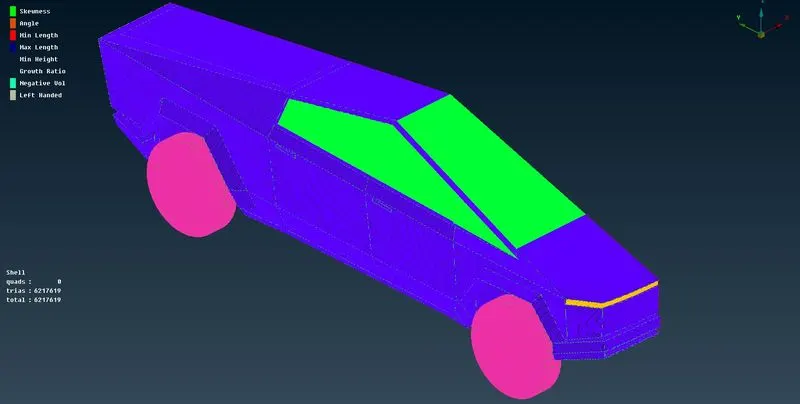
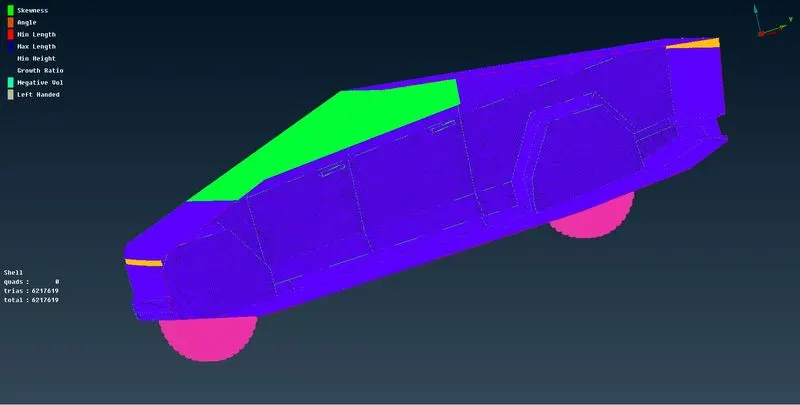
5. Cybertruck After Using Symmetry
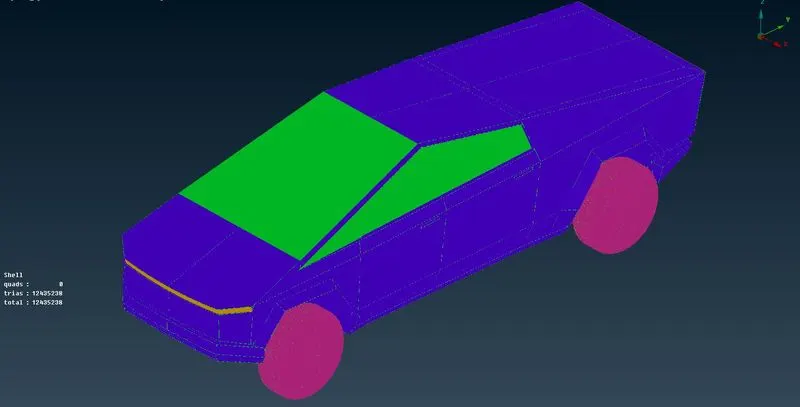
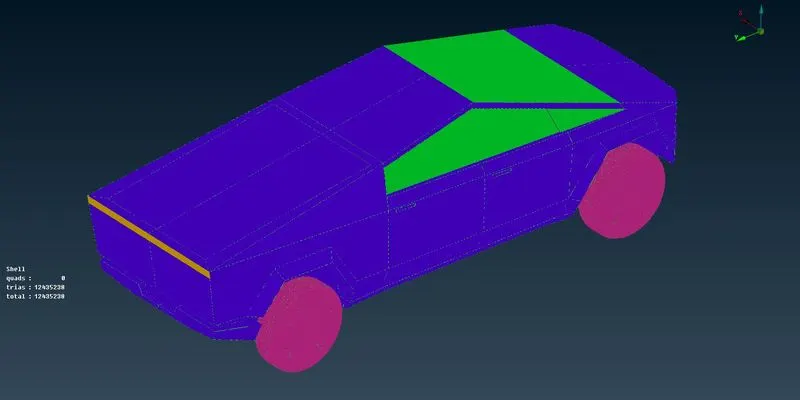
6. Wind Tunnel With PIDs
7. Surface Meshed Wind Tunnel
8. Volume defined between the faces of the wind tunnel and the cybertruck
CONCLUSION
First, half of the truck model is deleted. Then, TOPO cleanup is preformed on the model. Relevant PIDs are assigned and surface mesh is done on the half truck geometry. The the geometry is complete using symmetry tool. Wind tunnel is created and surface meshed and then the volume between the wind tunnel faces and the truck geometry is defined.
The Cybertruck model along with the wind tunnel, after meshing, have a total of 13037071 tria elements.
File Link : https://drive.google.com/file/d/1lbiVvTNu_BXBQQV4KQRII0RfkgGoY2xm/view?usp=sharing