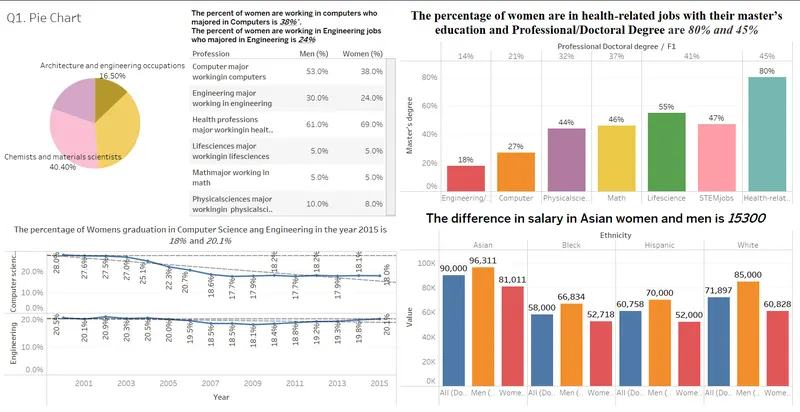
Project 1 - Analyzing the Education trends in Tamilnadu
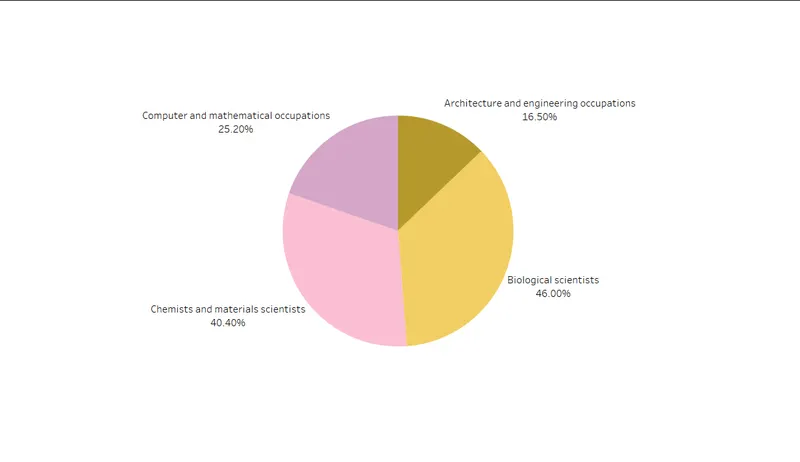
1. A pie graph of women in Biological Scientists, Chemists & Materials Scientists, Computer & Mathematical Occupations, Engineers & Architects
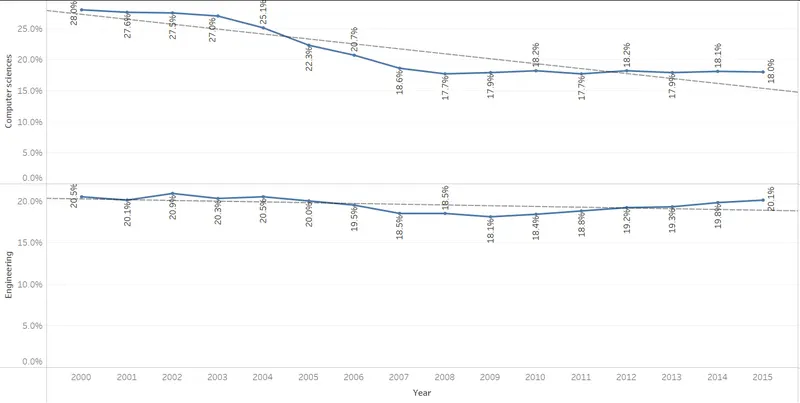
2. The trend of percent women graduating in Computer science and Engineering from 2000-2015
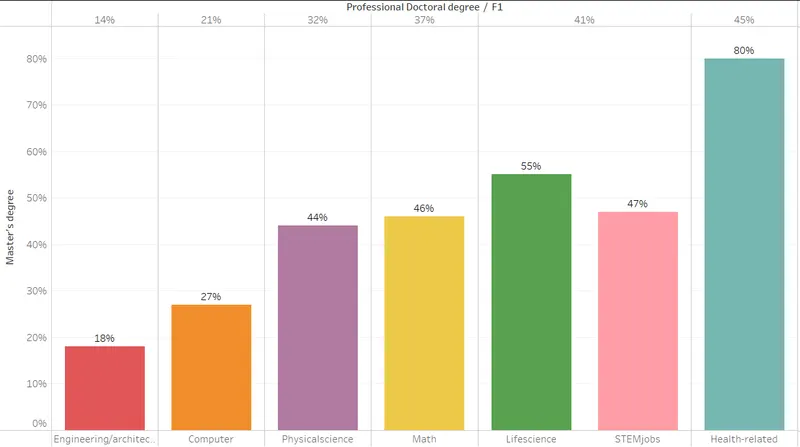
3. A bar graph of what percent of women are in stem jobs by education in which field.
4. Show a cross tab of men and women working in the related fields of their education.
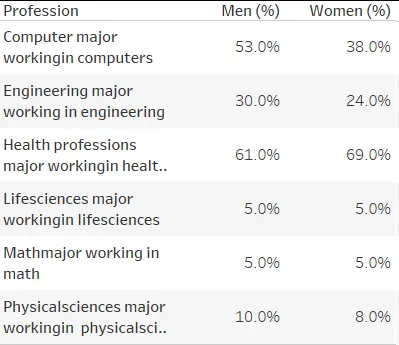
5. A comparison graph of All/Men/Women Salaries by ethnicity.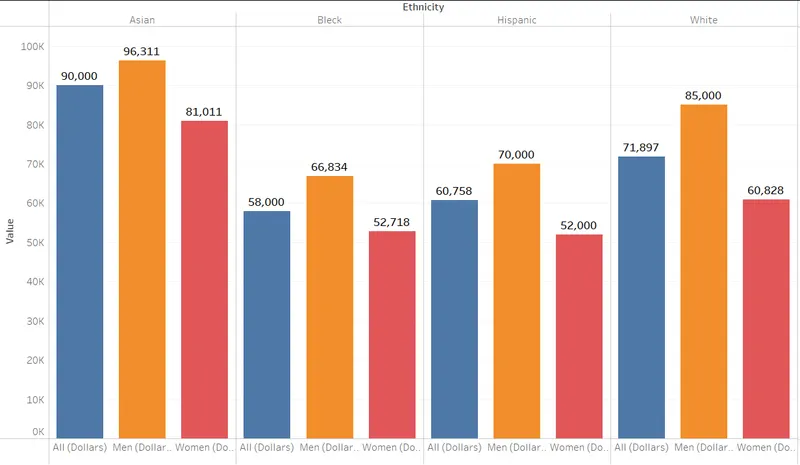
Detailed insight on what can be the possible issues on gender gap in STEM Jobs:
Despite the increasing the awareness of the issue on gender gap, women are still under represented in STEM fields.
- Social and Cultural factors:
- Social and cultural factors play a significant role in the gender gap in STEM fields.
- For instance, women may be discouraged from pursuing STEM career due to gender stereotypes that suggest that these fields are only suitable for men.
- Girls may also not receive the same level of encouragement as boys in STEM subjects.
- Lack of female role models:
- Another contributing factor to the gender gap in STEM jobs is the lack of female role models.
- When women do not see other women in STEM carriers, they may feel that they are not suitable for such jobs, and this may discourage them from pursuing STEM carrers.
- Lack of work-life balance:
- The lack of work-life balance in STEM jobs can also be a contributing factor the the gender gap.
- Women may be less likely to pursue carriers in STEM fields if they feel that these jobs are incompatible and their family responsibilities.
- The long hours and high-pressure work environments in some STEM fields can make it difficult for women to balance their work and personal lives.
- Educational Barriers:
- Educational Barriers can also contribute to the gender gap in STEM jobs.
- For instance, women may be less likely to pursue STEM degrees due to lack of access to quality education or resources.
- They may also face barriers such as unconscious bias in the classroom, which can impact their confidence and performance in STEM fields.
- Bias and Discrimination:
- Bias and discrimination can also contribute to the gender gap in STEM jobs.
- Women in STEM fields may face discrimination and bias in workplace, which can result in a lack of opportunities and career advancement.
- They may also be paid less than their male counterparts and may not be given the same level of recognition of their work.
In conclusion, the gender gap in STEM jobs is a complex issue with multiple contributing factors. Addressing these issues requires a concerted effort from individuals, organizations and policy makers to create an inclusive and supportive environment that encourages women to pursue carrers in STEM fields.
Dashboard: