Project 1
Project 1
Forearm crutches
Introduction:
a.Types of crutches
Crutches are medical devices that aid in ambulation by transferring the weight from legs to the torso and arms. They are walking aids that help people with leg injuries. There are three primary types of crutches. They are described below-
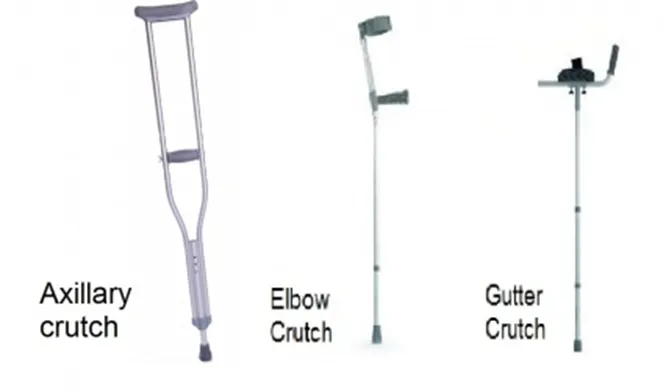
· Underarm crutches/ Axilla: these crutches are placed under your axilla (underarms) and can be height adjusted. These are the most common types of crutches used due to their ease of use and balance. However, their long-term use leads to discomfort and fatigue. They are also called axilla crutches.
· Forearm crutches: these crutches have a cuff that goes around the forearm and handles for support. These are also called elbow crutches. They are widely used for people with long-term mobility needs. One needs a good arm and upper body strength to use forearm crutches.
· Forearm support crutches/ Platform: these crutches have padded forearms and adjustable handles that make them more suitable for long-term use. They are also called adjustable arthritic crutches.
b.Parts of crutches
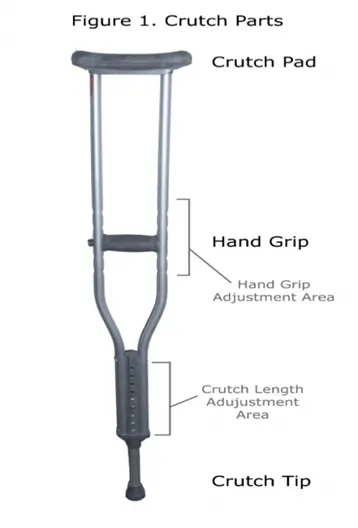
· Handgrip: it is the top part that a person holds onto. It provides a secure grip for the user
· Shaft or body: it is the main vertical part of the crutch. It extends from the handgrip to the bottom of the crutch.
· Arm support: the cuff or arm support goes around the forearm. It provides additional stability.
· Adjustable height mechanism: crutches generally have an adjustable height mechanism to allow the users to customize the height as per the needs.
· Rubber tip: the bottom of the crutch makes the contact with the ground. It also provides traction and is useful in preventing slipping
· Crutch pads: these are the cushions that are placed on the top of the crutch. They are instrumental in reducing the pressure.
c.Materials used in making the crutch
The forearm crutch and its parts are made of materials with mechanical properties that are suitable for the requirements of each part.
The main parts of the forearm crutch include shaft, paddles, height adjustment holes and rubber tip.
Materials used in making the parts of the crutch
· Frame/ Shaft: it is made of a material that has high strength and can bear the weight of a person without bending. It should also be corrosion-resistant to ensure the long life of the crutch. Usually, aluminium alloys are used for the frame.
· Cuffs: they should be made of a material that is capable of being flexible yet strong. They should be stable. Generally, rubber or plastics are preferred for making cuffs.
· Height adjustment mechanisms: these mechanisms could be adjustment pins or clamps. These materials should have high strength, little deformation, durable and high abrasion resistance. Usually, stainless steel is used for height adjustment.
Manufacturing process
Manufacturing of crutches can be divided into two major parts. First is the making of hollow tubes or shaft and the other is arm cuffs, grips and rubber tips.
Aluminium hollow tube:
· The starting block is also hollow. The hollow tube is made through a process called drawing. It is a process through which a heated starting block is drawn through a die
· Passage through the die reduces the diameter and stretches its length by applying high pressure.
· Once the desired dimensions are achieved, the tube is rapidly cooled through water.
· Depending on the desired shape of crutch, the tube is bent and holes are punched along its length for height adjustment mechanism.
Second part
· Arm cuffs, hand grips and rubber tips are manufactured using injection molding process
· The process briefly includes inserting the plastic polymer into the heating unit to obtain the molten material
· The molten material is inserted through high pressure injection into the mould to obtain the desired arm cuffs.
Assembly
All the individual parts are assembled to obtain the final structure and finishing to smooth out any rough edges and apply coatings to enhance the durability and appearance.
Testing methods for the materials used in crutch
1. Material testing: the composition of the material can be tested using techniques like X-ray fluorescence spectroscopy.
2. Tensile strength testing: the ability of a material to withstand tension and stress is evaluated.
3. Resistance testing: the impact resistance testing is used to assess the material’s toughness.
4. Hardness testing: it is performed to assess the hardness of the material
5. Fatigue testing: repeated loading and unloading is used to assess the material’s ability to withstand fatigue.
6. Durability testing: simulation is used to replicate the real-time conditions and assess the overall durability over an extended period.
7. Chemical resistance: the material is exposed to real-time environmental conditions like humidity, moisture and evaluated for any changes in its characteristics.
8. Biocompatibility testing: this is mandatory as it comes in contact with skin. It evaluates for any harmful products that might cause harm to the user
Conclusions
In addition to the above-mentioned testing, weight capacity should also be tested. Considering the customer needs like comfort, aesthetics, functioning improvements can be made further.
Suggested improvements
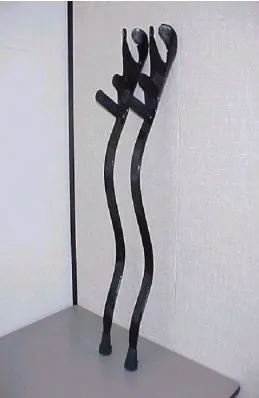
1. Shaft design can be more ergonomically designed by having bends in between thus reduces the high energy expenditure in the straight vertical designs
2. Material selection: graphite is another alternative material to aluminum as it is also durable, reusable and more sustainable.
If the design is innovative, IP rights have to be acquired by patents. We have to file a patent application and provide the supporting information to get IP rights. Once a patent is granted, it is valid for 20 years in India.