Project 1
Project-1
Forearm crutch
You make a report on the human forearm crutch, taking into account (a) types of crutches, (b) parts of the crutch (c) materials used in making the main crutch (d) a brief description of how each part is made
Introduction:
Crutches are a sort of walking aid that let people have a larger base of support. They help persons who can't use their legs to support their weight transmit weight from the lower body to the upper body (from short-term injuries to lifelong disabilities).
Types of crutches:
Axilla crutches, elbow crutches, and gutter crutches are the three different forms of crutches.
Underarm crutches or an axilla: The elbow should be flexed between 20 and 30 degrees, and there should be 2 fingers between the axilla and the axilla pad. The structure consists of a handpiece, an axilla bar, and two uprights connected distally by a single leg. Both the overall height and the height of the handgrip are adjustable; the range of adjustment is roughly 48 to 60 inches (12 to 153 cm).
Crutches for the arm: (or lofstrand, elbow or Canadian crutches). They have a single upright, a forearm cuff, and a handgrip in their design. From the handgrip to the floor, the height of forearm crutches is specified (adjustable from 29 to 35 inches/74 to 89 cm).
Gutter Crutches: (or adjustable arthritic crutches, forearm support crutches) A different kind of crutch consists of a metal strap, an adjustable handpiece with a rubber ferrule, and a padded forearm support. These crutches are used by patients who can carry some of their own weight, and they are especially helpful for people with rheumatic diseases.
Main Parts of the crutch & Materials used for the main parts:
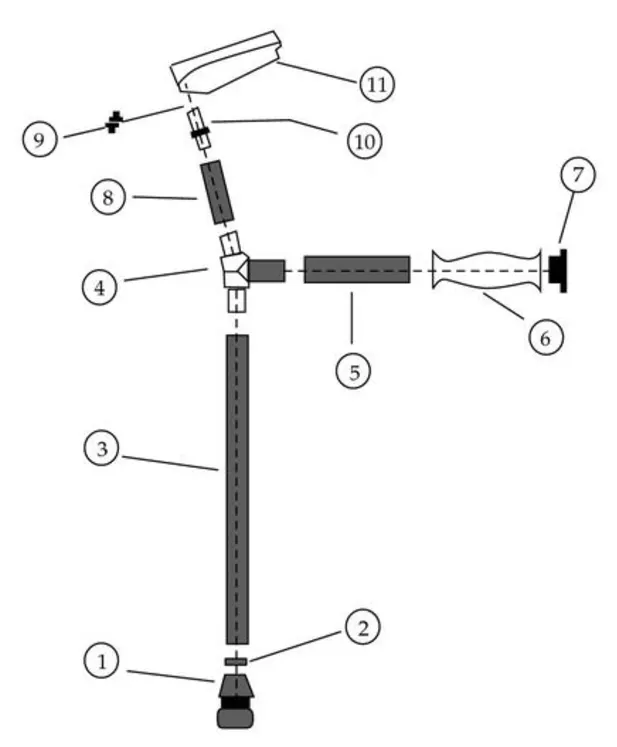
- Foot part is made up of rubber.
- End cap to join the foot and main tube is made up of aluminum.
- Main tube is made up of composite.
- Union to join the handle, main tube and Arm support tube is made up of aluminium.
- Handle tube is made up of composite.
- Grip for the handle is made up of EVA Form.
- Handle end cap is made up of aluminium.
- Arm support tube is made up of composite.
- Arm support pivot rivets is made up of composite.
- Arm support fitting is made up of aluminium.
- Arm support clip is made up of plastic.
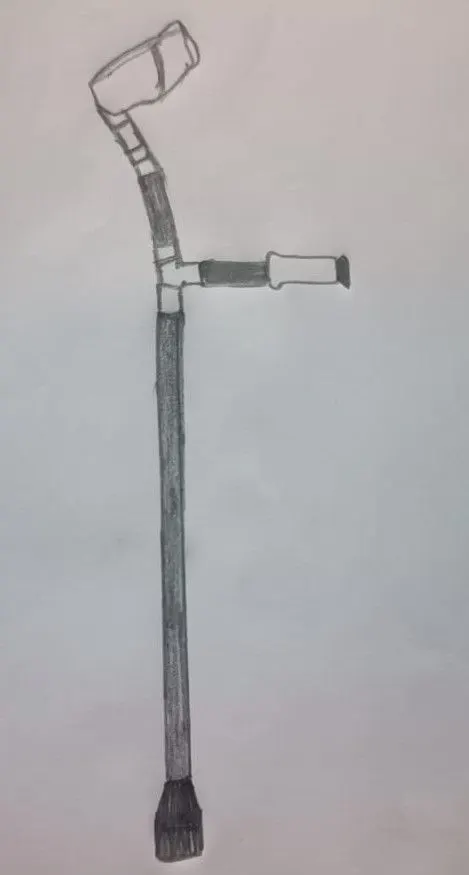
A sketch of a crutch
Brief description of how each part is manufactured.
The majority of the labour involved in creating forearm crutches is composed of aluminium hollow tubes, plastic arm cuffs, hand grips, and replaceable rubber tips. Some crutch-making businesses choose to purchase hollow tubes that have already been manufactured and come in a variety of shapes and sizes. However, a lot of crutch manufacturing businesses choose to create their own hollow tubes since it gives them more control over the quality and accuracy. In order to create the hollow aluminium tube, a stock billet must first be heated to extremely high temperatures before being forced through a die to shrink its diameter and length. The process improves the desired tube's surface polish and dimensional accuracy, but it needs a hollow starting billet.
Due to the initial heating procedure that maintains inner properties, the material is soft but still solid. Following the drawing operation, the tube goes through a brief cooling process called water quenching. The hollow tube is then twisted into the desired crutch shape by being punctured with holes of varying lengths throughout its length. This will be the last stage in the assembly process once all other parts have been attached. Arm cuffs, hand grips, and rubber tips are made via injection moulding, which is done with an IMM (injection moulding machine) or injection press. This device's multiple mould cavities allow it to be modified to fit the shapes of the components being made. In order to melt the plastic polymer, it must first be supplied into the machine's heating unit.
The molten plastic is then forced under intense pressure into the mould chambers for the corresponding arm cuff, hand grip, or rubber tip. Once the cavities are filled, more material is injected into the machine than is required to fill the moulds in order to account for the material's shrinkage as it solidifies. The moulds are opened, and the finished product is expelled from the machine when the object has been formed and cooled to the appropriate temperature. This manufacturing is perfect for creating rubber as well as plastic materials like the arm cuffs and hand grips due to its accuracy and precision in shaping parts as well as the complexity of designs. The forearm crutch can finally be put together after each component has been improved and put through quality control testing.
Conclusions
The project's conclusion is that the crutch may be redesigned and rebuilt using new materials like graphite and carbon fibre, among others. With the aid of alloys, crutches can be produced at a lower cost and as closely to the human body as possible. Reduced plastic usage can also benefit the environment.