Project 1
PROJECT 1:
Create a stateflow or Simulink model for the following flowchart.
The input to the model would be the power demand.
The output should be:
- Fuel cell power
- Battery power
- FC Operating state (running, standby)
Create plot of these outputs against time.
Why Fuel cell needs battery to meet some of the load transients/demand?
Battery and Fuel cell though belong to the same ElectroChemical family. However, there are few differences, Batteries are more of an energy storage systems where we provide input electrical energy to charge it and once its charged it can drive the vehicle (Discharge Mode). Some of the potential roles of battery in FCEV is that efficient energy management is possible as both the energy systems complement each other.
During “Regenerative Braking” of the Vehicle the surplus energy can be used to charge the battery. This regenerative electrical energy cannot be used to charge the Fuel cell as the energy input for the fuel cell is Hydrogen. On the contrary, the refuelling is very fast in the case of Fuel cells unlike Batteries.
Fuel cells create electricity but not fast enough to power the car during many of the things a car must do like accelerating, going up hills, etc. So the fuel cell feeds the battery and the battery powers the car. IOW, the battery is like a power queue. You have seen streaming videos online, right? You can frequently see the streaming progress and its generally just ahead of the video that is playing. Should the stream slow down or get interrupted, the video pauses (or sometimes just lowers its resolution) until the stream can queue up enough to resume play.
The battery’s role in a fuel cell vehicle is pretty much the same as the role of the battery in a electric vehicle; powering the car. This is one of many reasons why fuel cell vehicles have not gained in popularity and are likely to never get beyond a very small niche. The fuel cell system simply adds another layer of complexity, cost, and points of failure. Plus there are a handful of fuel cell refueling stations verses a half BILLION places to get electricity
Implementing control logic or simply a power flow logic for battery an Fuel cell.
We will use stateflow and simulink to meet the required logic. Below are the steps to build model.
- The ignition switch is actually the rotary switch which has been modified to have only two states i.e on or off.
- This switch is connected to the constant block which provides input to the stateflow logic as per the ON/OFF condition of Ignition switch.
- Signal builder is used to create a power demand profile.
- Sateflow has charts and transition statements which will be explained later.
- Finally the scope is used to capture the output of stateflow logic.
MODEL:
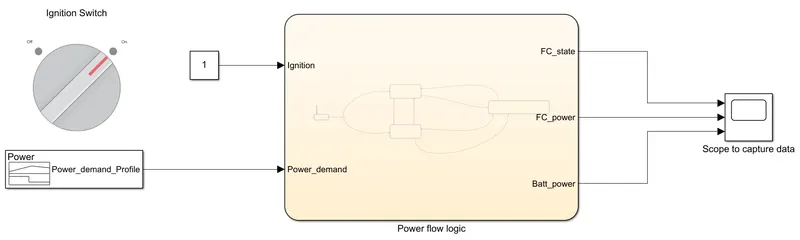
Working of model:
1. As soon as Ignition switch is turned ON, the initial state is active and allows the transition to be happen inside chart.
2. The other input i.e power demand profile has a following nature:
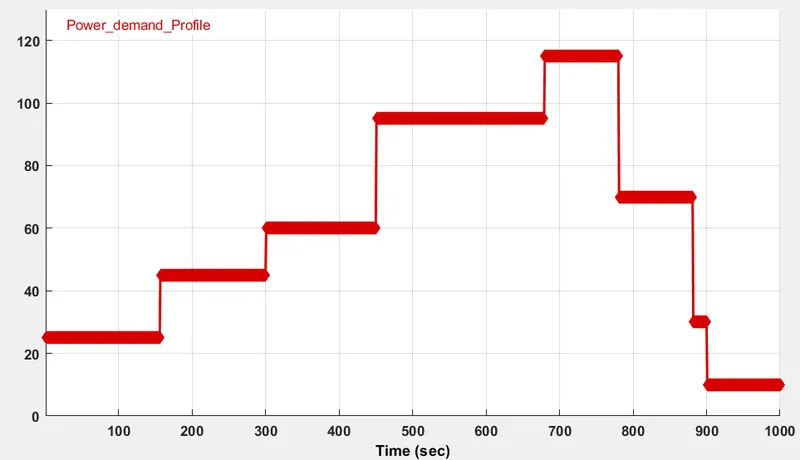
3. According to the power demand profile the transition between states will take place.
4. Power flow logic here implements the logic. This logic if said theoritically simply means that fuel cell will supply power to the motor when the power demand is >=30 and 80<=. Battery has its role when the power demand is 30< and when the power demand is >=80 where battery and FC both supplies the power to the motor. Below Power flow logic snap speaks for itself:
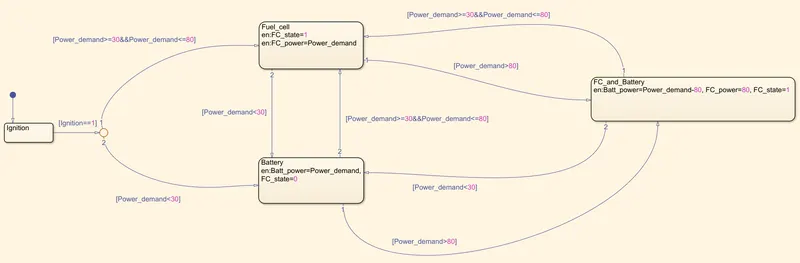
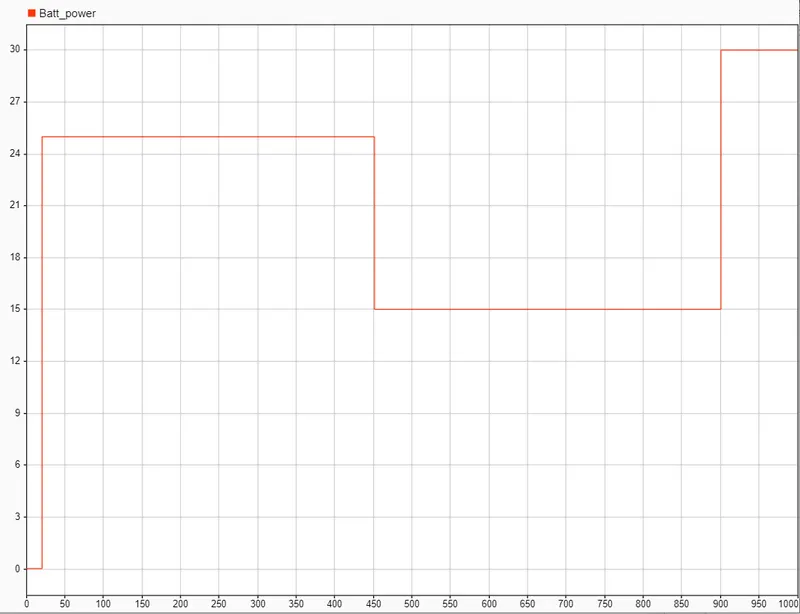
5. Finally the three outputs from power flow logic are FC_state which shows the active and inactice sate of fuel cell. FC_power tells how much is the power being provided by FC to the motor and same applies to Batt_power.
RESULTS:
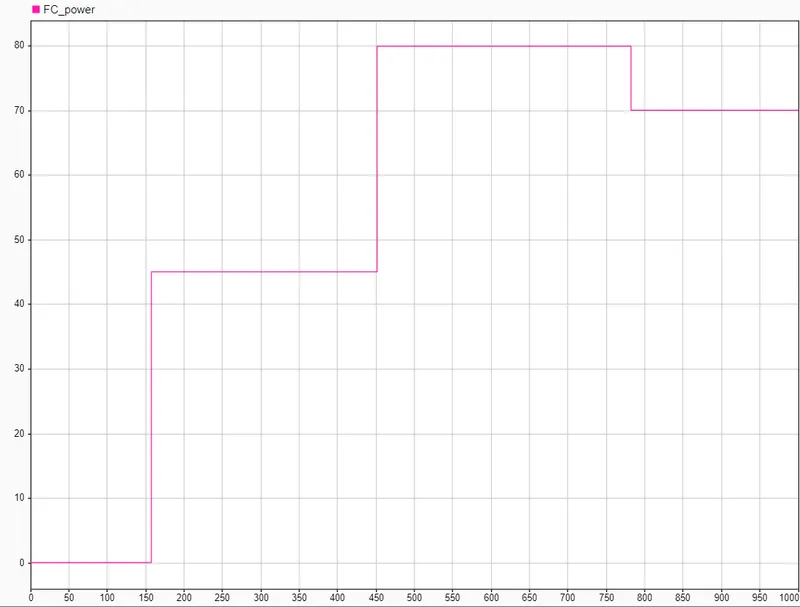
Fuel cell power:
Battery power:
FC_state:
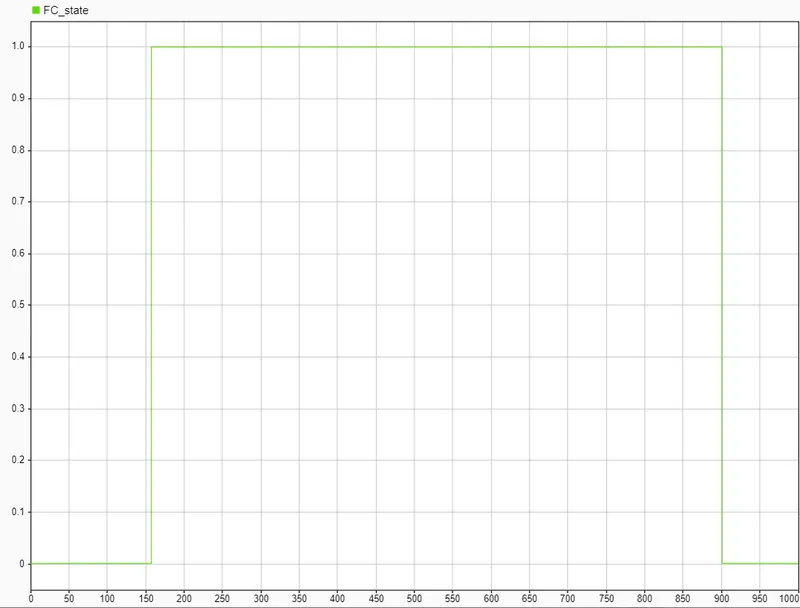
If we compare the results with power demand profile and our logic, it is quite evident that our model performed as per the logic.