Project 1
MULTIPARAMETER PHISIOLOGICAL MONITORING SYSTEM
Multiparameter patient monitoring system plays a vital role in healthcare system for the benefit of patients as well as for doctors and staffs. A multiparameter physiological monitoring system assess aspects of human performance and either respond with a corrective action, or alert a human being to do so. It can measure multiple physiological signs at a time and record temperature, blood pressure, blood oxygen, heart rate, respiration rate, alertness, and activity. Convenient monitoring of all the aforementioned parameters raises the strong requirement of light-weight, small-size, low-power and multi physiological parameter monitoring systems.
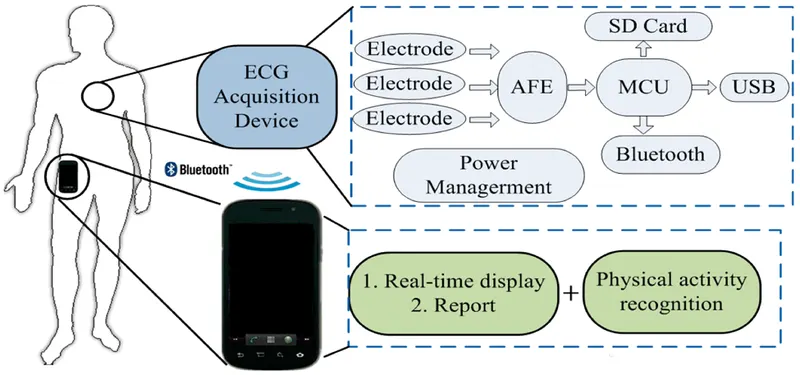
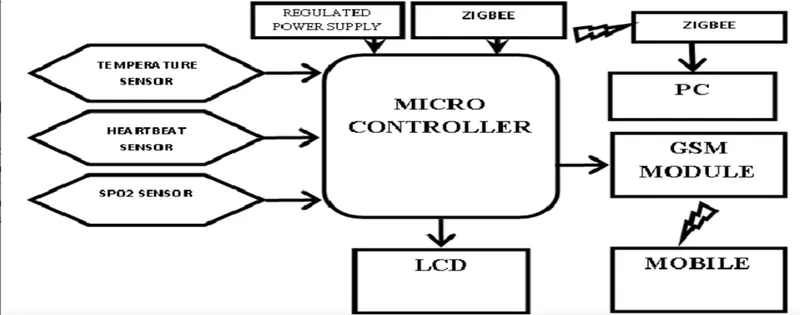
A Wearable multiparameter physiological monitoring systems have multiple parameters such as electrocardiogram acquisition module, respiration acquisition, blood oxygen rate, temperature acquisition module, motion state acquisition module, and wireless communication with easy processing module. Wearable monitors have two unique features,
1) High integration with multi-parameter: Full-featured physiological parameters monitoring equipment solve the adaptability of the sensor and anti-jamming technology, the wearable system technology, and highly integrated design technology.
2) Real-time Blood Pressure monitoring continuously: Based on the pulse wave propagation time sleeveless-belt continuous blood pressure monitoring sensor system, use hydrostatic method for online calibration and correction to overcome the impact of individual differences in the sensor detection accuracy and facilitate the achievement of the 24-hour continuous blood pressure monitoring.
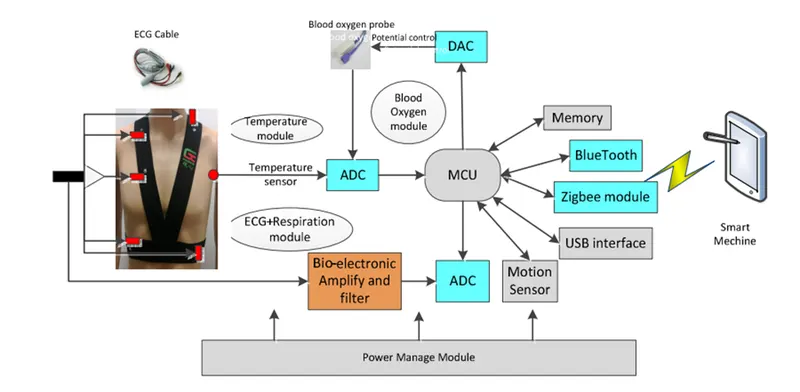
Here the ECG electrodes are embedded into the inside of bandages for not easy remove of electrodes. Measurement in this way can accurately position signal’s position of collection point, as well as maintain the consistency of signal measurement point. Temperature and oxygen probe are separately connected to the armpit and fingers as an attachment. Motion sensor real-time monitors the state. The wearable system wears next to the skin; wireless signal is absorbed by the body easily. To avoid the situation, high frequency circuit matching near field impedance is designed. The modular design in the hardware structure makes each unit powered off completely. And the software system adopts polling mode of each sub-unit low duty cycle. The wearable system uses high input impedance amplifier circuit, correlation detection method and other methods to achieve weak signal detection; a variety of methods is adopted to improve the signal-to-noise ratio. Multiply sensors are integrated in the same unit, the small size of the sensor units and modules reduce the volume of the monitoring system.
(Xu Z, Fang Z, Du L, Zhao Z, Chen X, Chen D, Sun F, Qian Y, Li H, Tian L. A wearable multi-parameter physiological system. InUbiquitous Information Technologies and Applications 2014 (pp. 643-648). Springer, Berlin, Heidelberg.)
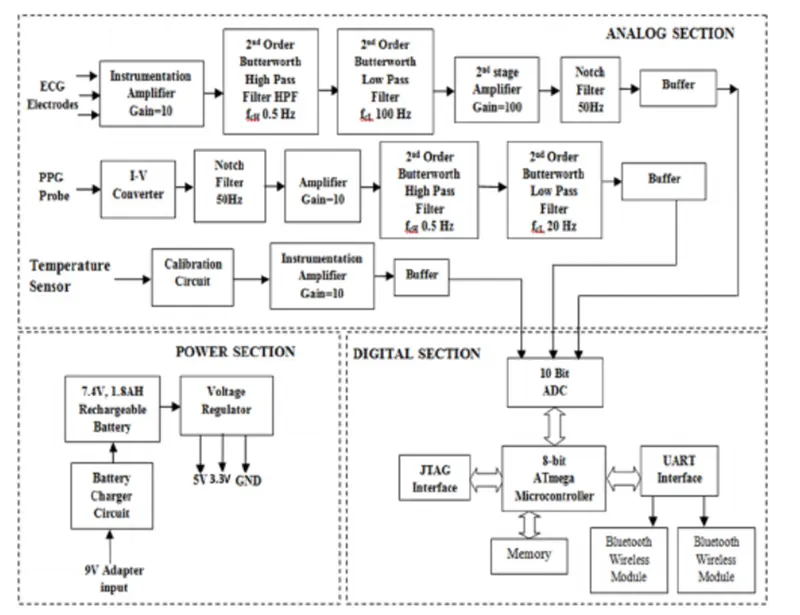
Electrocardiogram: Frequency (0.5-100 Hz), Amplitude (0.25 – 1mV), Piezoelectric transducer
Heart rate: 40-220 beats per minute, rate obtained from ECG signal
Respiration rate: 12-16 breaths per minute
Temperature: 0oc – 40oC, Thermistor sensor with accuracy of ± 0.1oC
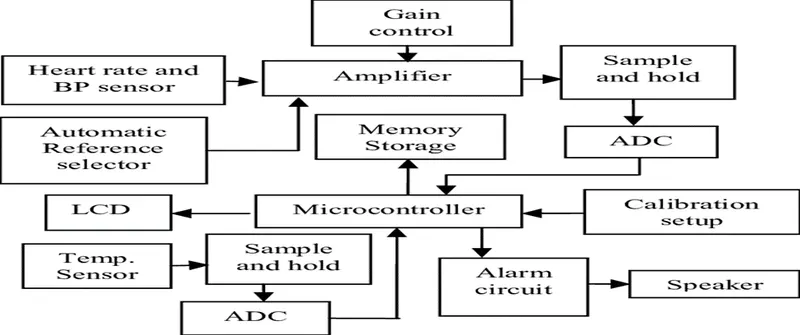
Block diagram
Verification
Verification is the documented proof that a product meets the specified requirements during development.
Qualification
Qualification is usually performed at facilities, instruments, production plants and QC labs, when they are relevant for the quality of the medical device. It is the documented proof, that the object to be qualified is suitable and safe for the intended use. A qualification consists of a DQ, IQ, OQ, and PQ:
- Qualification begins with the DQ (Design Qualification), which is performed before purchase to prove that all user requirement specifications are covered by the vendor’s system specifications.
- The IQ (Installation Qualification) proves that the delivery including all documents is complete and has been properly set up and connected.
- The OQ (Operational Qualification) is a testing procedure ensuring that every single function, including safety and alarm measures, operates properly.
- The PQ (Performance Qualification) is the final part of the qualification process, providing evidence, that the intended operation can be performed and reproduced within the specified limits for the complete area of operation
Validation
Validation is the documented proof that the object to be validated performs in line with the required reliability during practical operating conditions. In the context of medical devices, validation applies to the following areas:
- A process validation is performed at the production plant and is necessary if not all potential risks are covered by the quality control.
- The method validation is required if non-standard methods are used for quality control.
- The medical device itself needs to undergo a design validation. This includes clinical evaluations, performance evaluations and usability tests.
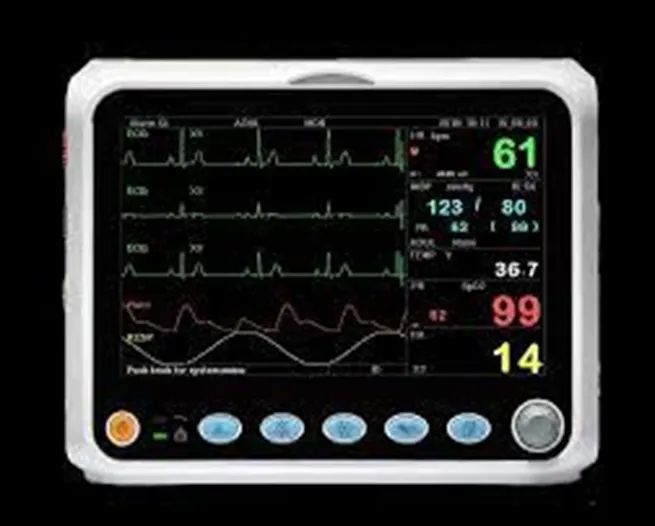
Screen layout for multiparameter monitoring system
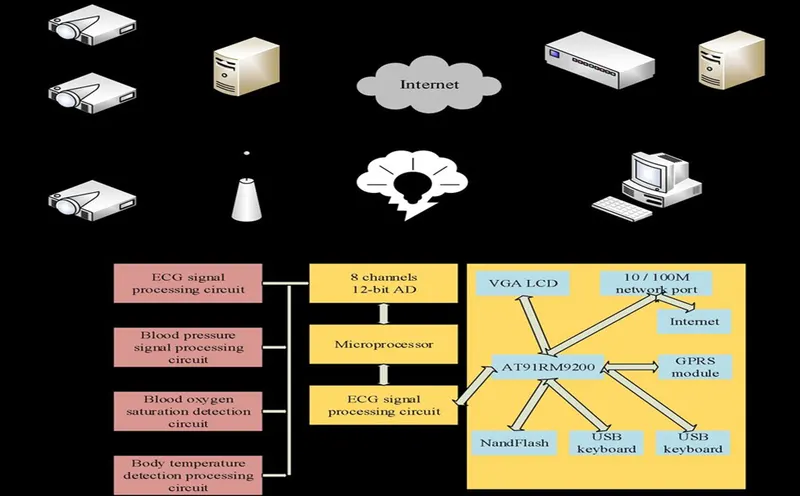
Design of ICU with 8 bedside monitor and central nursing station
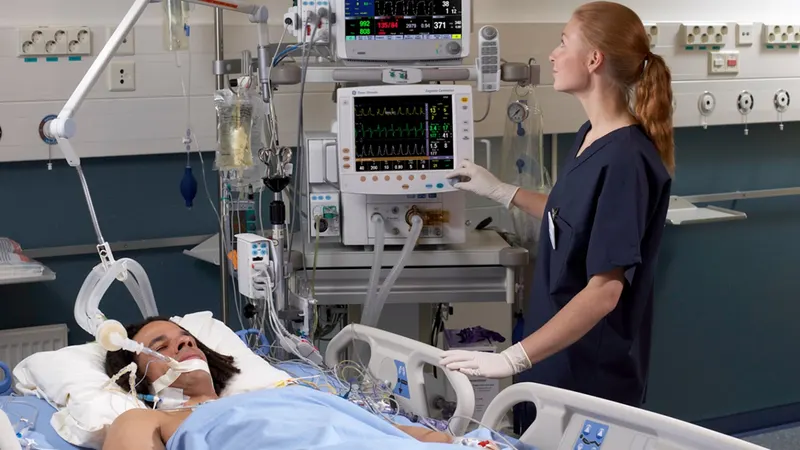
In the ICU patient is monitored by medical devices like to measure the heart rate, pulse rate, blood oxygen rate, ECG, body temperature etc., the patient is to be connected with all around and all the outputs are connected to microcontroller and by the display unit responses are to be observed. Central nurse stations are placed to serve and take care patients in better way. Also, the monitors are linked to the central nursing system which gives the 24*7 hours service. In hospital and healthcare systems have alarm and alert system to alert doctors, nurses, technicians to operate medical devices in proper time duration for safe and better treatment.
External storage devices like USB pen drive are used to store all set of information and records. Also, medical devices have recording and storage units to store datas for further uses. Now a days EMR (Electronic medical record) solutions available in medical sectors to auto store the clinical history of a patient.