Lateral brush tire model using Matlab
Aim:
To study the variation of lateral force and aligning moment with slip angle.
Given data or Inputs:
Coefficeint of friction-`mu`=0.9
Normal load-`F_z` =5000N
Length of contact patch-`l_t` =0.2m
Cornering stiffness-`C_a` =5000`N/(rad)`
Equations used:
- Lateral stiffness, `k_y`=`2*C_a/l_t^2`
- Critical slip, `alpha_c=(mu.F_z)/(2*C_a)`
- Lateral force:
- When `alpha<alpha_c`, : `F_y=C_a*alpha`
- When `alpha>alpha_c`
`F_y=mu*F_z-(mu*F_z)^2/(4*C_a*tan(alpha)`
- Aligning moment:
- When `alpha<alpha_c` : `M_z=C_a*l_t*alpha/6`
- When `alpha>alpha_c`
`M_z=(mu*F_z)^2/(12*l_t*K_y*tan(alpha))*(3-2*mu*F_z)/(l_t^2*K_y*tan(alpha)`
Matlab Code:
%inputs
Fz=5000;      %Normal load(N)
mu=0.9;       %coefficeint of friction
ca=50000;     %cornering stiffness(N/rad)
lt=0.2;       %Length of contact patch(m)

ky=2*ca/lt^2;           %lateral stiffness
alphac=mu*Fz/(2*ca);    %critical slip in radians

for i=1:151
    alpha(i)=(i-1)*0.1*pi/180;
    if alpha(i)<alphac
        Fy(i)=ca*alpha(i);
        Mz(i)=ca*lt*alpha(i)/6;
    else
        Fy(i)=mu*Fz-(mu*Fz)^2/(4*ca*tan(alpha(i)));
        Mz(i)=(mu*Fz)^2/(12*lt*ky*tan(alpha(i)))*(3-2*mu*Fz/(lt^2*ky*tan(alpha(i))));
    end
end

% plotting
figure(1)
plot(alpha*180/pi,Fy)
xlabel('Slip angle(deg)')
ylabel('Lateral force(N)')
title('Lateral force vs slip angle')
grid on

figure(2)
plot(alpha*180/pi,Mz)
xlabel('Slip angle(deg)')
ylabel('Aligning Moment(N-m)')
title('Aligning Moment vs slip angle')
grid on
Output:
Interference from plot:
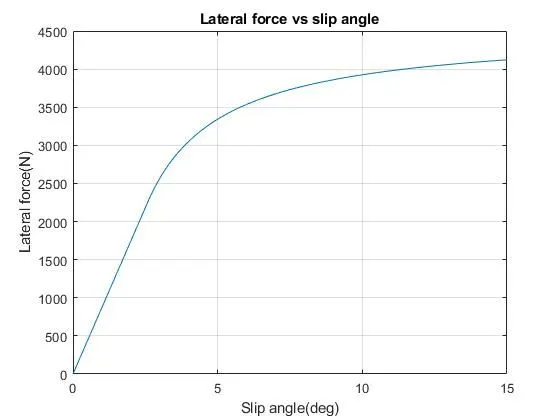
- From graph 1, we can understand that lateral force increases with slip angle. It varies linearly until critical slip and then behaves hyperbolic until maximum value of slip angle.
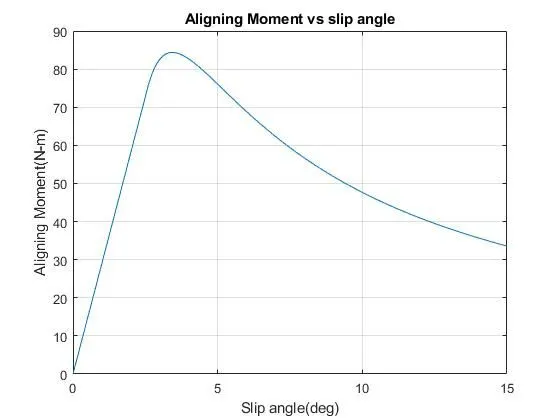
- From graph 2, the aligning moment also increases linearly until critical slip and later on decreases with slip angle.