Introduction to National Building Code and Steps in a Construction project
Q. 1) Answer -
a) A building codes or standards is a set of rules and clauses to regulate the construction activities in appropriate manner.
b) Building codes specify minimum standards for the construction of building .
c) The main purpose of building codes are to protect the public health,safety and general welfare as they relate to the construction and occupancy of structures.
d) The building code becomes law of particular juridiction when formally enacted by the appropriate government or private authority. As we follow the standard codes of building in software it gives us the drawing as per the specification in code book which are ready for construction and can be follwed by vendor.
e) Building codes are among these essential tools.Residential and commercial building codes provides a comprehensive set of minimum health,safety and energy standards for the design,construction and maintenance of new houses and building and major renovations.
Q. 2) Answer -
From national building codes of India 2005,the groups that will be essential in modeling a project in revit are -
1) Group 1 - For development,Building planning and Related aspects
2) Group 2 - For Structural design and Related aspects
3) Group 3 - For Construction related aspects including safety
4) Group 4 - For Aspects relating to Building services
5) Group 5 - For Aspect relating to Plumbing services including Solid waste
Q. 3) Answer -
Steps that occure in project cycle are
1) Initiation
2) Planning
3) Execution
4) Monitoring or controlling
5) Termination or closing
Initiation - The project initiation phase is very important.The initiation lays the foundation for all the future steps,all the way to the projects closure.We will determine how feasible this project is and whether it actually makes sense to go ahead with its execution.This also determine what resources this project will require,as well as where to source them.
Planning - once the initiation stage is over,your project will enter in the planning stage.As its name implies,this phase is everything to do with the planning and preparation of the project.Before you can being executing your project,you will need to create a detailed plan of action.A project plan brings clarity and systematization to what can quickly become a very easy process.
execution - In this stage,your project finally comes to life.During execution,implementation of plan and and take all the steps necessary to carry out the project.This is the longest and most important phase of the project in which all the action happens.
Termination - The termination stage of project is all about analysis and assessment.In this phase,the project manager and team will take stock of the project,what went well and what could have been improved.
Q. 4) Answer -
Different disciplines involved in the construction of project are as follows
a) Architect
b) Civil engineer
c) Structural Engineer
d) Electrical Engineer
e) Fire protection Engineer
f) HVAC Engineer
g) Environmental Engineer
h) Town Planner
i) Interior Designer
j) Transportation Engineer
k) Geotechnical Engineer
Structural Engineer - Structural engineer are involved in the design,analysis and maintenance of structures like buildings and bridges.These structures are designed to fit budget requirement and strength loading and capacity factors from various sources.They must consider the conditions that their structure will endure,including loads from people and vehicles as well as environmental loads such as wind and snow.
Environmental Engineer - Environmental engineer are tasked with analyzing and avoiding potential risks.Environmental engineer must have strong understanding of science and maths including hydrology and drainage as well as air science.
Transportation Engineer - Transportation engineer have a wide range of responsibility to design and maintenance of roadways,airports,ports and any other system that accomodates passengers or commerce for transportation.Beyond design,planning is an important aspect in determining the most effective routes and modes of transportation for given area.
Geotechnical Engineer - Geotechnical engineer utilize their understanding of soil strength and structural design to design foundation,analyze pavement strength and depth assit in the design of dam,tunnels,embankments,mines etc.
Q. 5) Answer -
For Unit apartment - Residential building
School with capacity of 1000 students - Educational building
A single unit shop - Mercantile building
Multi story shopping complex - Commercial building
Steel machine factory - Industrial building
Residential building - These building are used for normal residential purpose and should faciliate activities such as sleeping,living and cooking.the building must include one or more family residencies,apartments.
Educational building - These are building housing educational institite such as schools and colleges which are affiliated and recognized by an appropriate board,universityor any other authority.The building should promote the aggregation of educational ,recreational and instructional activities pertaining to educational purposes.further it is mandatory for the building to have proper residential facilities for essential staff who need to reside within the campus.
Institutional Building - These type of building consist of building that are constructed by the government,semi-government organizations for specific purposes.Those specific purposes include medical treatment purposes such as treatment of physical or mental illness,children's hospitals,centers for the care of orphans,auditoriums or complexes meant to be used for cultural or allied activities,religious accommodation facilities such as dharamshalas,jails,detention centres etc.
Mercantile Building - In these type of building,either the entire building or a part of it is used for housing shops,stores or showrroms where display and sale of wholesale goods,retail goods or merchandise is carried out.Such builiding should also accommodate office,storage and service facilities essential for the business which should be located in the same building.
Industrial Building - Building used to manufacture,assemble or process products or materials are termed as industrial building.They include manufacturing units,assembly plants,factories,power plants,gas plants,etc.
Q. 6) Answer -
Role of Design Team -
1) Design engineer are responsible for the research and design of a company's new products and systems.
2) They perform various tasks in an engineering department including drafting blueprints,creating test prototypes,and overseeing the manufacturing process.
3) The members of the design team are Client,Architect,Structural engineer,Quantity surveyor,Building services engineer,and Interior designer
4) The design team is primarily responsible for taking ideas and bringing it to life using their professional skills.The end result is a design that aligns with the clients's desires,is feasible,and is within the budgetary restriction s for the project.
Role of Management Team -
1) The executive management team is responsible for managing the company's core business operations as a whole,which require planning of various development processes,group principles and group practices as well as monitoring the development of financial matters and groups business plans.
2) At most fundamental level,management is a discipline that consist of a set of five general functions i.e,Planning,Organizing Staffing,Leading and Controlling.
3) Management team is responsible for establishing policies,guidelines and strategic objectives,as wellas for providing leadership and direction for quality management within the organization.
Q. 7)
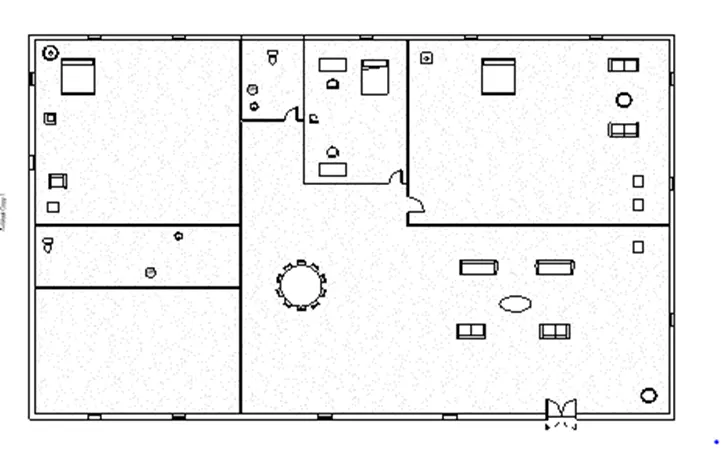
Aim - To model the project as per NBC requirement -
Procedure -
- Open the project file in revit
- Select the ground floor level and see the dimensions of rooms and other things if it satisfy the NBC clause.
Height -
- The height of building shall not exceed 15m
Area -
- The minimum plot size with ground coverage not exceeding 75%,and shall not be less than 40m2 in small and medium town and not less than 30m2 in metropolitian city.
Room size -
- The area of habitable room shall not be less than 9.5m2,where there is only one room with a minimum width of 2.4m and Where there is two rooms,one of these shall not be less than 9.5m2 and other not less than 7.5m2 with minimum width of 2.1m
Wall height -
- The height of Habitable room is 2.6m
- Height of kitchen is 2.6m
- Height of Wc/Bath is 2.1m
- Height of Corridor is 2.1m
- For sloping roofs the average height of roof is 2.6m
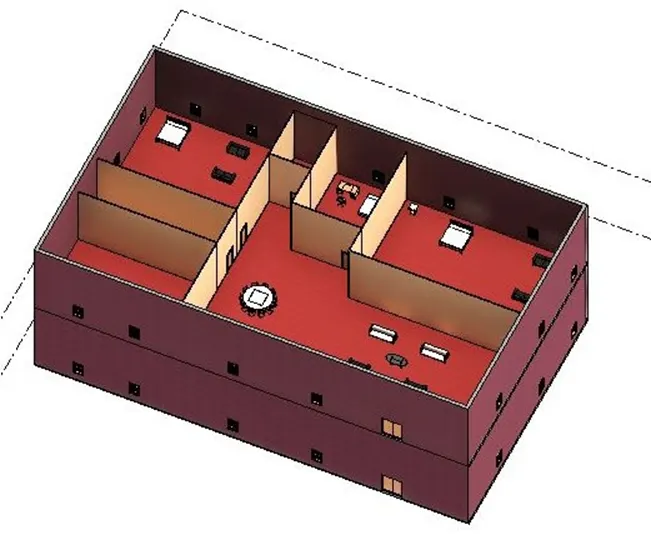
- Select the elevation view and change the height of floor to 12'
- Select the wall and constraint it to level
- Wall will change its height automatically.
- Select 3d view to see changes
- Area of building = 120'*70' = 8400 sqft
- Complete the model as per the NCB standards if required as other specifications
Q.8) Answer -
Maximum height of building shall not exceed 1.5 times maximum height
Area limitation can be seen from the table 3 of the floor area ratio FAR
FAR = Total covered area of all floors/Total plot area
Room size is considered as per NBC