Introduction to National Building Code and Steps in a Construction project
1) Building codes or standards essential for the modeling/ efficiency of drawings in Revit :
- A set of standards that are uniform to all the structures.
- It protects the construction safety
- Modern construction methods
- Provides building standards
2) From the National Building Code list the groups that will be essential when begin modeling in Autodesk Revit :
Group A : Residential buildings
Group B : Educational buildings
Group C : Assembly buildings
Group C : Institutional buildings
Group E : Mercantile buildings
Group F : Business buildings
Group G : Storage buildings
Group H : Industrial buildings
Group J : Hazardous buildings
3) List the five major steps that occur in project cycle . The steps should include from conceptualization of project to maintenance and final stage :
- Initiation - Here the documents which are needed for initiation of the building construction are created .
- Planning - Here the type of building model to be built will be created as a layout in both 2D and 3D model.
- Execution - Here the planned things are taken into the action with the help of the manpowers such as labors.
- closure - Here at last after finishing of the Project, the builded building will be finally analysed , that they are free from the damages and other problems and hand over to the client.
4) Examples of different disciplines involved in construction of a project :
- Construction - Here in this stage of the project, all the construction works of the building will be initiated and then completed.
- Finance and Estimating - Here all the financial and the estimation of the whole project will be analysed and then created for the complete project,
- Contracts and Bid - Here the contracts which are required for all the types of works for the projects are analysed and the bids are taken an account of it.
- Geotechnical - Here in geotechnical, as per the type of area the building needs to be build will be analysed and the Geotechnical team will be checking the soil and the type buildings which needs to be built are then finalised.
- Managements - The Management team then manage all the contractars, finance and other project works.
- Structural - Here the structural elements of the building will be constructed at the required dimensions .
- Surveying - Here the surveying team will be having the surveyed details of the area where the building has to be built and the construction of the building will be done as per the details available.
5) How are buildings classified ? Place the following buildings under each category :
a. Four unit apartments - Group A : Residential buildings
b. School with capacity of 1000 students - Group B : Educational buildings
c. A single unit shop - Group E : Mercantile buildings
d. Multi story Shopping complex - Group E : Mercantile buildings
e. Steel machine factory - Group H : Industrial buildings
6) Distinguish the roles of Design team and Management team :
DESIGN TEAM :
- Helps to finalise the plan
- Evaluationaries in the project
- Implementation the design
MANAGEMENT TEAM :
- Accomplishment of project
- Execute the design
- Achieves the satisfactory completion of the project
7) Refer to NBC, Identify the modeling requirements for the project ( from week 4) :
A. ) Height Limitations :
C-2.5 HEIGHT LIMITATIONS :
As per the NBC 2005, Clause C-2.5, the height of the building shall not exceed 15 meters (page no.43)
NOTES:
For buildings upto the height of 15m, there is no need to provide lifts.
Housing for the low-income group shall preferably be up to a maximum of two storeys.
Buildings for housing beyond 15m in height should resorted to in exceptional circumstances and it should be governed by provisions laid down in this code.
ABOUT MY MODEL :
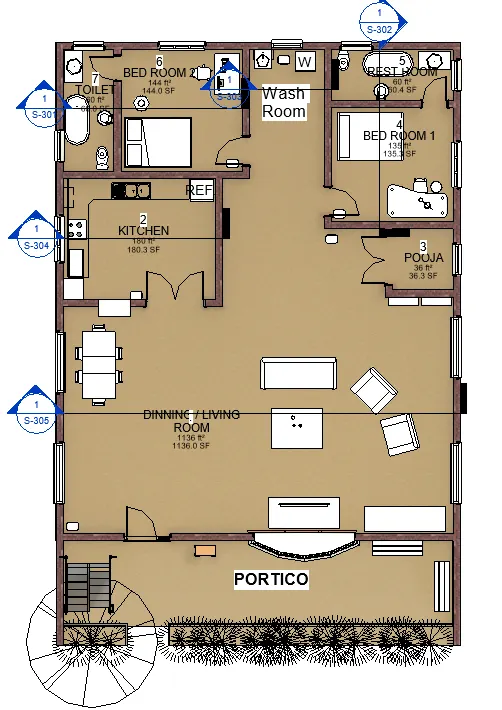
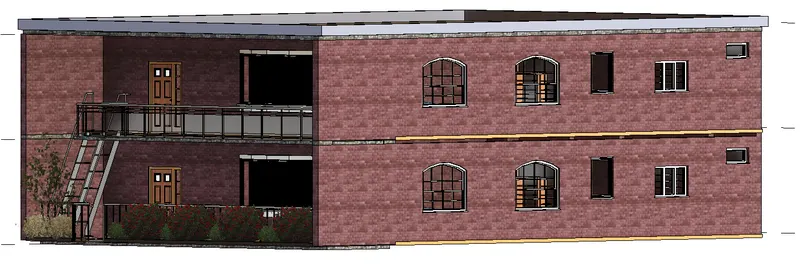
The height of the building in my model is 6.4 m which is less than 15m.
Hence, it follows NBC guidelines.
B. Area Limitations :
C-2.3 PLOT AREA
C-2.3.1 PLOT SIZE :
- As per NBC C-2.3.1, Page no.43
- According to NBC 2005, the minimum plot size with ground coverage not exceeding 75%, shall not be less than 40 sq.m in small and medium town and not less than 30 sq.m in metropolitan area.
- Plot size below 30 sq.m but not less than 15sq.m may be permitted in case of cluster planning.
- However, in such cases the ground coverage and FSI shall be 100 % and 2% respectively
ABOUT MY MODEL :
The area occupied by the building in my model is greater than 40 sq.m .
Floor area of my model is 47'8" x 40'8" i.e 175 sq.m .
Hence, it follows NBC guidelines.
C. Room sizing :
C-3.3 SIZE OF ROOM
As per NBC 2005, C-3.3, Page no 43
C-3.3.1 HABITABLE ROOM :
Every dwelling unit to be provided should have at least have two habitable rooms.
Even if one room house is provided initially it should be capable of adding a new second room in future.
However, in case single room tenements are required to be provided where future additions are not possible, the carpet area of multipurpose single room should be at least 12.5 sq.m.
Such one room dwelling units with 12.5 sq.m carpet area of habitable space is permitted only in case of on site rehabilitation of slum dwellers.
In a house of 2 rooms, first room shall not be less than 9 sq.m with minimum width of 2.5 m and second room shall not be less than 6.5 sq.m with minimum width of 2.1 m provided the total area of both the rooms is not less than 15.5 sq.m
In incremental housing the bigger room shall always be the first room.
ABOUT MY MODEL :
In my model the number of rooms in the building is 4 and the total area of the room is (40.32 sq.m) (38.33 sq.m) = 157.3
Which is greater than the value specified in the code. Hence the building is safe.
D. Wall height :
According to NBC 2005; clause F3.4, the minimum height of rooms and spaces should be :
a) Habitable room - 2.75 m
b) Kitchen room - 2.6 m
c) Bath/ water closet - 2.2m
d) Corridors - 2.1m
In case of sloping roof the average height of roofs for habitable rooms shall be 2.75m and the minimum height at eaves shall be 2.1m.
ABOUT MY MODEL :
In my model all the walls have a height of 3m which is greater than the minimum wall height specified in the code. Hence it is satisfied.
E. Thickness based on fire life and safety :
The thickness for the masonry walls are given by the Table 2 of fire and life safety section of NBC 2005.
ABOUT MY MODEL :
In my model the wall thickness is 8" (203mm) Which is greater than the specified value in the NBC code book. Hence model is safe.
F. Passageway requirements :
Width and Length of Means of access of passageway are given by the table 1 as per the NBC 2005 in clause 4.3
8) This model resembles the actual modeling requirements for Project 1 of course work :