Identification of Cracks
Name: Allan Bryan Jayson Cruz
Course: Master’s Certification Program in High-Rise Building Design & Analysis
Date: March 22, 2022
Course Topic: Analysis and Design of High Rise Buildings using ETABS and Foundation Design using SAFE for Seismic Loads
Challenge 1_Identification of Cracks
********************************************************
1 Aim & Introduction
***************
Aim
This challenge aims to familiarize the student with the different kinds of cracks occurring within a concrete structure subjected to applied loads. This cracks usually occur when the applied loads such as self-weight of structure, live loads, or seismic loads produces a higher force than the structure can withstand. To identify the cracks occurring in a structure is a good practice to distinguish what kind of failure occurred. This will allow the student to create an intelligent method on how to handle or repair the failure to avoid further damage and cost within a project.
Introduction
Cracks in concretes are caused by different phenomenon. These cracks may affect the appearance of the structure or may indicate significant structural distress or lack of durability. This depends on the crack location, type, and its nature. One phenomenon that produces cracks on concrete is the Seismic Loads. These seismic loads challenge the ductility of the reinforced concrete structure by forcing it to deflect into undesirable ways. With this reason, the structure must be designed properly to avoid structural failure. But on unexpected situations occur, methods of repair or handling shall be provided to avoid further damage or loss of life.
********************************************************
2 Question and Answer
********************************************************
Question 1: What is the mode of failure or damage of the beams in the figure shown. Are the damages repairable? Elaborate.
***************
a) 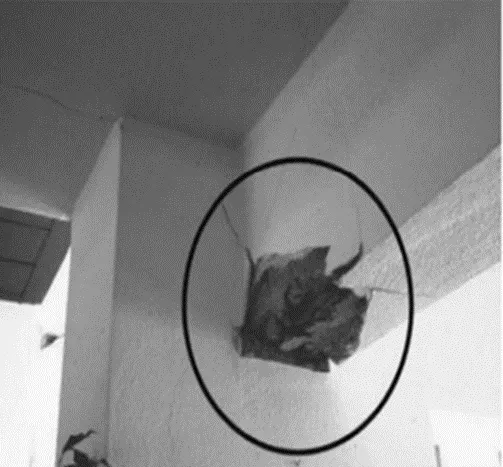
---> Observations
- The bottom of the concrete of beams appeared to be ruptured with its exterior cracked and reiforcements exposed.
- The top part of the beam and the conjunction of the beam and column appears to be safe.
- It is assumed that high tensile forces occur under the beam showing that the bottom reinforcements have yielded and caused the damage to the concrete.
---> Conclusions
- The failure can be classified as a kind of Flexural failure that occurs when stresses are shifted during a seimic event. Since the top portion of the beam are connected to the slab, the acquired compression forces on the top side of the beam can be transfered and dissipated throughout the members. Hence; the top side of the beam is safe.
- During the seismic event, stress reversal occurs allowing the bottom reinforcement of the beam to carry tensile forces as the structure deflects due to the seismic forces. Because of the unexpected event, the bottom beam reinforcement was not designed to withstand such forces hence; yielding of the bottom reinforcements.
---> Are the damages repairable?
Due to yielding of the steel reinforcements, the damage can no longer be repaired as yielded members cannot carry such loads anymore. Retrofitting of the member may be required so that the beam will not collapse if the same loads will occur. A steel plate covering with chemical anchors can be provided at junction to act as secondary reinformcents for the reinfoced concrete beam.
***************
b) 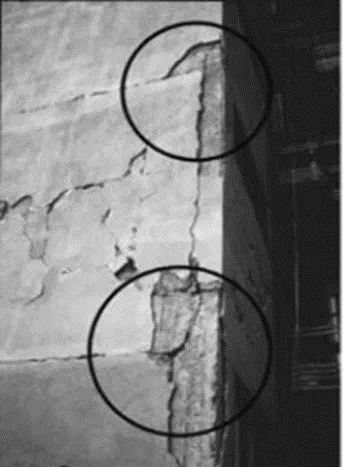
---> Observations
- The cracks occur at the column edges as well as the junction of the beam-column and throughot the structure.
- The cracks shown on the edge of the beam can be assumed as disjointment of the beam member to the column member during the seismic event.
- It is also clear that the cracks may have occured much further throughout the structure as the crack lines are clearly visible from the column onwards.
---> Conclusions
- The failure can be classified as a kind of Anchorage failure on the beam. This kind of failure occur when inadequate anchorage reinforment is provided between the junction of the beam and column. Usually, a development length is provided from the edge of the column following the path of the reinforcement to ensure the stability and connection of the two seperate members after concreting.
- The failure can be also called as Beam pull out failure as the beam is clearly being pulled out from the column. A normal anchorage between a column and a beam member should provide reiforcement bends with enough development length to maintain connectivity during such events.
---> Are the damages repairable?
Since the connectivity of a member relies solely on during the construction phase of the project, this failure will be deemed irreperable. To provide enough connectivity on concrete member joints, a series of clamps in the form of anchor bolts must be provided but will be very difficult as spacing requirement is important to avoid further damaging the concrete members.
***************
c) 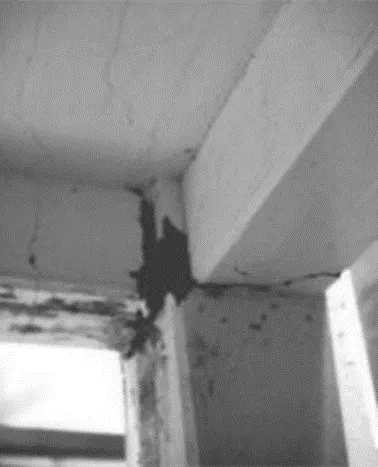
---> Observations
- The cracks occur at the beam-column joint which is represented by the blacked shading on the picture.
- Cracks are also seen around the beam width which travels from the crack at the beam-column joint.
- It can also be observed that the slab member experiences cracking which explains that the tension forces were very large that participation of other structural elements occured.
---> Conclusions
- The failure can be classified as a kind of Plastic Hinge failure. The Plastic hinge failure is a failure that occurs solely on the elastic portion of the structural members which pertains to its joints.
- A form of stress reversal on multiple stories occur that creates a Cyclic lateral loading througout the structure. This happens when lateral deflection occurs on both sides of the plane hence; the large tension that acted through the members.
---> Are the damages repairable?
Since the damage occured at plastic hinges of the structure, this cracks can be repaired as this event is ecpected during the design phase. The structure is designed or configured in a way where undesirable large forces can be transfered into a designated location so that cost and effectiveness of the structure can be achieved without sacrificing any aspects of the structure. Strengthening the joints can done to ensure that the cracks will no longer increase and the bigger capacity can be achieved at the designated location.
********************************************************
Question 2: What is the mode of failure or damage of the beams in the figure shown. Are the damages repairable? Elaborate.
***************
a) 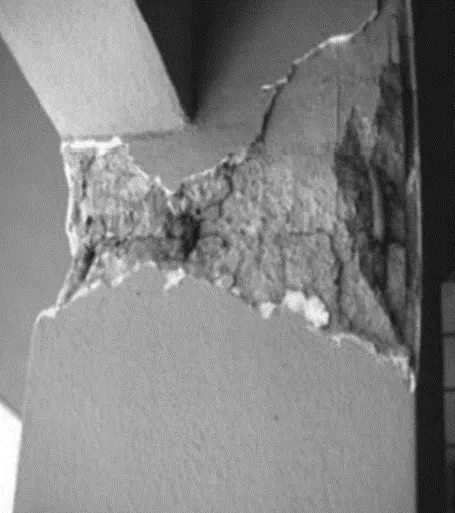
---> Observations
- The cracks occur around the column member only.
- The beam member is unaffected by the damage that has occured.
- The damage on the column seems to be caused by lack of effective force transfer throughout the structure. This can happen when columns are spaced farther away and beams are placed higher for space allocations.
---> Conclusions
- The failure can be classified as a Soft Storey failure or Plastic Hinge Failure.
- Since the column of the structure appear to be spaced at a longer distance than usual for the reason of space allocation possibly below the structure or at ground level, the structure will transfer the support condition of its base to the upper most part of the elastic section.
- In this case, a hollow columns space without infill walls to provide stiffness of the column, transfers its elastic properties on the location just before the rigid section of the structure appears allowing cracks or damages to form just before beam members on the second floor of a building.
- This failure is a usual occurence during a seismic event in a structural buildings that provide large open spaces for parking, recreational area and suchs without considering the stiffnes of the structure as a whole.
---> Are the damages repairable?
This kind of failure depends on the intensity of the damages attained by the column member. As long the column member is intact and no reinforcements have yielded during the seismic event, it can still be repaired and strengten after the event has conducted. But if cracks are severe, where flexural failure or reinforcement yielding is evident on the column, the failure can no longer be repaired.
***************
b) 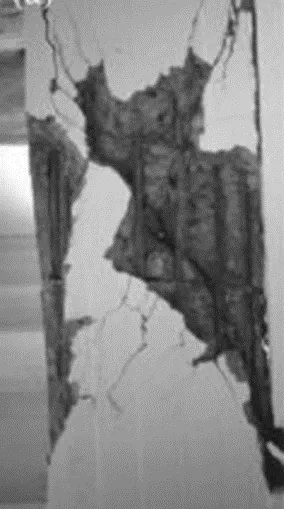
---> Observations
- The column member appears to be completely crushed.
- The direction of the breakage from the lateral location is diagonal which explains that shear forces caused the damages.
- The longitudinal reinforcements of the column appear to be ok as tension forces were not the cause of the damage.
- It is also evident that the a lack of horizontal ties may have caused the breakage on the concrete.
---> Conclusions
- The failure can be classified as a kind of Pure Shear failure.
- When a column lacks horizontal ties to counteract the shear forces that may pass through the column, a diagonal failure will occur from the location of the shear force applied. Without horizontal ties to keep the concrete intact, this will cause the concrete to be brittle as concrete are made to withstand heavy compression forces only.
- The longitudinal bars are also arranged to carry axial forces that is why the reiforcement remained unaffected by the damages that occured.
---> Are the damages repairable?
This failure can be deemed irreperable as increase in the concrete's shear reinforcement can no longer be attained. Also, the concrete is already broken hence; a new structure must be provided to support the remaining parts of the structure which is still intact.
***************
c) 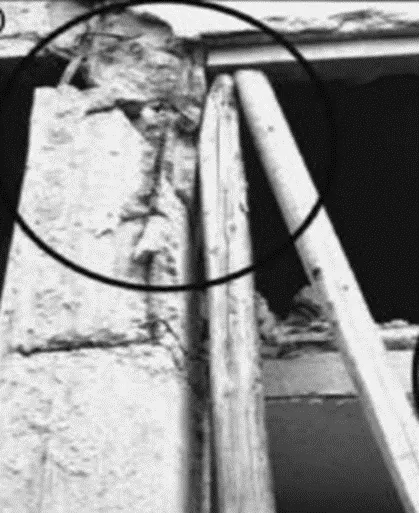
---> Observations
- The failure shows complete disjointment or failure of the column to the top beam member or any structural element above it.
- It appears that the column can no longer carry the forces above hence the additional wood support located on its side. This are treated as temporary supports to avoid collapse of the whole structure on that location.
- The image show the complete inadequacy of the column in strength, stability, and ductility for the structure.
- An intermediate slab can also be seen connected to the column at midheight which can be assumed as an equipment area, mezzanine, loft etc. that serves the same purpose.
---> Conclusions
- The failure can be classified as a kind of Short Column failure.
- This failure occurs when uncalculated forces are applied on a simple column assuming that the addition of said loads will increase the structural integrity.
- By providing the additional beam or slab element on a column without considering its effects in the design, unexpected shear forces may appear on this locations during seismic events that penetrates the weaker side of the column.
---> Are the damages repairable?
This kind of failure can no longer be repaired and a new column must be constructed immediately to avoid the collpase of the structure. A temporary fix may be applied given that the provided fix can carry the loads within the required period.
********************************************************
3 Conclusion
***************
Seismic Loads or Earthquake Loads are unexpected ground movement that produces large horizontal forces on a structure. These large horizontal forces produces large deformation on a structure that may cause severe damage that can be identified by cracks.
Concrete is a very brittle element that can withstand heavy compression forces. With the combination of steel reinforcements, the concrete is allowed to deform at a certain limit without severe strength loss or failure. This gives the concrete the ability to withstand tensile forces produced by horizontal loads from unexpected events.
Aside from the combination of steel and concrete, a structure must also attain the following to ensure its resistance to such loadings:
- Good Structural Configuration
- Lateral Stiffness
- Lateral Strength
- Good Overall Ductility
By providing these characteristics in a concrete, a structure will be able to withstand greater force than the designed forces without collapsing or inducing heavy damage which are irreperable.
Even with a good design and an effective earthquake resistance is provided, failures may still occur on undesirable locations because of different reasons. The ability to identify this failures must be attained by an Engineer so that the correct repair methods may be prepared to totally avoid further damages at minimum costs and time.