Project on Concrete Mix Design for various grades of Concrete
Name: Allan Bryan Jayson Cruz
Course: Master’s Certification Program in High-Rise Building Design & Analysis
Date: August 0, 2021
CONCRETE MIX DESIGN FOR VARIOUS GRADES OF CONCRETE
PROJECT
I. INTRODUCTION
Concrete
Concrete is a composite building material made by mixing cement, fine aggregates, coarse aggregates, and water in definite proportions which are cured and then hardened to form a mass like substance. Concrete is widely used in the construction industry as they act as a strong building material especially when combined with steel materials called reinforcements.
The concrete ingredients have individual properties that contribute to the strength, durability, and workability of fresh as well as hardened concrete. These materials are chosen carefully and proportioned using the process of concrete mix design. The proper proportioning of the concrete ingredients is very important to attain the desired strength and performance of a concrete material.
In a concrete mix, the cement, fine aggregates (usually sand), and coarse aggregates (usually crushed stones), and water are mixed together. When water is poured into the mix, a hydration process occurs. Hydration process is when water is added to cement forming a substance called cement-paste. This cement-paste acts as a binding material that hardens and binds all the concrete materials together. Water is an important ingredient in the creation of concrete. It reacts with cement and provides the workability of concrete that decides the proportion of water used in the mixture called the water-cement ratio. The lower the w/c ratio is, the higher the strength.
Concrete Mix Design
Concrete mix design is a systematic process of choosing economical relative proportion of various ingredients from available material that gives desired workability. It is also a step by step procedure in determining water-cement ratio, water content, estimation of coarse aggregate and fine aggregate content done in a laoratory with materials to be used. The concrete mix design is a process of selecting suitable ingredients for producing concrete of required strength, durability, and workability as economical as possible.
The concrete mix design decides the compressive strength of concrete that depends on the individual quality of concrete ingredients, the quantity of cement, quantity of water, quantitiy of aggregates, the mixing process, batching procedure, placing method, compaction percentage, and curing time. The main objective of the concrete mix design is to predetermine the compressive strength of the concrete in the most economical manner.
A good concrete mix design has the following qualities:
- Meets the strength requirement of the structure in terms of compressive strength.
- Fullfills the durability requirement of concrete.
- The concrete should be mixed, transported, and easily compacted.
- The concrete mix should be economical.
The concrete mix design is divided into 3 categories namely a) Nominal mix, b) Standard mix, and c) Designed mix. In this project, designed mix is conducted since nominal and standard mix is only available for concrete with grade of M25 and below.
Nominal mix is where materials are prescribed as per standard specifications. Their proportions are specified in the ratio cement to aggregate to attain required strength. This kind of mix is adapted for ordinary concrete based on past imperical calculations whose grade does not exceed M20.
Standard mix is where the minimum compressive strength of concrete is specified. The standard mix is described in IS 456:2000 such as M10, M15, M20, M25, M30, and M40.
Designed mix is where the mix design of concrete is designed and calculated by a structural engineer and the proportions are decided by the concrete producer. The mix proportionis designed according to workability, strength, etc., where certain specifications are considered.
Aim of this Project
The aim of this project is to provide the steps and procedure in calculating the design mix. In this project, 2 tests will be conducted where in item #1, the method and and steps in calculating the mix proportion of an M35 grade of concrete with fly ash content and item #2 is to calculate and describe the mix proportion of a M50 grade of concrete. The purpose of this paper is to determine the different steps to consider in the calculation of mix design where multiple considerations are applied such as placing method, water-cement ratio, etc. This paper also aims to show how to introduce different substances to the concrete mix such as fly ash. The calculation method and parameters considered are describe in the procedure and test conducted in this project.
*************************************************
II. TEST PROCEDURES
A. Data Gathering
The following data are required to perform the calulations for the design mix proportion of the designated grade as described in Section 9.1.2 of IS 456:2000.
- Grade of Concrete
- Maximum Nominal Size of Aggregate
- Minimum Cement Content
- Maximum Water-Cement Ratio
- Workability (In terms of Slump - usually acquired from Slump Cone Test or Code Specification)
- Exposure Condition
- Maximum Temperature of concrete at the time of placing
- Grading Zone of Aggregate
- Type of Aggregate (Aggregate should be Angular)
- Maximum Cement Content
- Admixture Used
- Specific Gravity of all Materials
- Moisture Content (Free)
B. Calculation Procedure
1. Obtain the Mean Strength of Concrete
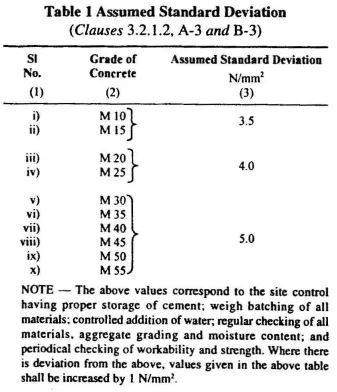
Target mean compressive strength of concrete at 28 days, f'ck = fck + 1.65 S
Where: fck = The compressive strength at 28 days
S = Standard Deviation (Table 1 of IS 10262:2009)
2. Selection of Water-Cement Ratio
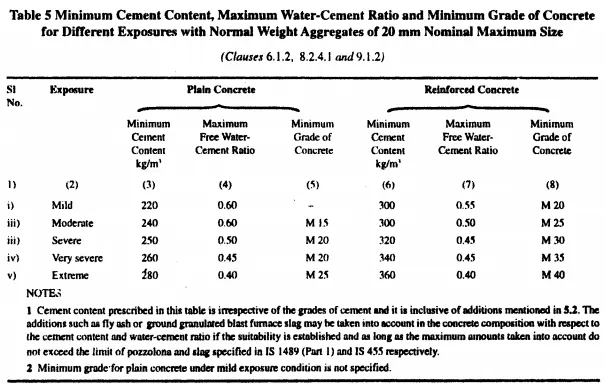
Water-Cement Ratio is obtained from the Table 5 of IS 456:2000.
In this criteria, the exposure condition used in the given calculation governs the selection as the cement content given in the table is irrespective of the grades of cement.
The table is divided into two categories which is described by Plain Concrete and Reinforced Concrete. Plain Concrete are low strength concretes whose grade does not exceed M25 while Reinforced concrete are concrete with steel components mixed in to form a substance strong both in tension and compression forces. The grades of reinforced concrete usually start from M20 onwards.
3. Selection of Water Content
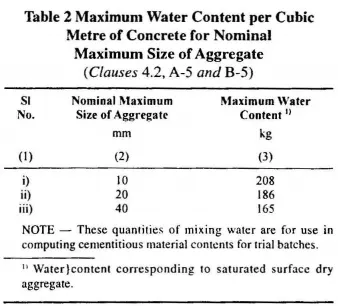
Water content is selected from Table 2 of IS 10262:2009 with specifications from Section 4.2.
The nominal maximum size of aggregate is considered for this selection. Upon selection of the maximum water content, the slump value or workability of concrete is also considered as the values given in the table is only for angular coarse aggregates with slump value of 25mm to 50mm. For desired workability (other than 25 to 50mm slump range), the required water content may be established by 3% for every additional 25mm slump. This water content value corresponds to the saturated surface of dry aggregate.
4. Calculation of Cementitious Material Content
For the calculation of the mass of cement, the main criteria is the water content (which is given in step 3), and the water-cement ratio (which is given in step 2). The water-cement ratio should conform to the desired codes or requirements given in design.
Example:
Water Content for 20mm Nominal Maximum Size Aggregate with 50mm slump = 186kg
Water-cement ratio for an moderate exposure condition = 0.5
Cement Content = 186 / 0.45 = 372kg
5. Volume of Coarse Aggregate and Fine Aggregate
The proportioning of the volume of aggregates can be determined from Table 3 of IS 10262:2009. The grading zone of fine aggregate and the nominal maximum size of aggregates are required to determine the volume of coarse aggregate per unit volume of total aggregates. The table values are based on aggregates in saturated surface dry condition.
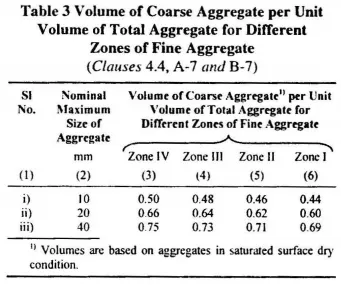
Once the volume of coarse aggregate is determined, other factors are considered such as water-cement ratio and placing method of concrete. The values given in the table is for water-cement ratio of 0.5. If the current water-cement ratio differs from this value, the volume of coarse aggregate will be adjusted with a rate of (+,-)0.01 for every (+,-)0.05 change in the water-cement ratio.
6. Mix Calculation
The mix per unit volume of concrete is calculated and listed as below.
- Volume of Concrete = 1 cu.m
- Volume of Cement = (Mass of Cement / Specific Gravity of Cement) x (1/1000)
- Volume of Water = (Mass of Water / Specific Gravity of Water) x (1/1000)
- Volume of Chemical Admixture = (Mass of Chemical Admixture / Specific Gravity of Chemical Admixture) x (1/1000)
- Total Volume of Aggregates (Fine Aggregates + Coarse Aggregates) = [a - [b + c + d)]
- Mass of Coarse Aggregates = e x V.Ca x SG.Ca x 1000
- Mass of Fine Aggregates = e x V.Fa x SG.Fa x 1000
Legend:
V.Ca = Volume of Coarse Aggregates (Calculated from step 5)
SG.Ca = Specific Gravity of Coarse Aggregates
V.Fa = Volume of Fine Aggregates (Calculated from step 5)
SG.Fa = Specific Gravity of Fine Aggregates
7. Mix Proportion
The mass of each individual concrete material is the listed as described below.
- Cement = ( ) kg/cu.m
- Water = ( ) kg/cu.m
- Fine Aggregates = ( ) kg/cu.m
- Coarse Aggregates = ( ) kg/cu.m
- Chemical Admixtures = ( ) kg/cu.m
- Water-Cement Ratio = ( ) kg/cu.m
8. Mix Ratio
The mix ratio describes the proportion of cement to fine aggregates to coarse aggregates that makes up a concrete substance.
To calculate the mix proportion of coarse and fine aggregates, their individual mass is divided by the total mass of cementitious material content.
The mix ratio is as follows;
Cement : Fine Aggregate : Coarse Aggregate
ex. 1 : 2 : 3
This will be designated as mix proportion for trial 1. To assure that the desired strength is achieved, steps 9 and 10 should be followed thoroughly.
9. The slump shall be measured and the water content and dosage of admixture shall be adjusted for achieving the required slump on trial. The mix proportions shall be reworked for the actual water content and check for durability requirements.
10. Two more trials having variations of 10% of water-cement ratio in step 9 shall be carried out and a graph between three water-cement ratios and corresponding strengths shall be plotted to work out the mix proportions for the given target strength for field trials. However, durability shall be met.
*************************************************
III. TEST
A.) MIX DESIGN FOR M35 GRADE CONCRETE WITH FLY ASH
A.1 Stipulations of Proportions
- Grade Designation : M35
- Type of Cement : OPC 43 Grade (IS 8112)
- Type of Mineral Admixture : Fly Ash (IS 3812 - Part 1) ; 30% partial replacement of cement by fly ash
- Max Nominal Size of Aggregate : 20mm (Zone I)
- Minimum Cement Content : 340 kg/m^3 (Table 5 of IS 456:2000)
- Maximum Water-Cement Ratio : 0.45 (Table 5 of IS 456:2000)
- Workability : 100mm (Slump Value for Pumpable Concrete - Section 7.1 of IS 456:2000)
- Exposure Condition : Very Severe (Reinforced Concrete)
- Method of Concrete Placing : Pumping
- Degree of Supervision : Good
- Type of Aggregate : Crushed Angular Aggregate
- Maximum Cement Content : 450 kg/m^3
- Chemical Admixture Type : Superplasticizers
A.2 Test Data for Materials
- Cement = OPC 43 Grade (IS 8112)
- Specific Gravity of Cement = 3.15
- Fly Ash (IS 3812 - Part 1)
- Specific Gravity of Fly Ash = 2.2
- Chemical Admixture = Superplasticizers (IS 9103) ; Specific Gravity = 1.2
- Specific Gravity of Aggregates :
- Fine aggregates = 2.74
- Coarse aggregates = 2.74
- Water Absorption :
- Fine aggregates = 0.5%
- Coarse aggregates = 1.0%
- Free Surface Moisture : Aggregate should be in dry condition
- Fine aggregates = Nil
- Coarse aggregates = Nil
- Sieve Analysis :
- Fine aggregates = Table 2 of IS 383
- Coarse aggregates = Table 4 of IS 383
A.3 Target Strength for Mix Proportioning
Target mean compressive strength at 28 days, f'ck = fck + 1.65 S
Where: fck = The compressive strength at 28 days = 35 N/mm^2
S = Standard Deviation (Table 1 of IS 10262:2009) = 5.0 N/mm^2
f'ck = 50 + 1.65 x 5.0 = 43.25 N/mm^2
A.4 Selection of Water-Cement Ratio
Exposure condition = Very Severe
Type of Concrete = Reinforced Concrete
By conforming to Table 5 of IS 456:2000;
Water-Cement Ratio = 0.45
A.5 Selection of Water Content
1. Consider Nominal Maximum Size of Aggregate = 20mm
By conforming to Table 2 of IS 10262:2009; Maximum Water Content = 186kg
2. Consider Slump Value = 100mm
Note: Table 2 of IS 10262:2009 is for angular coarse aggregate with 25 to 50mm slump range. For other slump values. an increase by 3% in water content occurs for every 25mm slump difference.
Water Content = 186kg + 186 x 3% x (100-50)/25 = 197.16kg
3. Consider Chemical Admixture = Superplasticizers
Note: This admixture can reduce the water content up to 20% and above.
Water Content = 197.16 x (100-20)% = 157.73kg
Water Content = 160kg or 160litres
A.6 Calculation of Cement Content
1. Consider Water-Cement Ratio = 0.45
Water Content = 160kg (From A.5)
Minimum Cement Content = 340kg
Maximum Cement Content = 450kg
Cement Content = 160/0.45 = 355.56kg > 340kg ; Ok
2. Consider additional Fly Ash content
a. Percentage of fly ash needs to be decided based on project requirement and quality of materials.
b. In some cases, increase in cementitious material can be warranted. Increase in cementitious material content and its percentage may be based on trial and experiences.
Note: In this calculation, an increase of 10% in cementitious material content is applied.
- Cementitous Material Content = 355.56 x 1.1 = 391.12kg
- Water Content = 160kg
- Water-Cement Ratio = 160/391.12 = 0.409
- Fly Ash Content (30% of Cementitious Material) = 391.12 x 0.3 = 117.34kg
- Cement Content = 391.12 - 117.34 = 273.78kg
- Chemical Admixture = 0.6% mass of cementitious content = 391.12 x .006 = 2.35kg
c. Data summary
Cement Content = 273.78kg; say 275kg
Fly Ash Content = 117.34kg; say 118kg
Chemical Admixture (Superplasticizers) = 2.35kg
A.7 Proportion of Volume of Coarse & Fine Aggregate
1. Consider nominal maximum size of aggregate and water-cement ratio = 0.45 as per Table 3 of IS 10262:2009
Nominal Maximum Size of Aggregate = 20mm
Fine Aggregate Zone = Zone I
By conforming to Table 3 of IS 10262:2009; Volume of Coarse Aggregate = 0.60
2. Consider actual water-cement ratio = 0.45
Note: As w/c ratio is lower by 0.1, the proportion of volume of coarse aggregate is increased by 0.02 (Rate of (+,-)0.01 for every (+,-)0.05 change in w/c ratio).
Volume of Coarse Aggregate = 0.6 + (0.5-0.45) x (0.01/0.05) = 0.61
3. Consider method of placing concrete = Pumping
Note: For pumpable concrete, volume of coarse aggregate is usually reduced by 10%.
Volume of Coarse Aggregate = 0.61 x (100-10)% = 0.55
Volume of Fine Aggregate = 1.0 - 0.55 = 0.45
A.8 Mix Calculations
a) Volume of Concrete = 1.0 cu.m
b) Volume of Cement = 275/3.15 x 1/1000
= 0.087 cu.m
c) Volume of Fly Ash = 118/2.2 x 1/100
= 0.054 cu.m
d) Volume of Water = 160/1.0 x 1/1000
= 0.16 cu.m
e) Volume of Chemical Admixture = 2.35/1.2 x 1/1000
= 0.002 cu.m
f) Volume of Aggregates (F.A. & C.A.) = [a - (b +c +d + e)]
= [1.0 - (0.087 + 0.054 + 0.16 + 0.002)]
= 0.697 cu.m
g) Mass of Coarse Aggregate = 0.697 x 0.55 x 2.74 x 1000
= 1050 kg/cu.m
h) Mass of Fine Aggregate = 0.697 x 0.45 x 2.74 x 1000
= 860 kg/cu.m
A.9 Mix Proportions for Trial 1
- Cement = 275 kg/cu.m
- Fly Ash = 118 kg/cu.m
- Water = 160 kg/cu.m
- Fine Aggregates = 860 kg/cu.m
- Coarse Aggregates =1050 kg/cu.m
- Chemical Admixture = 2.35 kg/cu.m
- Water-Cement Ratio = 0.409 (From A.6 Calculation)
Trial Mix Ratio = Cement & Fly Ash : Fine Aggregate : Coarse Aggregate
= 1 : 2.19 : 2.67
A.10 The slump shall be measured and the water content and dosage of admixture shall be adjusted for achieving the required slump on trial. The mix proportions shall be reworked for the actual water content and check for durability requirements.
A.11 Two more trials having variations of 10% of water-cement ratio in Section A.10 shall be carried out and a graph between three water-cement ratios and corresponding strengths shall be plotted to work out the mix proportions for the given target strength for field trials. However, durability shall be met.
B.) MIX DESIGN FOR M50 GRADE CONCRETE
B.1 Stipulations of Proportions
- Grade Designation : M50
- Type of Cement : OPC 43 Grade (IS 8112)
- Max Nominal Size of Aggregate : 20mm (Zone I)
- Minimum Cement Content : 360 kg/m^3 (Table 5 of IS 456:2000)
- Maximum Water-Cement Ratio : 0.4 (Table 5 of IS 456:2000)
- Workability : 100mm (Slump Value for Pumpable Concrete - Section 7.1 of IS 456:2000)
- Exposure Condition : Extreme (Reinforced Concrete)
- Method of Concrete Placing : Pumping
- Degree of Supervision : Good
- Type of Aggregate : Crushed Angular Aggregate
- Maximum Cement Content : 450 kg/m^3
- Chemical Admixture Type : Superplasticizers
B.2 Test Data for Materials
- Cement = OPC 43 Grade (IS 8112)
- Specific Gravity of Cement = 3.15
- Chemical Admixture = Superplasticizers (IS 9103)
- Specific Gravity of Aggregates :
- Fine aggregates = 2.74
- Coarse aggregates = 2.74
- Water Absorption :
- Fine aggregates = 0.5%
- Coarse aggregates = 1.0%
- Free Surface Moisture : Aggregate should be in dry condition
- Fine aggregates = Nil
- Coarse aggregates = Nil
- Sieve Analysis :
- Fine aggregates = Table 2 of IS 383
- Coarse aggregates = Table 4 of IS 383
B.3 Target Strength for Mix Proportioning
Target mean compressive strength at 28 days, f'ck = fck + 1.65 S
Where: fck = The compressive strength at 28 days = 50 N/mm^2
S = Standard Deviation (Table 1 of IS 10262:2009) = 5 N/mm^2
f'ck = 50 + 1.65 x 5 = 58.25 N/mm^2
B.4 Selection of Water-Cement Ratio
Exposure condition = Extreme
Type of Concrete = Reinforced Concrete
By conforming to Table 5 of IS 456:2000;
Water-Cement Ratio = 0.4
B.5 Selection of Water Content
1. Consider Nominal Maximum Size of Aggregate = 20mm
By conforming to Table 2 of IS 10262:2009; Maximum Water Content = 186kg
2.Consider Slump Value = 100mm
Note: Table 2 of IS 10262:2009 is for angular coarse aggregate with 25 to 50mm slump range. For other slump values. an increase by 3% in water content occurs for every 25mm slump difference.
Water Content = 186kg + 186 x 3% x (100-50)/25 = 197.16kg
3. Consider Chemical Admixture = Superplasticizers
Note: This admixture can reduce the water content up to 20% and above.
Water Content = 197.16 x (100-20)% = 157.73kg
Water Content = 160kg or 160litres
B.6 Calculation of Cement Content
Water-Cement Ratio = 0.4
Water Content = 160kg (From B.5)
Minimum Cement Content = 360kg
Maximum Cement Content = 450kg
Cement Content = 160/0.40 = 400kg > 360kg ; Ok
Chemical Admixture is 0.6% mass of cement = 400 x 0.006 = 2.4kg
B.7 Proportion of Volume of Coarse & Fine Aggregate
1. Consider nominal maximum size of aggregate and water-cement ratio = 0.4 as per Table 3 of IS 10262:2009
Nominal Maximum Size of Aggregate = 20mm
Fine Aggregate Zone = Zone I
By conforming to Table 3 of IS 10262:2009; Volume of Coarse Aggregate = 0.60
2. Consider actual water-cement ratio = 0.40
Note: As w/c ratio is lower by 0.1, the proportion of volume of coarse aggregate is increased by 0.02 (Rate of (+,-)0.01 for every (+,-)0.05 change in w/c ratio).
Volume of Coarse Aggregate = 0.60 + (0.5-0.40) x (0.01/0.05) = 0.62
3. Consider method of placing concrete = Pumping
Note: For pumpable concrete, volume of coarse aggregate is usually reduced by 10%.
Volume of Coarse Aggregate = 0.62 x (100-10)% = 0.56
Volume of Fine Aggregate = 1.0 - 0.56 = 0.44
B.8 Mix Calculations
a) Volume of Concrete = 1.0 cu.m
b) Volume of Cement = 400/3.15 x 1/1000
= 0.127 cu.m
c) Volume of Water = 160/1.0 x 1/1000
= 0.16 cu.m
d) Volume of Chemical Admixture = 2.4/1.2 x 1/1000
= 0.002 cu.m
e) Volume of Aggregates (F.A. & C.A.) = [a - (b +c +d)]
= [1.0 - (0.127 + 0.16 + 0.002)]
= 0.711 cu.m
f) Mass of Coarse Aggregate = 0.711 x 0.56 x 2.74 x 1000
= 1091 kg/cu.m
g) Mass of Fine Aggregate = 0.711 x 0.44 x 2.74 x 1000
= 857 kg/cu.m
B.9 Mix Proportions for Trial 1
- Cement = 400 kg/cu.m
- Water = 160 kg/cu.m
- Fine Aggregates = 857 kg/cu.m
- Coarse Aggregates =1091 kg/cu.m
- Chemical Admixture = 2.40 kg/cu.m
- Water-Cement Ratio = 0.4
Trial Mix Ratio = Cement : Fine Aggregate : Coarse Aggregate
= 1 : 2.14 : 2.73
B.10 The slump shall be measured and the water content and dosage of admixture shall be adjusted for achieving the required slump on trial. The mix proportions shall be reworked for the actual water content and check for durability requirements.
B.11 Two more trials having variations of 10% of water-cement ratio in Section A.10 shall be carried out and a graph between three water-cement ratios and corresponding strengths shall be plotted to work out the mix proportions for the given target strength for field trials. However, durability shall be met.
*************************************************
IV. RESULTS SUMMARY AND OBSERVATIONS
A. Summary of Results
A.1 Design Mix Proportion for M35 Grade Concrete with Fly Ash
Design Mix = Cement : Fine Aggregate : Coarse Aggregate
= 1 : 2.19 : 2.67
Proportions are listed below:
- Cement = 275 kg/cu.m
- Fly Ash = 118 kg/cu.m
- Water = 160 kg/cu.m
- Fine Aggregates = 860 kg/cu.m
- Coarse Aggregates =1050 kg/cu.m
- Chemical Admixture = 2.35 kg/cu.m
- Water-Cement Ratio = 0.409 (From A.6 Calculation)
A.2 Design Mix Proportion for M50 Grade Concrete
Design Mix = Cement : Fine Aggregate : Coarse Aggregate
= 1 : 2.14 : 2.73
Proportions are listed below:
- Cement = 400 kg/cu.m
- Water = 160 kg/cu.m
- Fine Aggregates = 857 kg/cu.m
- Coarse Aggregates =1091 kg/cu.m
- Chemical Admixture = 2.40 kg/cu.m
- Water-Cement Ratio = 0.4
B. Observations
By analyzing the results, we can observe that the design mix proportion for an M35 Grade Concrete with Fly Ash under very severe exposure condition has almost the same design mix of an M50 grade concrete under extreme exposure condition.
Although the strength provided by the 2 samples are different, proportion of cementitious material to fine and coarse aggregates for both test may be similar in value. This is because in the calculation of the M35 grade of concrete, a percent increase in the weight of the cementitious material is made due to the addition of fly ash. The mass may be of the same value but the quality and content will still vary. This is the reason additional test of concrete is still made even after designing the mix propotion. Certain factors will affect the workability, durability, and strength of concrete.
Aside from this, we can observe that the calculated water-cement ratio as per codal specification is followed for M50 grade concrete while in the M35 grade of concrete with fly ash, a new water-cement ratio was used. This is due to the additional volume of cementitious material introduced in the mix. The water content and the water-cement ratio of a concrete material contributes greatly to the strength and durability of concrete that is why any changes on the composition of the concrete, this value must also be reevaluated.
*************************************************
V. CONCLUSION
Finally, this project depicts the step to calculate and determine the design mix proportion of a concrete grade with no standard mix. The mix design is an important part of the construction community in order to achieve more complex, more durable, and stronger structures that require these kind of characteristics. The addition of other elements in the concrete mix is also viable to improve the concrete itself. Numerous test and thesis are coducted to determine the specific effects an outside substance can provide to the mix. These materials are like the chemical admixtures added in the concrete mix that ehances a specific property of the concrete such as workability, setting time, etc.
Other substances like fly ash, pound ash, bottom ash, etc, also contributes to some characteristics of concrete. These materials particularly contribute to the cement content of the concrete. Cement is a very expensive material, hence, test to reduce or replace some part of this substance are made. The fly ash, particularly, can replace 30% of the cement's mass which helps in reducing the cost of the whole construction itself.
To sum up, the very essence of mix design shines in the cultivation of stronger and bigger structures. The demand in stronger concrete material will increase in future. A strong concrete structure will keep the people of the industry safe from any disaster and in the future, it will also save the construction cost. The proper design mix of concrete is very important to achieve this kind ideas. In the view of a structural engineer, the mix proportion is one of the most important backbone of a quality structure.