Identification of Cracks
AIM:
To assess the type, cause and feasible rectification for the given structural issues based on the following building photos.
Before going in to the assessment, it is better to first distinguish the terms, a Damage and a Failure of a structure.
Damage of a Structure: A damage can occur in a structural frame or an element prior to its complete collapse of the element/structure. A damage is definitely repairable until no serious effects taking place within the building. (e.g.) Spalling of concrete, Damages due to minor Mechanical impact, sudden shocks, vibrations and minor earthquakes are possibly repairable based on its severity.
Failure of a Structure: A Failure of structure occur once it exceeds ultimate limit state. Failure of a structure or an element means it loses its ability to be a part of the structural system. Failures often cannot be repairable with the original component. Yet there are rare scenarios where we can repair/replace a failed component to continue functioning of the building. Now, let us assess the following Structural issues.
1(a)
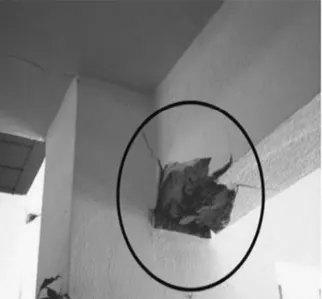
Type of Issue: Damage
Observation: At a Column Beam junction, the concrete portions are ruptured at the Beam bottom. We could see no severe issues developing in Column zone. Reinforcements are seemed to be intact.
Reasoning:
- The beam may have reached its compressive stress limit at Support and thereby ruptured (Technically, A beam will experience Tensile stress at Support top and Compressive stress at Support bottom).
- Or the structure might have been exposed to a Lateral force, due to which A plastic hinge forms at the Beam joint during reversal of forces.
- Or the beam portion might have been damaged due to any accident.
Rectification: Since the reinforcements are intact, The loss of concrete shall be replaced by patching with the same or higher grade of concrete. The structure may be reanalyzed for the latest design requirement and design capacity of compression face of beam shall be ensured.
1(b)
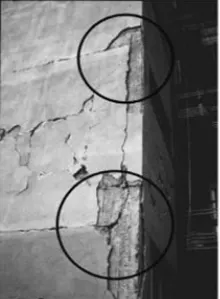
Type of Issue: Non-repairable Failure
Observation: First of all, this building looks older. At All Column Beam junctions, the connections were completely cracked and broken in both the levels. Reinforcements are seemed to be intact. Partition walls are damaged in one level.
Reasoning:
- The beams look stronger as there was no scope of failure or a warning is visible in Beam elements.
- The concrete collapsed at all connections where the capacity of column might not be adequate to the requirement.
- This resembles “Week Column-Strong Beam” concept.
Rectification: Prima facie, there seems no rectifications or repair available for this Failure. Even though there are advanced repair methods available like concrete injection, the quality of reinforcements at connections should be ensured before any concrete repairs.
1(c)
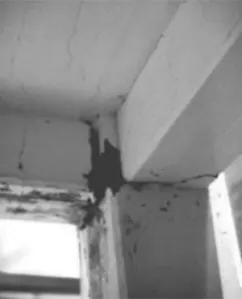
Type of Issue: Damage
Observations: The beams are showing no severe collapse warning (But random cracks are visible). The column portion visible in the photo also gives no collapse sign. The slabs are cracked. Concrete portions are broken at connection.
Reasoning:
- We can conclude this damage was not due to Gravity loads, as in Gravity effect, Column beam connections are rarely failing.
- Any earthquake could have affected the building wherein it exposed to heavy sway shear. Due to sway shear effects, the connections are prone to fail.
Rectification: Since the column and Beam are safe for further functionality, the connection can be strengthened by knowing revised design requirements.
2(a)
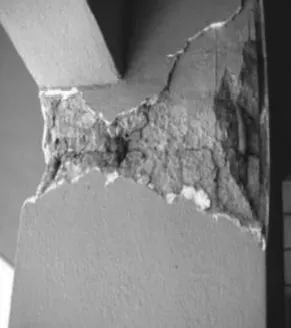
Type of Issue: Non-repairable Failure
Observations: There is no data available to predict beam response. The column is partly crushed and column reinforcements are slightly bent.
Reasoning:
- This is an Exterior column which may be subjected to more sway during lateral force. The bending reinforcements are also suggesting the participation of lateral forces in the failure.
Rectification: Once the reinforcements are bent or damaged or rusted, There is no possibility of repairing the reinforcement (tensile repair is not viable). But concrete may be patched to satisfy the compressive design requirement.
2(b)
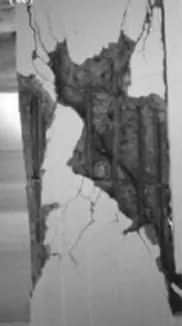
Type of Issue: Non-repairable Failure
Observations: It is very clear the concrete crushed to the core. Bu the reinforcements are not buckled and not bent.
Reasoning:
- Reinforcements are not bent. So there must not be any involvement of Flexure.
- Concrete crushed diagonally from one edge to the other edge perfectly shows pure shear failure in the column.
- It can not be predictable whether the shear failure occurred due to gravity load or lateral load.
Rectification: The aged concrete is completely crushed. There is no possibility to reconstruct the entire column without affecting the adjacent frame load paths.
2(c)
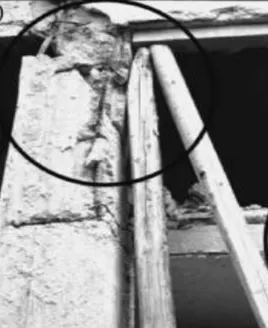
Type of Issue: Non-repairable Failure
Observations: It seems the column crushed during the construction stage itself. No partition walls are laid. The concrete completely crushed and reinforcements are bent. We could see temporary props are provided to support the adjacent beams.
Reasoning:
- Reinforcements are bent and so there should be involvement of Flexure for the failure of column.
- The concrete is totally collapsed nearby joint. This suggests weak design and detailing of Column critical location.
Rectification: The deviated reinforcements are very difficult to reposition. This gives no feasible option to strengthen or to re-functioning of column.
Conclusion:
Thus we have assessed the given building structural issues and elaborated the causes and feasible repair options.