Calculation of Stiffness in Structural elements
Answer for Question-1:
Aim: To compute lateral stiffness of one storey building with the given parameters.
Basic formulas of stiffness coefficient of Beams and frames:
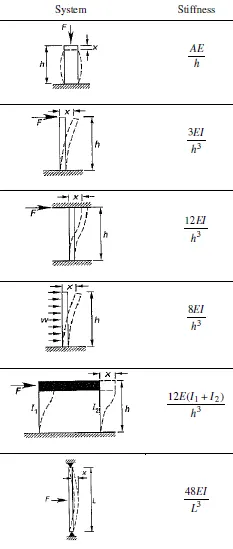
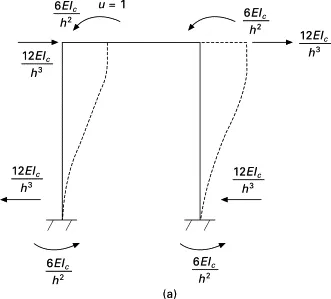
Steps:
1. Let us assume three different cases to apply for each degree of freedom.
`K_11`where first number denotes node of degree of freedom. second number denotes the node of unitary value. K is stiffness coefficient.
2. as in Case-1, we will apply unitary displacement in `u_1`node and remaining degrees of freedom `u_2`and `u_3`are zero. we will get following free body diagram.
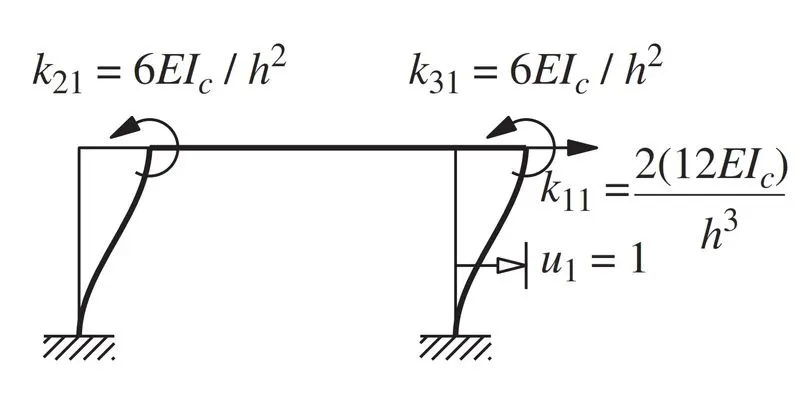
the equation of motion for the case-1 is as follow
`(24EI_c)/h^3``u_1`+ `(6EI_c)/h^2 u_2`+ `(6EI_c)/h^2 u_3`= `f_s`
3. as in case-2, we will apply unitary rotation in `u_2`node and remaining degrees of freedom `u_1 and u_3`are zero. we will get following free body diagram.
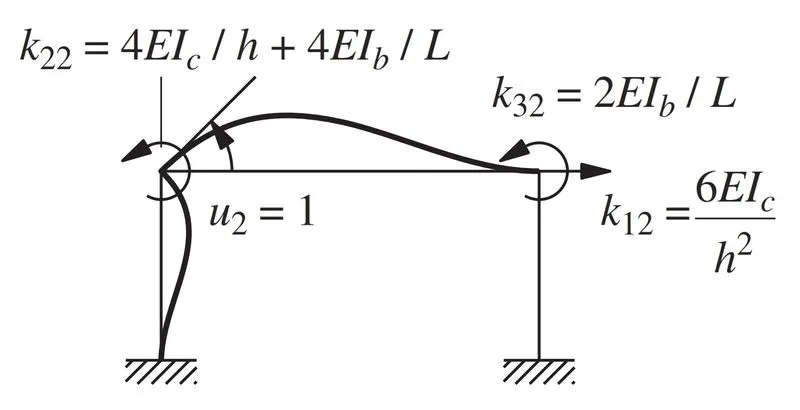
the equation of motion for case-2 is as follow
`(6EI_c)/h^2 u_1 + ((4EI_c)/h + (4EI_b)/(2h)) u_2 + (2EI_b)/(2h) u_3 = 0`
4. as in case-3, we will apply unitary rotation in `u_3`node and remaining degrees of freedom `u_1 and u_2`are zero. the free body diagram is simply reverse of as that of in case-2.
the equation of motion for case-3 is as follow
`(6EI_c)/h^2 u_1 + (2EI_b)/(2h) u_2 + ((4EI_c)/h + (4EI_b)/(2h)) u_3 = 0`
`EI_c = EI_b`so, while forming 3x3 matrix for the set of equations,
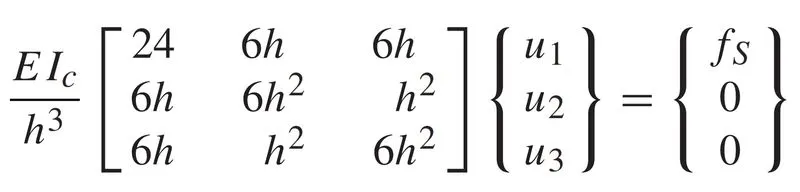
5. by using static condensation method, the values of degrees `u_2 and u_3`in terms of `u_1`can be identified as follow
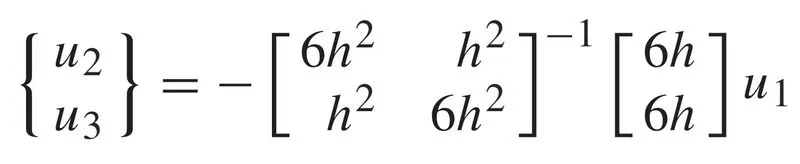
which will result in `[[u_2],[u_3]] = -6/(7h) [[1],[1]] u_1`
6. if we apply the above equation in the first equation of motion,
`(24EI_c)/h^3 u_1 - (EI_c)/h^3 [[6h,6h]] [[1],[1]] 6/(7h) u_1 = f_s`
`f_s = (24EI_c)/h^3 u_1 - ((EI_c)/h^3 * 12h* 6/(7h) u_1)`
`f_s = u_1((24EI_c)/h^3 - (72EI_c)/(7h^3))`
`= 96/7 (EI_c)/h^3 u_1`
Where k = `96/7 EI_c/h^3`
Thus, we arrived the lateral stiffness coefficient and substitued in the equation of motion as well.
Answer for Question-2:
Aim: To find number of degrees of freedoms, to establish the equation of motion and to calculate natural frequencies for the given system.
System (a):
As the vertical member is connected to an infinite stiffer beam, the number of degrees of freedom will be = 2, as depicted below (`u_1 and u_2`)
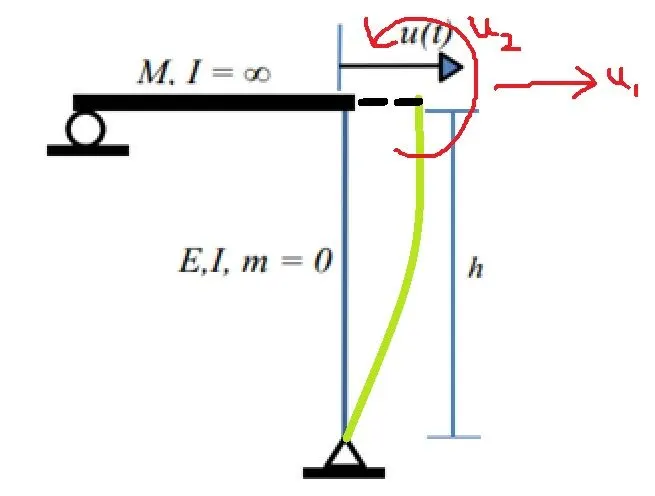
the general equation of motion `f_s + f_D + f_i = p(t)`
Here damping component is zero. others are derived as follow
`(12EI)/h^3 u_1 + (6EI)/h^2 u_2 + M ddotu = p(t)`
natural frequency formula `f = omega/(2pi) = root() (k/M) * 1/(2pi)`
where k = `infty`
So `f = infty`
System (b):
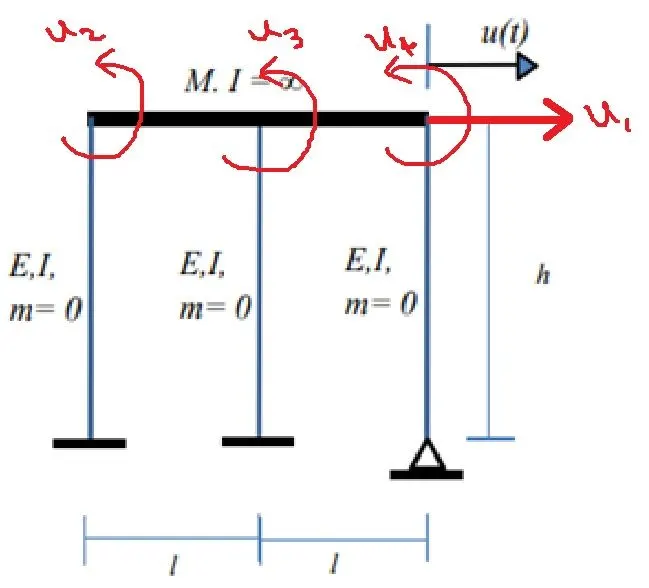
as we could understand from the above depiction, the number of degrees of freedom for the system is 4.
the general equation of motion `f_s + f_D + f_i = p(t)`
Here damping component is zero. others are derived as follow
`((24EI)/h^3 + (EI)/h) u_1 + ((6EI)/h^2)(u_2+u_3+u_4) + M*ddotu = p(t)`
natural frequency formula `f = omega/(2pi) = root() (k/M) * 1/(2pi)`
where k = `infty`
So `f = infty`
Answer for Question-3:
Aim: To calculate the natural period of the given system.
Simplified system as Planar frame:
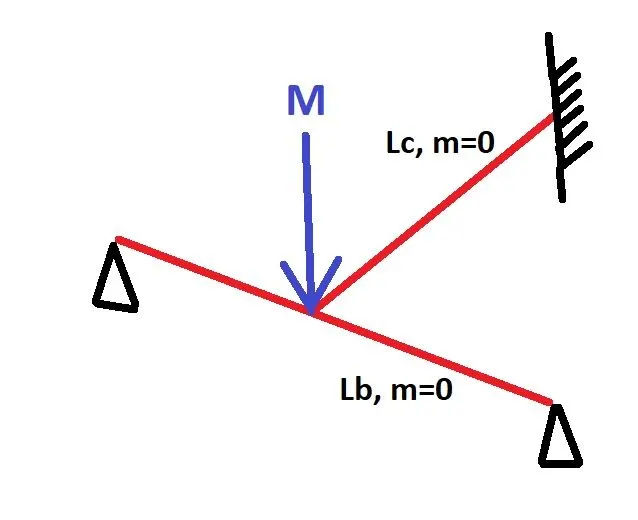
The displacement due to mass "M" is a function of stiffness of both members (fixed beam and simply supported beam).
Natural period of system `T_n = (2pi)/omega`
where `omega = root () (k/M)`
`k = W/u and mass(M) = W/g`
substituing the above relation in circular frequency of vibration `(omega)`
`omega = root() ((W/u)/(W/g))`
`omega = root()(g/u)`
Finally, `T_n = root()(u/g)* 2pi`
`T_n = 2 root()u`
where u = dispacement at joint
Answer for Question-4:
Aim: To determine the expression for the effective stiffness for the given structures.
System (a):
There are 2 stiffness components connected to the mass. One is Fixed cantilever beam. Another spring. Both are connected in series with the mass.
So the effective stiffness of the system with components in series.
`1/K_e = 1/k_1 + 1/k_2`
`k_1`= stiffness of beam
`k_2`= stiffness of spring = K
`k_1`= `(3EI)/L^3`
`1/k_e = L^3/(3EI) + 1/K`
`k_e = (3EIK)/(3EI+L^3K)`
System (b):
There are 3 stiffness components connected to the mass. Two of them are Fized end columns. Another spring. All are connected parellely to the mass.
So the effective stiffness of the system with components in parellel.
`K_e = k_1 + k_2 + k_3`
`k_1`= stiffness of column-1
`k_2`= stiffness of column-2
`k_3`= stiffness of spring = K
`k_e = (24EI)/h^3 + (24EI)/h^3 + K`
`k_e = (48EI+Kh^3)/h^3`
System (c):
There are 2 stiffness components connected to the mass. One is Fixed beam with bending stiffness. Another Inclined fixed beam with axial stiffness. Both are connected parellel with the mass.
So the effective stiffness of the system with components in parellel.
`K_e = k_1 + k_2`
`k_1`= bending stiffness of beam
`k_2`= axial stiffness of inclined beam
`k_e = (48EI)/L^3 + (EA)/root()(h^2 + L^2)`