Identification of Cracks
Q1). What is the mode of failure or damage of the beams in the figure above? Are the damages repairable? Elaborate
1a).
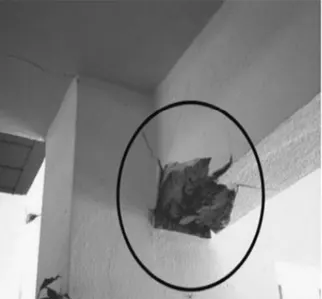
Answer:
Observations:
- Concrete is crushed and the reinforcement is exposed.
- Concrete spalled beyond the reinforcement which may be a sign of rupture.
- Beam top portion looks safe because of the flange advantange from slab.
- The crack develops from bottom to top means rebar yielding occurs in support bottom only.
Mode of Failure:
- Its form of flexural failure due to reversal of stress during earthquake.
- During stress reversal, support top experiences compression and bottom experiences tension.
- Top compressiom is managed by slab advantage. Whereas bottom tension was not satisfied by the provided reinforcement.
- Since the reinforcement got yielded, it cannot be repaired.
- This crack is formed due to flexural failure of a beam.
- the fluxural strength known as modulus of rupture, bending strength or fracture strength is a material property defined as the stress in the material just before it yields in a flexure test.
- the flexure stress represent the highest stress experienced within the material at the moment of rupture.
1b).
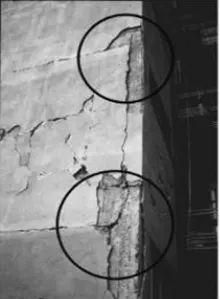
Answer:
Observations:
- Cracks along Beam-Column edge.
- Cracks seem to have developed through the structure as it looks much wider.
- Beam looks separated from the column at joints.
- Concrete is not severely crushed.
Mode of Failure:
- Its beam pull out faialure due to insufficient developmetn length of reinforcement in joints.
- During eathquake, the horizontal movement of structure makes this condition worse and detached the beam member from column.
- Providing the anchorage length between two existing concrete is very difficult. So not repairable.
1C).
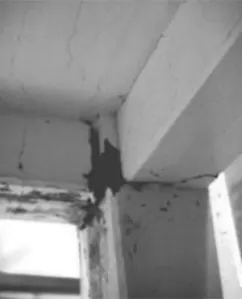
Answer:
Observations:
- Cracks are exactly at the joint of Column-Beam.
- Cracks in Beam developed through its entire width.
- Slab also developed more cracks along the beam width direction.
Mode of Failure:
- It's a plastic hinge failure.
- The damage occurred only in the joint zone first of all.
- Cyclic lateral loading and stress reversal at the joints led to the damage.
- Even the slab participated to its best to handle the Tension but cracked by undergoing tension with its falnge condition and unable to control the damage.
- This damage can be repaired by strengthening the joint.
Question2).
2a).
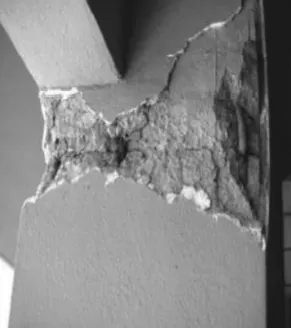
Answer:
Observations:
- Concrete damaged at top of a Column.
- Concrete damaged all around the column face.
- Beams are safe.
- The location of column looks at edge of the building.
- No walls are built along the column means it is probably at ground floor, for parking car movement access.
Mode of Failure:
- It's a soft storey failure, due to formation of plastic hinge.
- Due to absemce of Infill walls at the ground floor, the plastic hinge forms at the top of ground storey columns during lateral movement.
- Based on the development of crush of concrete, it can either be repairable or non-repairable.
2b).
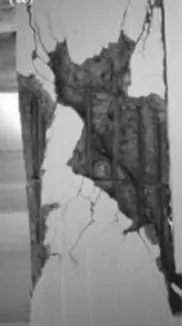
Answer:
Observations:
- Concrete developed complete breakage diagonally.
- Longitudinal reinforcements are intact.
- Shear reinforcement spacing looks wider, that is lesser shear rebar is provided for the column.
Mode of Failure:
- It's a pure shear failure.
- Inadequate shear reinforcement compels concrete takes all the shear stresses.
- The size of the columns is increased in the direction of shear to increase the shear capacity.
- Shear failure occurs when the acting shear force exceeds the shear capacity of the corresponding section of the structural menber.
- shear force acts along a plane parallel to the direction of force and hence , producing a sliding failure on beam.
- shear failure is considered as brittle failure as it does not provide any warning before complete failure.
- Shear reinforcement must be provided as per codal provisions provided by IS 456:2000.
- Provide adequate shear links.
- high grade concrete deformed bars must be used for proper anchorage.
2c).
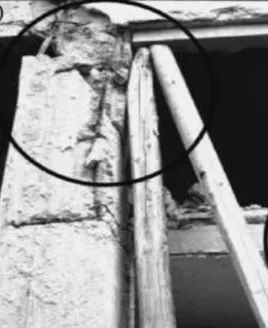
Answer:
Observations:
- Column is failed completely.
- Failure occured at top of column.
- There are two slabs connected to the column, probably one at mid height of the column.
- The wooden piles might be a Post failure support after column failed, providing temporary suppport to avoid collapse of the entire structure.
Mode of Failure:
- It's a short column failure.
- An additional slab or a beam connected to a column in mid-height leads to this effect.
- This leads to failure especially if the connection is unintentional and not accounted in design.
- The failure occured is not repairable.
- Short columns are commanly subjected to axial loads, lateral loads and moments , short columns under the action of lateral load and moments undergo lateral moments and bending
- under such circumstances when the stresses in steel and concrete reach their yield stress material failure happens and rcc column failures . this type of failures is also called as combined compression and bending failure.
- short column effect generally occurs in the building resting on the slopping ground.
- The performance of short column during an earthquake is poor , this is because a tail column and short column of some cross section move horizontally by amount , howeever a short coulmn is stiiff than tall column hence it attracts larger earthquake forces.