Identification of Cracks
Question 1:
a)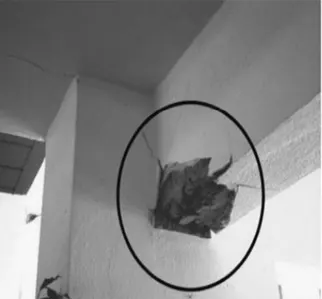 b)
b) 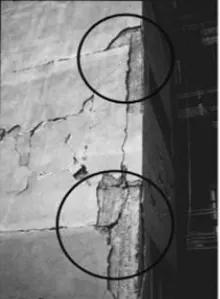 c)
c) 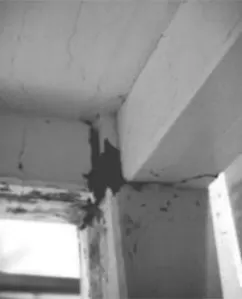
What is the mode of failure or damage of the beams in the figure above? Are the damages repairable? Elaborate
Ans:
1.a)
- Concrete is crushed and beam reinforcement is exposed in the given image.
- Bond between the concrete and reinforcement is no longer existed that means it is the sign of the rupture.
- The failure occurs at the bottom of the beam and beam top is safe.
- Reinforcement is still active at beam top.
- Development of the crack occurs at the bottom only that means rebar yielding occurs at the beam bottom only.
- This is type of flexural failure occurs due to reversal of the stress during earthquake.
- A stress reversal occurs when a given element of load carrying member is subjected to certain level of tensile stress followed by same level of compressive stress.
- Generally in beam design, beam is designed for tension at support top and for compression at support bottom.
- But during stress reversal, support top experiences compression and bottom experiences tension.
- During stress reversal top compression is managed by top concrete but designed bottom reinforcement is not enough to bear the tension.
- Due to excessive tension yielding of reinforcement occurs.
- Since reinforcement got yielded this failure is not repairable.
1.b)
- By observation it looks like that crack is developed throughout the depth of the beam.
- Beam and columns looks separated from each other due to development of the wide crack at the edge of the beam through the structure.
- Concrete is cracked and not crushed.
- It is the pull out failure which occurs due to insufficient development length of reinforcement at the beam joint.
- The portion of beam bar that is embedded in the column vai beam reinforcement bar is called development length.
- During the earthquake, horizontal movement of structure takes place. But due to insufficient development length this condition get worse and detaches the beam from column.
- Development length is the minimum length of bar that must be embedded in concrete beyond any section to develop its full strength.
- The main bar in the beam is extended the column to safely transfer stresses from beam to column.
- Development length creates safe bond between bar surface and concrete.
- It also ensures that during ultimate load condition the reinforcement bar should not slip through the concrete.
- But if the development length is not sufficient the structure fails due to slipping of joint.
- In such case bars will not fail first but failures will happens at joint.
- The reinforcement bars will split from concrete.
- As development length is not sufficient, during the earthquake the applied force at beam column joint is more than the maximum permissible limit, the restraining force between the beam and column will not be sufficient to hold the beam at its position and slippage will occurs and beam member detaches from the column.
- As providing the anchorage length between the two existing concrete is very difficult this failure is not repairable.
1.c)
- In the given image we can observe that crack developed exactly at the beam column joint.
- The crack developed through its entire the width of the beam.
- Random Cracks are also developed in the slab along the direction of the beam.
- It is a plastic hinge failure which generally occurs at the joints.
- In beam-column joints with high strength concrete and shear reinforcement in joints, the plastic hinge is formed at the beam-column joint interface, which is an undesirable failure mode.
- Cyclic lateral loading and reversal of the stresses at the joints causes this type of failure.
- For the given case along with the beam, slab also participated in resisting the tension but unable to handle excessive tension resulting into formation of the cracks.
- This joint can be strengthened.
Question 2:
a) 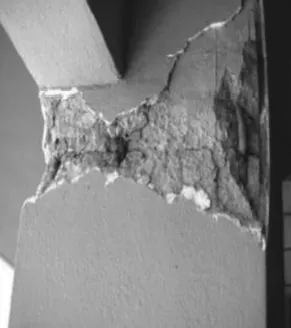 b)
b) 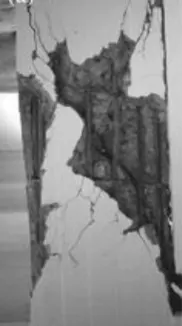 c)
c) 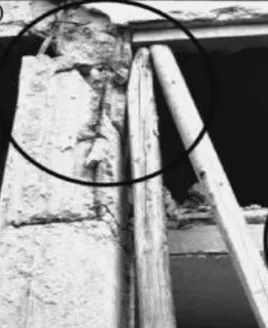
Ans:
2.a)
- Damage of the concrete took place at the top of the column.
- Concrete damaged all around the face of the column.
- There is no failure of the connected beam.
- This is probably a external type of column and located at the basement or ground floor type area as there are no built up walls.
- It is soft story failure in which formation of plastic hinge takes place.
- Due to absence of the walls connecting to the columns at the ground floor the plastic hinge formation takes place at the top of the ground story columns during lateral movement of the earthquake.
- Soft story is a condition of multi-story building structure with one or more story stiffness is much smaller than those of the upper floor.
- This condition occurs in the building with open ground floor while floors above it contains rigid walls as room divider.
- This kind of soft story is triggered by interaction between the walls and frame forming a composite structure called as infilled frame which is more rigid compared to the open frame structure underneath.
- In the event of a strong earthquake, this soft story fails first so that it is no longer capable of supporting the loads from upper floors.
- Eventually, is causes total failure of the building.
- Accordingly soft story failure is very dangerous and should be avoided if possible.
- This type of failure can be reparable or inreparable depending upon the crushing of the concrete.
2.b)
- From the image observations it looks like concrete failure takes place diagonally.
- The longitudinal reinforcement of the column is not damaged.
- Lateral share reinforcement spacing is much higher than the minimum standard spacing requirement which is 300 mm resulting in insufficient shear resistance due to insufficient lateral shear reinforcement.
- It is pure shear failure.
- Lateral loads in a structure are carrying by vertical elements such as columns and shear walls.
- When there are no shear walls, column carry these lateral loads.
- If no adequate shear links are provided these type of failure takes place.
- Shear force tends to produce sliding failure on a material along a plane that is parallel or slightly parallel (diagonal) to the direction of the force.
- When shear force exceeds the shear capacity of the column then this type of failure occurs.
- This failue is repairable.
2.c)
- From the observation it is seen that column failed completely.
- Failure takes place at the top of the column.
- There are two slabs connected to the column.
- To avoid collapse of entire structure, wooden piles are provided as a post failure support providing temporary prop.
- It is short column failure.
- In certain building either due to the ground conditions or due to the requirement of intermediate beam there requires the construction of short columns as shown below.
- The short columns are stiffer compared to long columns and hence most of the earthquake forces acting on the building are taken by the short columns.
- More the stiffness of any structure less will be its flexibility to undergo any sort of deformation.
- Earthquake design of a building is more efficient through the flexible design of the structure.
- More is the stiffness, more will be the force required to bring any deformation.
- If the short columns are not designed to take such large forces, damage is caused to the column and hence the structure is affected.
- This is called short column effect.
- The failure given in the picture is not at all repairable.