Project on Concrete Mix Design for various grades of Concrete
- Calculate the Concrete Mix Design for M 35 grade concrete with fly ash and M 50 grade concrete without fly ash.
Aim: Design Concrete mix for M 35 grade concrete with fly ash and M 50 grade concrete without fly ash using Indian standard recommended method IS 10262 2009.
Important terminology:
Mix design:
Mix design is process of selecting suitable ingredients of concrete and determining their relative proportions to produce concrete of certain minimum strength and durability as economically as possible.
Data required for concrete mix design
- Grade of concrete
- Maximum size of aggregate
- Minimum cement content
- Maximum water cement ratio
- Workability in terms of slump
- Exposure condition
- Grading zone of fine aggregate
- 0Type of aggregate
- Maximum cement content
- Type of admixture content
- Specific gravity of all materials used
- Free Moisture content
Procedure for Concrete mix design
1.Target mean strength
Concrete should be designed for certain higher strength than characteristic strength so that site strength will not fall below the characteristic strength. Assuming 5 % test results are allowed to fall below the characteristic strength, target mean strength is given by
F’ck = fck + 1.65 S
Where, f’ck = target mean strength
Fck = characteristic mean strength
S = standard deviation
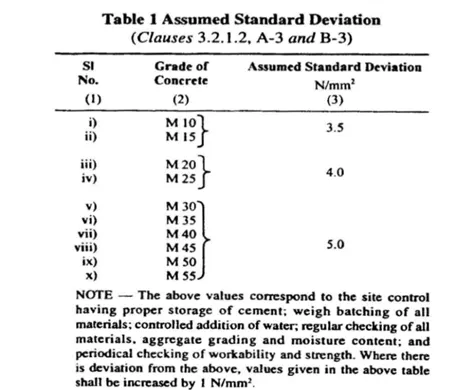
Value of assumed standard deviation as per IS 10262 2009 table 1
2.Selection of Water cement ratio
Water cement ratio is important term which controls the quality, strength, and durability of concrete.
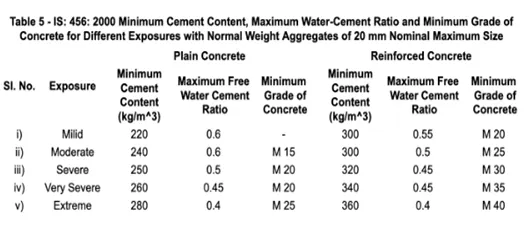
Based on the exposure condition water cement ratio is selected from table 5 of IS 456 2000
3.Selection of water content
water content of concrete influenced by size, shape and texture of aggregate, workability, cement and other supplementary cementitious material type and chemical admixtures.
Quantity of maximum mixing water content per cubic meter of concrete for nominal maximum size of aggregate as per IS 10262 2009 table 2 (Clauses 4.2, A-5 and B-5) for angular coarse aggregate and for range of 25 to 50 mm slump.
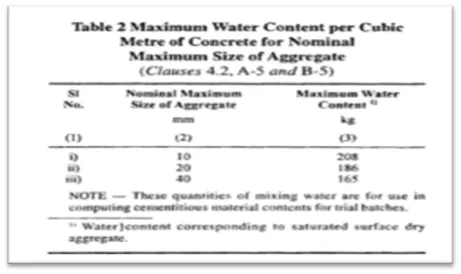
The water quantity reduced by 10 kg for sub angular aggregate, 20 kg for gravel and 25 kg for rounded gravel.
For slump other than 25 to 50 increase water content by 3 % for every increase in 25 mm slump.
Also, use of plasticizer reduces water content up to 10 % and super-plasticizer up to30 %.
4.Calculation of cementitious material content
Cement plus supplementary cementitious material content per unit volume of concrete is calculated from water cement ratio and should be checked against the minimum cementitious content for durability requirement as per is 456 2000 table 5.
5.Estimation of coarse aggregate proportion.
Volume of coarse aggregates per unit volume of total aggregate are assumed as per IS 10262 2009 table 3 for water cement ratio of 0.5.
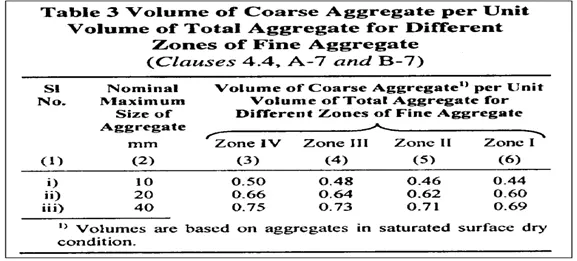
This volume is increased by 1 % for every decrease in water cement ratio by 0.05 and decreased by 1 % for every increase in water cement ratio by 0.05.
For more workable or pumpable concrete reduce the volume of coarse aggregate by 10 %.
6.Estimation of fine aggregate
- Volume of concrete = 1 m3
- Volume of cement `=(mass of cement)/(sp.gravity of cement *1000)`
- Volume of water =`=(mass of water)/(sp.gravity of water *1000)`
- volume of aggregate (FA & CA) = [a-(b+c)]
- Mass of coarse aggregate = d x volume of coarse aggregate x specific gravity of coarse aggregate
- Mass of fine aggregate = d x volume of fine aggregate x specific gravity of fine aggregate
7.Mix proportion:
- Cement in kg / m3
- Water in kg / m3
- Fine aggregate in kg / m3
- Coarse aggregate in kg / m3
- Chemical admixture in kg / m3
- Water cement ratio
8.Trial mix
Cement: fine aggregate: coarse aggregate
Concrete mix design for M 35 grade and M 50 grade of concrete
Required data
|
Type of cement Type of fly ash Max size of aggregate Minimum cement content Maximum water cement ratio Workability Exposure condition Method of placing concrete Degree of supervision Chemical admixture Type of aggregate Specific gravity of cement Specific gravity of fly ash Specific gravity of coarse aggregate Specific gravity of fine aggregate Water absorption a) C.A b) F.A Free surface moisture a) C.A b) F.A Grading of fine aggregate |
OPC 43 grade F type conforming to IS 3812 (part 1) 20 mm 320 kg / m3 0.45 125 mm Sever (RCC) Pumping Good Superplasticizer Crushed angular aggregate 3.15 2.2 2.78 2.7 0.5 percent Nil Nil Nil Zone 1 |
Mix design for M 35 grade concrete using fly ash
- Target mean strength
From table 1 of IS 10262 2009, standard deviation, S = 5 N / mm2
Target mean strength = fck + 1.65S
= 35 + 1.65 x 5
= 43.25 N / mm2
- Selection of w / c ratio
From table 5 of IS 456 2000 for sever exposure condition, maximum w / c ratio = 0.45
Based on experience adopt w / c ratio = 0.4
0.4 < 0.45, hence O.K
- Selection of water content
From table 2 of IS 456 2000 maximum water content per unit volume of concrete for max nominal size of aggregate 20 mm is 186 liters for slump up to 50 mm and w / c ratio 0.5
Here slump is 125 mm, (3 % increase for every 25 mm slump)
Hence, water content for 125 mm slump = 186 + 186 x 0.09
=203 liters
As superplasticizer is used water content can be reduced to extent of 30 %.
Based on trials water content reduction up to 25 % is achieved using plasticizer.
Hence, amount of water content required = 203 x 0.75 = 153 liters.
- Calculation of cement content
Water cement ratio = 0.4
Cementitious material (cement + fly ash) content = 153/0.4 = 383 kg / m3
Since, 383 > 320 it is O.K
Since fly ash is not as active as cement, based on trial and experience increase the cementitious materials by some percentage. Here in this case increase the cementitious materials by 10 %.
Hence, cementitious material content = 383 x 1.1 = 422 kg / m^3
Water content = 153 kg / m^3
Water cement ratio = 153 / 422 = 0.36
Let us take fly ash content as 25 %
Fly ash content = 25% x 422 = 106 kg / m^3
Cement (OPC) = 422 -106 = 316 kg / m^3
Saving of cement by using fly as = 383 – 316 = 67 kg / m^3
- Proportion of volume of coarse aggregate and fine aggregate content
Volume of coarse aggregates per unit volume of total aggregate as per IS 10262 2009 table 3 for water cement ratio of 0.5 for F A falling in zone 1 = 0.6
In present case water cement ratio = 0.4
Volume of coarse aggregate increased by `0.01/0.05×0.1`= 0.02
Volume of coarse aggregate = 0.62
For pumpable concrete these values are reduced by 10 %
Therefore, volume of coarse aggregate = 0.62 x 0.9 = 0.56
Volume of fine aggregate = 1 – 0.56 = 0.44
Mix calculations
a.Volume of concrete = 1 m3
b.Volume of cement =`(mass of cement)/(specific gravity of cement)×1/1000` =`316/3.15×1/1000` = 0.1 m^3
c.Volume of water = `(mass of water)/(specific gravity of water)×1/1000` =`153/1×1/1000 = 0.153 m^3`
d.Volume of chemical admixture, assuming 1.2 % by weight of cementitious material and specific gravity of 1.1
Mass of chemical admixture = `(1.2×422)/100`= 5.06 kg / m^3
Volume of chemical admixture = `(mass of chemical admixture)/(specific gravity of admixture)×1/1000`= `(1.2 ×422)/(100 ×1.1)×1/1000`=0.005.
e.Volume of fly ash = `(mass of fly ash)/(specific gravity of fly ash)×1/1000`= `106/2.2×1/1000`= 0.048 m^3
f.volume of aggregate (FA & CA) = [a- (b + c +d + e) = [ 1 – (0.1+0.153+0.048 + 0.005)] = 0.7 m^3
f.Mass of coarse aggregate = f x vol of CA x sp. gravity of CA x1000= 0.7 x 0.56 x 2.78 x 1000=1090 kg / m^3
g.Mass of fine aggregate = f x vol FA x sp. gravity of FA x 1000= 0.7 x 0.44 x 2.7 x 1000= 832 kg / m^3
In this case water absorption of coarse aggregate is 0.5 %
Correction for site correction for aggregate
Absorption of coarse aggregate = 0.5/100 x 1090 = 5.45 liters.
Hence, actual amount of water used = 153 + 5.45 = 158.45
Actual weight of coarse aggregate used = 1090 – 5.45 = 1084.5 kg / m^3
- Mix proportions for trial no 1:
|
Cement Fly ash Water Fine aggregate Coarse aggregate Chemical admixture Water cement ratio |
= 316 kg / m^3 = 106 kg / m^3 = 158.45 kg / m^3 = 832 kg / m^3 = 1084.5 kg / m^3 =5.06 kg / m^3 = 0.36 |
Trial mix ratio = 1: 2.63: 3.43
With above proportions of materials carry out trial no. 1 and see the quality of concrete and check for durability requirement.
Mix design for M 50 grade of concrete without using fly ash
- Target mean strength
From table 1 of IS 10262 2009, standard deviation, S = 5 N / mm2
Target mean strength = fck + 1.65S
= 50 + 1.65 x 5
= 58.25 N / mm^2
- Selection of w / c ratio
From table 5 of IS 456 2000 for sever exposure condition, maximum w / c ratio = 0.45
Based on experience adopt w / c ratio = 0.4
0.4 < 0.45, hence O.K
- Selection of water content
From table 2 of IS 456 2000 maximum water content per unit volume of concrete for max nominal size of aggregate 20 mm is 186 liters for slump up to 50 mm and w / c ratio 0.5
Here slump is 125 mm, (3 % increase for every 25 mm slump)
Hence, water content for 125 mm slump = 186 + 186 x 0.09
=203 liters
As superplasticizer is used water content can be reduced to extent of 30 %.
Based on trials water content reduction up to 25 % is achieved using plasticizer.
Hence, amount of water content required = 203 x 0.75 = 153 liters.
- Calculation of cement content
Water cement ratio = 0.4
Cement content = 153/0.4 = 383 kg / m3
Since, 383 > 320 it is O.K
- Proportion of volume of coarse aggregate and fine aggregate content
Volume of coarse aggregates per unit volume of total aggregate as per IS 10262 2009 table 3 for water cement ratio of 0.5 for F A falling in zone 1 = 0.6
In present case water cement ratio = 0.4
Volume of coarse aggregate increased by `0.01/0.05×0.1`= 0.02
Volume of coarse aggregate = 0.62
For pumpable concrete these values are reduced by 10 %
Therefore, volume of coarse aggregate = 0.62 x 0.9 = 0.56
Volume of fine aggregate = 1 – 0.56 = 0.44
- Mix calculations
- Volume of concrete = 1 m3
- Volume of cement = `(mass of cement)/(specific gravity of cement)×1/1000`
= `383/3.15×1/1000`
= 0.12 m^3
c.Volume of water = `(mass of water)/(specific gravity of water)×1/1000`
= `153/1×1/1000`
= 0.153 m^3
d.Volume of chemical admixture, assuming 1.2 % by weight of cementitious material and specific gravity of 1.1
Mass of chemical admixture = `(1.2×383)/100` = 4.6 kg / m^3
Volume of chemical admixture = `(mass of chemical admixture)/(specific gravity of admixture)×1/1000`
= `= ((1.2 ×383))/(100 ×1.1)×1/1000`
= 0.004m^3
e.volume of aggregate (FA & CA) = [a- (b + c +d)]
= [ 1 – (0.1+0.153+ 0.004)] = 0.74 m^3
f.Mass of coarse aggregate = e) x vol of CA x sp. gravity of CA x1000
= 0.74 x 0.56 x 2.78 x 1000
=1153 kg / m^3
g.Mass of fine aggregate = e) x vol FA x sp. gravity of FA x 1000
= 0.74x 0.44 x 2.7 x 1000
= 880 kg / m^3
In this case water absorption of coarse aggregate is 0.5 %
Correction for site correction for aggregate
Absorption of coarse aggregate = 0.5/100 x 1153 = 5.76 liters.
Hence, actual amount of water used = 153 + 5.76 = 158.76 liters.
Actual weight of coarse aggregate used = 1153 – 5.76 = 1147.2 kg / m^3
- Mix proportions for trial no 1:
|
Cement Water Fine aggregate Coarse aggregate Chemical admixture Water cement ratio |
= 383 kg / m^3 = 158.76 kg / m^3 = 880 kg / m^3 = 1147.2 kg / m^3 =4 kg / m^3 = 0.36 |
Trial mix ratio = 1: 2.29: 2.99
Conclusion:
- mix proportions for M35 grade concrete using fly ash and for M 50 grade concrete is given in the above tables.
- for M35 grade using fly ash trial mix proportion is 1: 2.63: 3.43 and for M 50 grade concrete without using fly ash mix proportion is 1: 2.29: 2.99.
- By using fly ash quantity of cement content can be reduced.
- With above proportions of materials carry out trial no.1 and see the quality of concrete. by Measureing the slump, water content and admixtures are adjusted.
- With adjustment mix proportions are recalculated at pre-selected w / c ratio which is trial mix no. 2.
- By variation of water cement ratio by 10 % two more trials are carried out and graph between water cement ratio and corresponding strengths shall be plotted to obtain mix proportions for given target strength for field trials.