Identification of Cracks
CHALLENGE 1
Aim: The main aim of this challenge is to gain the knowledge about the concept of different types of failures that occur in the structure during its life time and to differentiate between the structural and non-structural failure. The failure that generally occurs during the earthquake is also learnt.
What is the mode of failure or damage of the beams in the figure above? Are the damages repairable? Elaborate
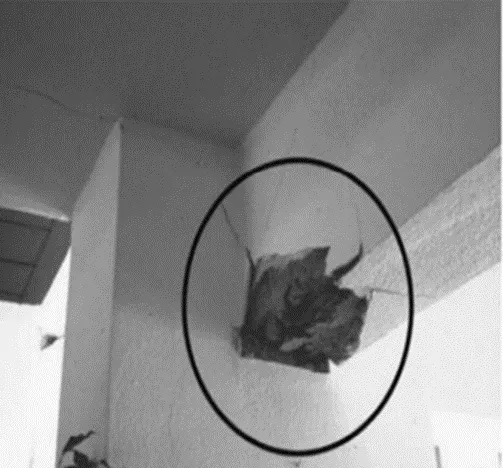
Ans: Observations.
- From the above image it is observed that the concrete of the beam is completely crushed and the bottom reinforcement of the beam is exposed to the atmosphere.
- Here as the concrete is crushed and the reinforcement is exposed this kind of failure may be due to rupture.
- The top portion of the beam is safe as there is no observation of any cracks.
- The top portion of the beam is safe because of the advantage of the slab as it acts as a top flange of the beam.
- The cracks are observed from bottom to the top portion of the beam. This indicates that the yielding of the reinforcement is occurring at the bottom support only.
Conclusion:
- This type of failure is a flexure failure. The flexural failure occurs due to the reversal of the stress which generally occurs during the earthquake.
- During the reversal stress process the bottom portion of the beam undergoes tension and the top portion of the beam undergoes compression.
- The compression force which is developed at the top portion of the beam is taken care by the slab which acts as a flange to the beam whereas the bottom portion which undergoes tension is not satisfied by the reinforcement.
- The failure mode here is flexure failure, thus the failure cannot be repaired.
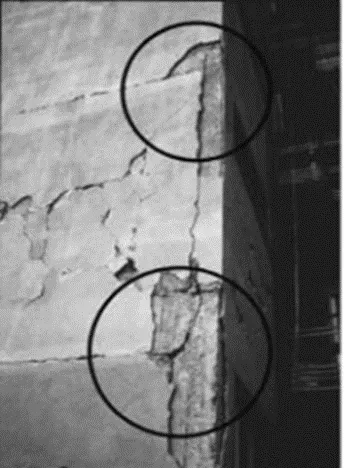
Ans: Observations:
- From the above picture it can be seen that the cracks are developed along the beam – column joints.
- The cracks seems to be wider. As the cracks are wider the cracks might have developed through and through of the beam and column.
- The concrete is not crushed completely.
- The beams seems to get separated from the column at the joint.
Conclusion:
- This type of failure is called as pull out failure. This pull out failure is mainly is due to insufficient development length that is provided in the beam.
- Due to the application of the lateral forces like earthquake or wind forces makes this failure even more critical which leads to the separation of the beam from the column.
- For the existing structures that are facing pull out failure cannot is repaired as it is difficult to provide the necessary development length in the members.
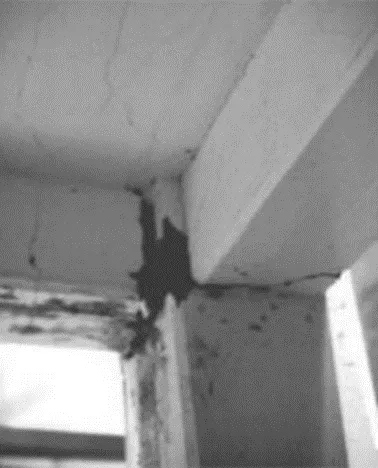
Ans: Observations:
- The cracks are observed at the beam and column joint.
- The cracks are also observed throught he entire width of the beam.
- It is also observed that some random cracks are developed in the slab along the width direction of the beam.
Conclusion:
- Since the damage occurred at the joint of the beam and the column this type of failure is called as plastic hinge failure.
- Plastic hinge effects are defined as the moment at which the entire cross-section has reached its yield stress. This is theoretically the maximum bending moment that a cross-section can resist.
- The main cause for this type of failure is due to the cyclic loading and the continuous process of stress reversal.
- As the damage is not more the failure can be repaired.
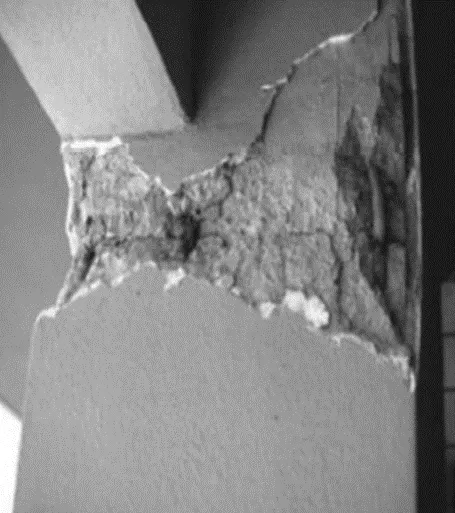
Ans: Observations:
- The concrete at the column is entirely got damaged
- The concrete at the column is damages around all the faces of the column
- The beam is not subjected to any kind of failure.
- From the figure it is observed that the column seems to be an exterior column.
- It can be observed that there is no wall between the columns. Thus it can be a parking area.
Conclusion:
- It is a soft storey failure
- The soft storey failure occurs due to the plastic hinge failure.
- As the wall are absent the plastic hinges are likely to form at the top of the ground floor when subjected to the lateral forces.
- Based on the length the concrete is crushed the failure can be either be repaired or unrepaired.
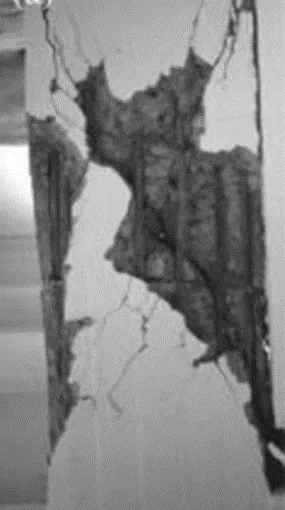
Ans: Observations:
- From the figure above it is observed that the concrete has completely got detached from the reinforcement around.
- The main reinforcement of the columns are completely intact.
- The shear reinforcement are seems to be placed at a larger distance. Thus the failure can be shear failure.
Conclusion:
- It is a shear failure.
- The proportion of providing the adequate amount of shear reinforcement can reduce this kind of failure when subjected to the earthquake.
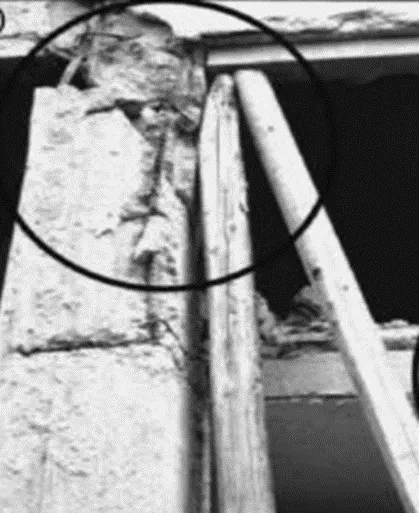
Ans: Observations:
- Here the top portion of the column is completely failed.
- It can be observed that two slabs are getting connected to the column one at the floor level and the other at the mid height of the floor.
- The temporary props are provided in order to avoid the entire failure of the structure.
Conclusion:
- This type of failure is a short column failure.
- The short column failure generally occurs due to the presence of the intermediate slab at the mid height of the storey.
- This leads to a huge failure if it is not designed properly.
- This cannot be repaired.
Conclusion:
From the challenge carried out it can be concluded that the various types of the failure that occurs during the life span of the structure when subjected to the earthquake are known. The concept of determining the type of failure and the major reason that leads to the failure are also learnt. The failure can be repaired or not are also learnt.
Vijayalakshmi S H