Identification of Cracks
Question 1:
What is the mode of failure or damage of the beams in the figure above? Are the damages repairable? Elaborate
a)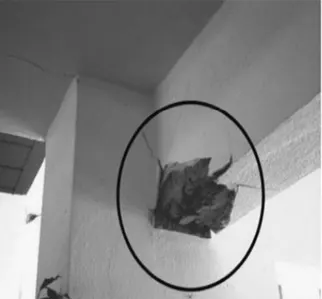
Observation:-
- By observing the picture shown, we can understand that concrete crushed due the impact of the force.
- And by concrete getting crushed we can also find reinforcement bars exposed out of the element.
- Though the element had such an impact it does not seem like there is severe damage to the element.
- The concrete in the element got spalled beyond the reinforcement which, as per observation from the image can be considered as the sign of rupture.
- Though the element is affected beneath it is clear in the top which seems to be the supportive effect of the flange advantage from the slab.
- And other point is, if crack is developed from bottom to top it shows sense that rebar yielding can occur in support bottom only.
Answer:-
- From our observations we conclude that,
- The failure occurred may be a form of flexural failure due to reversal of stress during earthquake.
- During this stress reversal what happens is the support top experiences compression and the bottom support experiences tension.
- The main point here is that the top compression on the element was managed by the advantage of the support from the slab to the element.
- As we know steel reinforcement and the concrete combined as composite material acts as the structural support for the building.
- As one of the material, the reinforcement got yielded this damage can be repaired.
b) 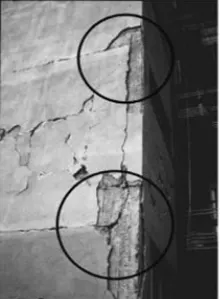
Observation:-
- In the shown image we observes the cracks along the edge of the beam and column.
- As like the older situation we are not finding any crushing of material or the element.
- But what we see is a crack due to some reason in the relation between the two elements.
- Though hard crushing or rupture is not found.
- We can see crack is developed through the structure and also the crack seems wider.
- And the other major point is that the beam got separated from the column at joints.
- Which is not a good sign of good relation between the elements.
- And as told earlier concrete is not severely crushed.
Answer:-
- As told in the observation there is poor relation between the elements joining.
- We can come to a point that this is a beam pull out failure due to insufficient development length of reinforcement in joints.
- In severe case of the earthquake at this same situation with severe horizontal movement of structure, the condition could have been worsen.
- Like the beams could have got detached from the columns which is not at all acceptable by the structure leading to severe impact of the earthquake.
- Now after such happening providing anchorage length between two existing concrete is very difficult and not advisable too.
- So this damage cannot be repaired.
c) 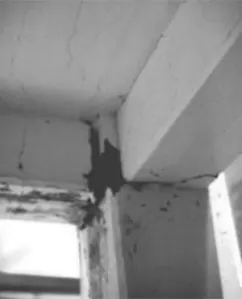
Observation:-
- In the case from the image we can see that the cracks in the structure are exactly at the joints of the column and the beam.
- And the crack has also got spread throughout its entire width.
- And along with these elements the slab has also developed more cracks along the beam width direction.
Answer:-
- After the observation, we can say that it is a plastic hinge failure.
- The damage here has occurred only in the joint zone first of all.
- The damage at the joint may be due to cyclic lateral loading and stress reversal at the joints.
- And as we see the slab it has also participated to its best to handle the tension due to the force.
- This we could note because here slab is severely cracked which means it has undergone tension with its flange condition.
- But it could not control the damage.
- In this case the joint can be strengthened.
Question 2:
a) 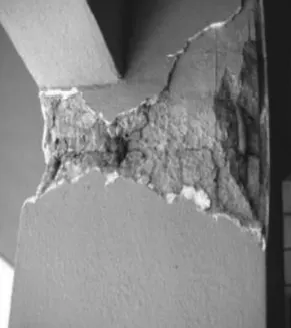
Observation:-
- In the image given we can find that, at the top of the column concrete has got damaged.
- And the concrete is seen damaged all around the face of the column at the top of the column.
- And also we can find that the beams are safe.
- It seems the columns is placed at the edge of the building.
- And other important thing can be noted is. It seems like a opening near the column.
- Which can be understood by absence of walls.
- It can probably be ground floor of the building, may left open for parking car and other movement access.
Answer:-
- So, it is understood from the image that it is a soft storey failure.
- Technically plastic hinge formation.
- As said before, due to absence of infill walls at the ground floor, The plastic hinge forms at the top of ground storey columns during lateral movement.
- Based on the development of crush of concrete it can either be repairable or non-repairable.
b) 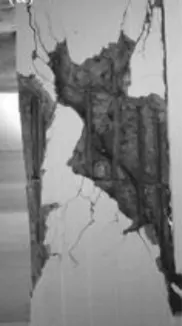
Observation:-
- In the image supplied the damage seems worse.
- Here the concrete in the element has developed complete breakage diagonally.
- As we can also see longitudinal reinforcements are intact but, Shear reinforcement spacing seems wider, which makes sense there may be lesser shear rebar provided.
Answer:-
- Here we can say it is a pure shear failure.
- Inadequate shear reinforcement certainly a reason for the concrete to take a high shear stress.
c) 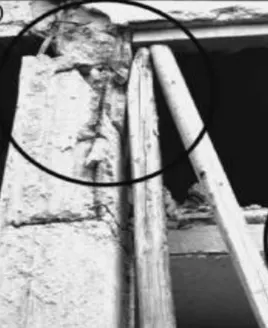
Observation:-
- Here the column completely failed.
- Majorly the failure seems to have happened at the top of the column.
- And we can also find two slabs connected to the column, probably one at mid height of the column.
- Here they have placed wooden supports which could be understood that may be post failure support.
- Which cannot be a perfect solution but a temporary support may be.
- This is to avoid complete collapse of the entire structure.
Answer:-
- Here we can say it is a short column failure.
- An additional beam or slab to the mid height of the column makes the column short on both remaining heights.
- Which may lead to short column failure.
- This type of failure is lead especially if the connection is unintentional and not accounted in design.
- The failure given in the picture is not at all repairable.