Identification of Cracks
Question 1:
a) 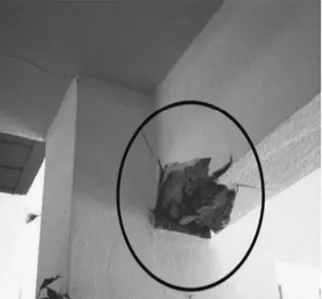 b)
b) 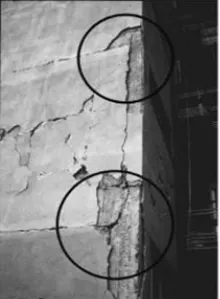 c)
c) 
What is the mode of failure or damage of the beams in the figure above? Are the damages repairable? Elaborate
a)
- Crack is formed due to flexural failure in beams. As we can see that damage is caused more to the beam then column. Damage is caused due to insufficient of reinforcement or concrete. To overcome this failures steel must be provided at top/bottom of beam.
- These damages are repairable, while repairing this we need to remove pipes, wires and turn off the water and power connection. It can be repaired by adding cement to the damaged part.
b)
- The failure is due to insufficient bond strength and improper curing. The beam cannot develop its full moment resistance at the end section and the force resistance and stiffness of the frame it belongs to drop accordingly. The loss of beam anchorage prevents a proper plastic hinge from forming at the end of beams. These types of column failure can be avoided if attended with much care. Cavities inside the column that were not filled properly with construction ground reduce the compressive area of the column. As a result, its axial capacity will be reduced.
- The damage is repairable although the original deficiency, namely the poor anchorage of beam bars in the joint, cannot be corrected easily.
C)
- These cracks are formed due to the beam-column joint failure. In the strong column-weak beam design, beams are expected to form plastic hinges at their ends and develop flexural overstrength beyond the design strength. The high internal forces developed at plastic hinges cause critical bond conditions in the longitudinal reinforcing bars passing through the joint and also impose high shear demand in the joint core. The bond performance of the bars anchored in a joint affects the shear resisting mechanism to a significant extent.
Question 2:
a) 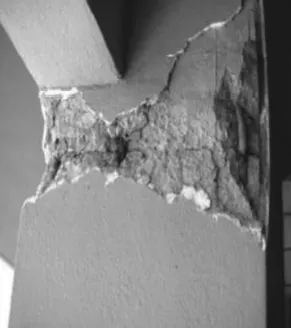 b)
b) 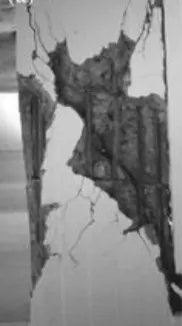 c)
c) 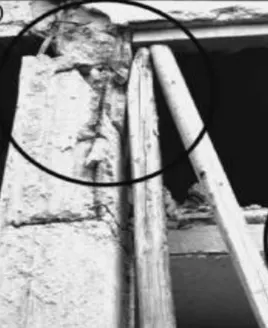
What is the mode of failure or damage of the beams in the figure above? Are the damages repairable? Elaborate
a)
- The failure is due to the flexural damage. Columns may be damaged or fail in flexure. Flexural damage is concentrated in horizontal bands at the very top or bottom of a column in a Storey. Such regions are the physical manifestation of flexural plastic hinges where the plastic rotation takes place. Flexural damage always includes a visible horizontal crack and loss of concrete cover often accompanied by bar buckling, opening of stirrups or partial disintegration of the concrete core inside the cage of reinforcement.
- Adequate development length for the longitudinal bar is to be ensured within the joint taking yield penetration into consideration.
b)
- This crack will be formed due to the shear failure of a column. Lateral loads in a structure are carrying by vertical elements such as columns and shear walls. When there are no shear walls, columns carry these lateral loads. Lateral loads are generated by winds, earthquake loads, from retaining structures, etc. Shear links are provided to columns based on the shear forces excreted on them. Further, the size of the columns is increased in the direction of shear to increase the shear capacity.
- Designers should have provided adequate shear links or sections to carry shear forces.
C)
- These cracks are formed due to the short column failure. In Short Columns, failure takes place due to yielding and we define this phenomenon as CRUSHING. Short Columns are classified based upon Slenderness Ratio which is the ratio of the effective length (Length between point of zero moments) and least lateral dimension of the column. Failure of column usually occurs due to anyone of the following stresses developed in the column. Short column will fail only because of direct compressive stress developed in the column or we can also say that short column will usually fail due to direct compression or crushing.
- In existing buildings with short columns, different retrofit solutions can be employed to avoid damage in future earthquakes. Where walls of partial height are present, the simplest solution is to close the openings by building a wall of full height which will eliminate the short column effect.