Identification of Cracks
Question 1: What is the mode of failure or damage of the beams in the figure below? Are the damages repairable? Elaborate.
a)
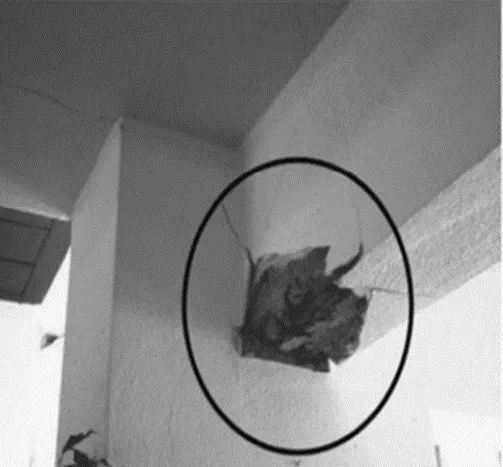
OBSERVATION:
- In the above image, it can be noticed that the damage is done to the beam but the column is perfectly fine.
- The layer of concrete is completely crushed and spalled, and reinforcement is exposed.
- The column is eccentrically loaded as the beam is offset to one side of the column. This indicates improper design.
- Concrete damage is continued beyond the reinforcement which is a sign of rupture.
- The top of the beam is totally fine because of the flange action of the slab and only the bottom of the beam is damaged.
- The cracks are developed from the bottom to the top which means the rebar yielding occurs at the bottom of the beam only.
RESULT:
- From the above observations, we can say that the cracks are formed because of flexural failure in the beams due to the reversal of stresses during an earthquake.
- Under normal conditions, the bottom part of the beam at supports resists compression and the upper part is subjected to tension, but during stress reversal vice versa is true.
- The additional forces in the upper part are resisted by the flange action of the slab but at the bottom portion the reinforcement yielded and the concrete is cracked and spalled.
- The repair for this crack cannot be done due to the high yielding of the steel reinforcement.
b)
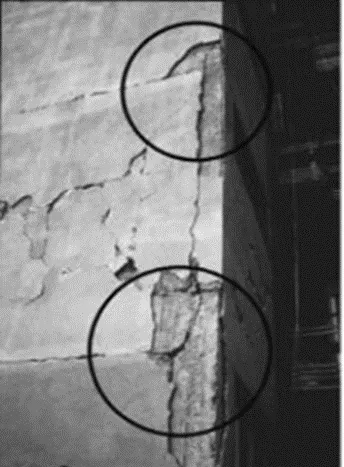
OBSERVATION:
- The failure in the above image is along the beam-column edge.
- It can be seen that the failure has developed through the structure.
- The beam looks detached from the column along the edge, the concrete of the beam and the column is not much damaged or we can say that the concrete of the column and the beam is not severely crushed.
- The concrete cover is cracked and spalled may be because of inadequate cover under the present exposure conditions.
RESULT:
- From the above observations, we can conclude that the failure occurs due to the Beam pull-out.
- Beam pull-out failure is a failure mode in which the anchors pull out of the concrete lacking the required development length to transfer stress between column and beam at the joint.
- Normal anchorage between the column and the beam is provided in form of reinforcement bends with enough development length to maintain the connectivity.
- Providing anchorage between two existing concrete members in the long span is not possible.
- Hence the failure is not repairable.
c)
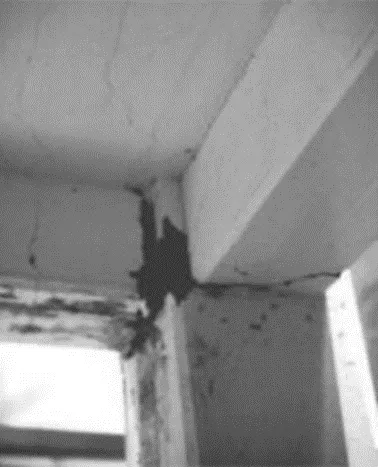
OBSERVATION:
- In the above image, the crack developed is at the beam-column joints. The black area in the above figure is the area of the failure that occurs at the beam-column joints.
- The crack developed through the entire width of the beam.
- The slab also experiences some cracks along the beam width direction.
RESULT:
- From the above observations, it can be concluded that this failure occurs due to the formation of a plastic hinge.
- The cyclic loading during an earthquake causes stress reversal at the junction, leading to this damage.
- Cracks formed in the slab show that the flange action of the slab is also unable to resist the loading caused during stress reversal.
- This failure is repairable as it occurs at the plastic hinges of the structure.
- We have to design the structure in such a way that the undesirable large forces should not concentrate at the plastic hinge zone.
- This failure can be repaired by strengthening the joints.
Question 2:
a)
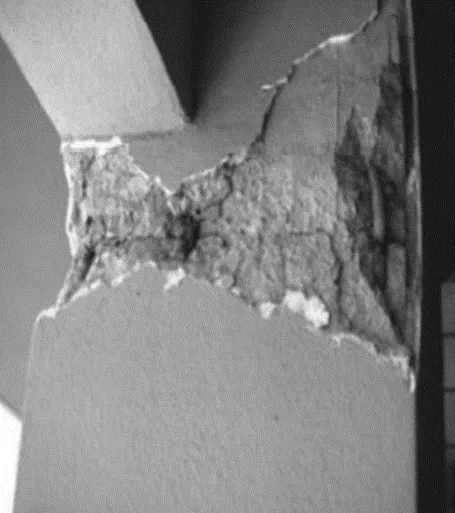
OBSERVATION:
- In the above image, the failure occurs at the top of the column only.
- Concrete all around the column is spalled.
- We can see that there are no walls around the column so we can assume that this column is located on the ground floor.
- The column is located at the exterior part of the building, hence it is subjected to eccentric loading.
- The longitudinal reinforcement can also be seen buckled.
RESULT:
- From the above observations, we can conclude that this failure is a plastic hinge or soft-storey failure.
- As there are no infill walls around the column at the ground level, so the plastic hinge will form at the top of the ground-storey columns.
- This type of damage occurs on the column occurred due to the lack of effective force transfer throughout the structure. This can happen only when the columns are spaced much far away and the beams are provided at a higher place to provide the space.
- The reparability of the failure completely depends on the severity of the column spalling.
- If the column member is intact and there is no effect on the reinforcement and no yielding occurred during the seismic event then only we can consider that this failure can be still repaired and strengthened.
- But if the cracks on the columns are more severe, and the flexural failure occurs to the column then we can conclude that the failure cannot be repaired.
b)
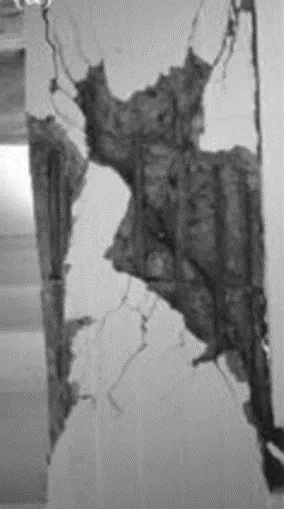
OBSERVATION:
- In the above image, it can be seen that the column member is severely crushed.
- We can see that the damage in the column is in the lateral direction which means the direction of the breakage or the damage is diagonal which means shear force caused the damage to the column.
- It can also be seen that the shear reinforcement which is provided by the lateral ties is at a much larger distance.
RESULT:
- This failure is an example of pure shear failure.
- The column does not have adequate horizontal ties to restrain the shear force, so a failure occurs diagonally where the shear force is applied.
- The column is severely crushed so it is not possible to repair this failure.
c)
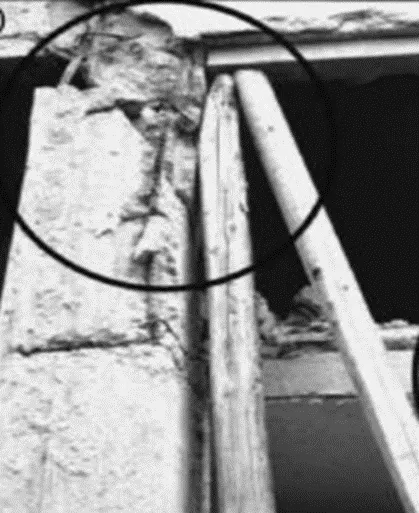
OBSERVATION:
- In the above image, we can see that the failure occurs at the top beam member of the column.
- It is completely disjointed.
- The column can no longer withstand the loads therefore wooden support has been provided to support the slab.
- This support is treated as a temporary solution to avoid the collapse of the whole structure.
- In the above image we can see that there is another slab connected mid-height to the damaged column.
RESULT:
- This failure is an example of short column failure.
- This type of failure occurs when there are uncalculated forces applied to the column leading to its failure.
- The column is subjected to heavy shear force because of the additional slab provided at mid-height.
- Based on the above observations it can be concluded that this kind of failure is not possible to repair.