Identification of Cracks
Ans.1.
a) What is the mode of failure or damage of the beams in the figure above? Are the damages repairable? Elaborate.
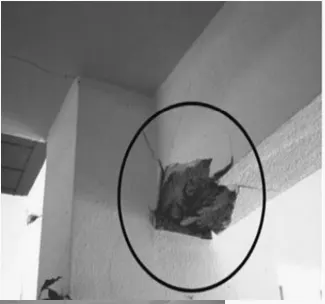
Ans.
This crack will be form due to flexural failure of a beam.The flexural strength, known as modulus od rupture, bend strength, or fracture strength, is a material property, defined as the stree in a material just before it yeilds in a flexure test.The flexural strength represents the heighest stress experienced within the material as its moment of rupture. It is measured in terms of stress,to overcome this type of failure main steel is provided at bottom or top of the beam. The damages are reapirable.The repair damaged beam, local welder or metal shop and request angel iron, cut and drilled to the length of the beam being repaired. Remove any pipes, wire etc. is currently going through the beam. Take care that water and electric supply is off, before doing so. mount the angle iron on jack and temperory post. Get the angle iron in place and slowly raise the jack until the angle iron is wedged up against the damage beam.Screw the angle iron the beam and remove the temperory post. Slide any pipes or wires previously removed back throughthe beam and turn water and electricity button ON.
b) What is the mode of failure or damage of the beams in the figure above? Are the damages repairable? Elaborate.
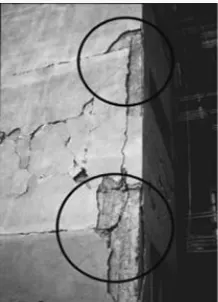
Ans.
This type of mistake take place when there is problem while construction and also due to honeycombing in the concrete.To avoid cracks in concerte, avoid using high slump concrete. Concrete of moderate slump (less than 5 inches) results in less cracking. High slump concrete can only be used if it is controlled by concrete admixtures or designed such that segreagation and bleeding of concrte is controlled. Concret admixtures such as water reducers or super plasticizers can be used to increase slump while reducing addition of water content. Air entertained concrete can also be produced to increase slupm especially when concrete is subject to feezing and thawing actions. The honeycombing occurs when the fine mortor fails to thoroughly fall and fills the gaps created by the coarse aggregate. As mentioned previously, poor concrete consolidation is usually the top cause of honeycombing, along with poor vibration, and improper ratio of fine to coarse aggregate, dry concrete and construction conditions that are not up to the standard.
c) What is the mode of failure or damage of the beams in the figure above? Are the damages repairable? Elaborate.
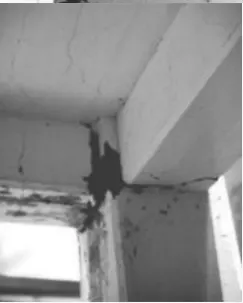
Ans.
These type of cracks are formed due to beam-column jint failure. In storng column and week beam design, beam are expected to form plastic hinges at their ends and develop flexural overstrength beyond tthe design strength. The high internal forces developed at plastic hinges cause critical bond conditions in the longitudinal reinforcement bars passing through the joint and also impose high shear demand in the joint core. The bond performance of the bars anchored in the joint affects the shear resisting mechanism to significant extent.
Ans.2
a)
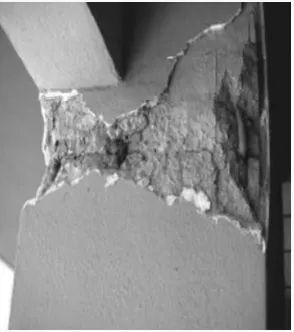
Ans.
This type of cracks form when there is flexural failure of the column. Columns have the most important role in all structural members of the building. According to the base civil engineering concept, column failure occurs after the beam and other components get damaged. Performance of existing buildings in earthquake indicates that the beam are less vulnerable to the damage during earthquake and their damages appears less on critical part compared wuth that of columns and column-beam joints.
b)
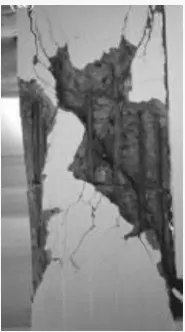
Ans.
This type of crack forms due to shear failure of the column. Lateral loads in the structure are carrying by vertical elements such as columns and shear walls.When there are no shear walls, columns carry these loads. Lateral loads are genrerated by winds, earthquake loads, from the retaing structure. Shears links are provided to columns based on the shear forces coming over them. The size of column is increased in the direction of shear to increase the shear capacity.
c)
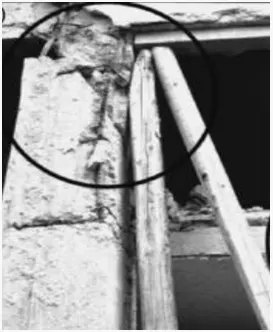
Ans.
These cracks are formed due to short column failure. In short columns, failure takes place due to yielding and we define the pheonomenon as crushing. Short column are classified upon slenderness ratio which is tha ratio of effective length (Length between point of zero moments) and least lateral dimensions of the column. Failure of column usually occurs due to anyone of the following sresses developed in the column or we can also say that short column will usually fail due to direct compression or crushing.