Hood design-Week 2
Desiging and assembly of BIW component - HOOD outer & inner panel
Abstract :
The overall look and aesthetic look of car body starts from hood who gives brillant attractive way of styling and counter looks bringing back to car. Basically in design of hood inner panel there are many and protocols to be followed for pedestrain safety binding all of them in a single report is explained in the project.
HOOD
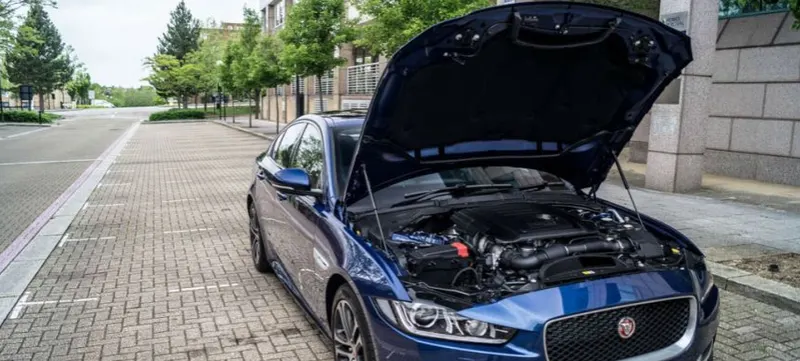
A car hood is the metal part that covers the engine of an automobile. The term car hood is a North American term, used primarily in America and Canada. Hood comes from the Old English word hod which means a hood, a soft covering for the head. Interestingly, hood is used by British English-speakers to refer to the waterproof cloth top covering the passenger compartment of a car or pram.
A car bonnet is the metal part that covers the engine of an automobile. The term car bonnet is a British term, used primarily in England, Ireland, Scotland, Wales, India, New Zealand, Australia, etc. Bonnet comes from the Old French word bonet, which means cloth used as a headdress.
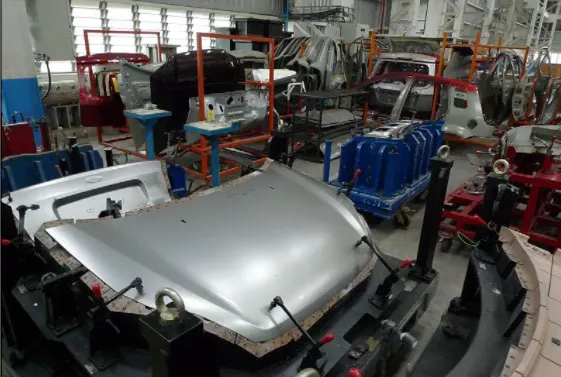
WHY DO WE NEED A HOOD FOR...?
The main function of the car hood is to protect the components underneath it for example, the engine. Without this protection, small stones kicked up by other cars could puncture a fluid container or damage the engine. In addition, most engines are not supposed to be exposed to excess water.
PEDESTRAIN SAFETY
Pedestrians are the most vulnerable road users who are at the high risk of vehicle collisions in traffic, Almost 1.2 million pedestrians are killed annually in road traffic accidents worldwide. The major injuries occur in lower, upper leg and head of the pedestrian, where the fatalities of the pedestrians in the accident is mainly due to head injury resulting from the hard impact of the head against the stiff hood or to the ground. In recent years, engineers are working on the vehicle front end design which includes bumper and hood to reduce the injuries to the pedestrians in the event of pedestrianvehicle collision.

Euro NCAP is a voluntary vehicle safety rating system created by the Swedish Road Administration, the International Consumer Research & Testing, backed by members, and motoring & consumer organisations in several EU countries.They provide consumers with information regarding the safety of passenger vehicles. In 1998, operations moved from London to Brussels.
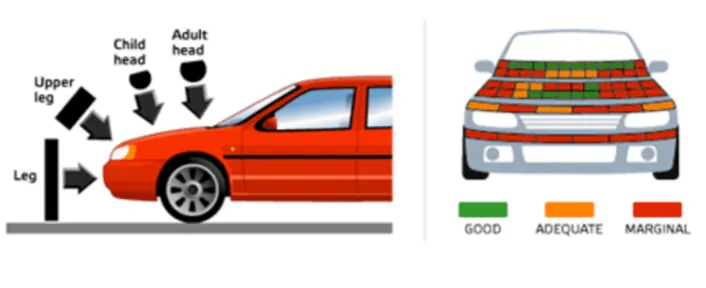
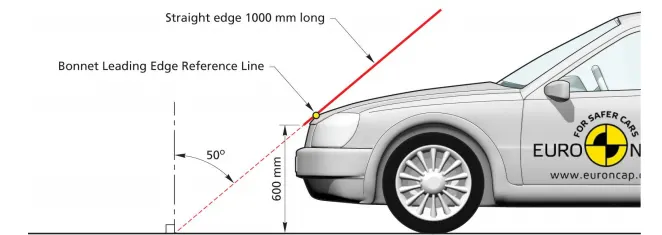
Many pedestrian crashes involve a forward moving car (as opposed to buses and other vehicles with a vertical hood/bonnet). In such a crash, a standing or walking pedestrian is struck and accelerated to the speed of the car and then continues forward as the car brakes to a halt. The pedestrian is impacted twice, first by the car and then by the ground, but most of the fatal injuries occur due to interaction with the car. Vehicle designers usually focus on understanding the car-pedestrian interaction, which is characterized by the following sequence of events: the vehicle bumper first contacts the lower limbs of the pedestrian, the leading edge of the hood hits the upper thigh or pelvis, and the head and upper torso are struck by the top surface of the hood and/or windshield.
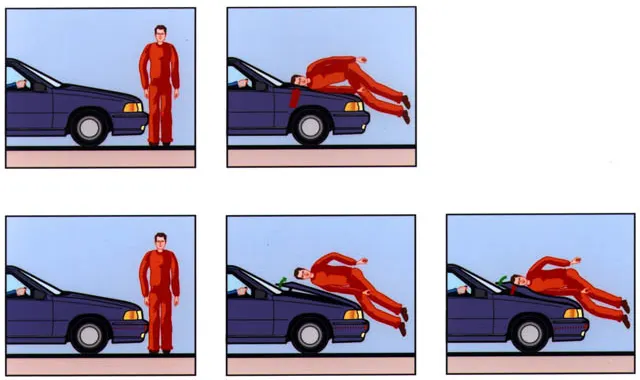
Methods to lift hood if required
1.Support rod
A hood rod is designed to hold your hood propped open whenever you need to do some work in your car's engine bay. When used, it must be firmly secured to ensure that it provides a stable hold on the hood. Meanwhile, when not in use, it must be kept stable in place and must not move around. The hood rod clip is the part assigned with that function. This clip clamps onto the rod and ensures that it is firm in its place when not in use. It keeps the rod from moving around under the hood and from causing trouble. 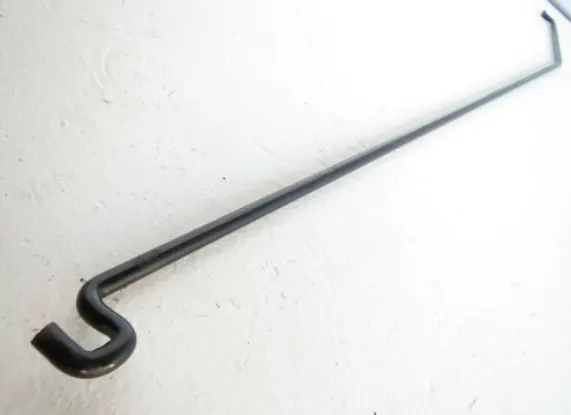
2.Gas stay
A gas stay is a type of spring that, unlike a typical mechanical spring that relies on elastic deformation, uses compressed gas contained within an enclosed cylinder sealed by a sliding piston to pneumatically store potential energy and withstand external force applied parallel to the direction of the piston shaft.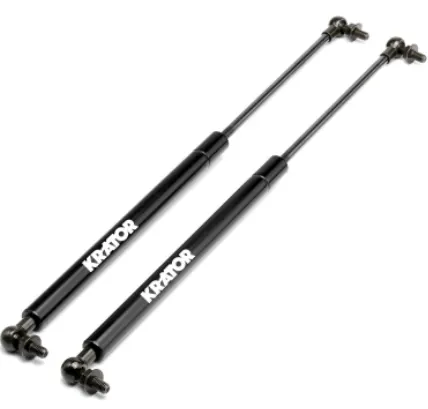
Hemming
Hemming is a technology used in the automotive industry to join inner and outer closure panels together (hoods, doors, tailgates, etc.). It is the process of bending/folding the flange of the outer panel over the inner one. The accuracy of the operation significantly affects the appearance of the car’s outer surfaces and is therefore a critical factor in the final quality of a finished vehicle.
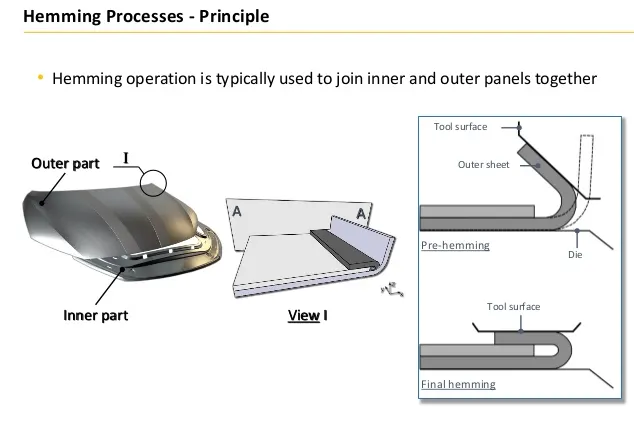
Benifits of hemming
- Die storage systems
- Fully automatic die-changing systems with parameters that change with each die
- Pressing capacity typically 60 to 180 tons
- Large panel-size capacity
- More than one part can be produced on same line
- Electric hemmers do not need hydraulic oil, are quiet and eco-friendly
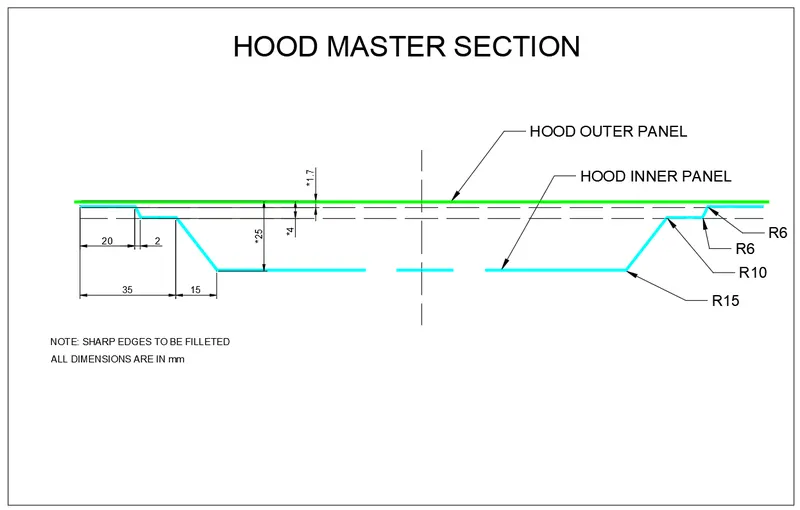
MASTERSECTION : Master sections are the guides for design requirements which decide the component packaging after technical (Styling, Concept or Class-A) surfaces.
Parts of a Hood
- Hood outer panel
- Hood inner panel
- Latch and Striker
- Hinge engine compartment
- Hinge hood part
CLASS A SURFACE :In automotive design, a class A surface is any of a set of freeform surfaces of high efficiency and quality. Although, strictly, it is nothing more than saying the surfaces have curvature and tangency alignment – to ideal aesthetical reflection quality, many people interpret class A surfaces to have G2 (or even G3) curvature continuity to one another (see free form surface modelling). Class A surfacing is done using computer-aided industrial design applications. Class A surface modellers are also called "digital sculptors" in the industry. Industrial designers develop their design styling through the A-Surface, the physical surface the end user can feel, touch, see etc.
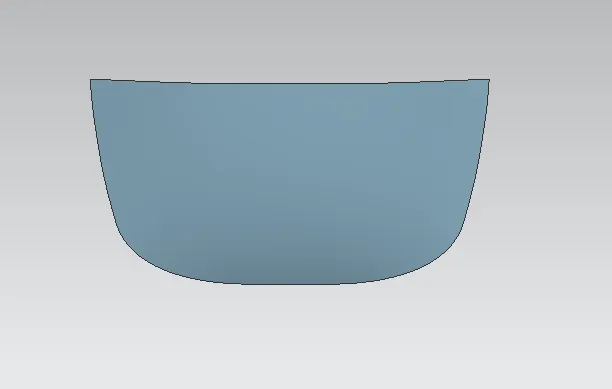
The above fig shows the outer pannel of the hood.
According to the Master section we need to draw the hood design and we need to fallow the master section.
So that we need to understand the master section and try to perform according to that.
First we want to offset the given model according to master section and now we want to perform the tools like offset face, offset curve, Trim sheet, Law extension, Emboss, Project curve and for the edges we use Edge blend or Face blend and we use Sew coomand to join the two parts.
The above mention tools are most important and with help of these commands we need to draw the sketch.
First we need to perform the half of the section and we need to mirror the object with thte help of Mirror Geometry.
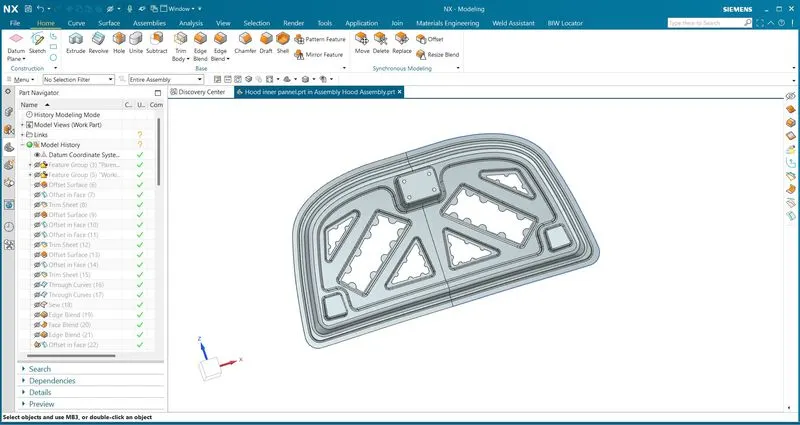
The above fig shows the hood design.
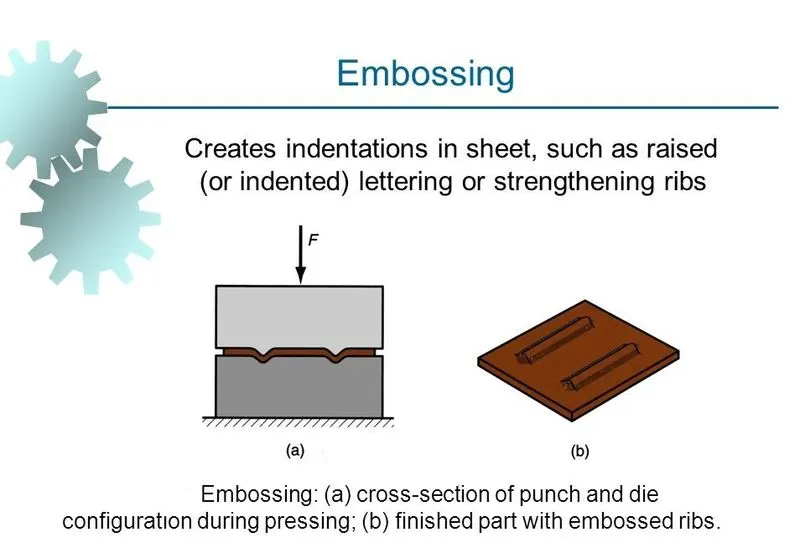
In the inner pannel of hood we gave the emboss to protect the engine when we hit the car at 40km/hr.
Mostly emboss will resist the for by layer by layer and it will not damage the engine or car.
Emboss is mainly used on surfaces, you can use an intersecting solid as Michael shows, you can also use a curve or sketch profile.
The second main important design consedaration is Hinges and Striker.
These are also most important the hood design .
HINGE ASSEMBLY :
Hinges is the assembly of components connected to the door and body of the vehicle, linked to each other and capable of rotating around the same axis. Conventional system consists of two hinges for each door, an upper hinge and a lower hinge.
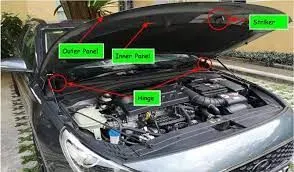
Hemming
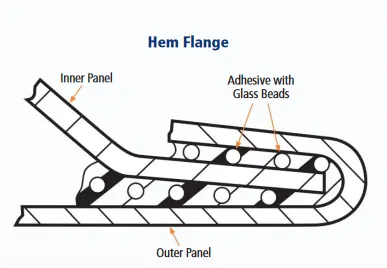
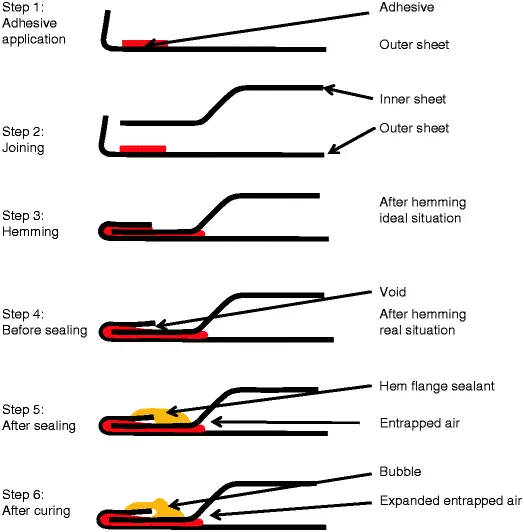
Hemming is a forming operation in which the edges of the sheet are folded or folded over another part in order to achieve a tight fit. Normally hemming operations are used to connect parts together, to improve the appearance of a part and to reinforce part edges.
In car part production, hemming is used in assembly as a secondary operation after deep drawing, trimming and flanging operations to join two sheet metal parts (outer and inner) together. Typical parts for this type of assembly are hoods, doors, trunk lids and fenders.
The accuracy of the hemming operation is very important since it affects the appearance of the surface and surface quality. Material deformations, which occur during the hemming process, can lead to dimensional variations and other defects in parts. Typical hemming defects are splits or wrinkles in the flange, material overlaps in the corner areas or material roll-in. This is why it is important to use simulation tools in order to, on the one hand, better understand the hemming process and, on the other hand, significantly reduce the number of “trial and error” loops during tryout und production.
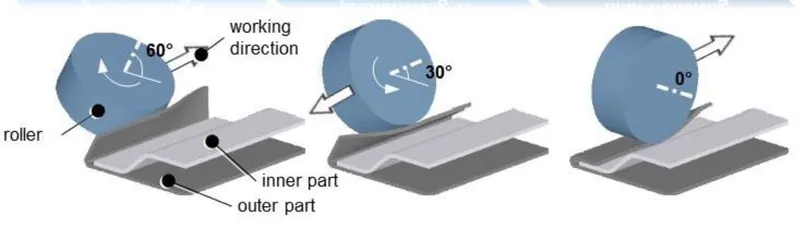
There are various types of hemming operations:
Conventional die hemming
Roll hemming
In conventional die hemming, the flange is folded over the entire length with a hemming tool.
In roll hemming, the hemming roller is guided by an industrial robot to form the flange
Hinge Reinforcement
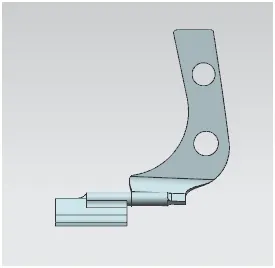
Devices for preventing movement between relatively-movable hinge parts for maintaining the hinge in two or more positions, e.g. intermediate or fully open the maintaining means acting perpendicularly to the pivot axis with a coil spring perpendicular to the pivot axis specially adapted for vehicles
The present invention concerns a hinged door check, for vehicle doors in particular, consisting of two hinged parts which are connected swivelling around an axis of rotation by a hinge pin and which have a holding device integrated between them defining different relative rotational positions. The holding device consists first of at least one catch element kinematically connected with the first hinged part and spring-loaded in a working direction perpendicular to the axis of rotation, and secondly of a track kinematically connected with the second hinged part , essentially shaped like the sector of a circle and arranged coaxial to the axis of rotation with respect to its radius of curvature, having at least one latching point cooperating with the catch element . The hinge pin is connected detachable from the first hinged part by fasteners , so that the hinged parts are separable when unloosening the fasteners while keeping the connection between the hinge pin and the second hinged part and the holding device assigned to the latter.
Stricker
t bolts to the underside of the hood at the front. It engages the hood latch when closed.
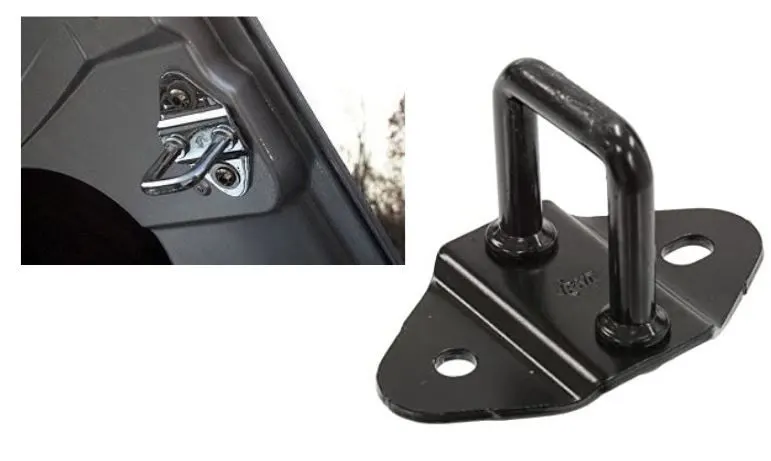
Latch and Striker
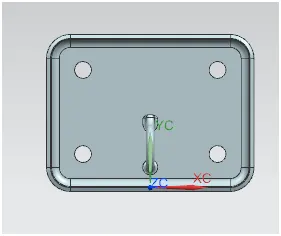
A latch or catch (called sneck in Northern England and Scotland) is a type of mechanical fastener that joins two (or more) objects or surfaces while allowing for their regular separation. A latch typically engages another piece of hardware on the other mounting surface. Depending upon the type and design of the latch, this engaged bit of hardware may be known as a keeper or strike.
A latch is not the same as the locking mechanism of a door or window, although often they are found together in the same product.
Latches range in complexity from flexible one-piece flat springs of metal or plastic, such as are used to keep blow molded plastic power tool cases closed, to multi-point cammed latches used to keep large doors closed.
NOTE:
Data to be used:
Input Parameters:
- Hood Outer Panel
- Master Section Sketch
Hood Thickness Information
- Outer Panel Thickness = 0.75mm
- Inner Panel Thickness = 0.75mm
- Reinforcement Thickness = 1.5mm
These are the most important parameters we need to consider while preparing the HOOD
EMBOSSING & MASTIC POINTS:
MASTIC JOINT:
Mastic is an adhesive that, along with thin-set mortar, is used to stick a sheet metal. While mastic does have strong points, such as great adhesive properties and adaptability to many substrates, high performance in wet areas is not one of its high points.
Sealants (sometimes called mastics) are used for waterproofing, such as repairing a leaking window. They are usually supplied in the form of a large tube with a nozzle at one end and may be either clear or black.
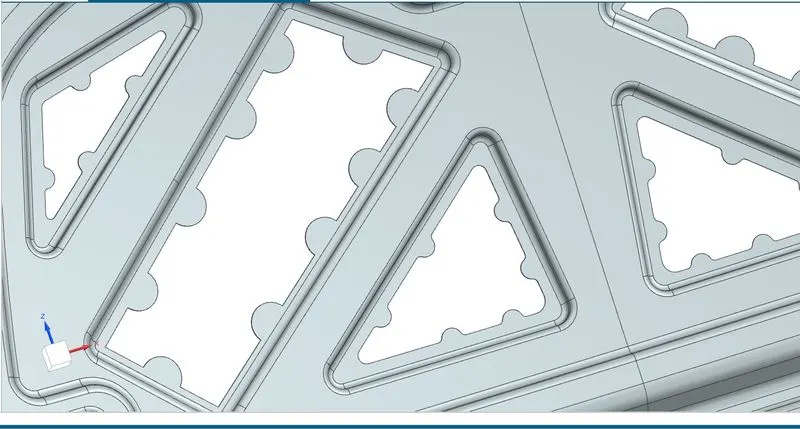
The above fig shows the how to give mastic point in the Inner pannel of Hood.
Mastics are used to join the Hood Inner pannel and Outer pannel.
The mastic point distances are 80mm.
Another main funcion of hood is HEMMING it is the most important to join the edges of hood.
Hemming is used in the car to resist the wear and tear of the hood.
For making a hemming we need to fallow some important parameters where to reduce the wear and tear of the hood.
If we not fallow the parameters of hemming and we got more noise of the hood when we are travelling.
Hemming Data:
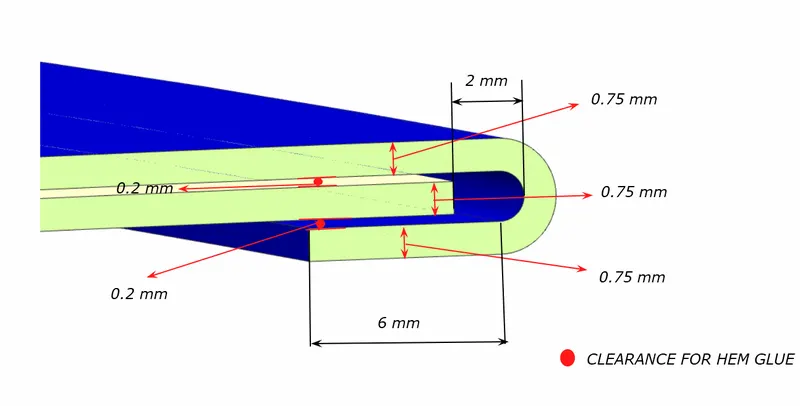
Hemming is a forming operation in which the edges of the sheet are folded or folded over another part in order to achieve a tight fit. Normally hemming operations are used to connect parts together, to improve the appearance of a part, and to reinforce part edges.
The above fig shows the hemming how to do and what are parameters we need to consider.
The given distance for the edges are used to reduce the weaar and tear and get friction.
DEEP DRAWING:
Deep drawing is widely-used in sheet metal forming, e.g. manufacturing of car body parts in the automotive industry. Details are given in the glossary.
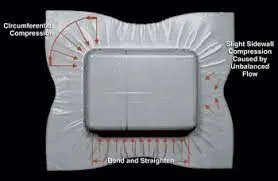
Deep drawing is one of the most widely used processes in sheet metal forming. Apart from its use in many other sectors, it is applied in the automotive industry for the manufacturing of car body parts.
Process definition:
The deep drawing process is a forming process which occurs under a combination of tensile and compressive conditions. A flat sheet metal blank is formed into a hollow body open on one side or a hollow body is formed into a hollow body with a smaller cross-section.
Deep drawing processes are divided into three types:
Deep drawing with tools
Deep drawing with active means
Deep drawing with active energy
In the automotive industry, deep drawing is usually carried out using rigid tools.
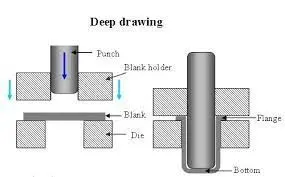
Illustration of the deep drawing process
The figure illustrates the deep drawing process. The rigid tools consist of a punch, die and binder. In deep drawing, the plate holder closes after the metal sheet blank has been inserted.
Next the sheet is clamped between the die and the binder. This process slows down the flow of the sheet while it is being drawn and thereby prevents wrinkles from forming under the binder. The punch stretches the sheet over the die radius and forms it in the die. The amount of punch force necessary for forming is thereby continually increased up to the lower dead center of the punch.
Whereas in pure deep drawing there is no reduction of sheet metal thickness, forming is achieved in stretch forming purely as a result of a decrease in sheet metal thickness. Stretch forming is extensively used for the forming of only slightly curved parts with low depth of draw (e.g. roofs, doors).
When drawing complex car body parts in practice, there is usually a combination of stretch and deep drawing involved. It is necessary that the sheet metal is stretched as well as possible without reaching the material’s limits (e.g. splits, wrinkles).
There are approximately 300 to 400 sheet metal parts which fit together to form the body of a car. In order to manufacture high quality sheet metal parts optimally for their particular use, specialized software simulates the complete deep drawing process.
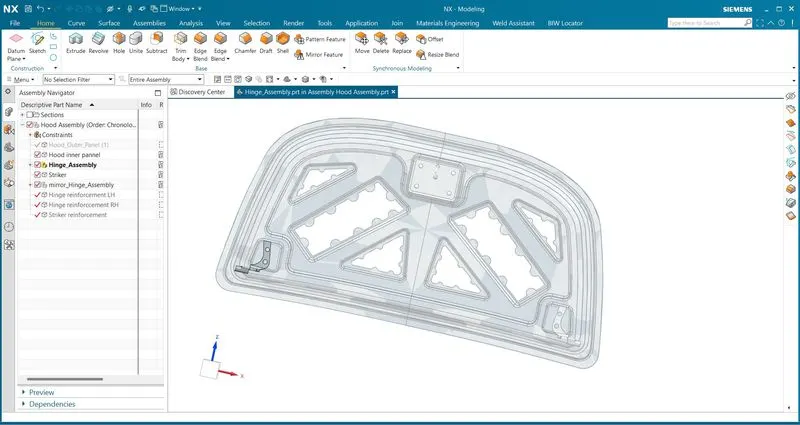
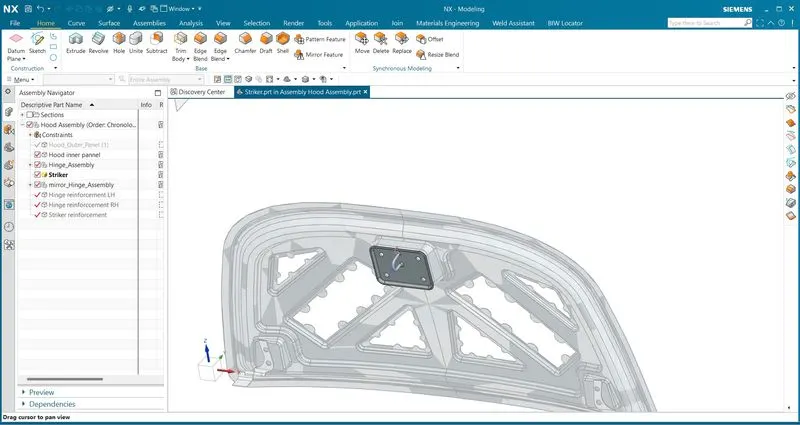
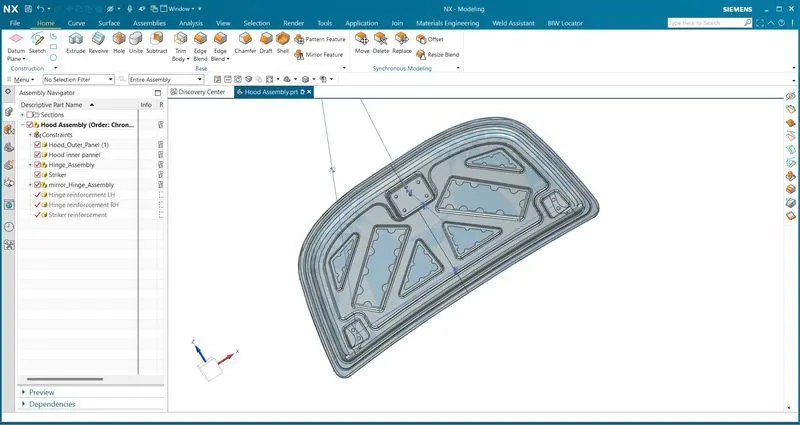
The below figures who we want to sketch every part of the hood and how to assembly each part.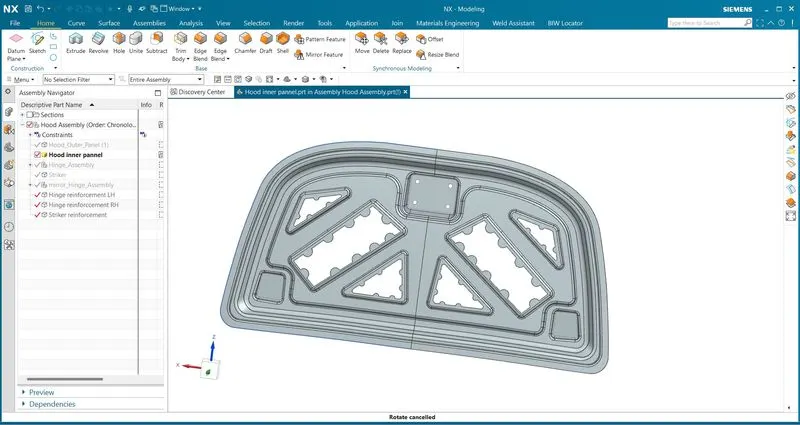
Hinges
Striker
Mastic and Emboss
Hood assembly
Reinforcement:
Reinforcement are used to make strengthen the materials to with stand the forces so we use reinforcement to the Hinges and Striker to the hood.
IMPORTANT COMMANDS:
Features Used in NX Cad
Offset Surface:
Offset surface command is used to offset a surface or face. Selecting a surface to offset will generate an IntelliShape offset surface that is defined by the originating surface. This IntelliShape will update if the originating surface is modified
Offset in face:
Use the Offset Face command to offset one or more faces along the face normals. You can offset faces either by positive or negative distances, provided the topology of the body does not change.
Trim sheet:
Use the Trimmed Sheet command to trim sheet bodies to intersecting faces and datums, and projected curves and edges.
Through curves:
through curves command use to create a body through multiple sections where the shape changes to pass through each section. Sections are curves, points, solid edges, solid faces.
Law Extension:
Use the Law Extension command to extend an existing surface or sheet based on the laws for distance and the angle of the extension. Law Extension creates flanges or extensions when a particular direction is important or when it is necessary to reference the existing face
Trim and extend:
This option lets you extend and trim one or more surfaces using a set of tool objects composed of edges or surfaces. 1 Two intersecting solid bodies. 2 Selected body on the right is the object to trim (the target).
Face Blend
Face Blend is enhanced to provide a dedicated type for blending along intersection edges of bodies combined with a Boolean feature. Face Blend is primarily used to blend between faces of separate bodies. It can also be used to blend between faces of a single body.
Edge blend
Edge blend command use to round sharp edges between faces. The radius can be constant or variable.
Emboss
Emboss is mainly used on surfaces, you can use an intersecting solid as Michael shows, you can also use a curve or sketch profile. create your sheet feature. select emboss, and select your face and sketch. Attached is an example of an embossed sheet.
Sketch:
Creates a sketch in the current application. Use the direct sketch tools to add curves, dimensions, constraints, etc.
Datum plane:
Creates a datum plane used to construct other features.
WAVE Geometry Linker:
Copies geometry from other parts in the assembly into the work part.
Extend sheet:
Extend a sheet body by distance or to the intersection with anotherbody.
Mirror geometry:
Copies geometries and mirror them across a plane.
Sew:
sew command use to combine sheet bodies by sewing common edges together, or combines solid bodies by sewing common faces. The selected sheet bodies must not have any gaps larger than the specified tolerance
Thicken:
Use the Thicken command to offset one or more connected faces or sheets into a solid body. Thickening occurs by offsetting the selected faces along their face normals, and then creating sidewalls. The Thicken command is similar to the Offset Face command.
Curve on surface:
Creates a surface spline features directly on face.
Extract body:
Use the Extract Body command to create an associative body by extracting faces from another body.
Conclusion:
The Hood design successfully completed with help of NX Cad.