Hood design-Week 2
CAR HOOD DESIGN
AIM: Design Hood Outer Panel, Inner Panel and the necessary reinforcements by following the Master Section mentioned with the Design parameters.
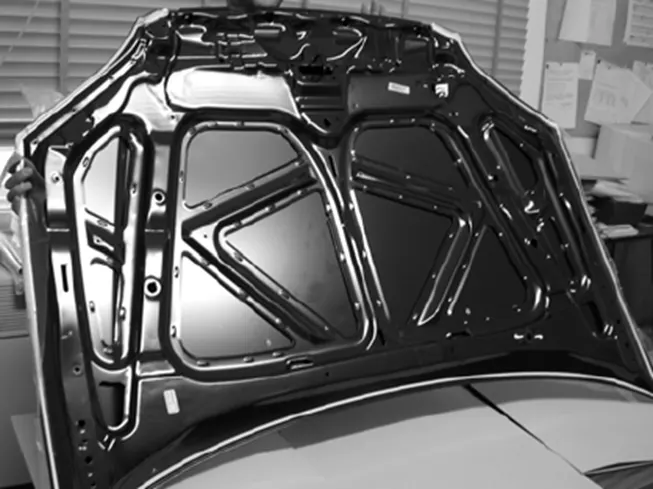
- INTRODUCTION
A car hood, also referred to as a bonnet in some other countries, is the hinged cover thatrests over the engine of a front-engine vehicle.
Its main function is to direct access to the engine, battry and other crucial parts of thecars for repair and maintenance and to protect these parts from direct sunlight and dust
A concealed latch is typically used to hold down the hood. Hoods sometimes also contain hood scoop, wiper jets, power bulge, and/or hood ornament.
Car hoods are typically constructed from steel and sometimes from aluminum. Aftermarket car hoods may be constructed from various other materials, including carbon fiber, fiberglass, or dry carbon.
Car bonnet is the important component which is utilized for several purposes at the front. Therefore, bonnet must be designed in suitable manner and it should minimize the hindrances from the disturbance caused by the external environment on the hood and its components below it. When the car is in running condition, the resisting forces from the air acting on the hood therefore the design of the bonnet should be made aerodynamic toreduce the air resistance.
- HOOD STRUCTURE
The bonnets of the most vehicles are basically fabricated using the sheet metal structure, a good energy absorbing structure so it causes substantially a small threat. Outer and inner stiffener panels are made or fabricated by using the of sheet metal structures therefore environment used is surface modeling. Since the hood assembly is a sheet metal component, hood structure is vulnerable to the vibrations. The source of the vibrations could be the engine generated vibrations, the vibrations due to the un-evenness in the road surface, and aerodynamic interactions of the hood surface when the vehicle is in motion. Excessive vibrations will put an impact on the passenger's ride comfort, and also make the structure susceptible to fatigue failure. Too many vibrations also affect the functioning of the locking mechanism of the bonnet, considerably risking the unlocking function and bonnet will be open up while the vehicle is in motion. Because of the many on going efforts are to reduce the weight of the vehicle, the thickness of the bonnet is beingreduced to its possible values. This could considerably increase the severity of the vibrations that the structure is subjected to. Hence, determining the fundamental frequencies of the bonnet structure and its behaviour at those frequencies is necessary.
3. HOOD DESIGN CONSIDERATION
The human comfort factor for automobile design is first consideration. It is a method to safeguard and protect space for the human user and necessary components that make up the vehicle being designed. Other purposes areprovided by alternative solutions and proposals. Ensure the all safety regulation requirements are meeting. The following aspect considered during primary hood assembly ,design.
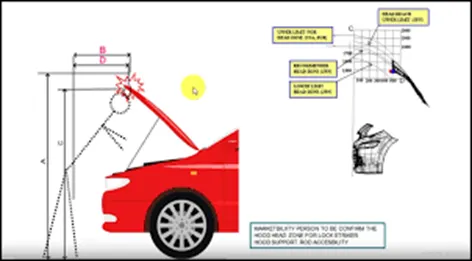
3.1 HEAD CLEARENCE
While designing the hood head clearance also consider because when the hood is in open condition it shouldn't collide or hit to head of the worker. If the open angle is less, high chance to hit the striker. It depends on the average height people in that country.
3.2 PEDESTRIAN SAFETY
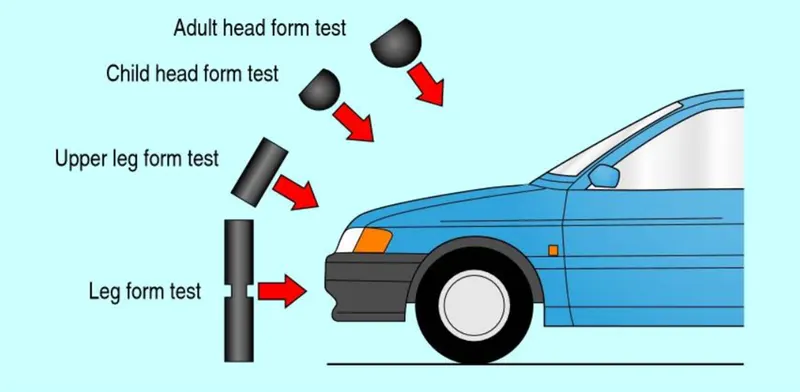
- The most important safety requirement to be considered while designing the Bonnet is thePedestrian Safety from a frontal collision
- Besides functioning as an engine compartment cover, the bonnet of modern vehicles can also help manage the impact energy of a pedestrian’s head in a vehicle-pedestrian impact. However, a bonnet’s ability to absorb impact energy may be impeded by the proximity of the bonnet to components packaged inside the engine compartment, i.e., by its under bonnet clearance. For example, for a given bonnet design, the bonnet’s ability to absorb impact energy through deformation can be significantly reduced when the bonnet and engine block are in close proximity.
- To reduce the death of pedestrian and injuries in the traffic, measures from the automotive industry as well as environmental changes are required. The European Enhanced Vehicle Safety Committee has developed test procedures to estimate the level of pedestrian protection for the front parts of the vehicles. Based on the report, legal requirements have been derived. The European directive consists of head impact, upper leg impact and lower leg impact .To test how good the cars is at pedestrian protection, the car industries performs different tests on the cars that simulate an real life accident with head impact, upper leg impact and lower leg impact. In the hoods perspective, the head impact protection is the most common and is in the highest priority
HOOD STAY:
SUPPORT ROD: In curve bend shape to increase rigidity avoid wobbling with sufficientclearance around the parts provided between the engine compartment and bonnet or inVice-versa position. Supporting rod consist of opening angle, mount and dis mount of therod fixing location. (Bend not less than 35 MM more bend causes reduce in opening angleand rod bends due to hood weight)
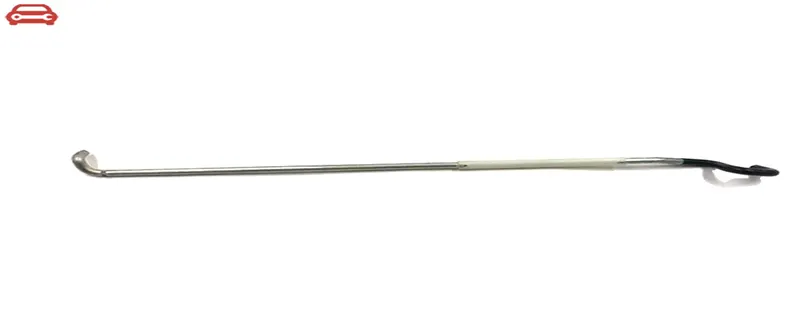
Supporting rod should be arrange opposite side of battery in the engine compartmentotherwise causes difficult during battery replacement.
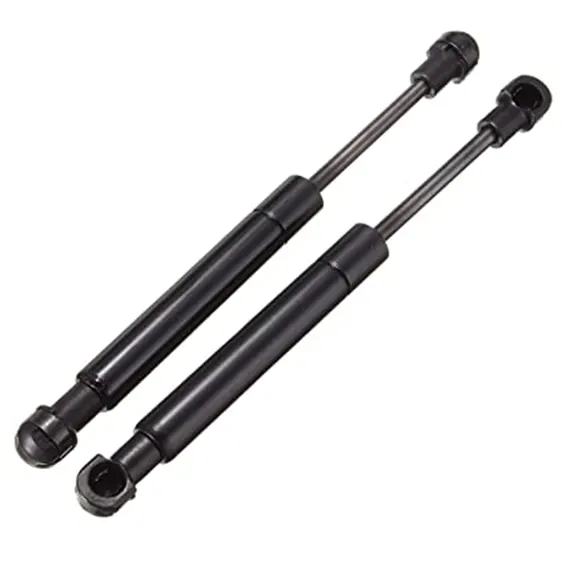
GAS STAY: Use to open the hood with little effort and hold it in open condition, But byadding gas stay will increase weight 500-800gms.
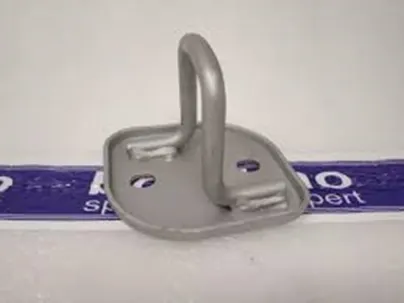
Stricker:Latch is a striker, which is placed over the hood & get attached to the hole provided in engine compartment this is used for locking purpose of hood with engine compartment.
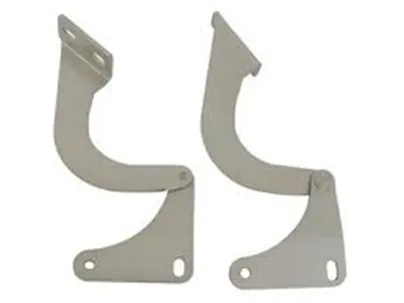
Hinges:Hinge is used for controlling element for opening & closing of the hood, It connects the hood & engine compartment of car. The hood's hinges serve one other purpose be sides holding the hood-safety.
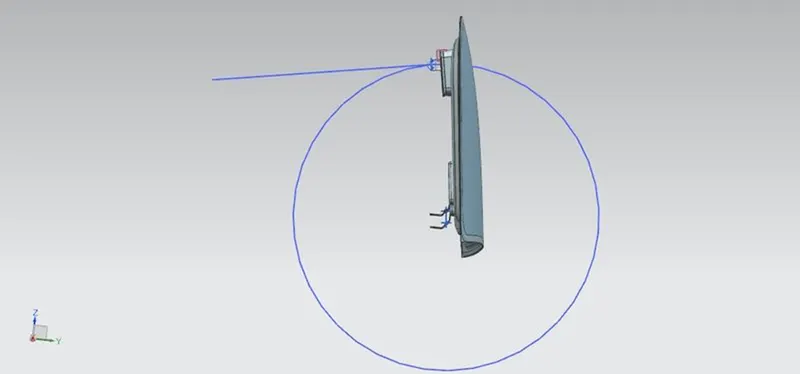
Latch Trajectory:
The latch trajectory is the path which the striker will follow when the hood is open/closed while pivoting on the hinge axis. The latch trajectory is taken as a circle with the hinge axis as the center of the circle. The striker is placed 90 degree such that it is tangent to the circle. Hinge axis should be perpendicular, Latch trajectory helps to define proper closingangle of both stricker and hinges provided in hood.
Striker assembly based on latch trajectory .The hood latch system must be able to catchthe striker of the hood upon closing . It must be tangentially perpendicular to the circle made from hinge axis.This path follow the striker on opening and closing of hood.
Mastic Data:
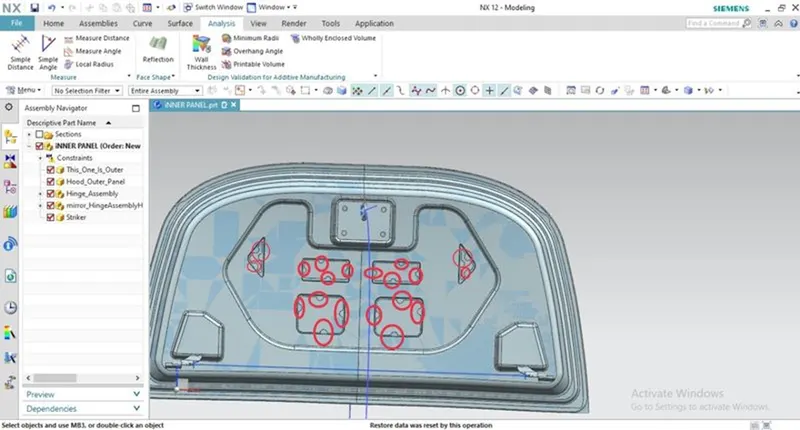
Mastic stiffness area filled with mastic seal between the outer and inner panel around 5MM and every mastic seal able to increase strength of 80MM diameter, the reason for providing mastic at inner panel to maintain the aesthetic look of outer panel. Smallrubber or hard paste applied in between both inner and outer panel after fed in to the furnace the paste gets harder to join the both panel and also improves NVH.
Below image shows the mastic points where the pasteis applied, and it will get hardened in further processes like passing through a furnace, etc. Resulting in a rigid joint.
Hemming:
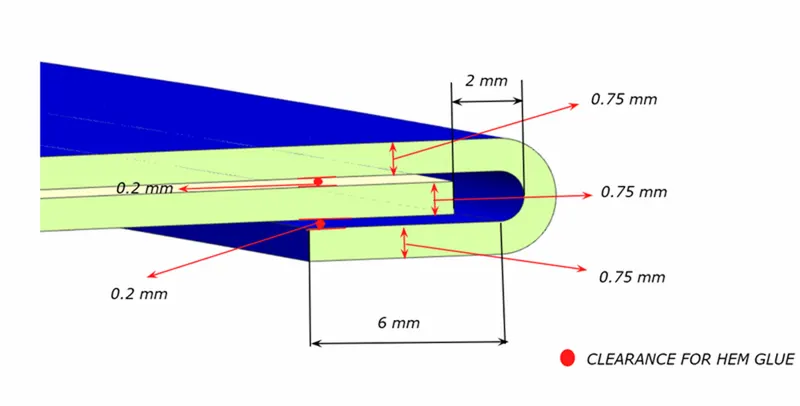
Hemming is a sheet metal forming process in which sheets are joined by bending it usuallyto 180°. Automotive body panels and automotive parts such as deck-lids, trunk-lids, doors, hoods and tailgates are formed by hemming process
The outer panel & Inner panel join by Hemming process. It is the process of bending/folding the flange of the outer panel over the inner one. The flange of the outer panel
Roll hemming : Is carried out incrementally with a hemming roller. An industrial robot guidesthe hemming roller and forms the flange. Roll hemming operation can also be divided intoseveral pre-hemming and final hemming process steps. Roll hemming is very flexible touse and tool costs are significantly lower as compared to those of conventional diehemming. However, the cycle times are much higher since the hemming is realized using ahemming roller which follows a defined path.
In contrast to the conventional press hemming the roller hemming is completed incrementally by an industrial robot driven hemming roller. The advantages of roller hemming against the conventional process are based on technological and economic criteria. Roller hemming allows a more adaptive process, which offers advantages when producing lower numbers of units.
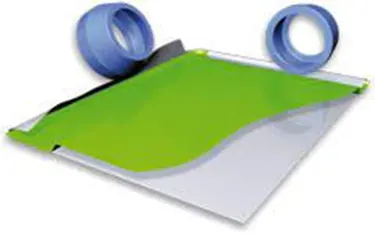
Embossing – Sheet metal embossing is a stamping process for producing raised or sunken designs orrelief in sheet metal. This process is carried out by means of matched male and femaleroller dies, or by passing the sheet or rolls of metal between rolls of desired pattern.
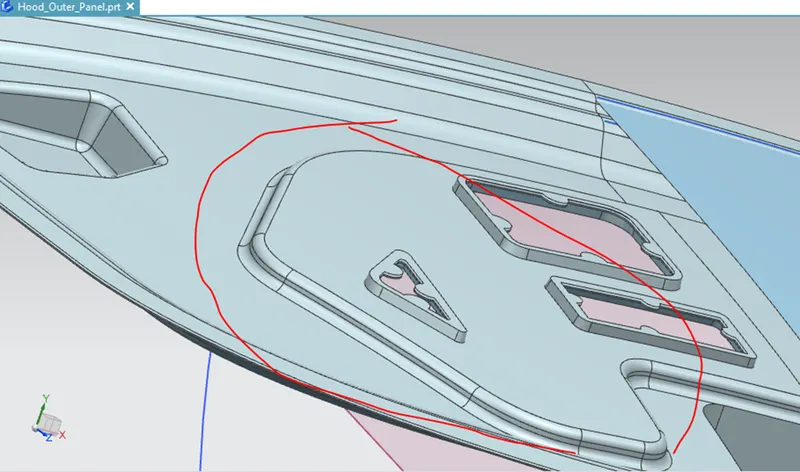
Components of a Car hood –
The hood of a car generally includes –
- Hood Inner panel,
- Hood outer panel,
- Striker and Latch,
So, In order to design the hood we have given some design approach like master sketch ofthe panel by the use of which we can create the inner panel.
INNER PANEL DESIGN:
The inner panel master section was designed based on the master sketch. The innerpanel is the critical part of the hood which acts as a force redirecting medium duringfrontal crash. Hence, it becomes very important to ensure that the inner panel is designedin such a way that the damage caused to the passenger as well as the pedestrian isminimum.
The inner panel consists of different contours known as Emboss & various cutoutsmade on the emboss which reduces the weight of the hood. It also consists of the masticsealants extruded from the cutout edges.
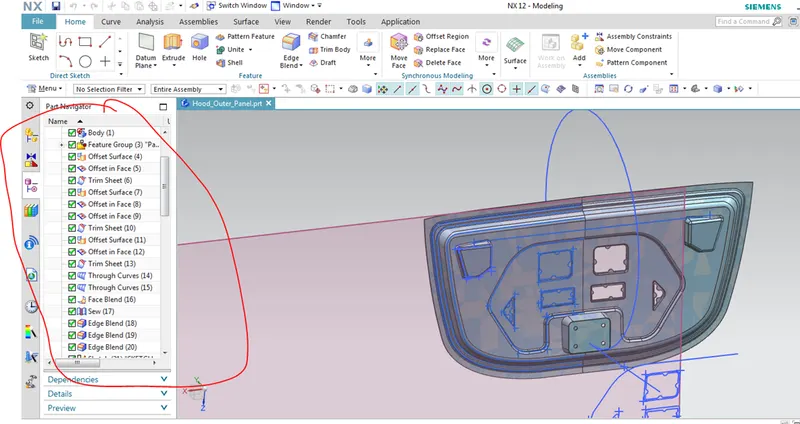
The various commands & features that were used to design the inner panel are given asfollows:
Command Use in NX CAD For Hood Design
- Offset Surface : This command is used to create a surface or a body by offsetting a set offaces.
- Offset Curve in Face : Offsets curves along the faces on which they lie.
- Trim Sheet : Trims off a portion from a sheet body.
- Trim and Extend : Trims or extends a set of edges or faces to the intersection with anotherset of edges or faces.
- Extend Sheet : Extends a sheet body by distance or to the intersection with another body.
- Trim Body : This command is used to trim a portion of a body along a plane or a face.
- Through Curves : Creates a body through multiple sections where the shape changes topass through each section.
- Law Extension : Creates a law-controlled extension from base sheet, dynamically or basedon laws for distance and angle.
- Face Blend : Adds tangent blend faces between selected set of faces based on the radiusspecified.
- Edge Blend : Rounds sharp edges between faces based on the radius specified.
- Projected Curve : Projects curves, edges, or points onto faces or planes.
- Emboss : Modifies a body with faces made by projecting a section along a vector, withoptions for end cap location and shape.
- Curve on Surface : Creates a surface spline feature directly on a face.
- Mirror Geometry : Copies geometries and mirrors them across a plane.
- Sew : Combines sheet bodies by sewing common edges together, or combines solidbodies by sewing common faces.
- Thicken : Creates a solid body by adding thickness to a set of faces
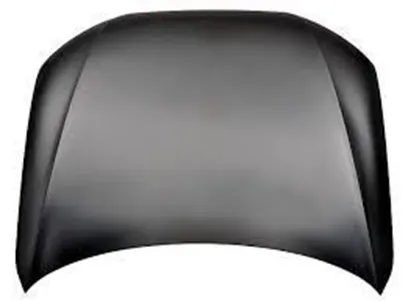
2.Hood outer panel - It is a sheet metal cover which has a streamline and smooth structurefor minimsing the air resistance and for providing good aesthetics. Overall, it affects theperformance of a car in the form of reduced air drag. Its aesthetic design can make the carhave in its arsenal a cool selling feature.
CONCLUSION : In this way, by following the procedure, we designed both panels and set the striker trajectory and the reinforcements necessary and learned the features used incurves, surface and assembly.
We got the good knowledge about the designing of hood.
Succesfully completed the hood designed based on master sketch by using NX CAD. Both the outer and innerpanels designed. Based on given data porper reinforcemets, the final hood assembled using NX CAD software.