Fender Design - Wheel Arch Challenge
Fender Design - Wheel Arch Challenge
Aim: To examine the given fender design & Calculate the Wheel Arch gap at required points and check whether the car passes the European standard.
Abstract:
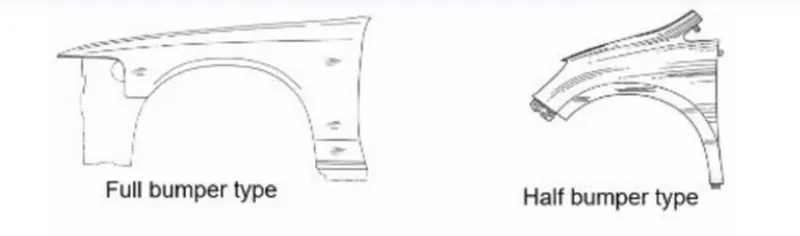
Fender is the part of a vehicle that surrounds the wheel. Apart from being the exterioraesthetic part of the vehicle, its important function is to prevent debris such as mud, gravel,rocks, fluids and other street particles from entering the engine compartment or beingtossed into the air by the high-speed rotating wheel as this can cause damage to theengine components, nearby vehicles, or pedestrian nearby the moving vehicle.There are two types of fenders, full bumper type, and half bumper type.
Wheel Arch in Fender:
The function of the wheel arch is to protect from mud, and stone and during accidents help pedestrians and consider wrap-around distance for head impact.
It is found in the distance from the outermost tyre to the L-shaped brackets in the fender and helps to determine the range of SRL.
Different countries have different standards and regulations for compliance with the wheel arch of fenders, which means the vehicle's use permit requires it to comply with those standards.
Thus, we can see that standards and regulations vary from country to country.
- US regulation,
- European regulation,
- Japanese regulation.
Japan Regulation Requirement:
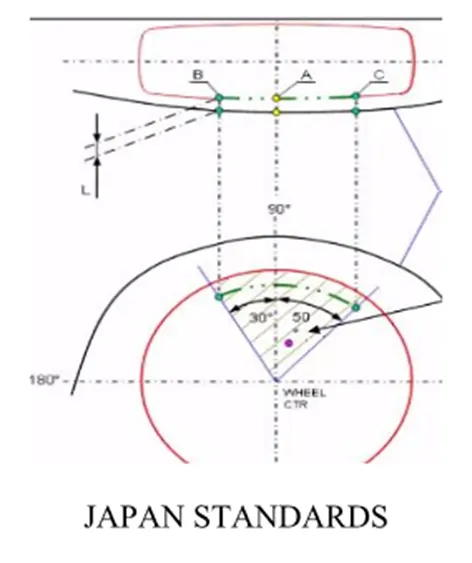
- Define the wheel center.
- Create a perpendicular line. The point projected from side view to top view will be A.
- Take the 50° right and 30° left of the car and project the points from side view to top view (Band C).
- When the region created is projected from the side view to the top view, you allow tohave a gap of minimum 5 mm. The Japan’s government through its regulation team iswho determines that 5 mm value.
- Measure clearance L of tire, hub, cap, and fender in 3 different positions within area K andproduce clearance check chart to validate.
- All these points should have minimum clearance of 5 mm. Clearance must be greater than5 mm in all the 3 positions.
- Wheel Guard Requirement: The value of ‘a’ shall be more than 5 mm at a line 30° forwardand 50° rearward from the central vertical axis of wheel’s axis.
- We will have to do this study and see if the fender is matching. If this is not matching, weshould go with the styling team and ask them again to change the curvature of the fender.This procedure should be followed up to we get the 5 mm gap requirement.
European regulation:
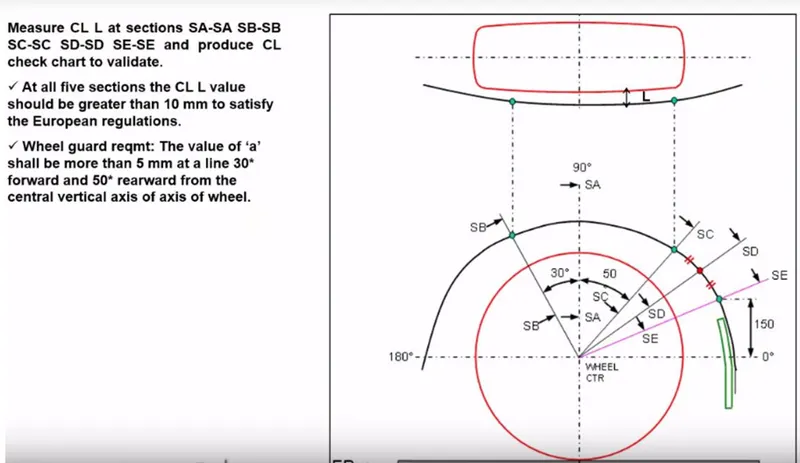
The Clearance ‘L’ should be measured at sections SA-SA, SB-SB, SC-SC, SD-SD and SE-SE and create a clearance check chart to validate, In all the five sections the value of L should be greater than 10 mm to satisfy the European Regulations.
Wheel guard requirement: The value of ‘a’ should be more than 5mm at line 30° forward and 50° rearwards from the central vertical axis of the wheel.
Methodology:
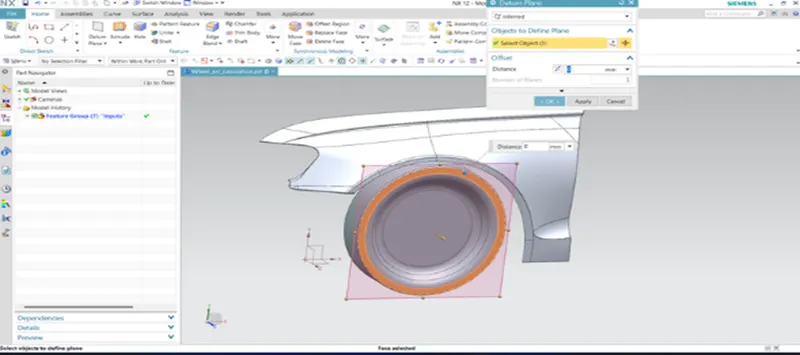
- Create the plane at the outermost edge of the wheel
- Create the sketch on that plane. Take the reference from the outer edge of the wheel andinner edge of the fender.
- Create the axis lines from the center of the wheel at 0, 90 and 180 degrees.
- Consider vertical 90 degrees line as SA. Draw a line 30 degrees forward line SB and 50degrees backward line SC from SA.
- Now create the offset line at a distance of 150 mm from the horizontal line of the wheelcenter and make an intersection point with fender reference. Draw a line from the center ofthe wheel to this point and name it as SE.
- Now create the exact center point between the SC and SE on fender reference. Draw a linefrom the wheel center to this point and name this as SD.
- Now measure the clearance L between these lines and the fender outer edge in thedirection parallel to the axis of the wheel. Create the checklist.
- Also, measure the value of 'a' from SB and SC sections to the edge of the fender in the direction perpendicular to the axis of the wheel. Create the checklist.
Measure CL L at sections SA SB SC SD SE and produce CL check chart to validate:
Sections SA:
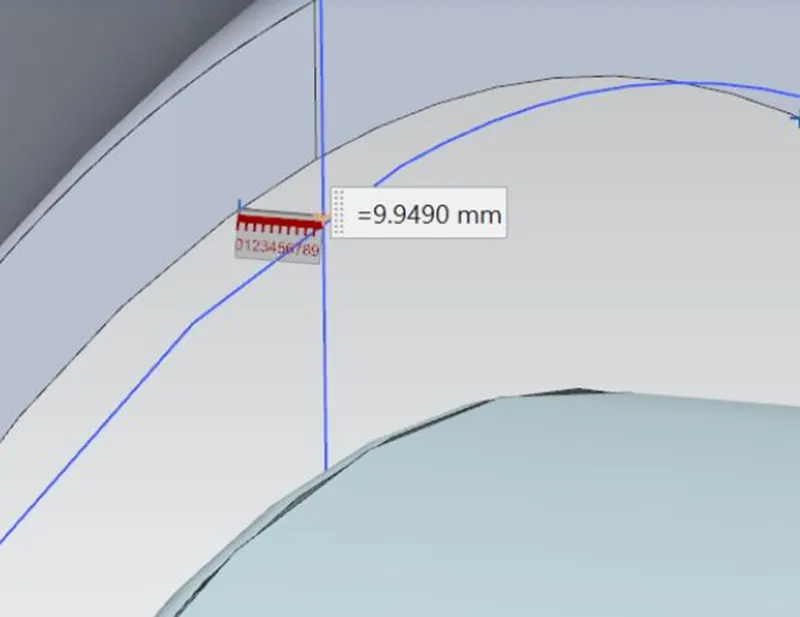
CLEARANCE L at sections SA is 9.94 mm WHICH IS =10 mm from wheel to wheel archer.
Section SB:
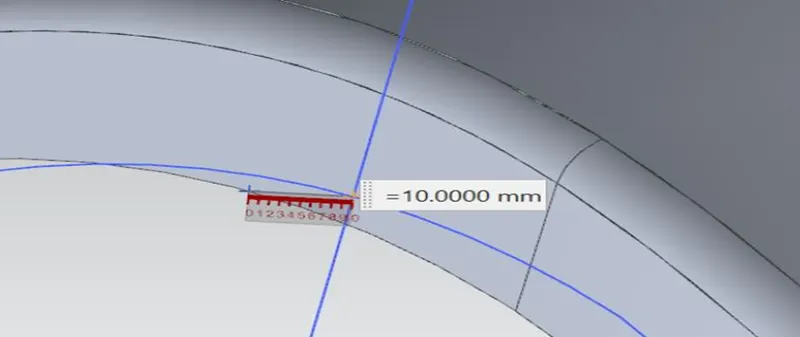
CLEARANCE L at sections SB is 10 mm from wheel to wheel archer.
Section SC:
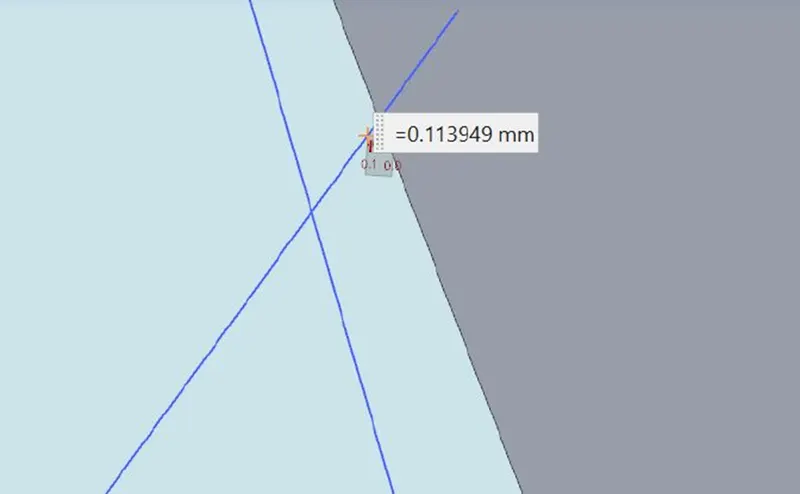
CLEARANCE L at sections SC is -0.11 mm from wheel to wheel archer.
Section SD:
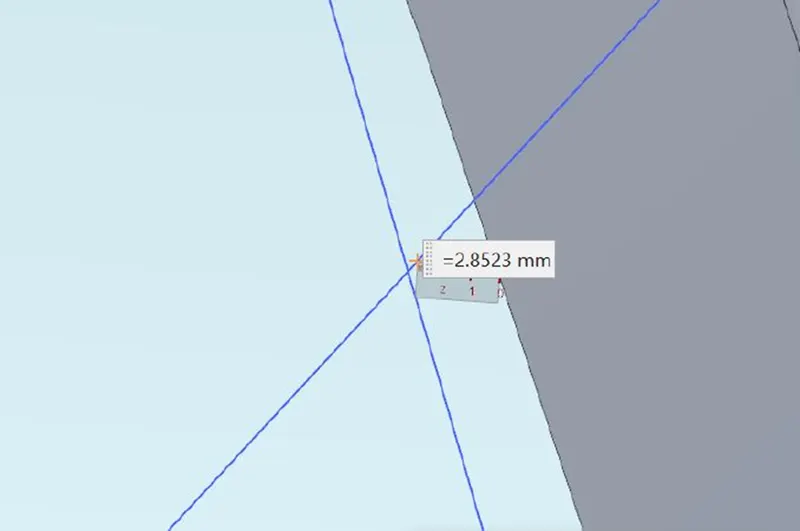
CLEARANCE L at sections SD is -2.8 mm from wheel to wheel archer.
Section SE:
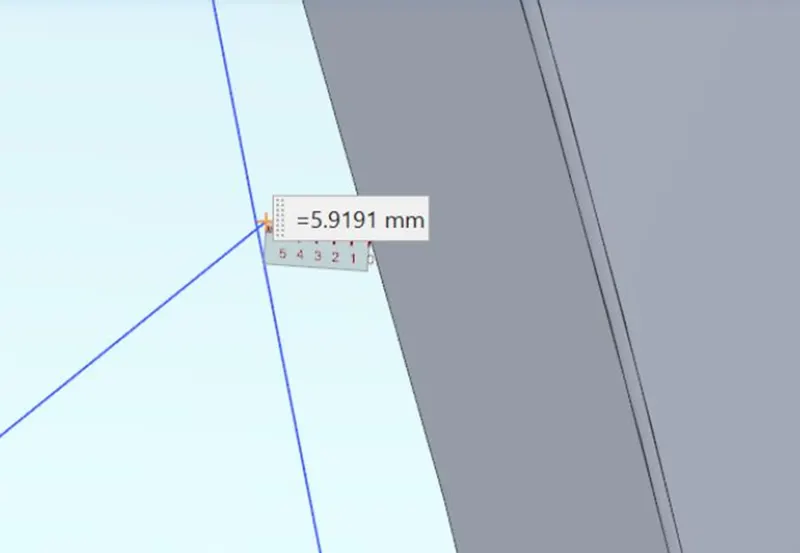
CLEARANCE L at sections SE is -5.9 mm from wheel to wheel archer.
Checking whether the front fender wheel arch meets the standards:
|
Position |
Observed clearancevalue(mm) |
Required clearancevalue(mm) |
Passes the requirement? |
|
SA |
9.949 |
10 |
Fail |
|
SB |
10 |
10 |
Pass |
|
SC |
-0.113 |
10 |
Fail |
|
SD |
-2.8523 |
10 |
Fail |
|
SE |
-5.91 |
10 |
Fail |
Conclusion:
Hence from the above results we can conclude that the fender does not pass the European regulations, as the minimum clearance L between the fender wheel arch and wheel for vehicle and pedestrian safety is 10 mm and this design does not meet the requirement.