Section Modulus calculation and optimization
SECTION MODULUS CALCULATION AND OPTIMIZATION
Aim:-To Calculate the section modulus for the previously designed hood and optimized hood.& To Come up with the new section that has improved section modulus of the previous section.
INTRODUCTION:
Section modulus is a geometric property for a given cross-section used in the design of beams orflexural members. Other geometric properties used in design include area for tension and shear,radius of gyration for compression, and moment of inertia and polar moment of inertia for stiffness.Those properties are
- Centre of Area (or centroid)
- Second Moment of Area or Moment of Inertia (I)
- Section Modulus (S)
- Radius of Gyration (r)
Though generally section modulus is calculated for the extreme tensile or compressive
fibres in a bending beam, often compression is the most critical case due to onset of
flexural torsional buckling. Generally tensile extreme fibres have a higher allowable stress or
capacity than compressive fibres.
Centre of area (or centroid):
The centroid of a section is important in structural design and is like the centre of gravity of the shape. Many other simple shapes are symmetrical about the x-x and y-y axes and the centroid can easily be seen.
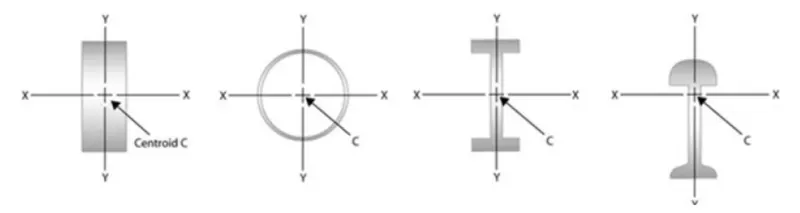
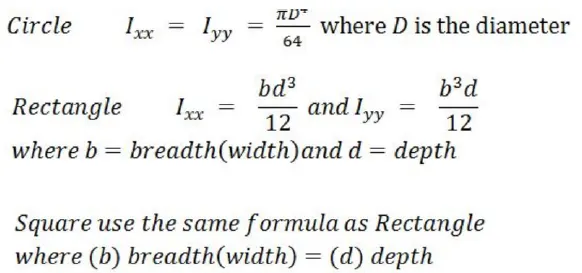
Second moment of area or moment of inertia (I): The second moment of area is a geometrical property of an area which reflects how its points are distributed with regard to an arbitrary axis. The second moment of area is typically denoted with either an I The second moment of area is also known as the moment of inertia of a shape. It is directly related to the area of material in the cross-section and the displacement of that area from the centroid. Once the centroid is located, the more important structural properties of the shape can be calculated. The axis that determines the centroid is also known as the neutra axis (N/A). The second moment of area is a measure of the 'efficiency' of a shape to resist bending caused by loading. A beam tends to change its shape when loaded. The second moment of area is a measure of a shape's resistance to change.
Section modulus (S): The section modulus of the cross-sectional shape is of significant importance in designing beams. It is a direct measure of the strength of the beam. A beam that has a larger section modulus than another will be stronger and capable of supporting
greater loads. section modulus is denoted by S. To calculate S, the distance (y) to the extreme fibres from the centroid (or neutral axis) must be found as that is where the maximum stress could
cause failure.
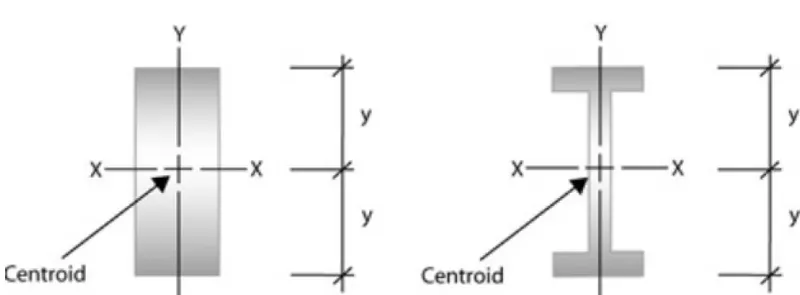
where I = moment of inertia, y = distance from centroid to top.
For symmetrical sections the value of S is the same above or below the centroid. For
asymmetrical sections, two values are found: S max and S min.
Radius of Gyration (r): This is another property of a section and is also a function of the
second moment of area. Put in general terms, the radius of gyration can be considered to
be an indication of the stiffness of a section based on the shape of the cross-section when
used as a compression member.
The radius of gyration is used to compare how various structural shapes will behave under
compression along an axis. It is used to predict buckling in a compression member or
beam.
The formula for the radius of gyration r is:

in mm
where I = second moment of area
A = area of material in the cross section
OUR MODEL:
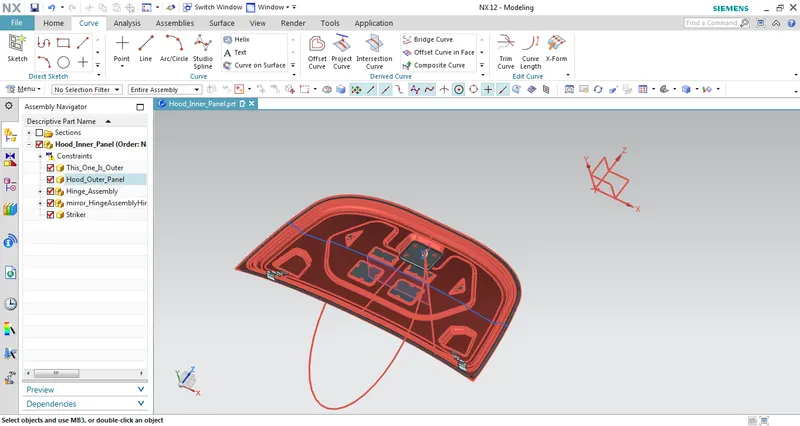
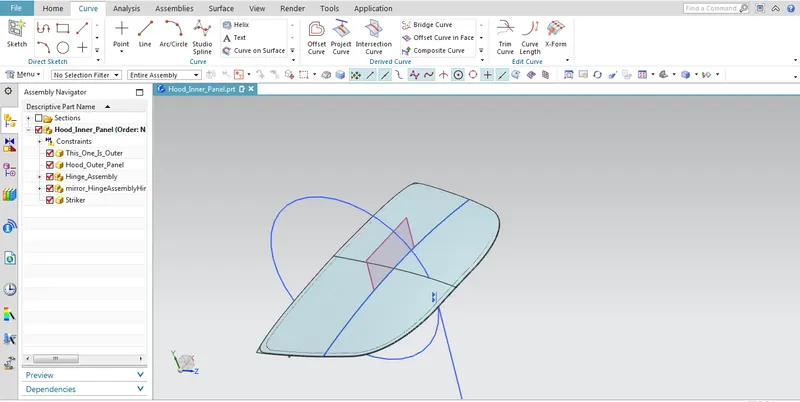
We have a hood model. We are going to calculate the section modulus for this hoodand optimize and calculate again.
PROCESS:
- First create a plane in the centre of hood then and take inter section curve for the hood withrespect to this plane. This curve is not fully closed. So, go to sketch.
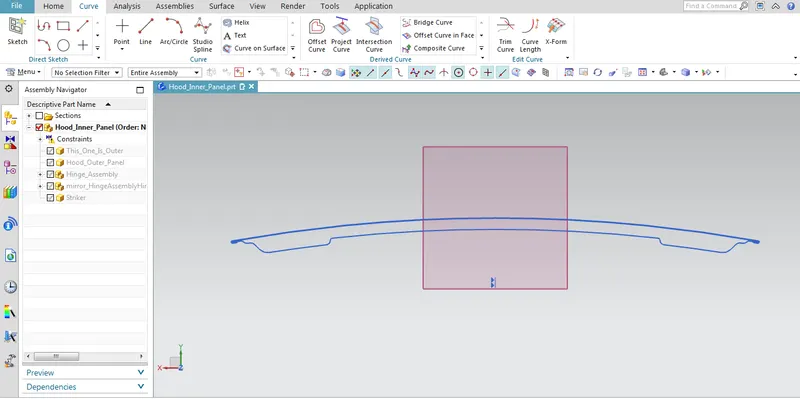
- Create a sketch in the created plane project the intersection curve and fill the gap by lines.
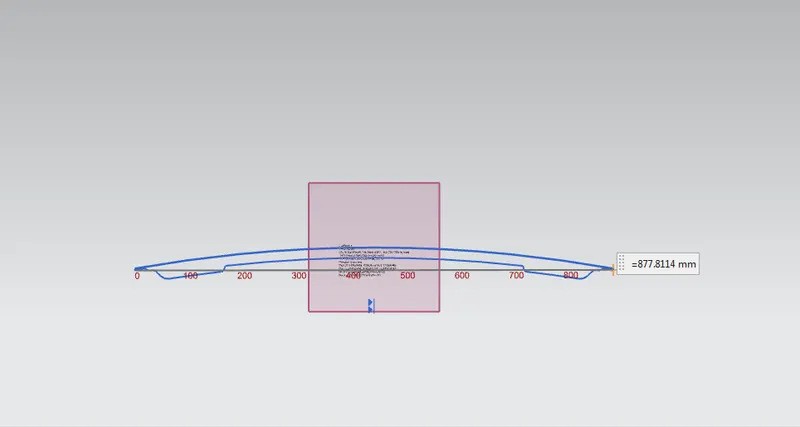
- Extend and trim the lines to create a full closed curve. Reference lines draw and measure the length of h
- Section inertia tool is used to get moment of inertia of the model. It is used to calculate thesection of modulus by the formula.
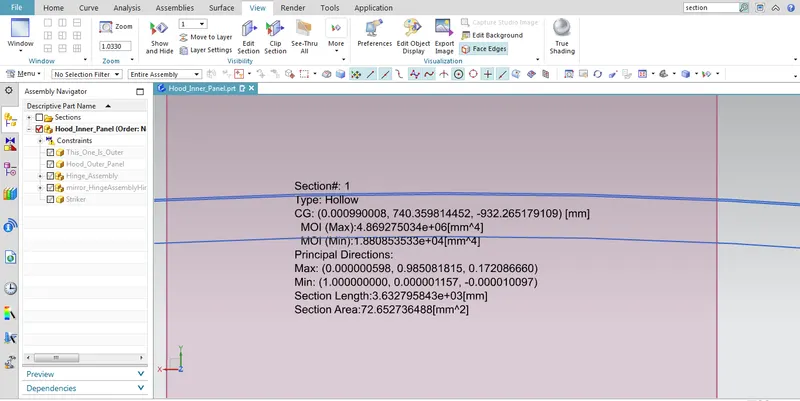
In this case we have got this result
- Maximum moment of inertia: 4.869275034*10^6mm^4
- Minimum moment of inertia: 1.880853533*10^4mm^4
- Hood length: 877.8114 mm
We should take minimum value for section modulus calculation.
Y= L/2 = 877.8114 mm / 2
Y = 438.9057 mm
Section modulus = 1.880853533*10^4mm^4 / 438.9057 mm
S = 0.0042853*10^4 mm^3
S = 42.583 mm^3
Optimized Hood:
We have offset the projection curve at 0.5mm and calculate the section modulus.
In this case we have got this result
- Maximum moment of inertia: 4.86345034*10^6mm^4
- Minimum moment of inertia: 1.950853533*10^4mm^4
- Hood length: 877.8114 mm
We should take minimum value for section modulus calculation.
Y= L/2 = 877.8114 mm / 2
Y = 438.9057 mm
Section modulus = 1.9503588*10^4mm^4 / 438.9057 mm
S = 0.0042853*10^4 mm^3
S = 44.436 mm^3
CONCULATION:
Moment of inertia and section modulus are successfully calculated and compared with optimized model. When we increase the crosses section area of the hood, moment of inertia and section of modulus increased. So, strength also increased. We have concluded that while we offsetting the inner panel at 0.5mm in downside (optimized) we get result better than previous model.
Hood should design in such a way that it should absorb all maximum loads when a crash happens. So while designing we have design in such a way that it should not be more stiffeand not more weeker.
This concludes the calculation and optimization of the section modulus of the hood design.