Hood design-Week 2
Challenge - HOOD DESIGN
Aim: - The main objective of this project is to learn the essential tools, commands, and surface modeling of Hood designing using Siemens NX Cad. This project is to develop a design idea for hood BIW that satisfies the manufacturing requirements, functional requirements, and EURO NCAP standards.
Introduction: - Hood is the engine cover hinged to the car's body (front-engine automobile). It gives you access to the vehicle's engine and is also vital for safety against the frontal impact of the car.
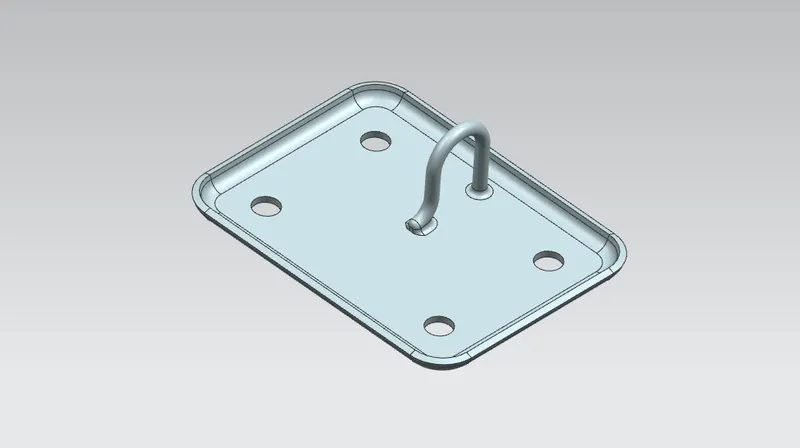
The hood (North American English) or bonnet (Commonwealth English) is the hinged cover over the engine of motor vehicles. Hoods can open to allow access to the engine compartment or trunk on rear-engine and some mid-engine vehicles for maintenance and repair. Generally, the passenger car hood may be held down by concealed Latch. But in a race car or car in aftermarket, the hoods may be held down hoods pin. Hoods sometimes also contain a hood scoop, wiper jets, power bulge, and/or hood ornament. Car hoods are typically constructed from steel and sometimes from aluminium. Aftermarket car hoods may be formed from other materials, including carbon fibre, fibreglass, or dry carbon. The hood design may vary from one make and model to another SUV. The hood is also designed for several requirements. A car hood is meant to protect the performance parts of your vehicle, including the engine, while also providing easy access for repairs and maintenance. They serve a great deal of purpose in protecting the passenger inside the car and the pedestrian in the event of an accident. The hood can incur damage as well.
Types of hoods support
There are two types of support available for the hood support
- Gas Stay
- Support Rod
Gas Stay
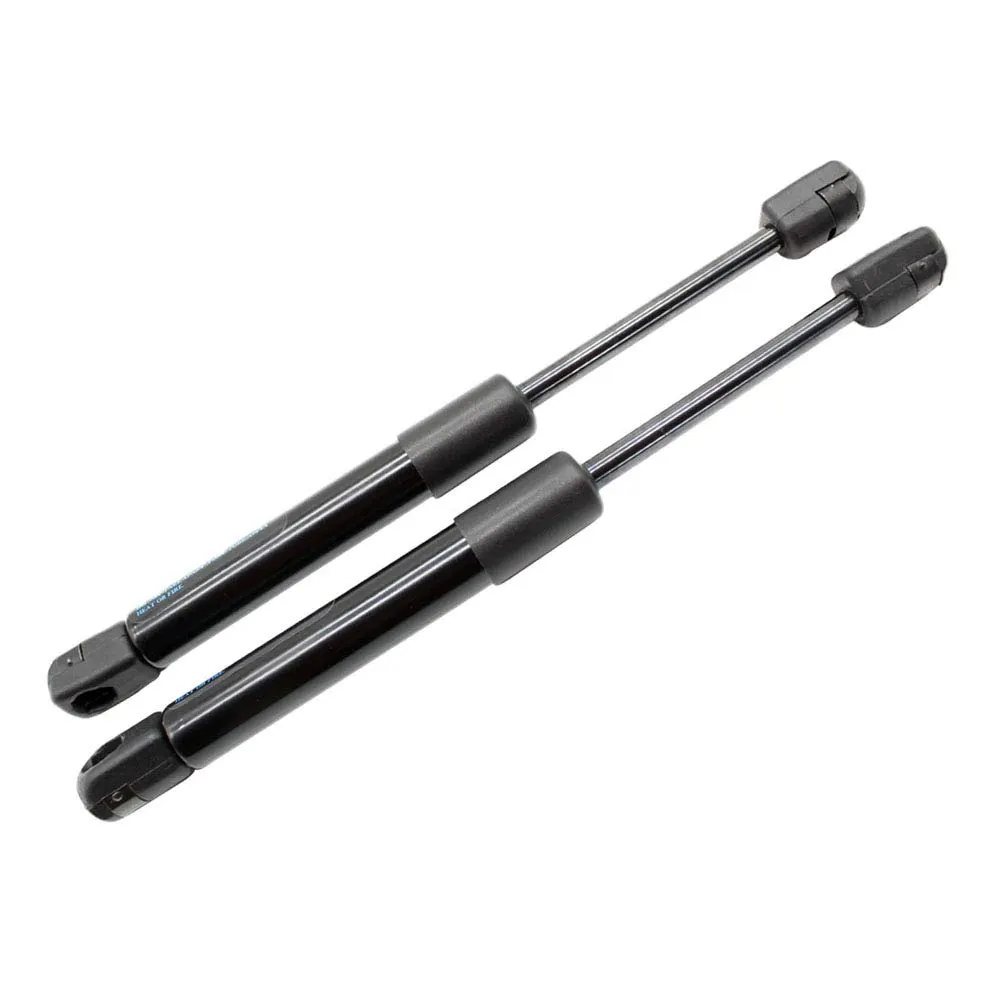
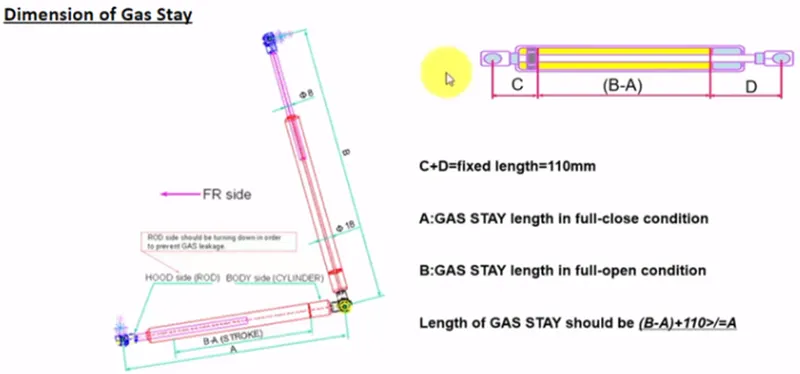
Gas Stay Gas stay is the device for supporting the engine hood of a motor vehicle in its open position using an actuator activated by gas. This is mainly used when the car hood is heavy. In this, no men's power is required. Spring stays are designed to be used on upward-lifting doors; once the door is open n slightly, the spring will push the entrance to the fully open position. Euro fits stock various size springs depending on the door size requirement.
Support Rod
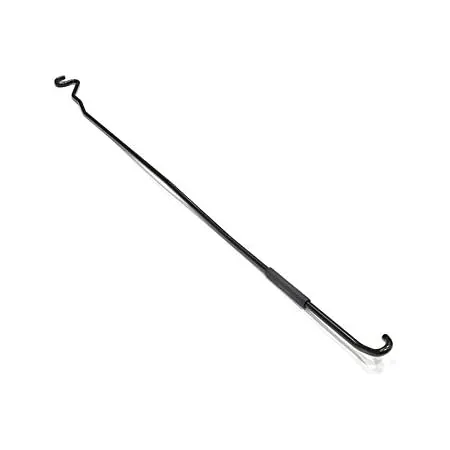
A support rod is a device for supporting the engine hood of a car in its open position using a rod. This is mainly used where the car bonnet weight is negligible. We have to lift the hood ourselves and place the support provided either in the hood or the engine component.
Design constraints to be followed: -
- Passenger safety
- Pedestrian safety
- Manufacturing feasibility
- Position the striker along the Trajectory of the centre of the hinge axis.
- Joining techniques of the inner and outer panel.
Passenger Safety Whenever a frontal crash occurs in the car, the first part affected will be the hood. So must be designed in such a way that it should not come from the body of the vehicle and must absorb the energy as far as possible ad divert the force towards the side panel of the car so that the amount of force which is sent to the cabin is lesser since the force lesser the passenger will experience less amount of force so that passenger safety is ensured.
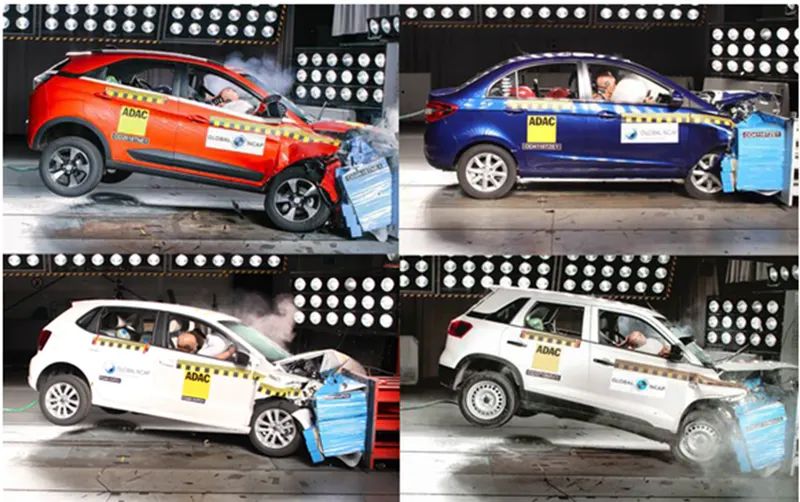
Pedestrian Safety Safety of the pedestrians needs to be considered during the design as per the NCAP Euro assessment. Hood is of two types based on the side reference line. The side reference line is an imaginary line drawn from the ground at an angle of 45degree. If this line falls on the fender, then the hood is inlaid, and if the line falls on the hood, the hood is wrapped around the hood.
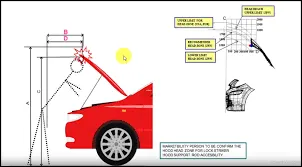
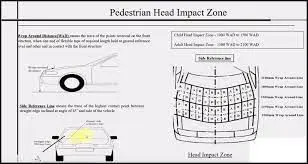
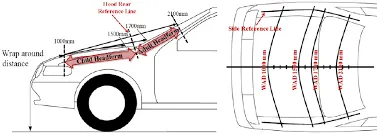
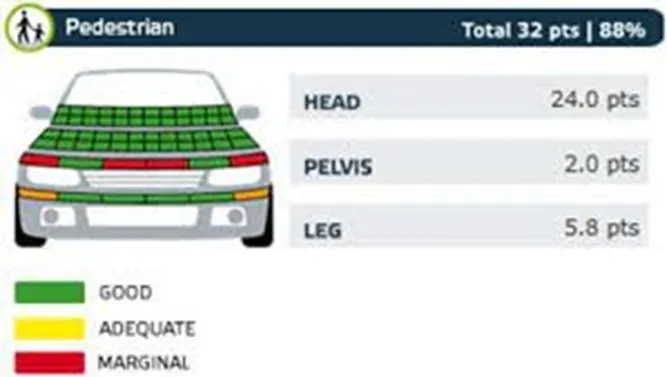
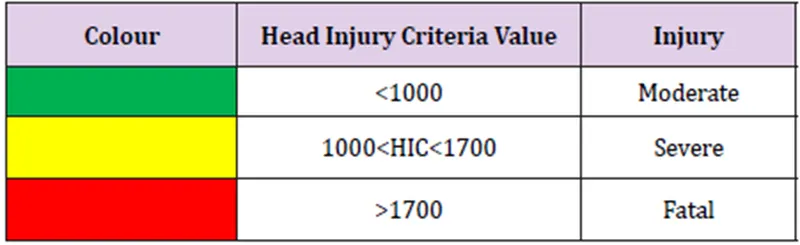
Child and adult impact areas on the hood are defined by wrap-around distance. The space between the wrap-around length of 1000- 1500mm in the child head impact zone and from 1500-2100 WAD is the adult head impact zone. We know the area where the pedestrian going to be hit; as a design engineers, we must make sure that they are exercising the most minor force such that they were not getting any serve injury without compromising the strength of the hood so that passenger safety must be assured.
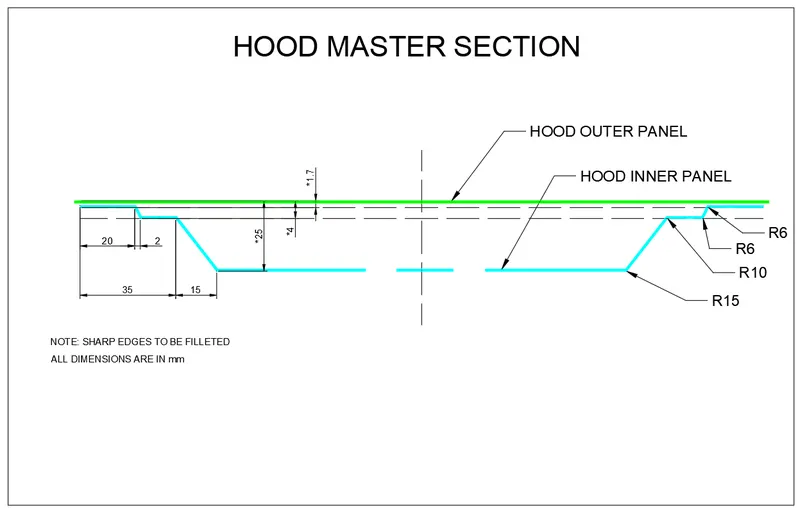
The Head impact area is defined as the side reference line and wrap-around distance. This zone will get a red, yellow, and green rating using the head injury criteria calculated using the expression. For this reason, the inner panel kept 25mm from the outer panel and created the embosses to improve the strength of the hood.
Components of Hood
1. Outer Panel
2. Inner Panel
3. Hinge
4. Latch
5. Reinforcement
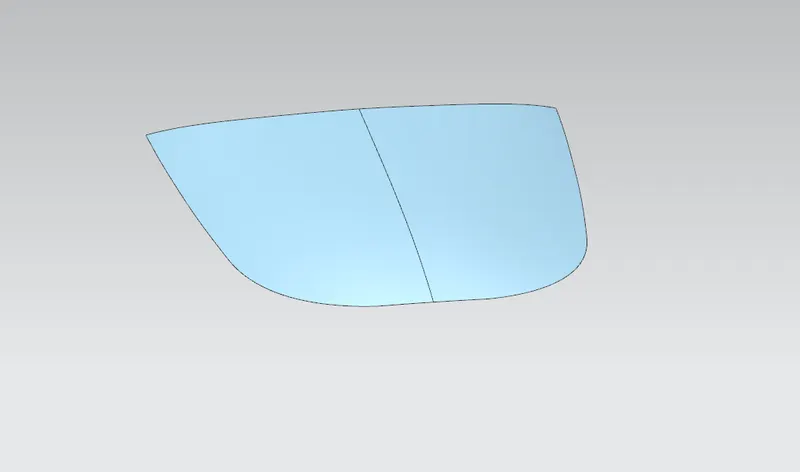
Outer Panel - A car hood panel is one of the most important components of the BIW (body in white), it is considered the closure sheet-metal component. The outer panel has the aesthetic look to it but on its own is very weak and not capable of handling force during impact. Most automobile hood outer panels are made of traditional steel plates, and their quality does not meet the needs of lightweight development. For this reason, it is necessary to obtain lightweight effects through the application of automotive aluminium sheets. The most widely used car aluminium alloys in the market are deformed aluminium alloys of 6111, 6016, and 5182. The production process of the outer panel of the hood mainly includes blanking, deep drawing, trimming, turnup, and side turnup. Among them, deep drawing is a key process to ensure the quality of parts.
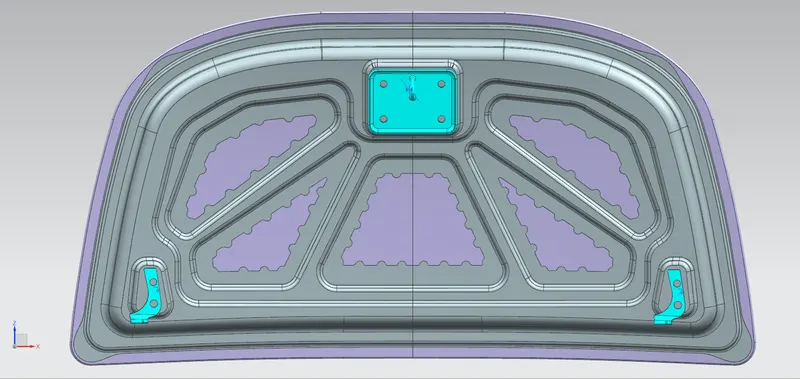
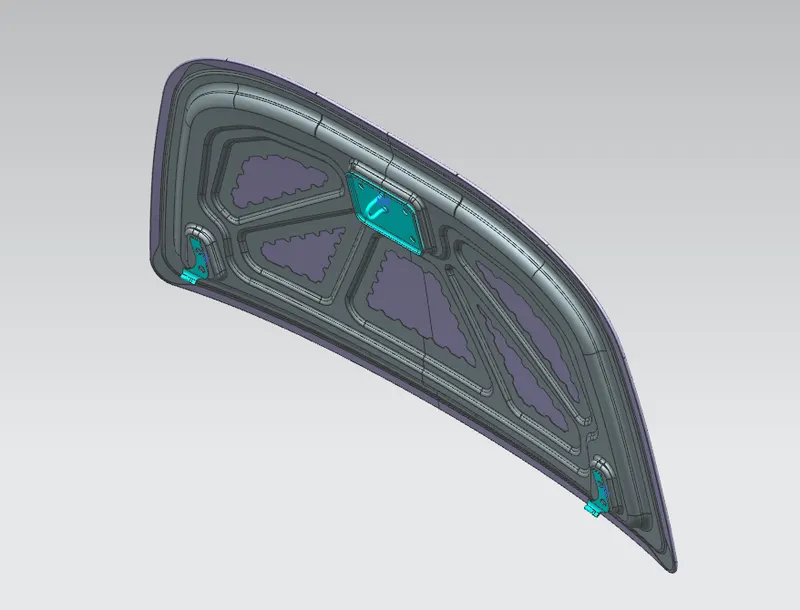
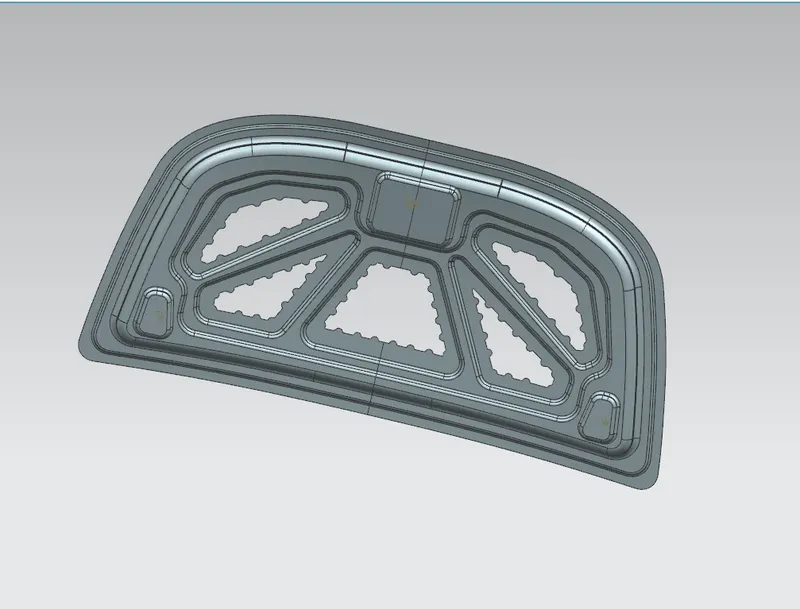
Inner Panel – The inner panel of the hood is not visible to the customer, but this is the engineering feature of the outer panel. The hood panel is required to have a high initial reaction force against the impact exerted on the hood to enhance the energy absorption capacity. The hood is further required to minimize a reduction of a reaction force by deformation in a collision. A hood inner panel according includes an inner panel main body forming part of a hood of a vehicle, a front bead provided on the inner panel main body and extending along a vehicle width direction, and a rear bead provided on the inner panel main body, located on a rear side of the front bead and extending along the vehicle width direction. The front bead includes a center portion in the vehicle width direction that is curved toward the front of the vehicle and located in front of each end portion in the vehicle width direction, and the rear bead includes a center portion in the vehicle width direction that is curved toward the back of the vehicle and located behind each end the portion in the vehicle width direction.
Hinge - A hinge is a machine element that connects two bodies allowing angular movement about a fixed axis of rotation, all the while preventing translations and rotations on the remaining two axes. A hinge can be considered as a journal bearing with only one degree of freedom where a shaft is rotating in a hole. Hinges only allow one rotation, either yawing (the most common), pitching, or rolling. Hinges are a jointed and flexible device that is attached to any swinging part. Hinges are mechanical bearings that are used to connect two swinging objects or points and give them the freedom to move relative to each other. Hinges have limited movement, allowing the joint to move only at one angle and restricting the other movements of swinging parts.
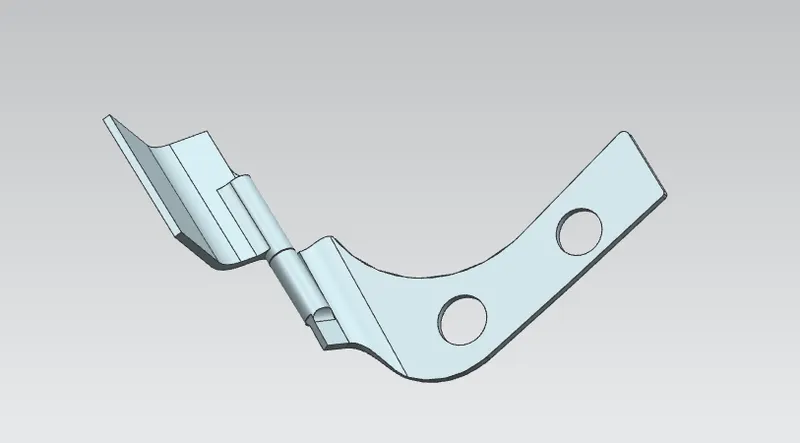
Latch - Latchesare mechanical components that allow the temporary joining of parts that are moving relative to each other. They are actuated to release the coupling and allow the two parts to separate. Latches are mostly seen on doors and enclosure openings. They are also used in devices such as seat belts, clamps, straps, and objects with retractable parts. Different designs feature various methods of actuation, holding style, and mounting. The hood latch is extremely simple. When the hood is closed, the latch slides over what is called a catch, and spring covers the latch to keep it snug. When we pull the knob inside the car to open the hood, the hood latch cable opens the latch, allowing it to bypass the catch and open.
Data used-
Hood Thickness
- Outer Panel thickness=0.75
- Inner panel thickness-0.75
- Reinforcement thickness =1.5
Master Sketch: -
Design Approach: -
The styling gathering will give us the skin data. The arranging engineer will mull over the engineering common sense of the part with furthermore considering the NCAP standards and will provide analysis so they can change the styling of the hood properly.
The master sketch territory is obliged different areas. Moreover, various predefined values are given to us as demonstrated by which we need to engineer and plan the sketch and model the hood.
Starting there forward, the CAE engineer will do an examination and testing on the part shown and subsequently report analysis to the hood engineer and make the significant changes.
Parts description: -
Deep drawing In this corporation, a sheet is pulled into the ideal shape using a punch and pass-on gadget. The sheet is outlined in the condition the pass on by driving the punch down on it. To avoid the sheet wrinkling itself, the sides of the sheet are held someplace close to folios. In the automotive industry, deep drawing is usually carried out using rigid tools.
Latch Trajectory The latch trajectory shows the striker's way when the hood is opened and shut on a vehicle. The range of the round Trajectory is controlled by the set standard dependent on the typical stature of an individual. The range is estimated from the pivot hub up to the Latch. It is the Trajectory on which the movement of the hood (opening and closing are dependent). This circular Trajectory has a radius equal to the length from the centre point of the centre axis of the Hinge to the striker point on Latch. The striker point is also tangent to the Trajectory.
Mastic sealant: The mastic points are regions where mastic interferes with the outer panel to the inner board. We can't use spot welding because this gives less elegantly fulfilling results. Accordingly, mastic is used to join the panel as it doesn't modify the actual metal.
Embosses: - The design of embosses is done by the force distribution of frontal impact. It is designed so that the reduction of force starts when it is directed till the corner, i.e., up to the hinges, and loses the maximum amount (of force) till the end.
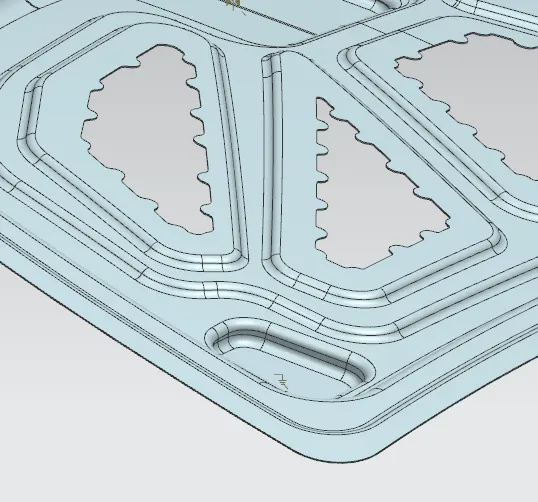
Reinforcement: - The Zone near the turn and Latch has more chances of disillusionment in the hood panel. Consequently, to avoid any failure to rotate and latch region upheld with extra materials whose thickness is regularly directed by the vehicle. The reinforcements give additional fortitude inner panel of the centres where various parts, for instance, the lock and rotate, will be put. The reinforcement ensures that the turns and the snare have better assistance to avoid frustration.
Hemming: - The Heming process involves joining the outer and inner panels of the hood by bending their corner curvature areas to 180 degrees. There is also some corner relief given to the sheet to get stationed so that the rollers that do the Heming of sheets can roll appropriately in the required area. Hemming is a sheet metal operation widely used in the automobile sector because the welding or joining process can not be done on styling parts as it may affect the car's aesthetics.
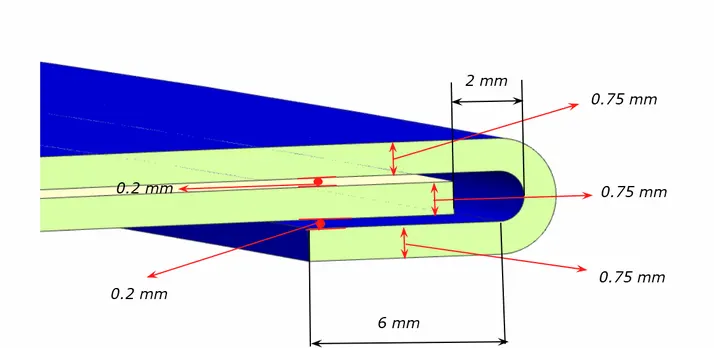
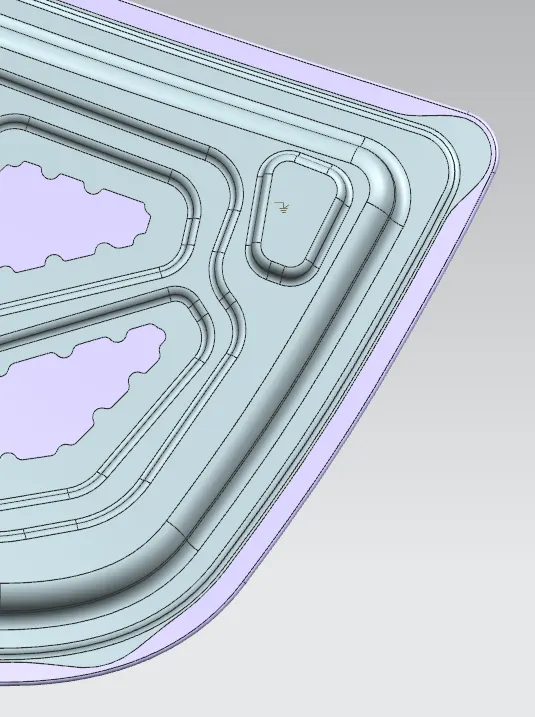
Reliefs: - Reliefs are provided at the front and side portion of the panel for smooth rolling operation .so that no tearing of the sheet happens when the roller passes through a specific portion.
Tools:
- Offset surface- The offset surface gadget copies the picked surface at a provided distance and guidance.
- Emboss- The embossing contraption makes a punched surface of the picked shut contour. The punch is produced using a chosen surface containing the contour surface. Sketch. a draft can be obliged the punch from either the end cap or the base surface.
- Trim sheet- The trim sheet gadget parts the target surface along the intersection curve of the target surface and the gadget surface. The piece of the cover on either side of the intersection can be either discarded or retained according to need.
- Through curves- This contraption creates a surface between two various surface sections where the shape can change in section.
- Law Extensions- Creates an extended surface subject to an open-chain contour or a shut contour on the picked target surface. A draft can be obliged by the extension.
- Face blend- Creates a curved blend or fillet along two picked surfaces in gave direction vector. The blend curve can be changed regarding reach, width, and continuity.
- Extend sheet- Creates an extension of the picked sheet up to a given distance.
- Offset in the face- Creates an offset in the front or edge on the target face up to a provided distance.
- Bridge curve- Create a roundabout portion between two intersecting and non-intersecting curves. The beginning and endpoint of the roundabout changed by providing distance.
- Projected curve- Creates a projection of a curved profile onto a goal surface. The surface can be linear and curved. The direction can be changed by a reasonable vector.
- Sew- combines sheet bodies by sewing common edges together or combines solid bodies using sewing faces. Any opening between the surfaces can be closed.
- Mirror Geometry- Mirror a geometry along a face.
- The curve on the surface- Creates a surface spline feature directly on the face.
- Thicken- creates a strong body using thicken.
- Extracted body- Creates a body of picked geometry that can be changed by editing the parent feature and rebuilding the extracted feature.
HOOD INNER PANNEL
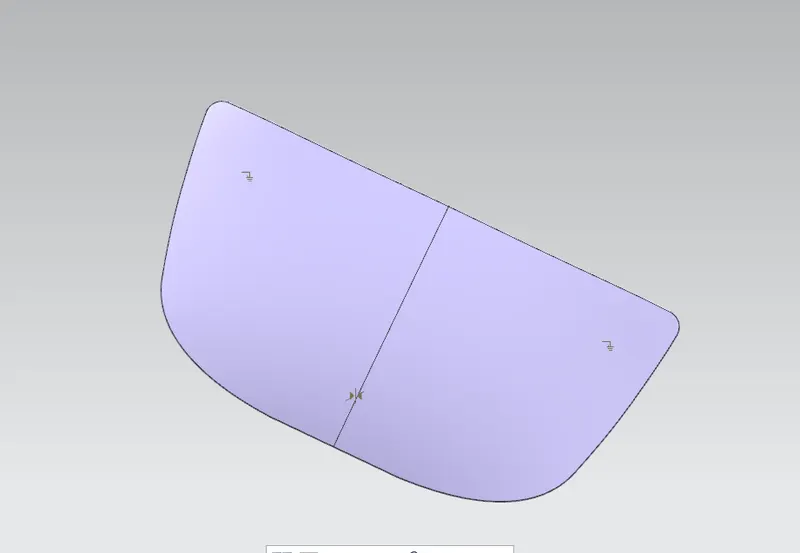
HOOD OUTER PANEL
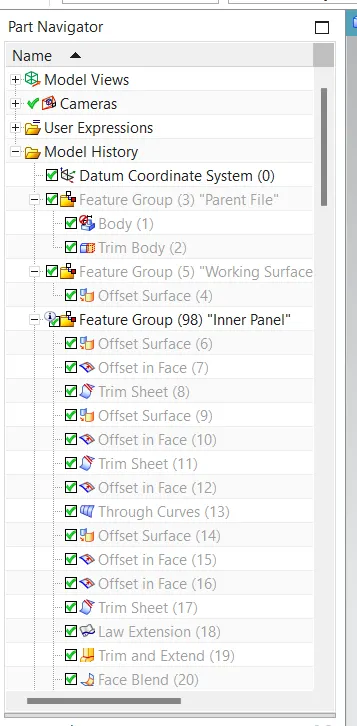
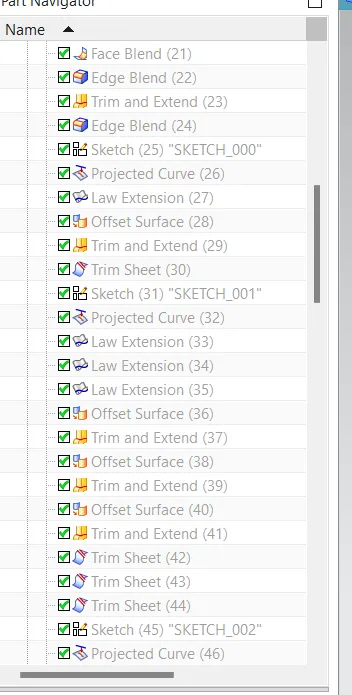
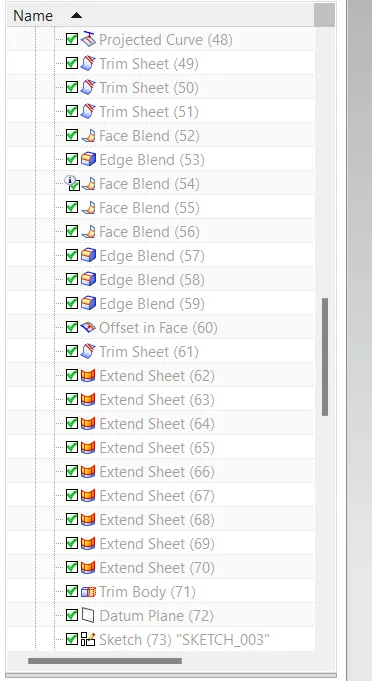
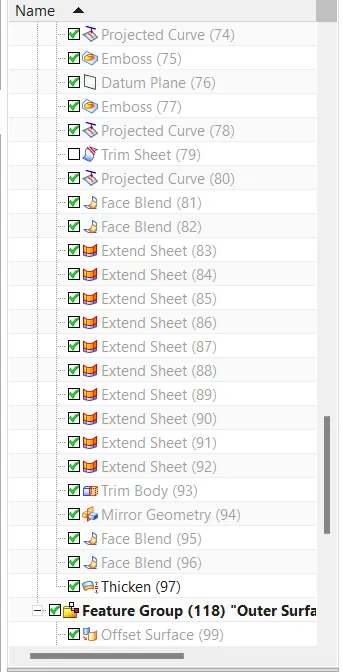
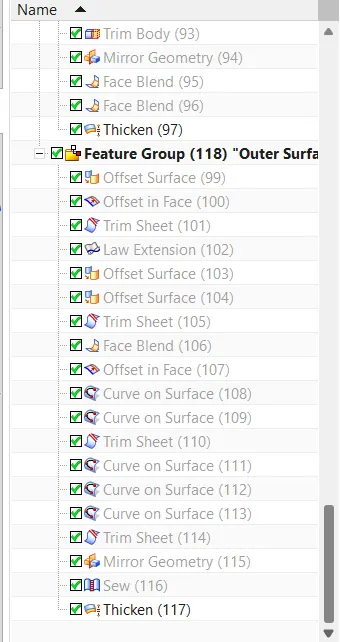
TREE STRUCTURE
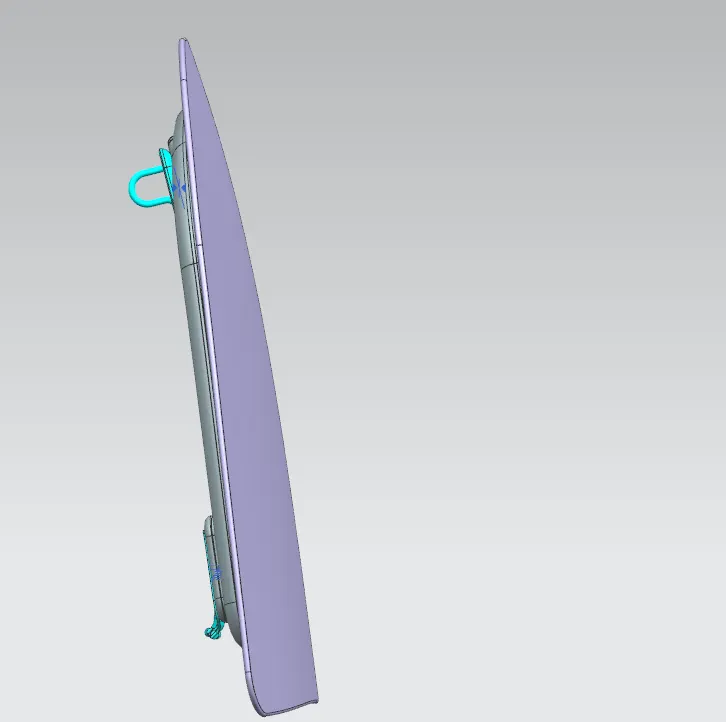
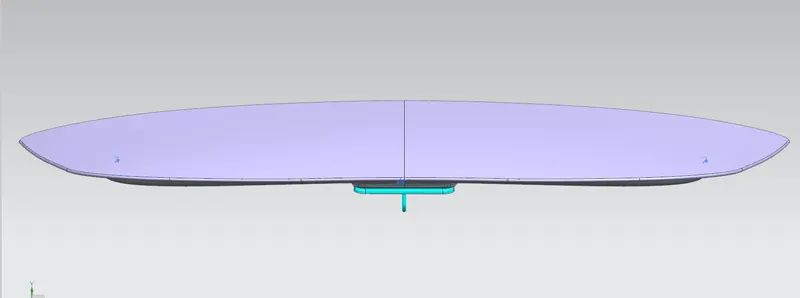
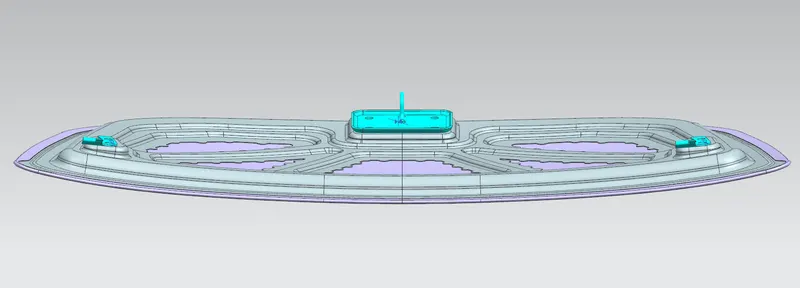
HOOD DESIGN ASSEMBLY -