Hood design-Week 2
Indroduction
A car hood, also referred to as a bonnet in some other countries, is the hinged cover that rests over the engine of a front-engine vehicle. Its purpose is to provide access to the engine for repair and maintenance. A concealed latch is typically used to hold down the hood. On vehicles with an aftermarket hood and on racecars, hood pins may be used to hold down the car hood. Hoods sometimes also contain a hood scoop, wiper jets, power bulge, and/or hood ornament. Car hoods are typically constructed from steel and sometimes from aluminum. Aftermarket car hoods may be constructed from various other materials, including carbon fiber, fiberglass, or dry carbon.
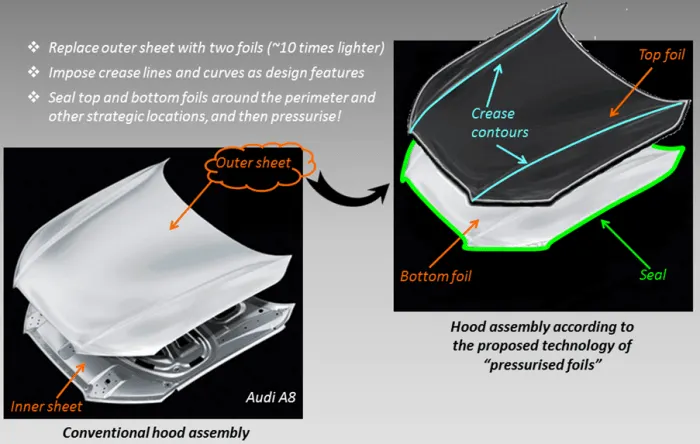
oncerns regarding the severity of a potential pedestrian head injury during a collision with a motor vehicle have led to advanced hood designs on many models. Such designs may include a multi-cone inner hood panel design. An active structure that is capable of pushing the surface of the hood away from the vehicle's hard motor components in the event of a pedestrian crash is also in use. Pyrotechnic or spring force designs are often used in active-hood design

The European Enhanced Vehicle Safety Committee has developed test procedures to estimate the level of pedestrian protection for the front parts of
the vehicles. Based on the EEVC WG 17 report, legal requirements havebeen derived.The European directive consists of head impact, upper leg impact and lower leg impact [10].
To test how good the cars is at pedestrian protection, the car industries performs different tests on the cars that simulate an real life accident with head impact, upper leg impact and lower leg impact. In the hoods perspective, the head impact protection is the most common and is in the highest priority.
1) The gap between the hood outer and the inner panel is minimum of 2 mm
2) The distance from the hood outer to the hood innermost surface is 25 mm. Engine compartment is installed below this 25 mm surface. Hence the dimension is fixed.
3) The geometry is defined at almost 45 degree or angled outwards to enable tool to stamp and come out of the part.
1.HOOD OUTER PANEL
2.HOOD INNER PANEL
3.Hinge Assembly
4.Striker
Opertaions Done on Hood
1.Deep Drawing
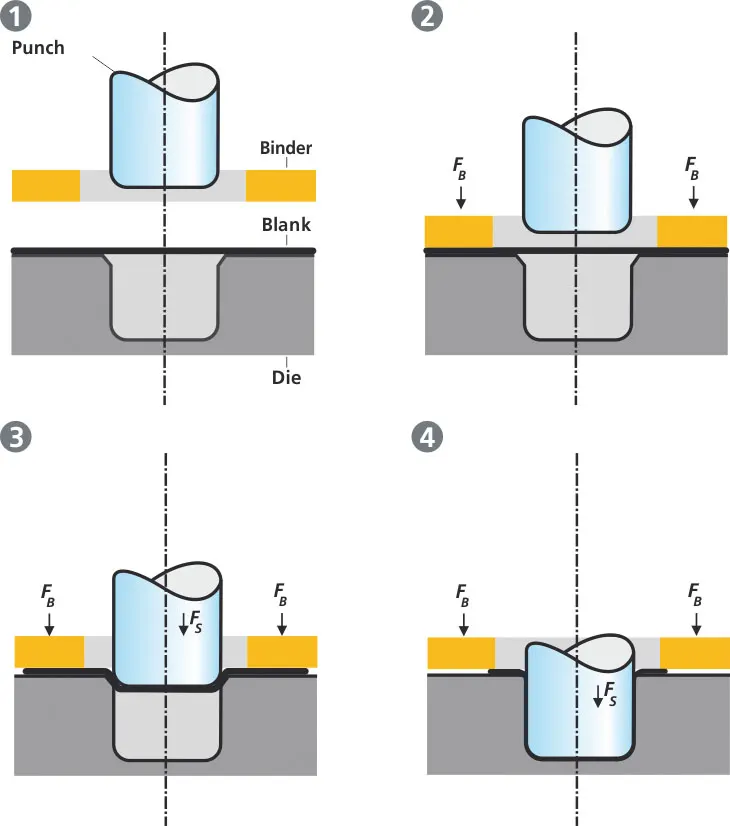
Deep drawing is a sheet metal forming process in which a sheet metal blank is radially drawn into a forming die by the mechanical action of a punch. It is thus a shape transformation process with material retention. The process is considered "deep" drawing when the depth of the drawn part exceeds its diameter.
2.Embossing
Embossing is a metal stamping process for producing raised or sunken designs or reliefs by passing metal sheet or strip between rolls of the desired pattern. The process enables repeated production without variation and does not change the metal's wall thicknesses.
3.Hemming
Hemming is the process of joining both the outer and inner panel together. The hemming process roles and wraps the hood outer panel around the inner panel and holds it tightly together. The following are the dimensions followed for hemming.After the hemming process is done, now we need to provide corner relief on the corners of the hood so that the part is manufactural.
Mastic Sealent
The Mastic sealant or the Mastic point is an elastic compound that behaves like a rubber. The mastic points are defined on the hood inner panel where the hood can easily deform. They help the hood outer panel to come back to its original shape after it gets deformed. The mastic has an influence area of 80mm.
Isometric View