Hood design-Week 2
HOOD DESIGN
Objective : To design and model the car hood with inner panel outer panel and required reinforcements .
Software used : CATIA V5
The following tasks are performed :
- Develop the inner panel
- Develop the outer panle with hemming data.
- Providing the proper embosssings.
- Providing MAstic data
- Positioning all the reinforcements.
Master sketch :
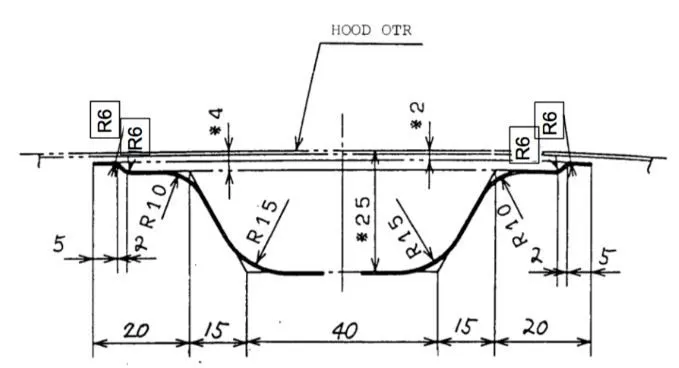
Data to be used :
- Outer Panel Thickness = 0.75mm
- Inner Panel Thickness = 0.75mm
- Reinforcement Thickness = 1.5mm
HOOD
Introduction :
A car hood, also referred to as a bonnet in some other countries, is the hinged cover that rests over the engine of a front-engine vehicle. Its purpose is to provide access to the engine for repair and maintenance.
The car’s hood consists of an inner and an outer panel. The inner panel provides strength, while the outer panel is just a metal cover. The underside of the hood is often covered with a sound-absorbing material. Some high performance cars have ‘hood scoops’ which channel outside air directly to the air filter, which gives improved performance and efficiency.The hood or bonnet is the hinged cover over the engine of motor vehicles that allows access to the engine compartment for maintenance and repair. On passenger cars, a hood may be held down by a concealed latch.
In Japan and Europe, regulations have come into effect in recent years that place a limit on the severity of pedestrian head injury when struck by a motor vehicle. This is leading to more advanced hood designs, as evidenced by multicone hood inner panel designs as found on the Mazda RX-7 and other vehicles.
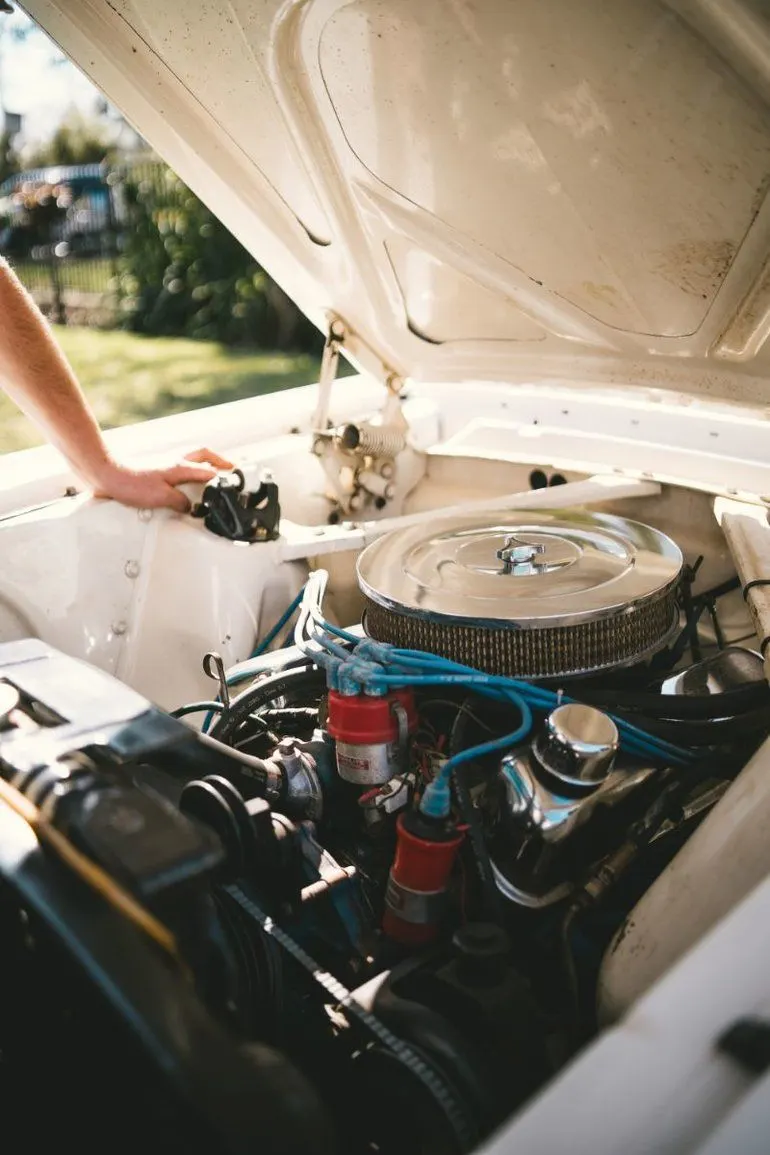
Parts of the hood :
- The basic parts of the hood are inner panel , outer panel, reinforcements and emboss .
- Latch and striker mechanism for opening and closing the hood . hinges are needed for support and strength.
Types of hood Support :
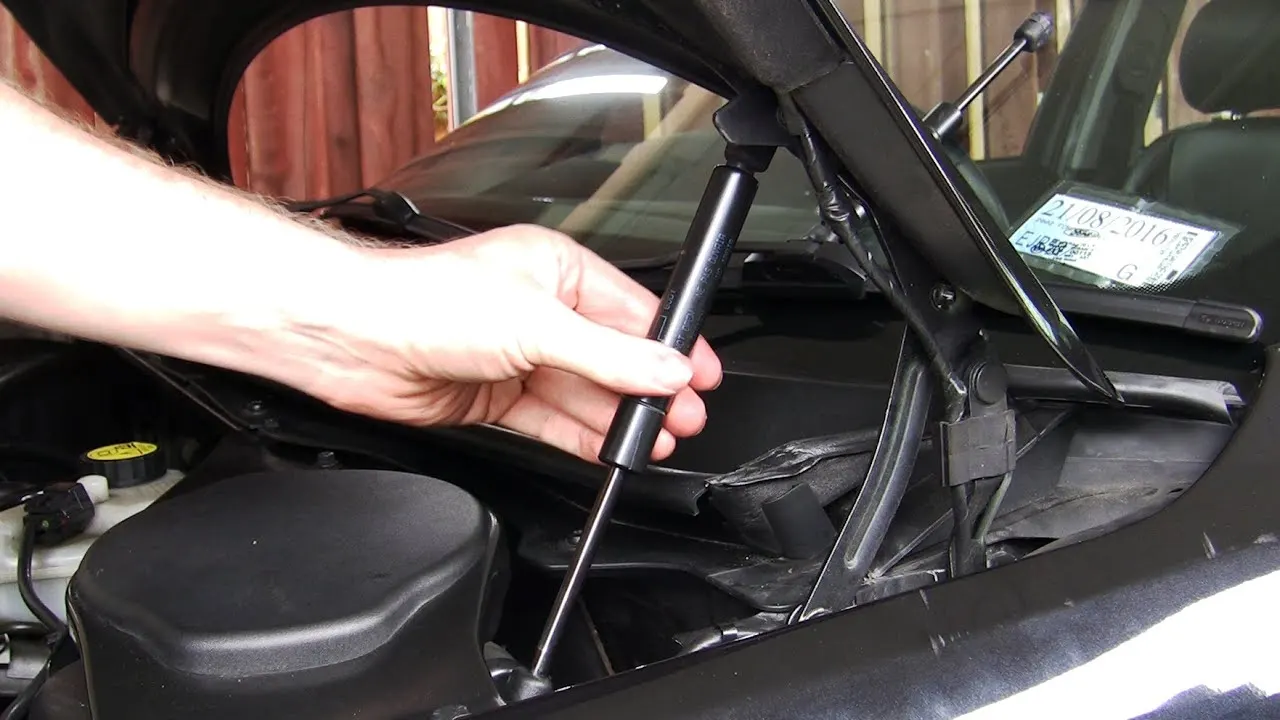
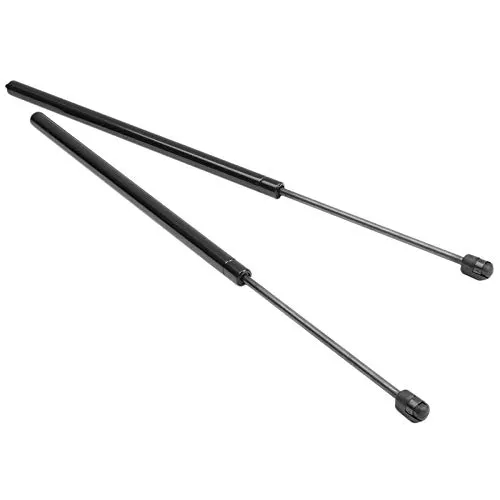
1.Gas Stay : These are used to lift tha car hood or bonnet , its purpose to just give the lifting force to the hood , then it automatically opens the car hood by means of gas pressure. This is used where the car bonnet size is heavy to lift .
2. Support rod :
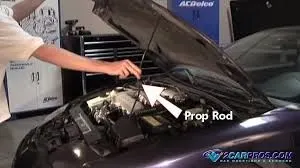
This is widely used in many car, because this very easy and cheap. In this type we have to lift the hood by ourselves and place the support rod in the space provided either in the hood or engine component. This is mostly used for where the car bonnet weight is small.
DESIGN CONSIDERATIONS :
Opening Angle Consideartion :
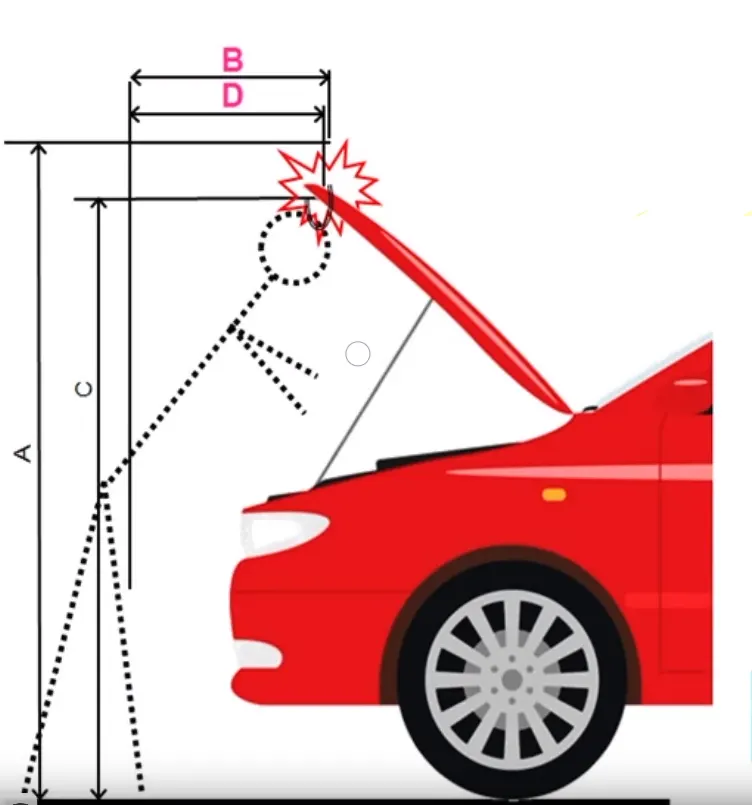
This is one of main creterion in designing of the hood . This opening angle varies from persob to person and country to country . For example the average height of the indians is 5.8 whereas in the european countries the average height will be 6 feet , based these heaights the opening angle may varies.The opening angle is considered important criteria because when the opening angle is less there is a chance of head injury to the human.
N CAP
Euro NCAP, or the European New Car Assessment Programme to give it its full name, is an independent crash-test safety body, which rigorously assesses the safety of new cars, and helps to further the advancement of car safety technology.With safety at the forefront of all car makers' minds, and many firms and organisations signing up to the 'Vision Zero' initiative - which aims to eliminate all deaths and serious injuries from our roads - Euro NCAP's test programme is an ever-evolving one, with its architects periodically updating crash-test regimes to ensure cars are assessed using the most stringent criteria possible. The current Euro NCAP safety regime includes a dual rating, with cars tested both with and without various high-tech safety features. This means some cars may get five stars if they are configured with autonomous emergency braking, for example, but drop to four stars for the second rating if this feature is not standard.
Wrap around distance: It is the distance from the road to the point where the head of the pedestrian collides with the hood.In the below images we can see the wrap-around distance .
NVH-NOISE, VIBRATION AND HARSHNESS:
Noise, vibration, and harshness (NVH) is the study and modification of the noise and vibration characteristics of vehicles, particularly cars and trucks. While noise and vibration can be readily measured, harshness is a subjective quality. Many problems are generated as either vibration or noise, transmitted via a variety of paths, and then radiated acoustically into the cabin.[1] These are classified as "structure-borne" noise. Others are generated acoustically and propagated by airborne paths. Structure-borne noise is attenuated by isolation, while airborne noise is reduced by absorption or through the use of barrier materials. Vibrations are sensed at the steering wheel, the seat, armrests, or the floor and pedals. Some problems are sensed visually - such as the vibration of the rear-view mirror or header rail on open-topped cars.
INNER PANEL :
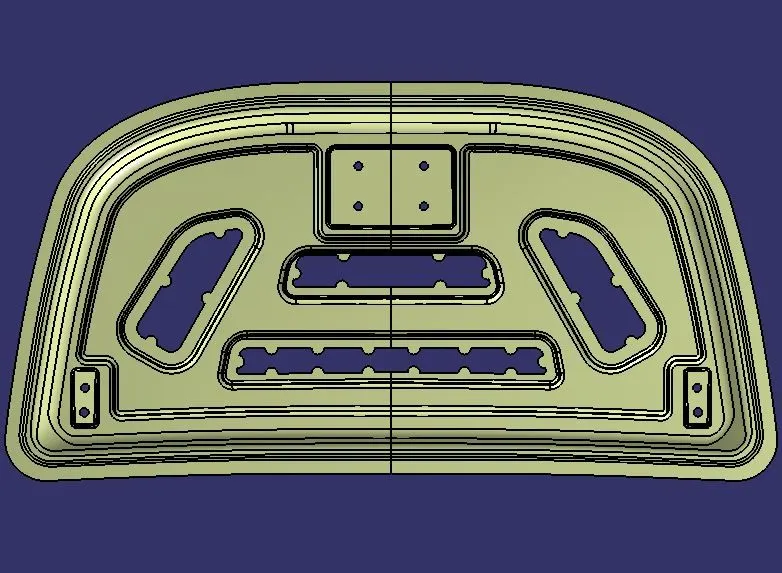
Inner panel is the one which supports the outer panel , It consists of holes , embosses and mastic sealants which are used to fix the innerpanel with the outer panel .
Design of Inner Panel :
- For designing the inner panel we have to extract the surface from the given outer panel class A.
- By using the mastersection as a reference we have to create the inner panel.
- After creating the inner panel we have to give the embossings , These are given according to the requirement.
Inner Panel
Embossing :
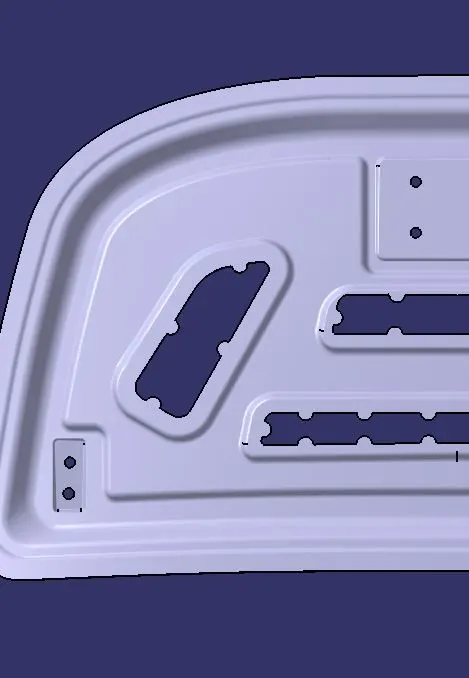
- Embosses are added to the inner panel to improve the stiffness of the part. The embossing are done in such a way as to perform the Deep Drawing direction smoothly.
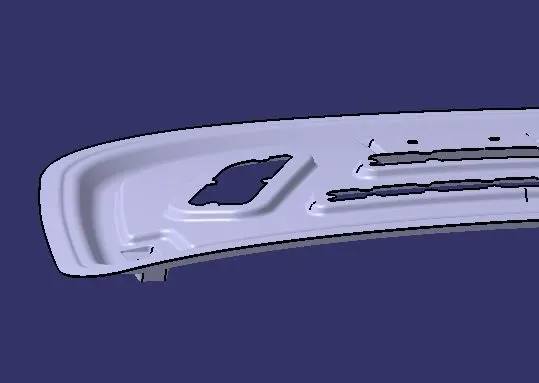
embossings ,.
- The design and direction of the embosses should be the guide for the force to travel in case of a collision, dissipating the force away from the passengers to the outside of the vehicle (towards the Hinge) and thereby reducing the impact force drastically.
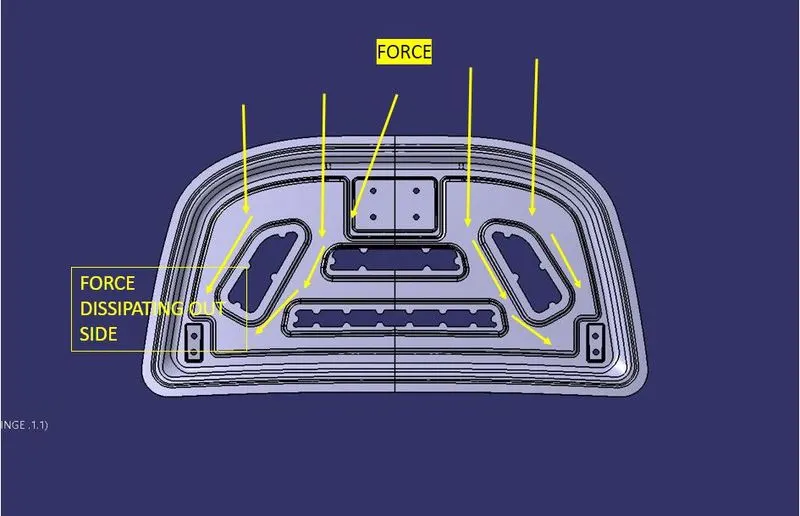
Fig. Shows the force moving towards outside
- The geometry is created based on the master section that was designed above. After performing the initial stages of design, we will provide local embosses to strengthen the component. The component will be strengthened based on the master section. When a force impacts the hood from the front, it travels in an upward direction. The component is designed to divert the force away from the passengers into the hinges, as shown in the image belowThe embosses in the inner panel are made according to the diversion of the load path. The emboss depth is kept at a maximum of 5mm to be on the safer side so that the part is manufacturable.
Mastic Sealants :
The Mastic sealant or the Mastic point is an elastic compound that behaves like a rubber. The mastic points are defined on the hood inner panel where the hood can easily deform. They help the hood outer panel to come back to its original shape after it gets deformed. The mastic has an influence area of 80mm.
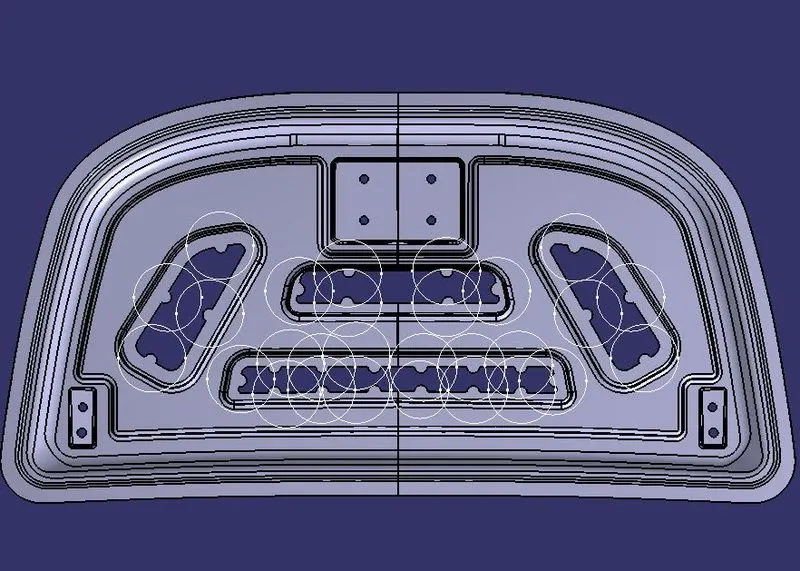
OUTER PANEL :
Outer panel is nothing but a outer skin of inner panel. Otherwise called as a cover of inner panel. It is the part, which gives luxurious look to the hood or bonnet. Outer pannel and inner pannel cannot join by any welding process like spot welding or rivet, which spoil the outer look of a car.The outer pannel is generally extracted model from the prototype design.

outer panel
Hemming :
Hemming is a forming operation in which the edges of the sheet are folded or folded over another part in order to achieve a tight fit. Normally hemming operations are used to connect parts together, to improve the appearance of a part and to reinforce part edges.In car part production, hemming is used in assembly as a secondary operation after deep drawing, trimming and flanging operations to join two sheet metal parts (outer and inner) together. Typical parts for this type of assembly are hoods, doors, trunk lids and fenders.
In this case Hemming is done to assemble the inner panel with the outer panel. Here there are predefined nomenclatures to follow w.r.t gap (0.2mm) between the outer and inner panels on both sides where sealants are applied to achieve water tightness.Hemming is preferred over Spot Welding given its superior aesthetic finishing.Relief is provided on the hood corners to avoid intolerance issues arising from the rolling process in Hemming operation.
Hemming Data
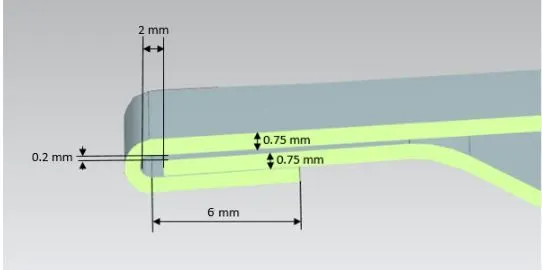
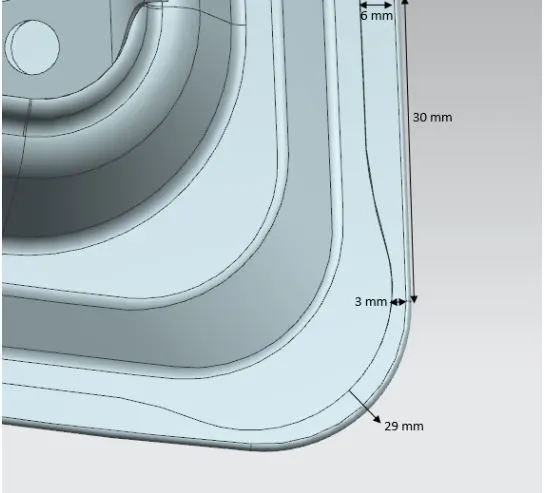
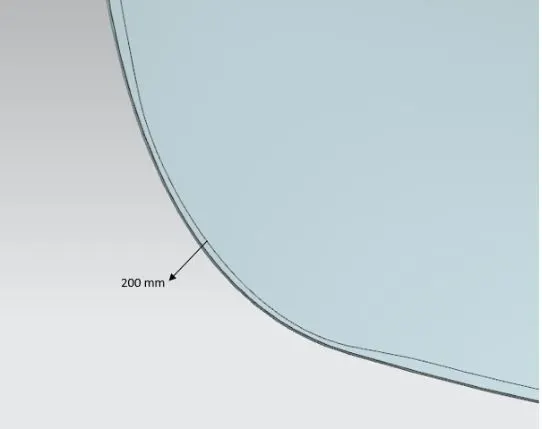
Given hemming Data
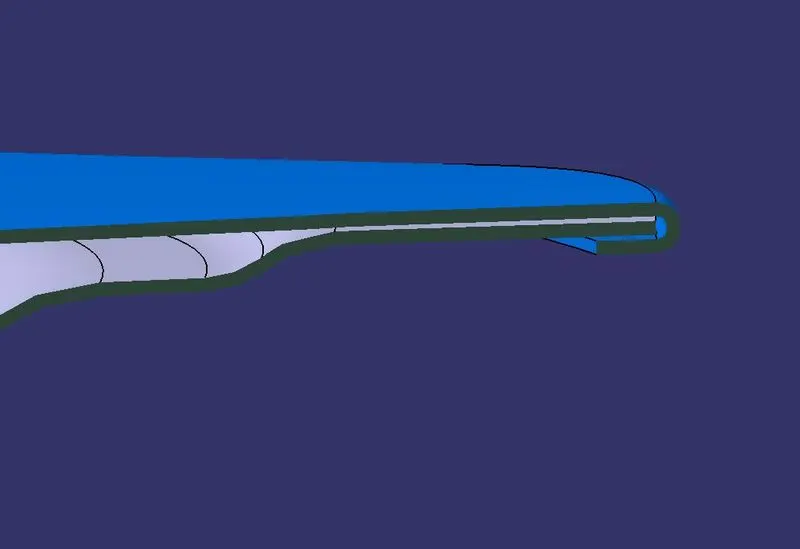
hemmimng between outer and inner panel
CORNER RELIEFS are given therefore when we create hemming it wont creates a problem
HINGE , LATCH AND STRIKER :
Hinges enable the opening and closing of the Hood. The Latch & Striker forms the locking mechanism of the hood with the engine compartment. One part of the Hinge is mounted to the engine compartment and the other to the inner panel of the Hood, on both sides.
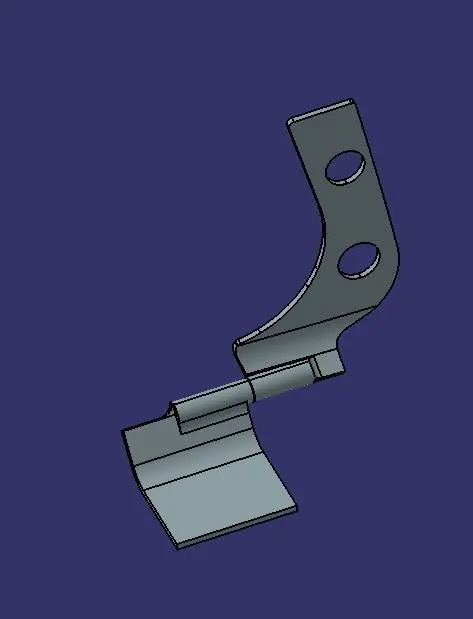
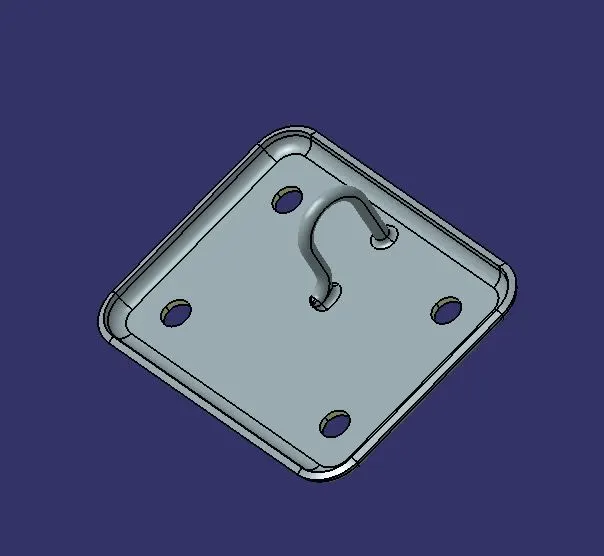
Hinge latch and striker
Position Of Hinge and Striker :
For postioning hinge and striker,we have to place hinge tantatively and take hine axis point and place position from data taken from the parent car or our own.The other major functional of the hood is the opening and closing of the hood. This is done with the help of the latch and striker. To position the latch and striker effectively, we position the hinge and draw the hinge axis. Now, using the hinge axis as the center we draw a big circle to the position where we need the latch to be placed. Then, we draw a tangent line to the circle at that point and place the latch in that region.
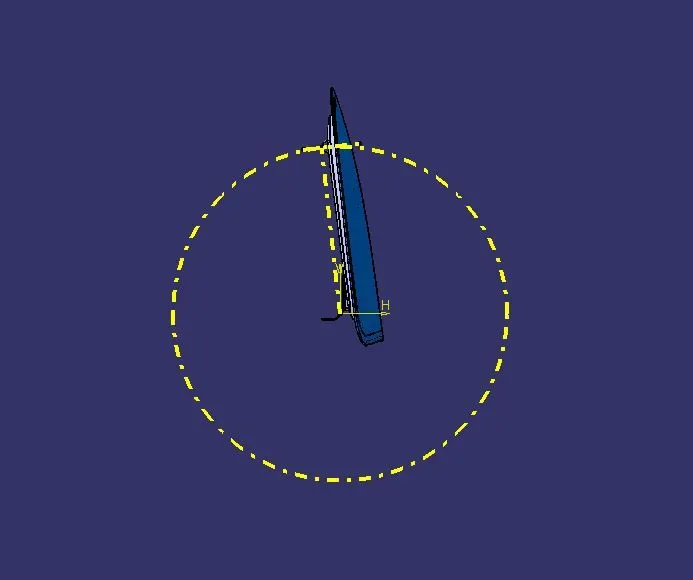
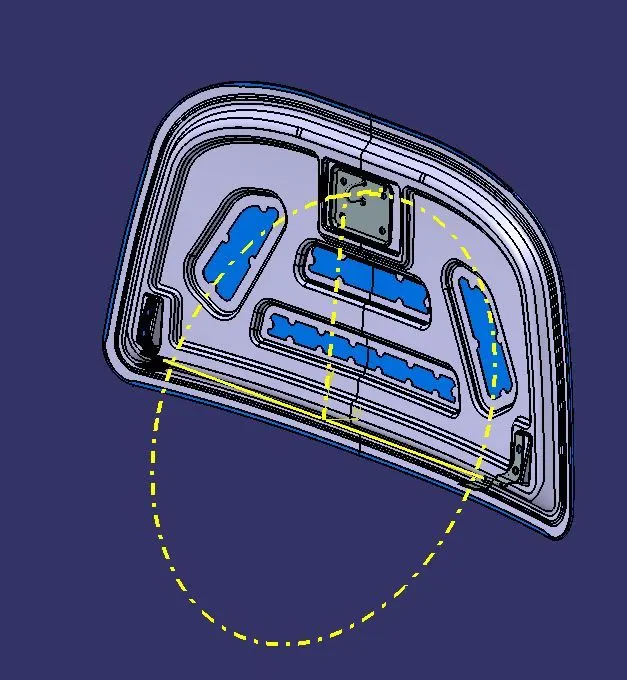
Position of striker Position of hinge
REINFORCEMENTS :
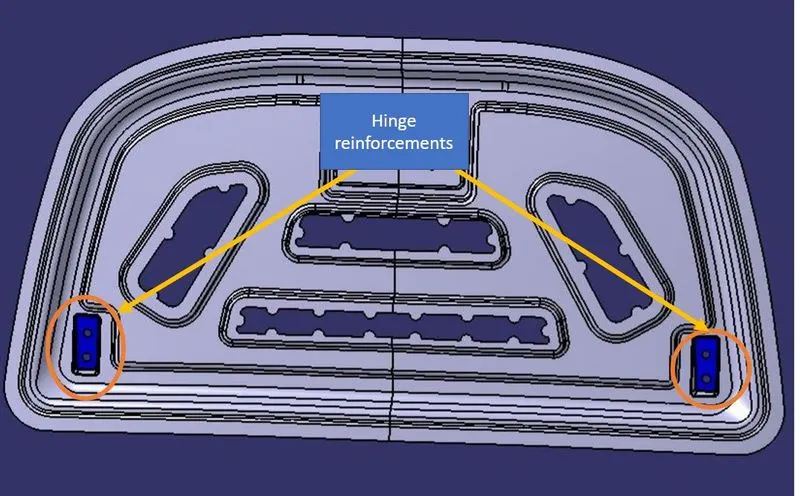
- Reinforcements are created to reduce the NVH factor in the car hood
- A 1.5 mm thick hinge reinforcement has been created and is shown below .
SHEET METAL OPERATIONS
DEEP DRAWING The deep drawing process is a forming process which occurs under a combination of tensile and compressive conditions. A flat sheet metal blank is formed into a hollow body open on one side or a hollow body is formed into a hollow body with a smaller cross-section
Deep drawing processes are divided into three types:
- Deep drawing with tools
- Deep drawing with active means
- Deep drawing with active energy
In the automotive industry, deep drawing is usually carried out using rigid tools.
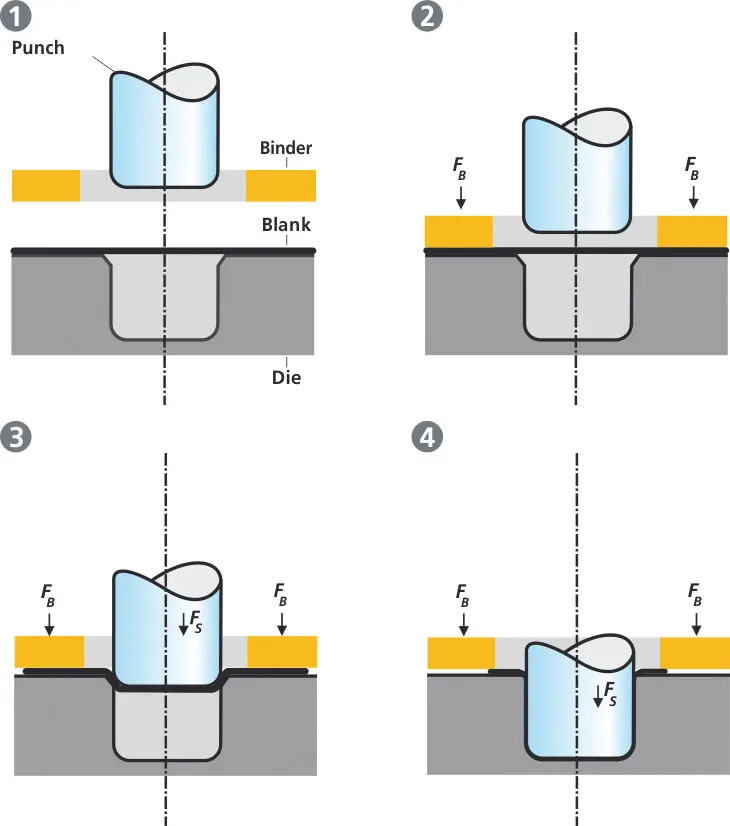
BLANKING AND PIERCING
Piercing is a shearing process in which raw metal is pierced with a machining tool, resulting in the creation of a circular or other shaped hole. As the raw metal is pierced, the metal from the newly created hole is considered scrap. The piercing machine forces a tool, known as a blanking punch, through the sheet metal.
Blanking is often confused with piercing because both processes involve cutting holes into raw metal. However, they aren’t necessarily the same. With blanking, the metal from the hole is saved and used rather than discarded. In other words, manufacturing companies perform blanking to create small pieces of metal, whereas manufacturing companies perform piercing to create metal objects with a single hole.
ASSEMBLY OF HOOD OUTER PANEL,INNER PANEL , LATCH AND STRIKER AND HINGE
- Firstly the inner panel which is created are thickened .
- The hemming data is added to the outer panel and the outer panel also thickened .
- The latch and hinge trajectile has been created.
- Finally the parts are assembled in assembly workbench .
The assembled part is given below
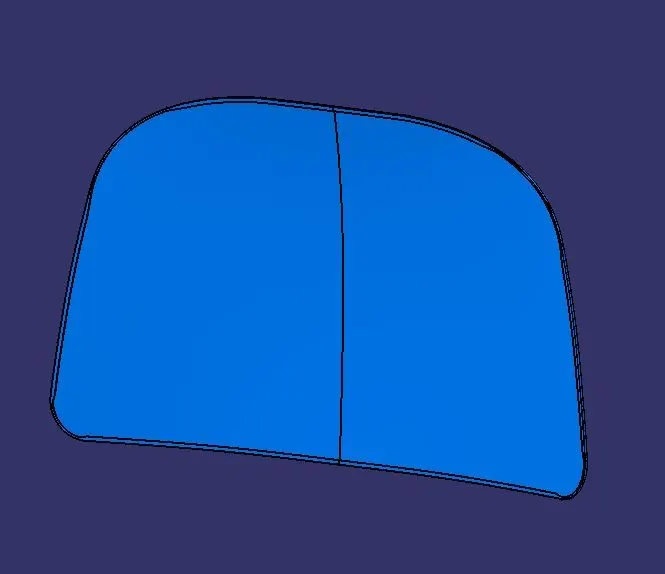
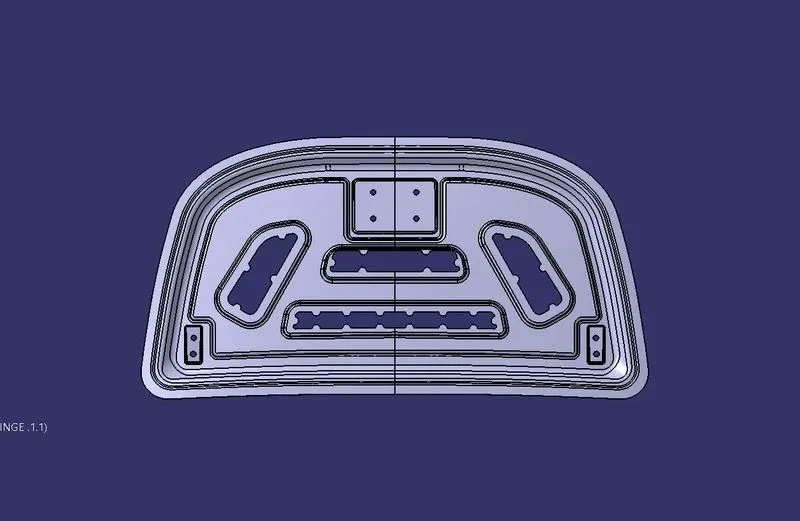
outer panel with hemming Thickened inner panel
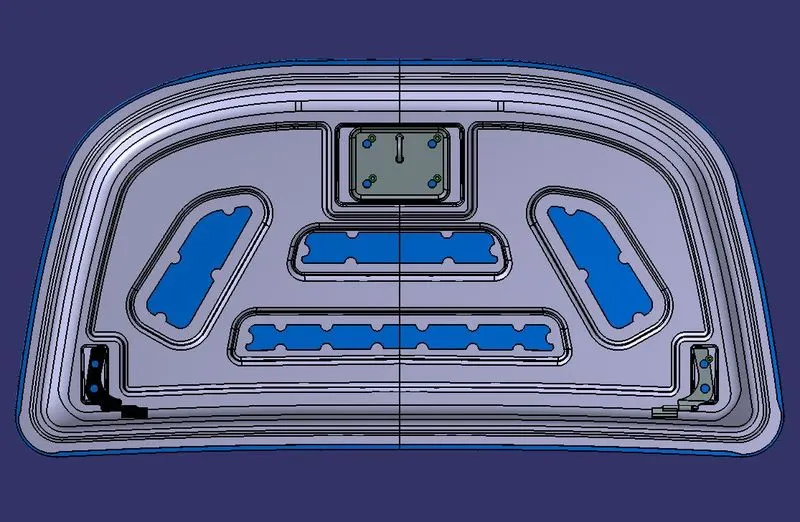
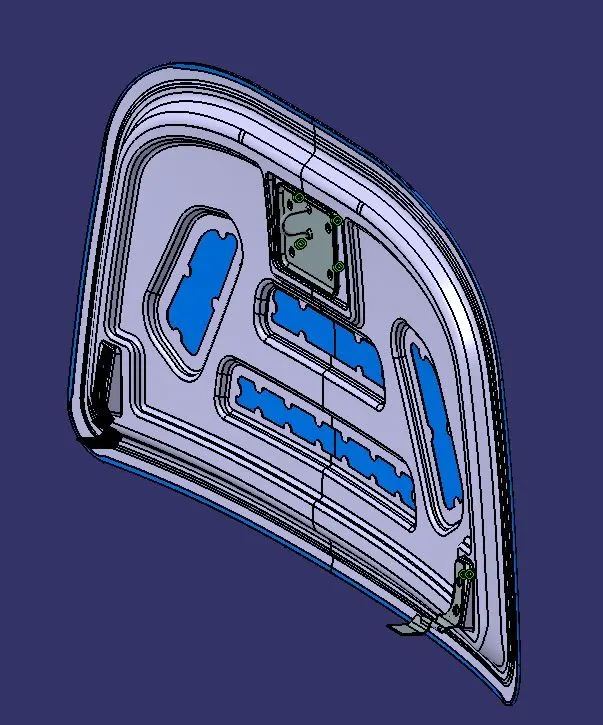
Final Part
CONCLUSION :
- The design considerations for the Hood is taken are discussed and taken into consideration while designing the hood.
- Accordibg to the given mastersection the inner panel and hemming of outer panel created.
- Finally all the parts are assembled together.