Hood design-Week 2
OBJECTIVE
To design Hood Outer and Inner panel along with suitable reinforcements by following the Master Section
INRODUCTION
Hood
A car hood, also referred to as a bonnet in some other countries, is the hinged cover that rests over the engine of a front-engine vehicle. Its purpose is to provide access to the engine for repair and maintenance. A concealed latch is typically used to hold down the hood. On vehicles with an aftermarket hood and on race cars, hood pins may be used to hold down the car hood. Hoods sometimes also contain a hood scoop, wiper jets, power bulge, and/or hood ornament. Car hoods are typically constructed from steel and sometimes from aluminum. Aftermarket car hoods may be constructed from various other materials, including carbon fiber, fiberglass, or dry carbon. The hood design may vary from one make and model to another
A car hood is meant to protect the performance parts of your vehicle, including the engine, while also providing easy access for repairs and maintenance. It is possible for the hood to incur damage as well. One of the most common types of damage is to the hinge, which is the device that connects the hood to the body of the vehicle. Over time, the hinge can become loose or may fall off completely. The hood is also prone to receiving scratches and dents.
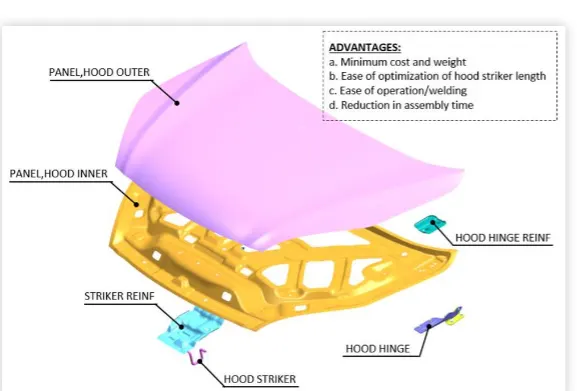
Design Boundary Conditions for Bonnet
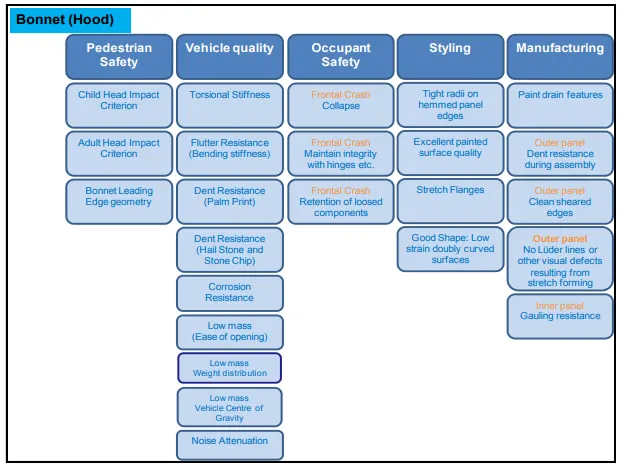
Design options assessment -Design Failure Modes and Effect Analysis
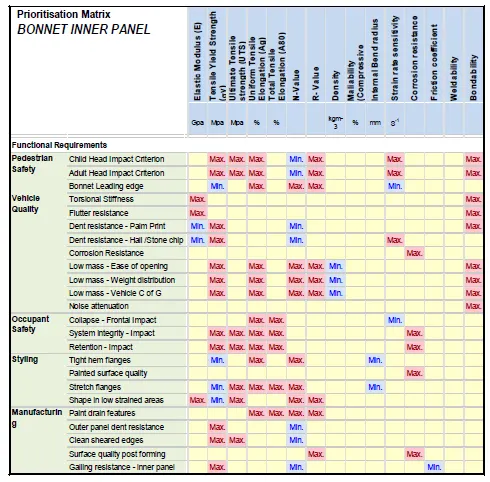
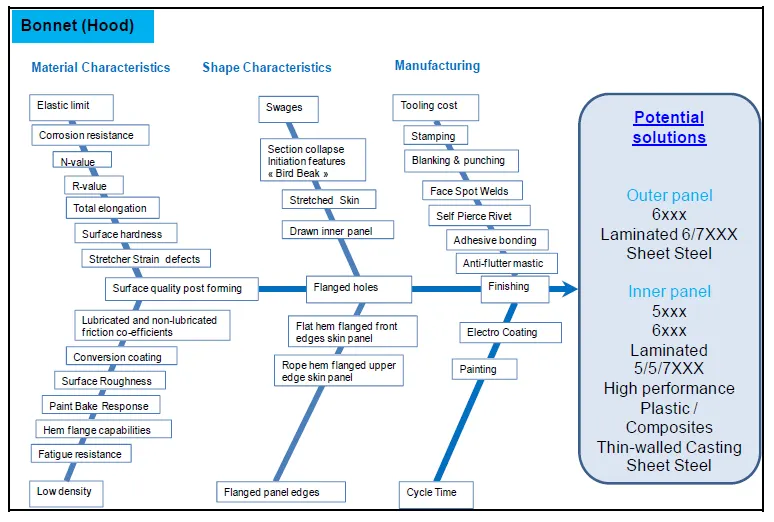
Bonnet influence the following performance measures:
- Overall vehicle mass
- Weight distribution
- Height of vehicle center of gravity (the bonnet and the boot lid are usually located
above the C of G of the vehicle, hence weight reduction is beneficial) - Vehicle drive-by noise intensity
let us understand the rules and regulation standards for designing the hood.
- A perfect hood design means it should have a great impact distribution angled outside the car.
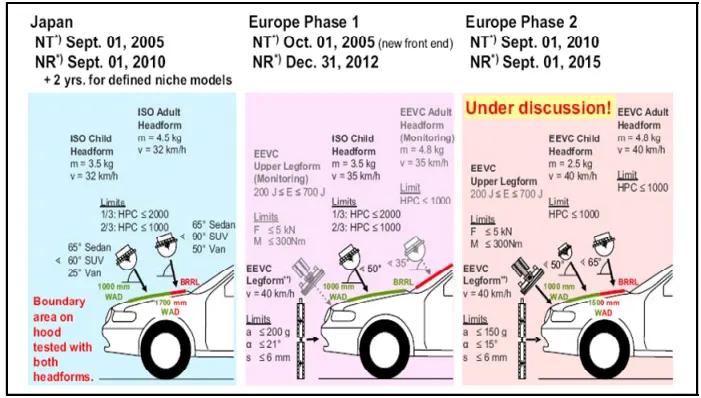
- In Japan and Europe, regulations have come into effect that places a limit on the severity of pedestrian head injury when struck by a motor vehicle. This is leading to more advanced hood designs, as evidenced by multicore hood inner panel designs.
- European Enhanced Vehicle-Safety Committee (EEVC), European New Car Assessment Program (euro NCAP)
EURO NCAP SAFETY STANDARDS
EURO New Car Assessment Programme is a safety assessment center that evaluates the safety performance of the car. They evaluate potential risk of pedestrian impact in the event of collision with the car and provide rating for the new vehicles
Euro NCAP maintains that vehicles that offer protection without a deployable device, offerprotection at lower speeds and some protection at higher speeds. Therefore, Euro NCAP requires that vehicles equipped with deployable pedestrian protection systems also provide protection at impact speeds below the system deployment threshold on the part of the vehicle affected by the deployable pedestrian protection system
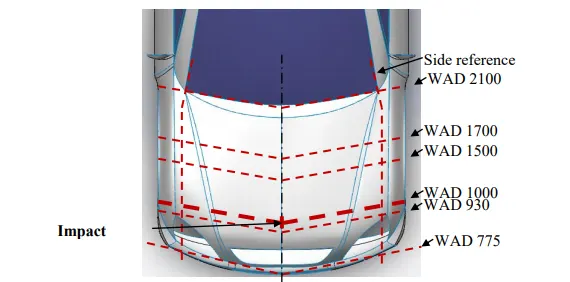
New Car Assessment Program (NCAP) forpedestrian protection, it needs to define zones of car hood for analysis. It can benoted that when the collision projection point locates between (Wrap Around Distance) WAD 1000and WAD 1500, the head type will use the children head type. The adult head type will be used whilethe collision projection point locates between WAD 1700 and WAD 2100.
Master Section and Specification
Master Section
The Master Section is the input which is a predefined sketch suitable for various design situations and it used to develop the hood model using the Hood Styling Surface
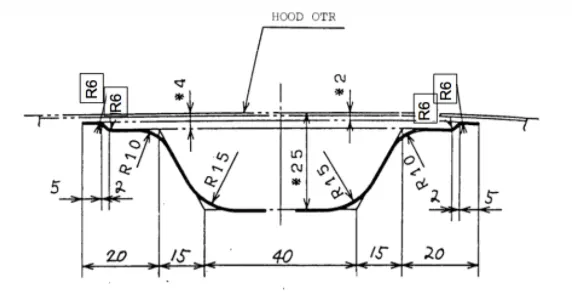
Hood Thickness Information
- Outer Panel Thickness = 0.75mm
- Inner Panel Thickness = 0.75mm
- Reinforcement Thickness = 1.5mm
SHEETMETAL OPERATIONS
The process involved in designing hood as a sheet metal operation is
- Blanking and piercing
- hemming
- Deep drawing
- Embossing
1.Blanking and piercing
Blanking and piercing are shearing processes in which a punch and die are used to produce parts from coil or sheet stock. Blanking produces the outside features of the component, while piercing produces internal holes or shapes. The web is created after multiple components have been produced and is considered scrap material. The "slugs" produced by piercing internal features are also considered scrap
2.Hemming
Hemming is a sheet metal forming process in which sheets are joined by bending it to 180degree. Automotive body panels and automotive parts such as decks-lids, trunk-lids, doors, hoods and tailgates are formed by the hemming process, in this process usually a sheet is bent with the help of inner and outer sheet.The purpose of Hemming projects is to fold and fold the outer sheet metal panels on the inner sheet metal panels in various parts, such as the vehicle's door, engine hood, trunk lid, usually composed of two sheet metal panels, and to join the two panels together
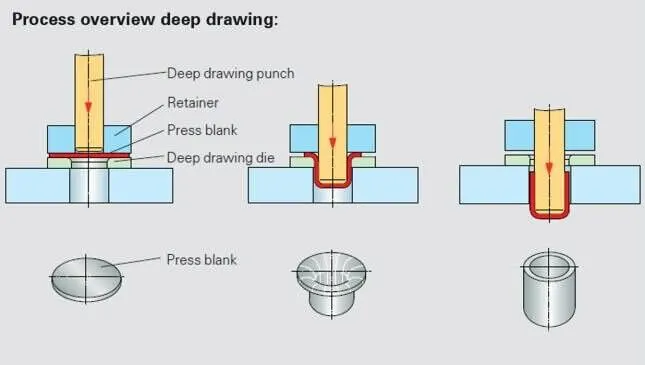
3.Deep drawing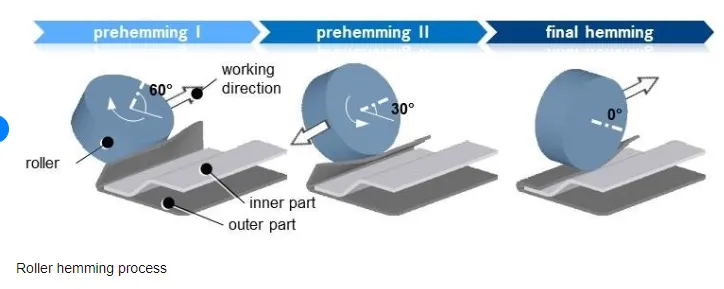
Deep drawing is a sheet metal forming process in which a sheet metal blank is radially drawn into a forming die by the mechanical action of a punch. It is thus a shape transformation process with material retention. The process is considered "deep" drawing when the depth of the drawn part exceeds its diameter. Operation in which thickness of the shell wall is reduced and its surface smooth. When material gets compress between punch and die, which reduce the thickness and increase the height of the cup
Deep drawing processes are divided into three types:
- Deep drawing with tools
- Deep drawing with active means
- Deep drawing with active energy
4.Embossing
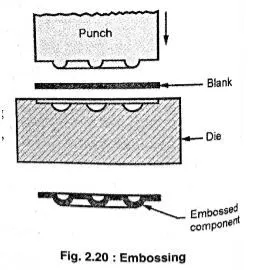
Embossing is a metal forming process for producing raised or sunken designs or relief in sheet material by means of matched male and female roller dies, theoretically with no change in metal thickness, or bypassing sheet or a strip of metal between rolls of the desired pattern
DESIGN OF HOOD
The major Tools/Features used in the Nx-cad for modeling were
- Surface Offset
- Offset Curve Face
- Trim Sheet
- Through Curves
- Law Extension
- Trim and Extend
- Trim Body
- Extend Sheet
- Edge and Face Blend
- Emboss
- Bridge Curve
- Mirror Geometry
- Sew
- Thicken
- Curve on surface
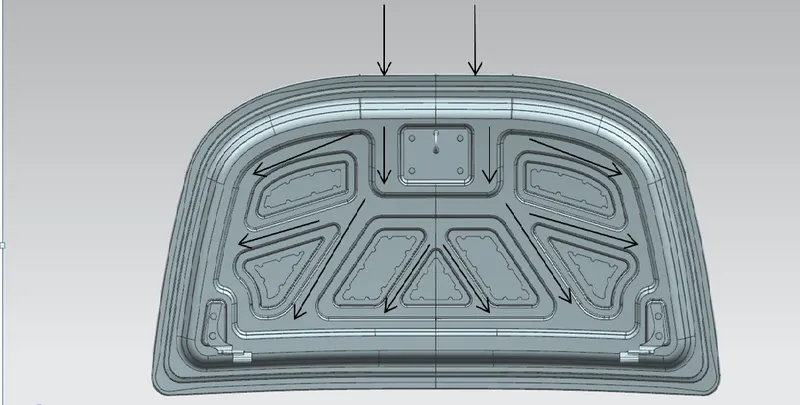
Designing the initial structure based on the master section, embossing was performed to strengthen the structure as well as to integrate channels to direct shock flow and dissipate maximum energy away from the cabin. With successful designing of these channels using the process of embossing, latch and hinge placements are designed for attachment of this structure to the vehicle.
Once the structure for the inner panel is prepared, reinforcement is provided to compensate for the strength drop which occurred due to the inclusion of latch and hinge placement. At this stage, the NVH team also contributes to implementing major design changes and the inclusion of components to reduce vehicle vibration and noise control.
Apart from hemming, the center region of the inner panel structure is kept in contact with the outer panel using mastic sealants. Mastic sealants are rubberized components placed between the outer and inner panel to provide annexed contact. These sealants help maintain the outer panel aesthetically pleasing as well due to the absence of welds, nuts or bolts in the process of consolidation
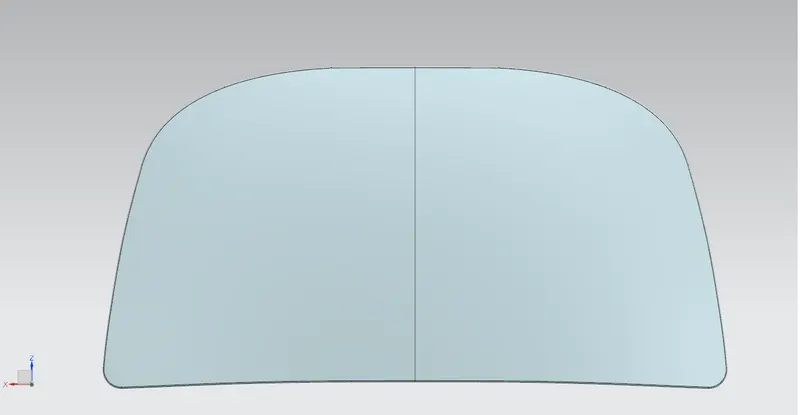
Hood Outer panel
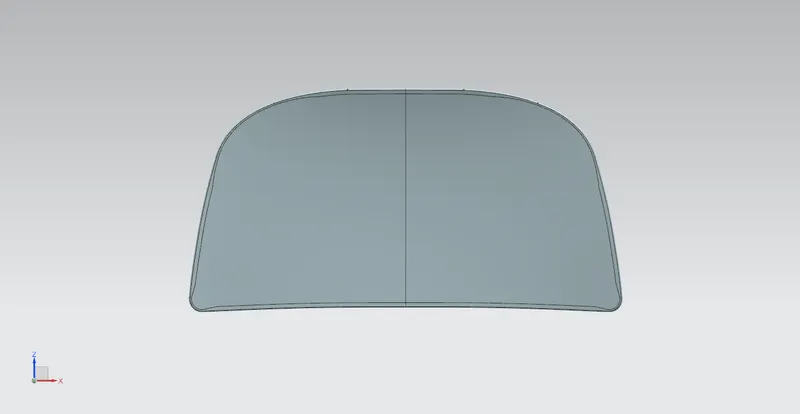
Hood inner panel
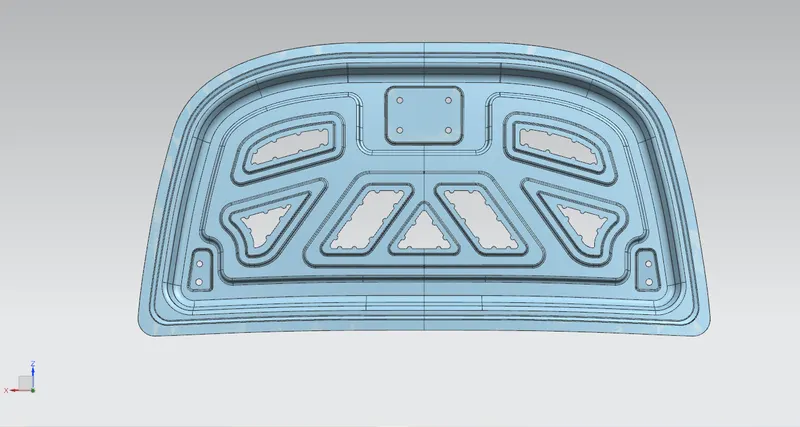
ASSEMBLED HOOD
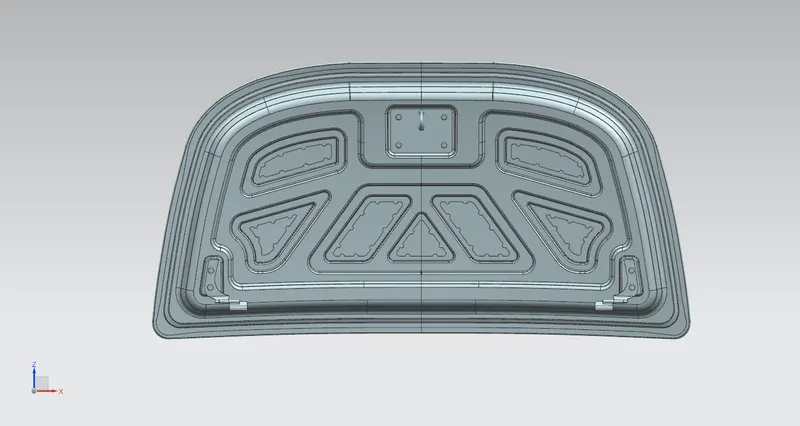
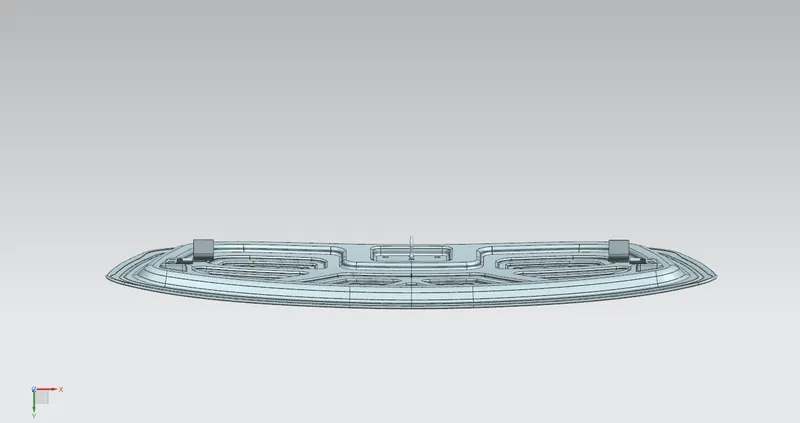
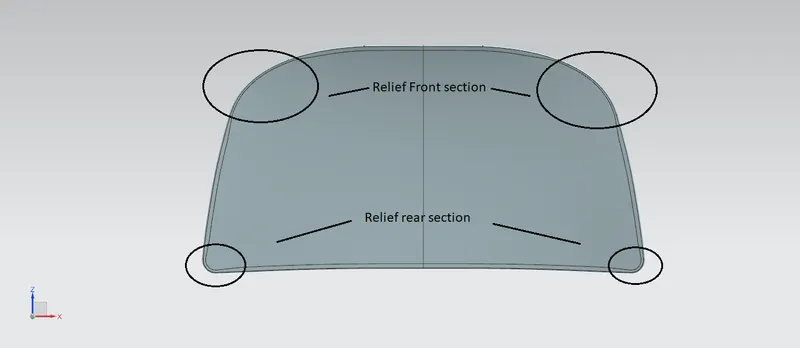
Hemming
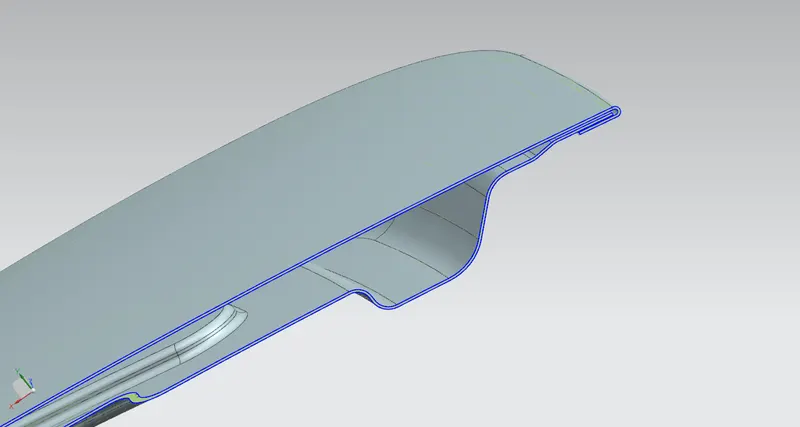
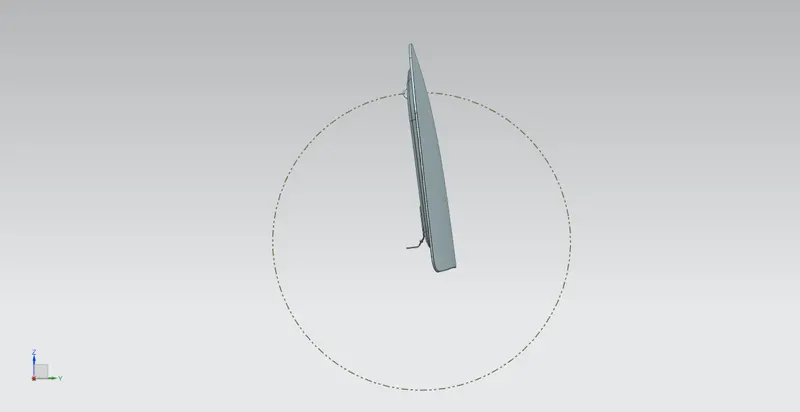
Hood Opening and Closing Trajectory
The trajectory for opening and closing the hood is considered to be an important factor where the striker center axis is coincidental with the hood center axis . The striker axis is perpendicular to the circle which is drawn by considering the center of the two hinge axis
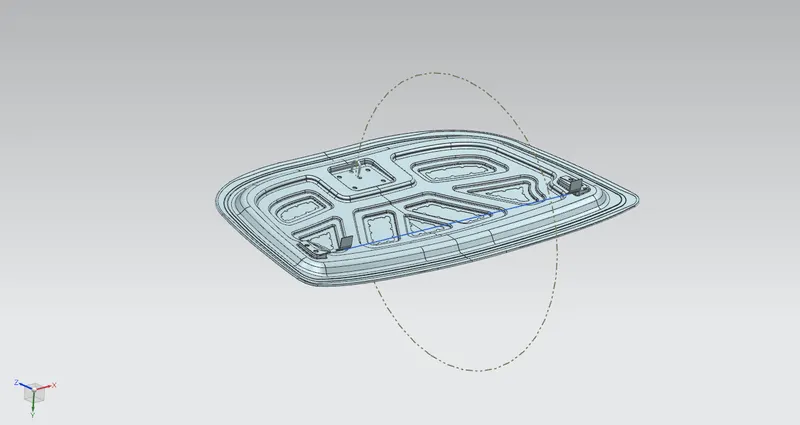
Striker Mechanism
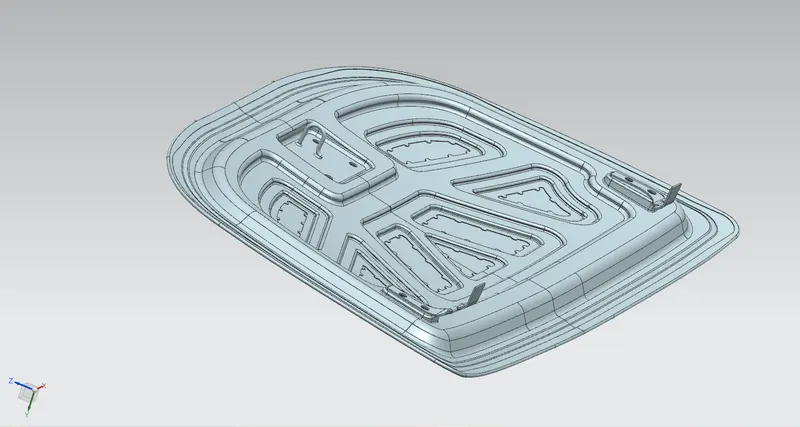
Mastic Sealant
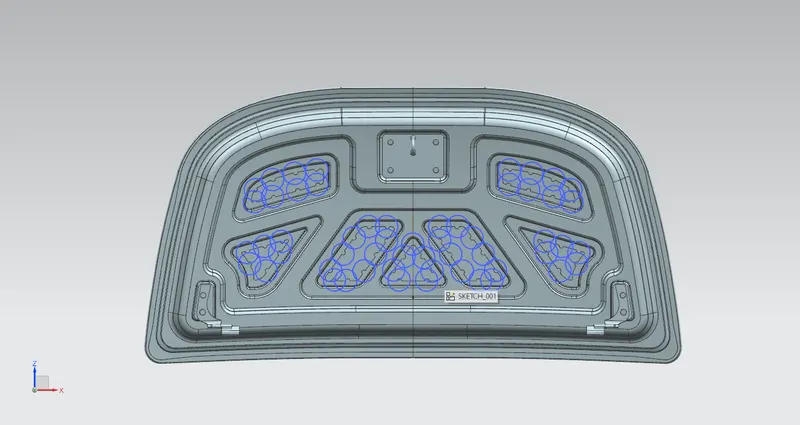
The Mastic sealant or the Mastic point is an elastic compound that behaves like a rubber. The mastic points are defined on the hood inner panel where the hood can easily deform. They help the hood outer panel to come back to its original shape after it gets deformed. The mastic has an influence area of 80mm
Shock Flow
The component will be strengthened based on the master section. When a force impacts the hood from the front, it travels in an upward direction. The component is designed to divert the force away from the passengers into the hinges. For minimizing the impact of injury when collision with the hood a flow pattern is provided to minimize the impact of injury so that there is minimum damage.
CONCLUSION
These factors are considered while designing and manufacturing the hood inner and outer panel as per EuroNcap safety standards.Passenger Vehicle Hood is designed in NX by following the master section data within the underlining design parameters
References
1.European new car assessment programme - pedestrian testing protocol
2.Design case study Bonnet and Boot Lid - The Aluminium Automotive Manual