Hood design-Week 2
AUTOMOBILE HOOD DESIGN
Here we are going to understand and design the concept of the front-mounted engine hood according to the standards.
in this report, the flow information will be as follows
- What is the hood
- Materials use
- Pedestrian- Vehicle Collision
- Data
- Designed
- Conclusion
What is Hood
- A car hood is also referred to as a bonnet in some other countries. generally, it is used to cover the engine and its accessories. hood also considered as another door which is used to repair and helped to maintenance engine.
- The car hood consists of an inner and an outer panel. the inner panel is just a metal cover. The underside of the hood is often covered with a sound-absorbing material.
- The hood is a hinged cover over the engine of motor vehicles That allows access to the engine compartment for maintenance and repair.
- Some high-performance cars have Hood scoops that channel outside air directly to the air filter, improving performance and efficiency.
- The Hood release is a small lever usually mounted under the dash. it's connected to the hood latch by a cable. the hood latch has a safety feature that requires a second latch to be released before the hood will open. This prevents accidental opening while driving
Materials used to make Hood
- The Hood is typically made of the same material as the rest of the bodywork. This may include steel, aluminum, fiberglass, or carbon fiber.
Before going to hood design, let us understand the rules, regulations, and standards for designing the hood.
- A perfect hood design should have an excellent impact distribution angled outside the car.
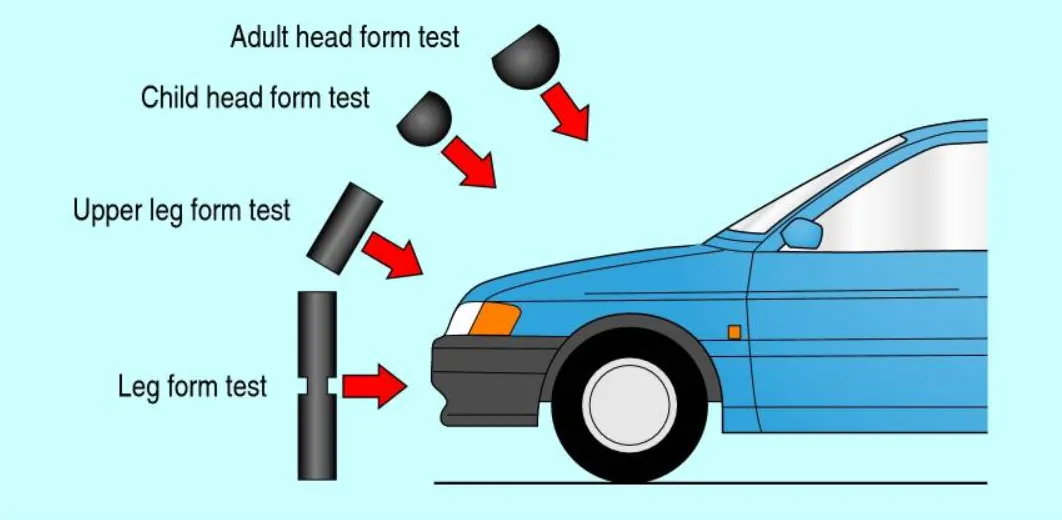
- In Japan and Europe, regulations have come into effect that places a limit on the severity of pedestrian head injury when struck by a motor vehicle. This is leading to more advanced hood designs as evidenced by multicore hood inner panel designs.
- European Enhanced vehicle-Safety Committee(EEVC), European New Car Assessment Program(euro NCAP)
Pedestrian- Vehicle Collision
- India, however, ranks 1 in the number of road accident deaths across the 199 countries reported in the World RoaD Statistics, 2018 followed by China and the US. As per the Who Global Report on Road safety 2018, India accounts for almost 11%if of the accident-related deaths in the World.
- Road transport remains the most favored mode of transport for both freight and passenger movement in India. The fast-growing population and exceptional rate of motorization coupled with the ever-growing urbanization have made people vulnerable to frequent road accidents resulting in fatalities, injuries/disabilities.
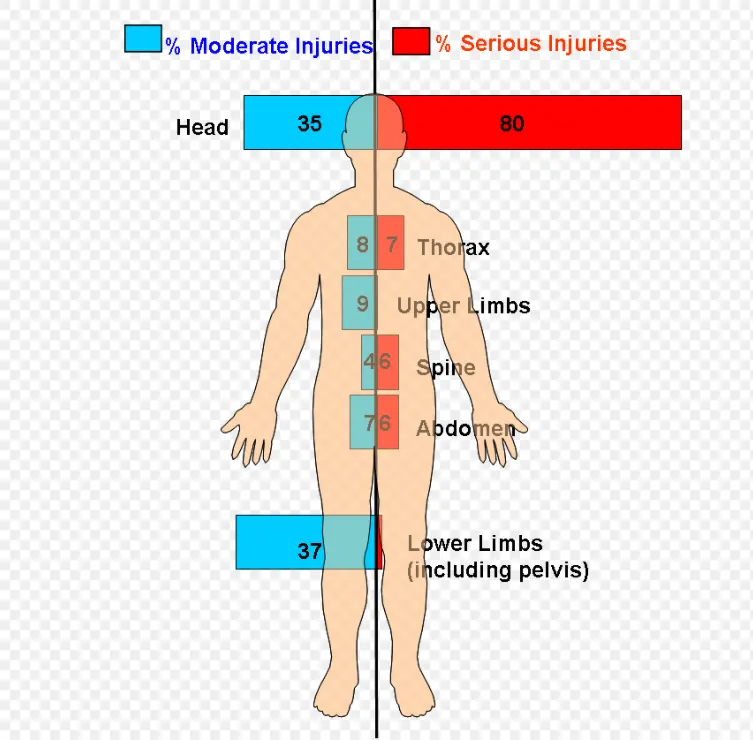
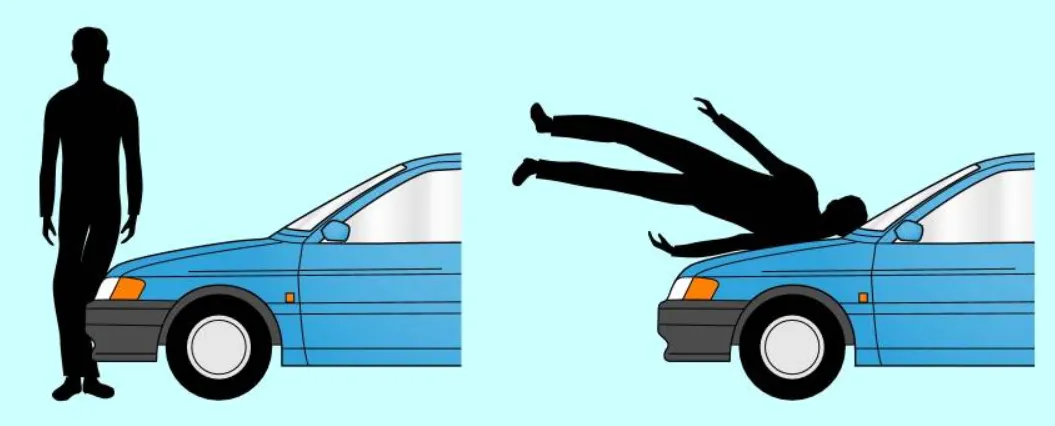
- the sequence of injuries and events in pedestrian collision images are mentioned below.
DATA Of Hood
Master section data was already provided by the support instructors of the course.
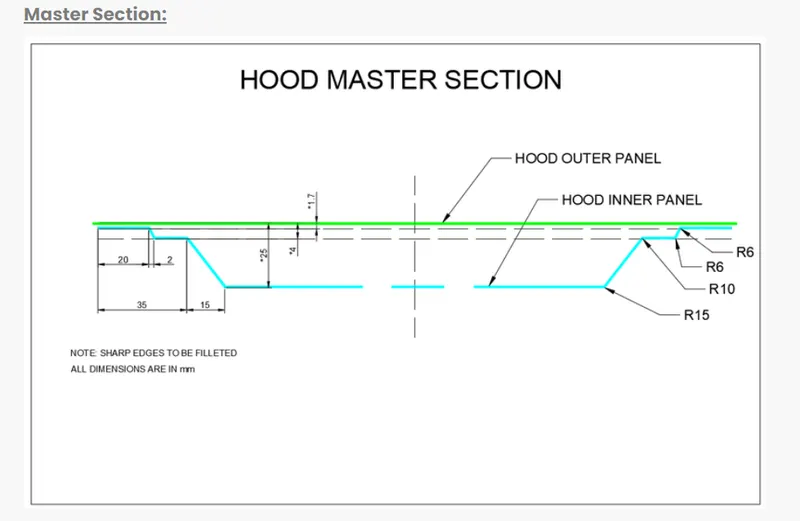
Hood Thickness Information
- Outer Panel Thickness = 0.75mm
- Inner Panel Thickness = 0.75mm
- Reinforcement Thickness = 1.5mm
Design
In the design section of the hood, we have some component details given below:
1) Hood Outer Panel
The outer panel works as a metal cover. It is responsible for the aesthetics of the vehicle.
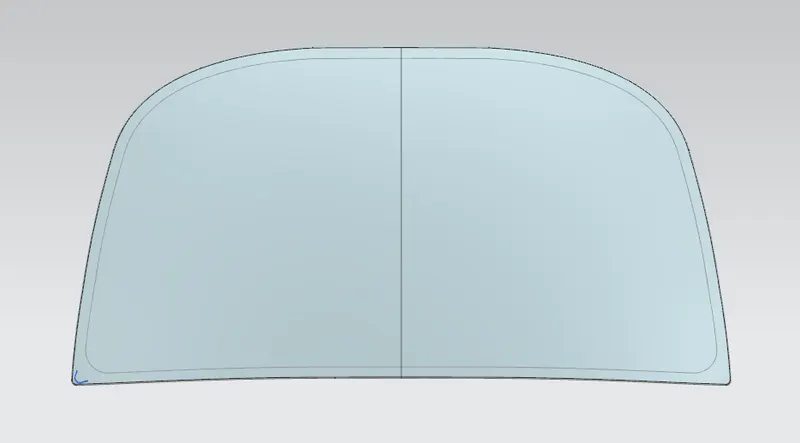
Fig.1 Hood Outer Panel
2) Hood Inner Panel
the inner panel provides strength and supports the outer panel. it is where hood valancer and hinges are attached .
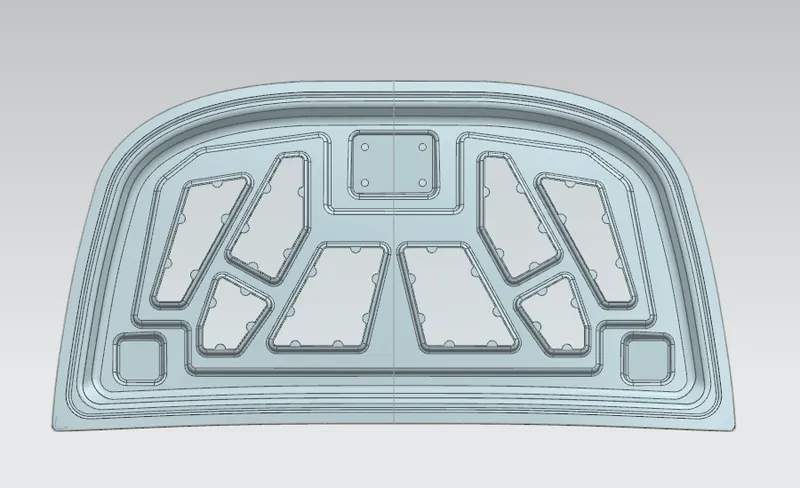
Fig 2 Hood Inner panel
3) Hinges
Hinges allow the hood to rotate around a fixed axis for opening and closing movement . One part of the hinge os fixed with the engine compartment,, while other part is connected to hood.
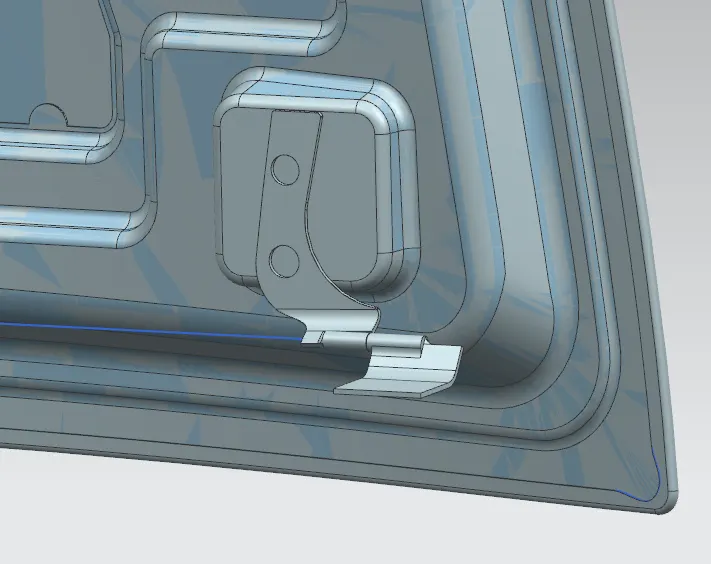
Fig3 Hinge Assembly
4) Latch and striker
latch and striker mechanism is provided to lock the hood, in order to prevent accidental opening of the hood during driving. The latch is present on the engine compartment while the striker is attached to the inner part of hood.
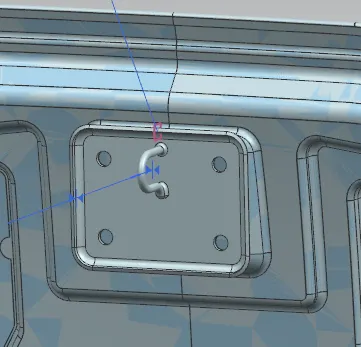
Fig4 Latch or Striker
5) Support Rod
it is a device that supports the hood in open position it us also called as hood balancer rod.
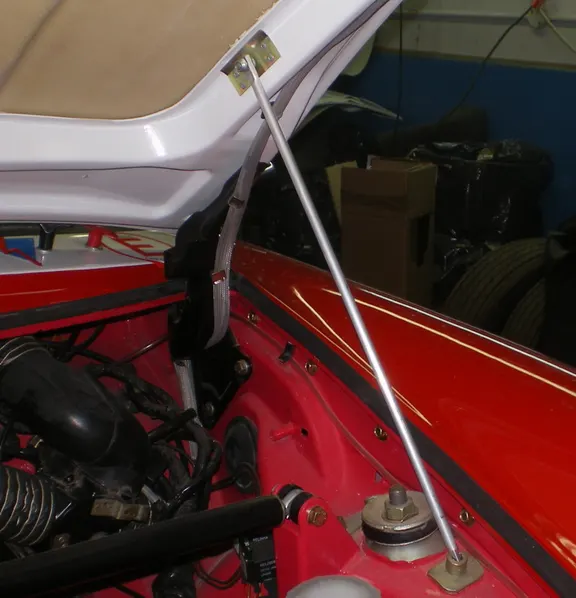
Fig5 support road
Important Features used in designing:
- Trim Body – It is used to trim one or more bodies using a face or plane. You can also specify the bodies to retain and the bodies to discard.
- Offset Surface – It allows you to offset one or more existing surfaces.
- Offset in Face – This command will allow you to offset particular edges or curves on selected faces.
- Trim Sheet – It is used to trim off a portion of a sheet body using curves, faces, edges or planes.
- Through Curves – It will allow you to create a body Through multiple sections, where it’s shape changes to pass through each section.
- Law Extension – This command extends a curve or edge to create a sheet body at desired angle length by changing the rules under angle law and length law.
- Trim and Extend – It helps you to trim and extend intersecting surfaces and make corner at their intersection.
- Face Blend – It creates fillets between faces.
- Edge Blend – It creates fillets on edges.
- Extend Sheet – It will allow you to extend an existing surface to required distance.
- Emboss – Emboss command creates an embossing by modifying a body with faces created by projecting a curve/section along a direction. You can modify the emboss using options like endcap location and draft angle.
- Projected Curve – It is used to project an existing curve/curves on a selected plane or surface by selecting a direction for projection.
- Mirror Geometry – As name suggests, it allows you to mirror geometries about selected plane or surface.
- Sew – It combines sheet bodies together by sewing their common edges. There shouldn’t be any gaps larger than specified tolerance.
- Thicken – It is used to convert a surface to solid body by providing thickness.
- Extrude – It helps you to create a feature from a sketch. You are also able to create thin feature using a sketch or curve under this command.
- Wave Geometry Linker – With this you can create, associative or linked copies of any entity of a part into other parts. It may be a surface, edge, curve, body, sketch etc. The changes made to the original entity will be reflected in the copy of that entity.
-
Sheetmetal Operations in Car Hood Manufacturing Process:
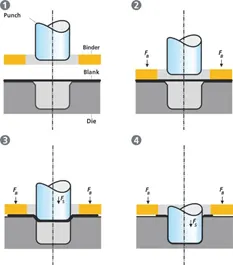
Deep Drawing process
It is a sheet metal forming process in which a sheet metal blank is radially drawn into a forming die by the mechanical action of a punch. The process is considered deep drawing when the depth of the drawn part exceeds its diameter.
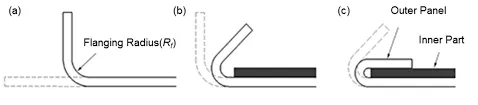
- Hemming process
Hemming is a forming operation in which the edges of the sheet are folded over other part or simply folded in order to achieve a tight fit. In car part production, hemming is used in assembly as a secondary operation after deep drawing, trimming and flanging operations to join two sheet metal parts (outer and inner) together.
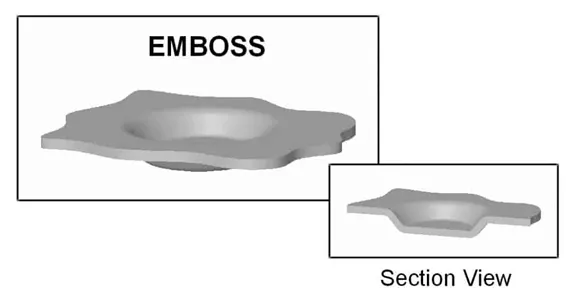
- Embossing process
Sheet metal embossing is a stamping process for producing raised or sunken designs or relief in sheet metal. This process is carried out by means of matched male and female roller dies, or by passing the sheet or rolls of metal between rolls of desired pattern.
Conclusion
therefore, we have designed a hood that falls under the rules and regulation of the manufacturers standards.