Hood design-Week 2
Hood- It is a hinged cover that rests over the engine. Its purpose is to provide access to the engine for repairing and maintainance. It is meant to protect parts like engine and battery.
Designing- 1)Proper reinforcements to be given to hood in the places where the sheet metal is lost for design purpose. It includes giving emboss and providing proper blends so that the parts life does not deteriorate.
2) pedestrian safety. The hood should be designed in a way that when any accident occurs with a pedestrian involved hitting the hood. The damage to the pedestrian should be minimal.
Components- It consists an inner panel, outer panel, 2 hinges for the opening and closing purpose of the hood and a latch/striker for the locking and unlocking of the hood.
Latch Trajectory- It is the trajectory that the hood latch follows during opening and closing. This trajectory is defined by taking an axis of the hinges and then plotting a circle to plot the position of latch.
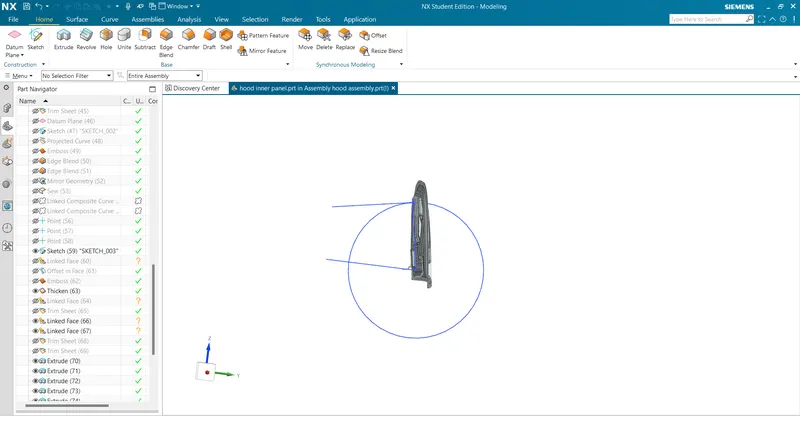
Mastic data- Mastic sealants are provided between the inner and outer panel of the hood. It is a rubber like substance that is expanded between the inner and outer panel. The diameter of each mastic is 80mm.
Emboss- Emboss is given to the part which is not visible from the ouside so that the aesthetic look of the vehicle is not compromised. It is always given in sideways direction or away from the passengers to let the force go towards the emboss and the passenger is dealt with minimal damage.
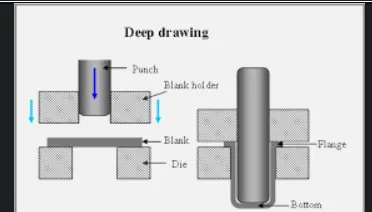
Manufacturing processes.-1) Deep drawing- It is a process in which a sheet metal blank is radially drawn into a die by the mecahnical action of punch. The process is suitable for industrial small-series and mass production.
2) Hemming - It is a process in which two metal sheets are joint together. In this process the outer sheet wraps the inner sheet for the purpose of joing together.