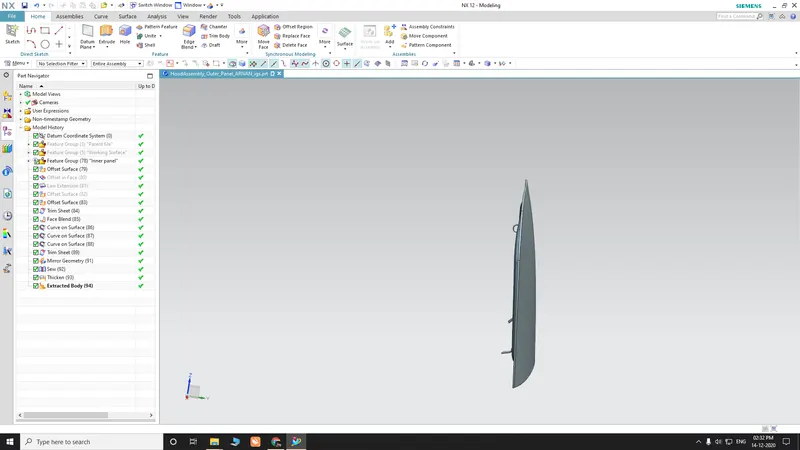
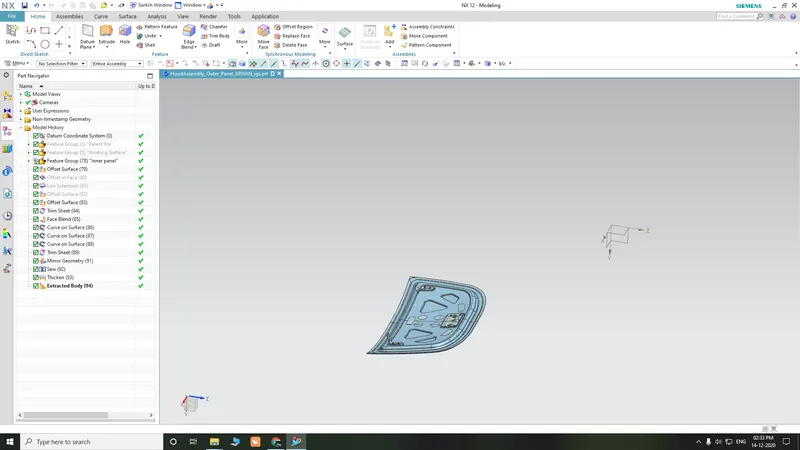
Hood design-Week 2
HOOD DESIGN
Aim : To Design outer panel, inner panel and necessary reinforcements.
INTRODUCTION:-
- For any inner section there is have outer section , we called it as cover or shield or protection for the inner section.
- For example inner section in our body consists of nerves, muscles ,heart ,bones etc, this inner section was covered with skin is called as outer section or acts a protection layer for inner things.
- The same concept was applicable to mechanical components of an vehicle, however, without outer panel the inner section of an vehicle doesn't mean anything.
- In a vehicle there are various inner sections where should cover by outer panel, like side doors, back door, front door and overall of body of the car.
Here i would like explain in detail importance of front door also called as a FRONT HOOD OR BONNET(from normal english).
The hood is the hinged cover over the engine of motor vehicles that allows access to the engine compartment.
The hood consists of two panels
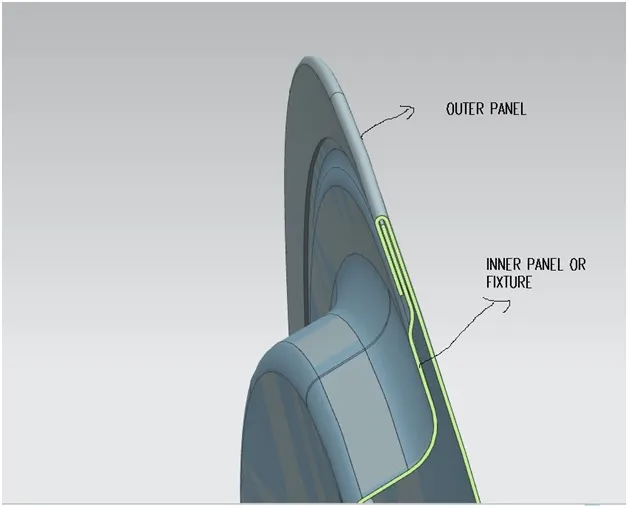
1)OUTER PANEL:-Outer section or body looks like smooth surface in design allowing enhancing the performance of an car.
2)INNER PANNEL:-This panel we also called it as a fixture for the outer panel which acts as a strengthen to the outer panel.
Objective:
The main objective of this project is to come up with a design idea for the bonnet or hood BIW that satisfies the manufacturing requirements, functional requirements, and as well as Euro NCAP standards.
The hood or bonnet have following components:
- Hood outer panel
- Hood inner panel
- Latch & striker re-enforcement
- Hinge re-enforcement
Design:
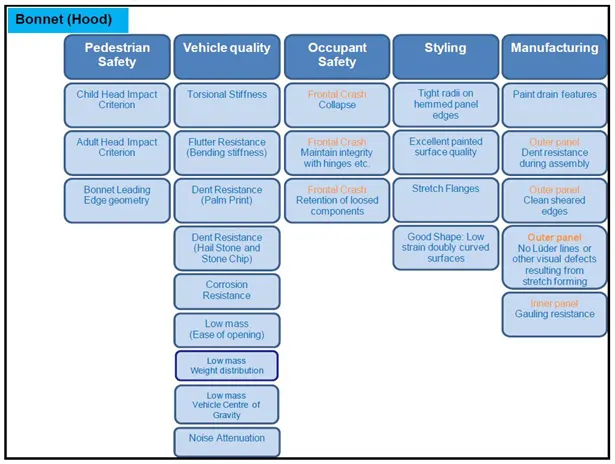
Pedestrian safety
In Japan and Europe, regulations have come into effect that place a limit on the severity of pedestrian head injury when struck by a motor vehicle.[2] This is leading to more advanced hood designs, as evidenced by multicone hood inner panel designs as found on the Mazda RX-8 and other vehicles. Other changes are being made to use the hood as an active structure and push its surface several centimeters away from the hard motor components during a pedestrian crash. This may be achieved by mechanical (spring force) or pyrotechnic devices.
Design of inner panel:
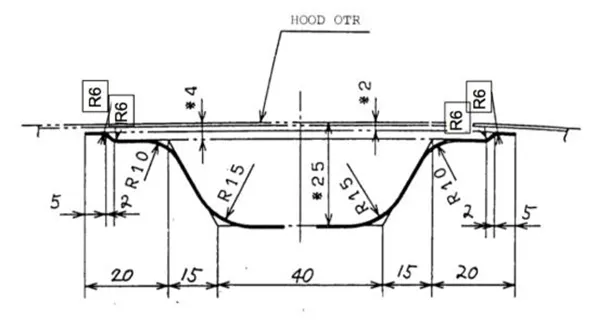
Master section: The master section is created based on the requirements received from the marketability team and the manufacturing requirements that we saw before. Below are the images of the master section used for the design.
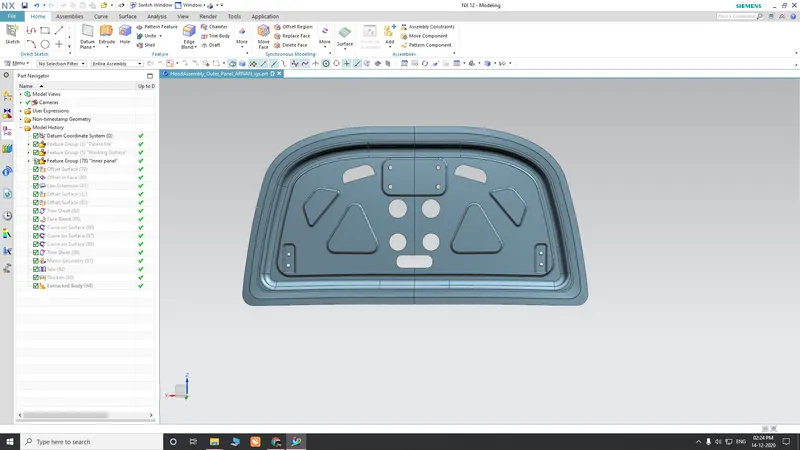
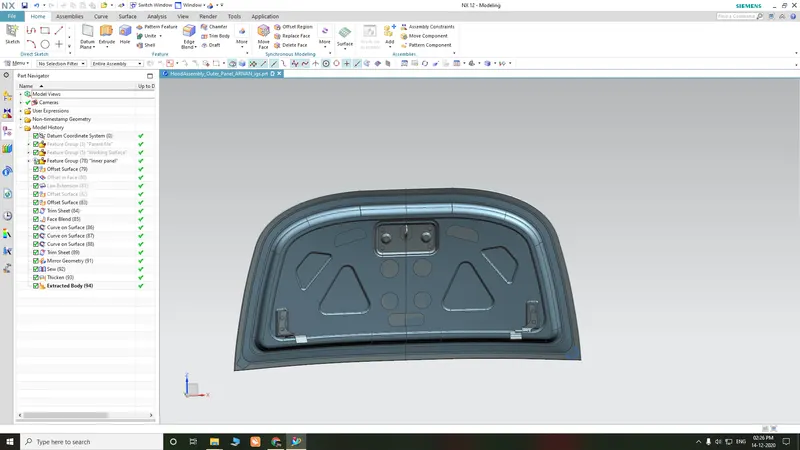
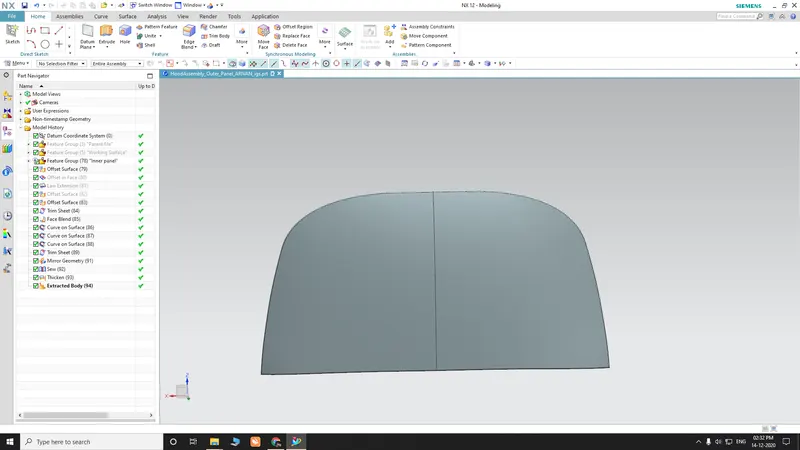
The main operations were carried out during the design of hood was
1)Offset curve on face:- In this operation the curve is created with reference to edge of the surface .
2)Trim sheet:-Unwanted material was removed with reference object curve projected on the surface.
3)Through curves:-Its an command used to create surface between two surfaces with reference to edge of an two sufaces.
4)Law of extension:-Its an command used to create surface with reference to curve projected on the surface.
5)Trim and extend:-This command used to create surface between two parts and eliminating unwanted material.
6)sew:-This command used to form unite body .
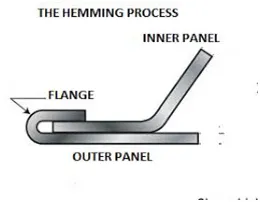
7)Hemming:-Its an operation to blend the flange wrap around the surface results to enhance the stiffness of the materila.
8)Thicken:-Its an command used to thicken the surface .
9)Assembly constarints:-This command used to assemble the various parts on the body.
The components include in the hood was
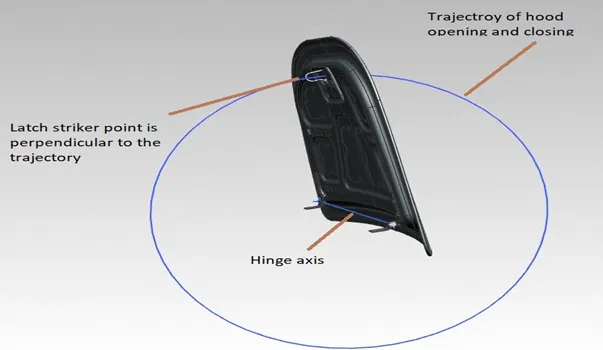
1)Latch trajectory:-This is the part of the hood have a trajectory or hook type design used to lock or unlock from the vehicle engine compartment.
2)Hinge assembly:-This hinge was placed on the hood to give rollover action to tilt up or tilt down the hood.
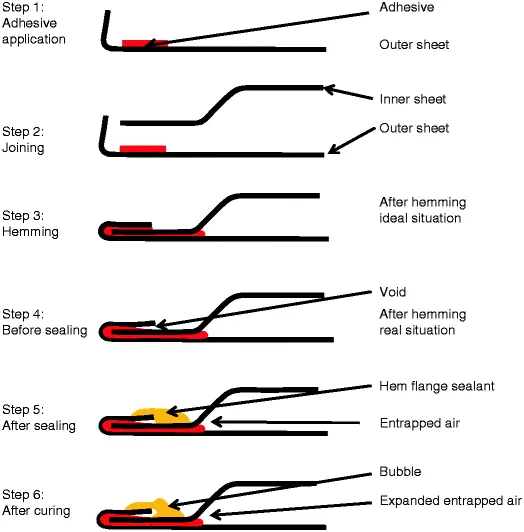
3)Mastic seal:-This seal used to attach the inner and outer panel instead of welding(welding gives spots on the surface which give aesthetic look on the surface, that's why the mastic seal was introduced).
- Each mastic points in the fixture covers over 80mm dia to stick together between inner and outer panel.
Hemming process:
Hemming is the process in which the edge is rolled flush to itself, while a seam joins the edges of two materials. Normally hemming operations are used to connect parts together, to improve the appearance of a part and to reinforce part edges. In hood design. Hemming is used in assembly as a secondary operation after deep drawing, trimming and flanging operations to join two sheet metal parts (outer and inner) together.