Hood design-Week 2
CAR HOOD DESIGN
AIM
- To design the car hood outer pannnel,inner panel and the neccessary reinforcements by the given data in the master section.
- To make the detailed report about the hood design which includes a detailed explanation about hood and its components,latch trajectory,mastic data,emboss definitionsand manufacturing process like deep- drawing and hemming.
HOOD
INTRODUCTION
A car hood also referred to as a bonnet in other countries is hinged cover that rests over the engine of a front engine vehicle. Its purpose is to provide a access to the engine for maintenance and repair.Car hoods are typically constructed by aluminium and sometimes from aluminium. It consist of inner panel and outer panel . The inner panel provides strength while the outer panel functions as the metal cover.
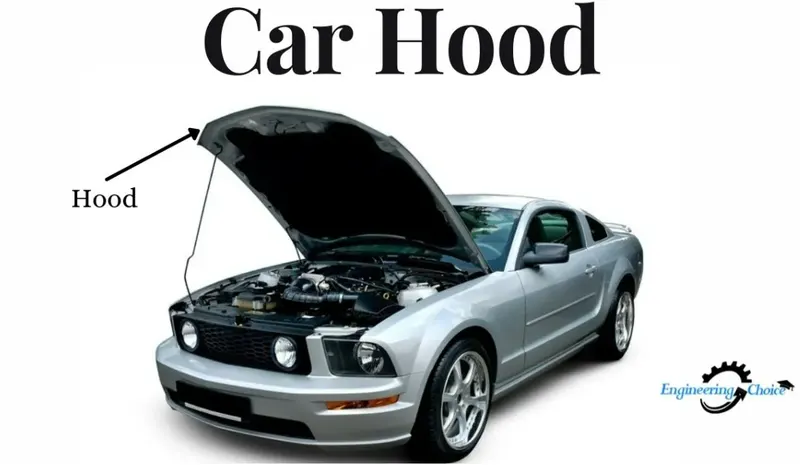
FIG:- HOOD IN FRONT ENGINE VEHICLE ( open condition)
COMPONENTS IN HOOD
1) Hood outer panel
2) Hood inner panel
3) Hinge assembly
4) latch and striker
1)HOOD OUTER PANEL
- Its the outer look of the car hood.
- Its gives the additional style to the car
- The outer should be thin and lite weight
- Its joined together with the inner panel
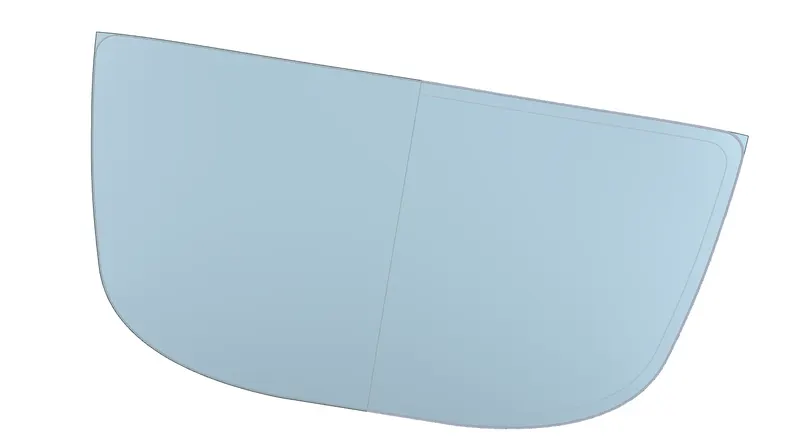
FIG:- OUTER PANEL
2)HOOD INNER PANEL
- Its the inner layer of the car hood
- Hinge assemblies , latch and striker are fixed on it
- The embosses, and reinforcement for hinge and striker are developed on its surface
- Its joined together with the outer panel by using of mastic stealents
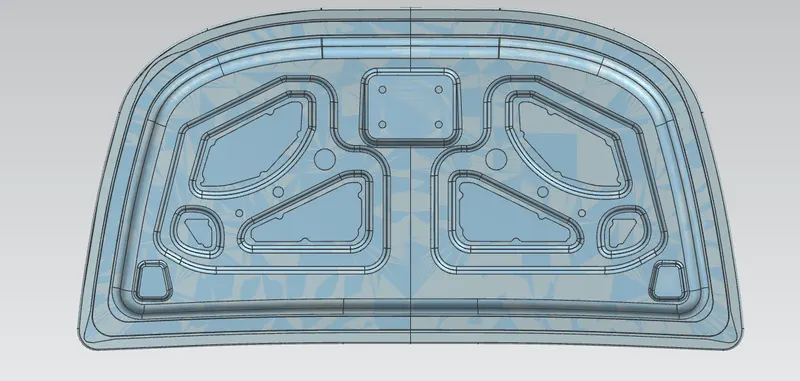
FIG:- INNER PANEL
3)HINGE ASSEMBLY
A hinge is a mechanical bearing that connects two solid objects , typically allowing only a limited angle of rotation between them. Two objects connected by an ideal hinge rotate relative to each otherabout a fixed axis of rotation, all other translations or rotaions being prevented,and thus a hinge has one degree of freedom. Hinges may be made of flexible material or of movimng components .
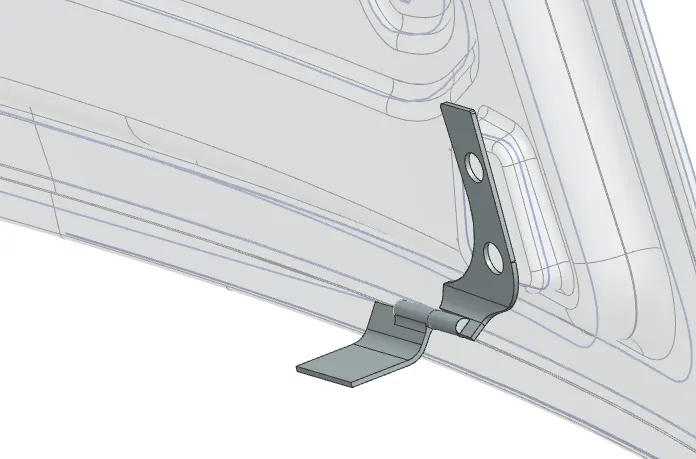
FIG:- HINGE ASSEMBLY
4) LATCH AND STRIKER
The hood latch system is a vital component in every automotive. It is located behind the grille, directly under the hood striker, which is on the hood. the hood latch has many important functions.As the engine of the car is may times refered to as the " heart" of the car , it is necessary to keep the engine covered and protected.
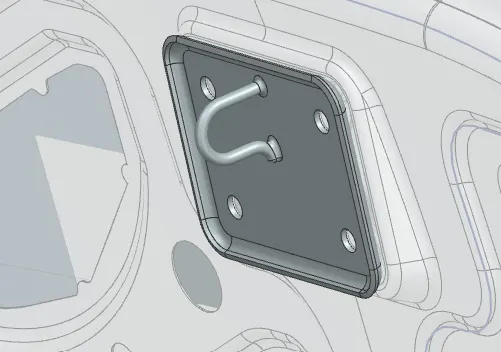
FIG:- LATCH AND STRIKER
Two types of rods use to hold the hood during the opening condition
They are,
1) support rod
2) gas stay
1)SUPPORT ROD
Its one of the component used to holding the hood. Support rod is not always straight, its have some blendy and curves. Because the straight rod can be easily bends. the curves and bends are gives he t more strength and makes rigid. Its mounted on the engine compartment or hood outer panel. The curvature limit of the rod is must contains below the 32mm. If it cross 35mm due to the weight of the hood the rod will be bend. Support rod should be placed opposite side ton the battery for easily put and change of battery. Cost effective is simple.
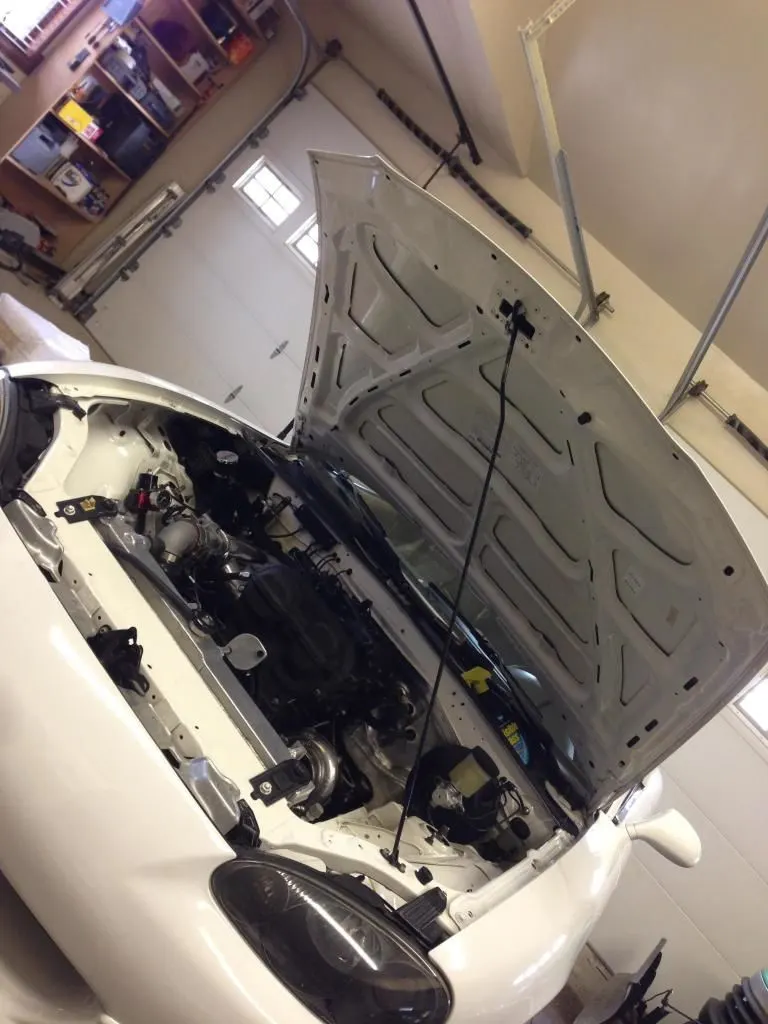
FIG:- SUPPORT ROD ( hood open condition)
2)GAS STAY
Gas stay is one of the device is use to open and hold the hood without any manual help. Its operated by the pistons. Stud balls are used to fix the gas stay at both corners. During the mounting of gas stay need additional bracket or reinforcement. cost effetive is high compared to the support rod.
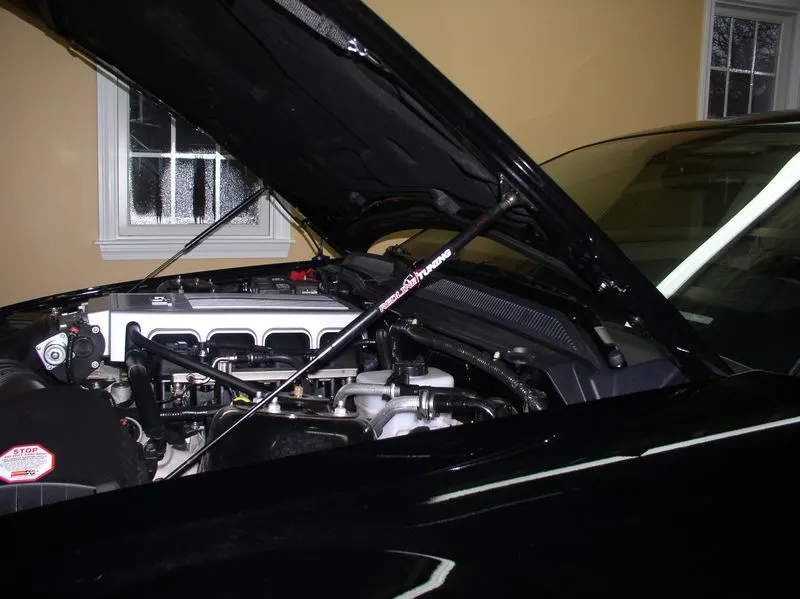
FIG:- GAS STAY ( opening condition)
LATCH TRAJECTORY
- Its a mechanism is used to fix the latch at correct position with perpendicular to the hinge axis.
- The steps in latch trajectory as follows,
- Initially positioning the hinges tentatively to each other in opposite directions.
- Draw a straight line to the hinge axis and mark the centre point of the line.
- Then take the centre point of the latch and and draw a line to the center of hinge axis , consider a line as radius and make the circle , this circle is trajectory of the hood opening and closing.
- At this situation if the striker is exactly perpendicular to the trajectory on this region locally then the hinge position is correct or else we need to move the hinges forward or reverse to get the perpendicular in nature.
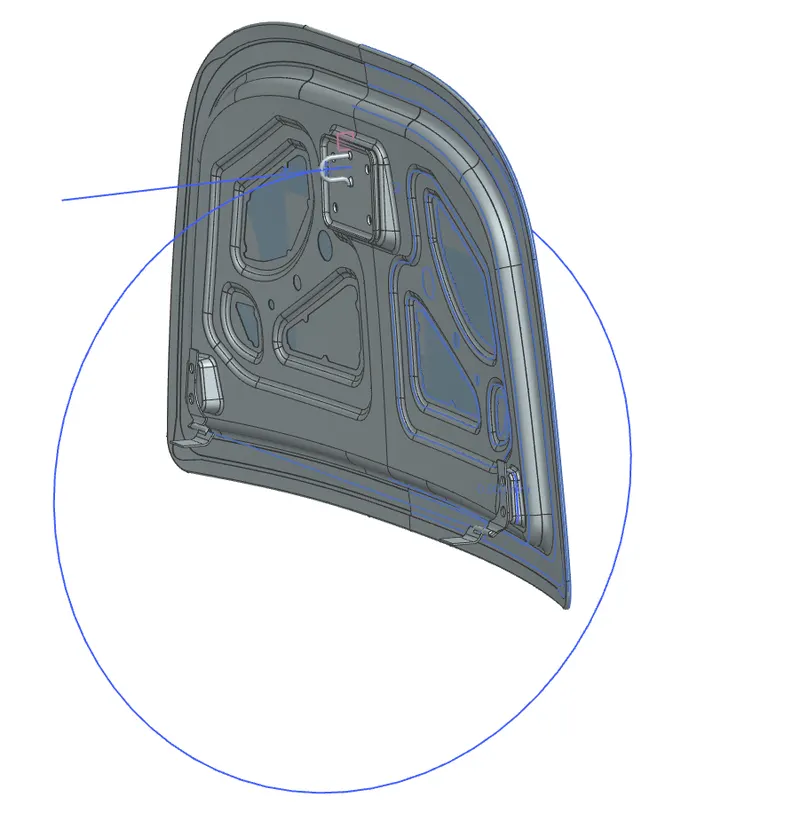
FIG:- LATCH TRAJECTORY
MASTIC DATA
The mastic stealent or mastic point is an elastic compound that behaves like a rubber. The mastic points are defined on the hood inner panel where the hood can easily deform. They help the hood outer panel to comback to its original shape after it gets deformed. The mastic stealants are pasted inbetween the hood outer panel and inner panel. Mastic stealents are have the dentency of improving the strength locally around 80mm dia.
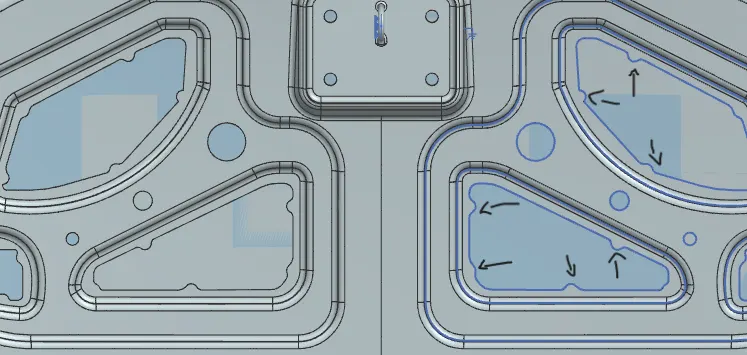
FIG:- MASTIC POINTS
EMBOSS
Embossing is an artistic technique that create a pattern on a material such as paper, metal, sheet, leather or wood . The pattern can be raised or in relief depending on how it is embossed. In hood design the embosses are used to distract the forces to the other directions by the help of related pattern of the emboss on hood inner panel. Mostly the designer should be create the emboss to distract the striking force into some angle direction to conduct the forces to the car outer directions. Generally the embosses sketches are created by the basic design of V and reverse Y.
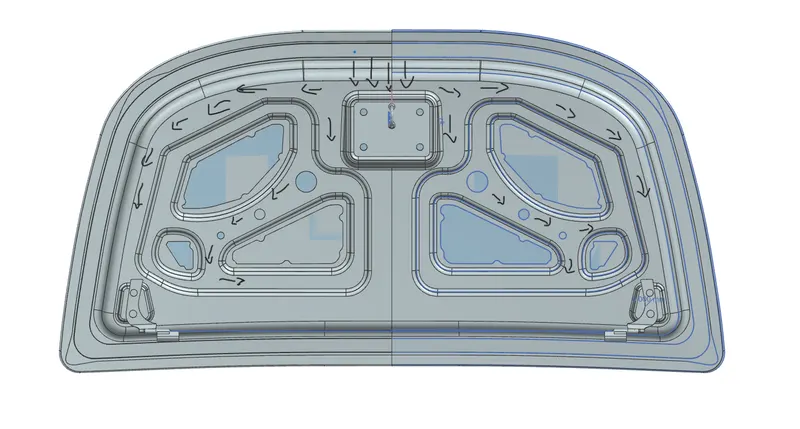
FIG:- EMBOSSED FACE
PARAMETERS USED IN HOOD DESIGN
1) OFFSET SURFACE
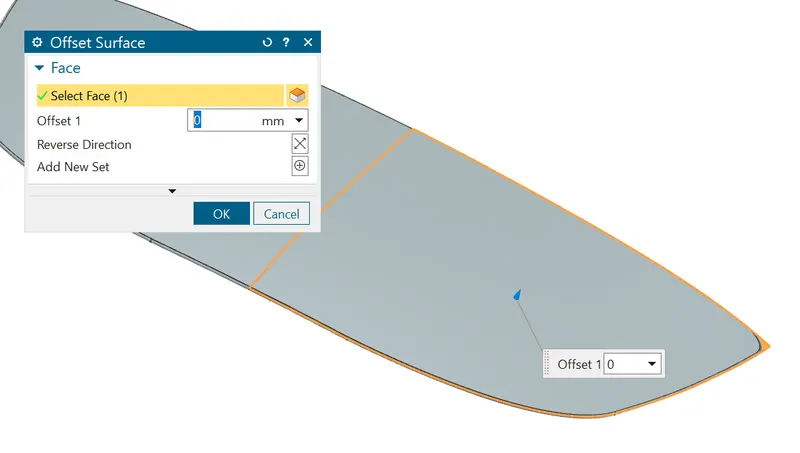
( Its used to offsetting the face to the required dimensions)
2) OFFSET CURVE ON SURFACE
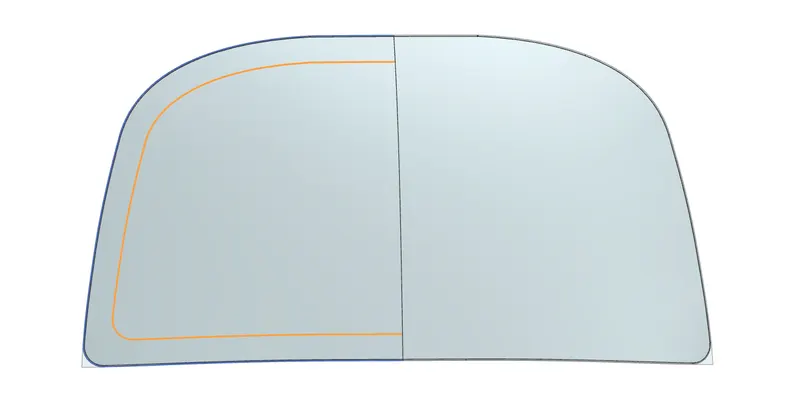
(Its used to offsetting the curve to the body faces in both forward and reverse direction)
3)TRIM SHEET
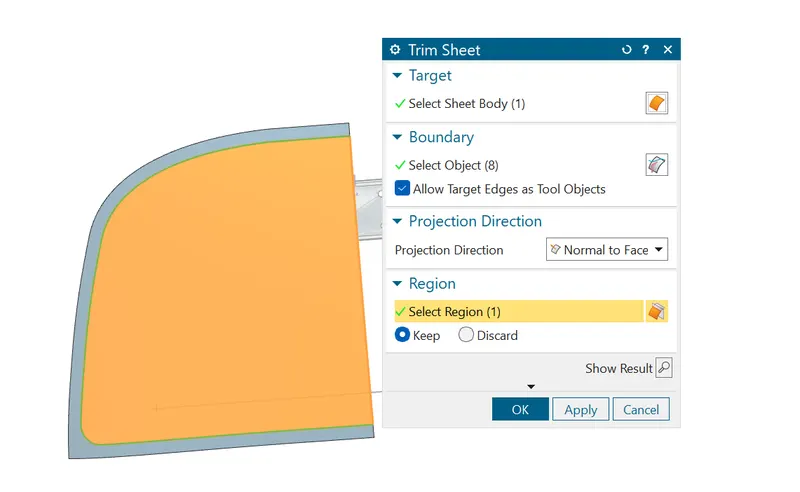
(Its used to trim the sheet tonrequired boundary and selected region)
4) THROUGH CURVES
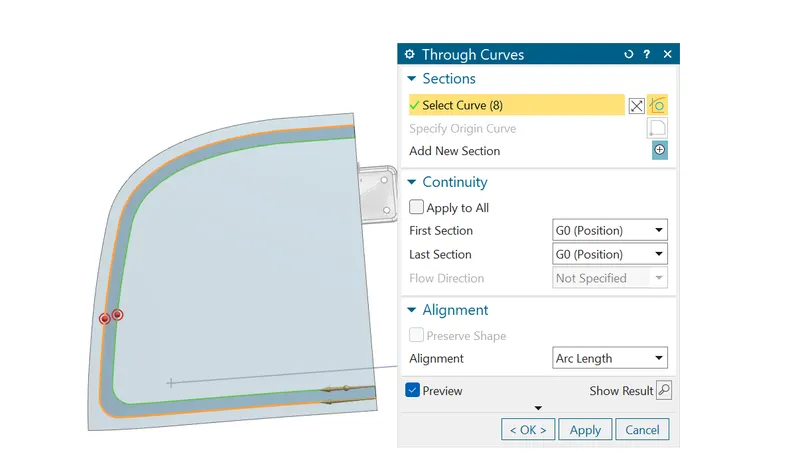
(Its used to create the region inbetween the two sheets at different positions)
5) LAW EXTENSIONS
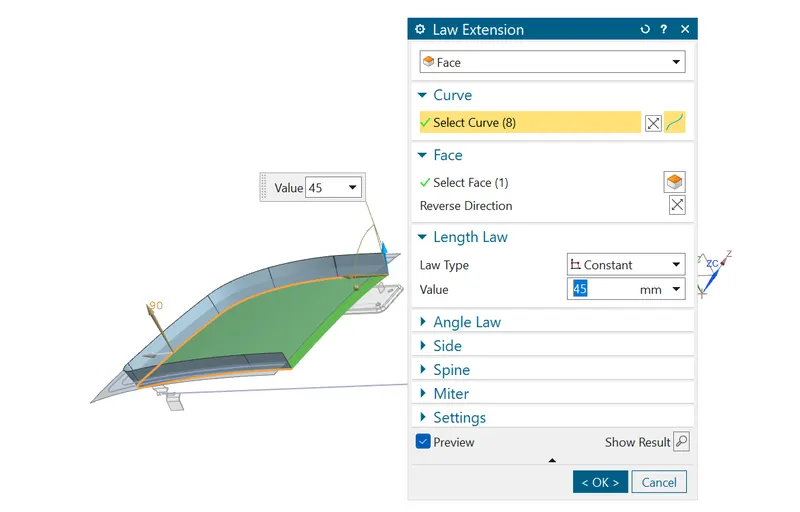
( Its used to extend the sheet to the required length and required angle)
6) FACE BLEND
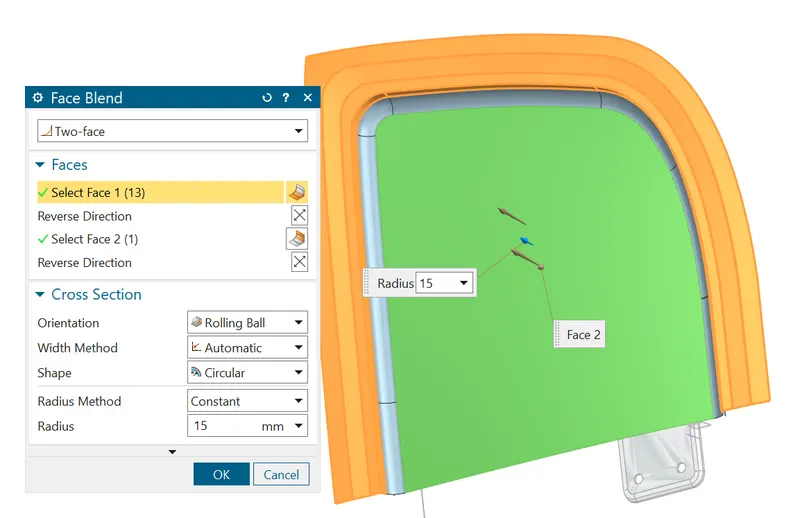
( Its used to create the curvey surface in between the sharp edged faces)
7) EDGE BLEND
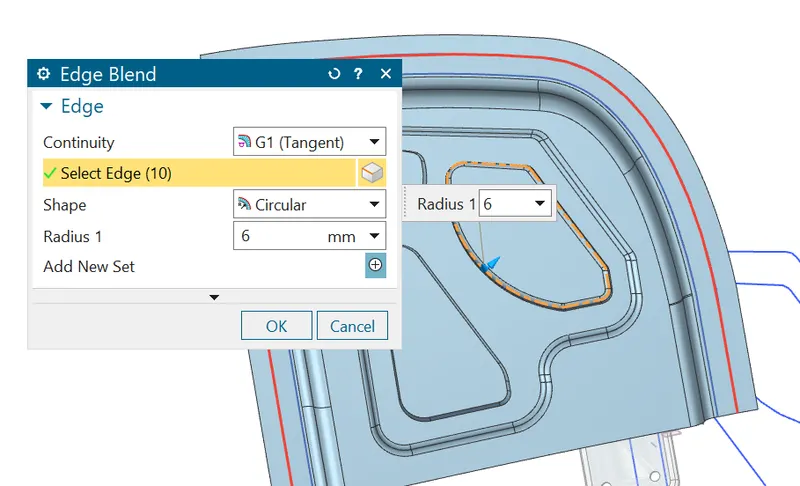
( Its used to convert the sharp edge of the body in to curved edge)
8) ASSEMBLY CONSTRAINTS
The hinge assembly and the striker is fixed by using touchalign and fixed constraints.
( SHEET METALS ARE GENERALLY MANUFACTURED BY DEEP-DRAWING AND HEMMING PROCESS)
DEEP DRAWING
The deep-drawing is the sheet metal forming process that uses a punch and dies to draw (pull) the workpiece into the desired shape. The sheet metal is placed between the two dies, and the punch is forced against it to create the desired profile. Deep-drawing is used to make cups,bowls and other hollow shapes from sheet metal. It is used to produce precision parts with complex shapes. The deep-drawing process uses either a hydraulic or mechanical press.
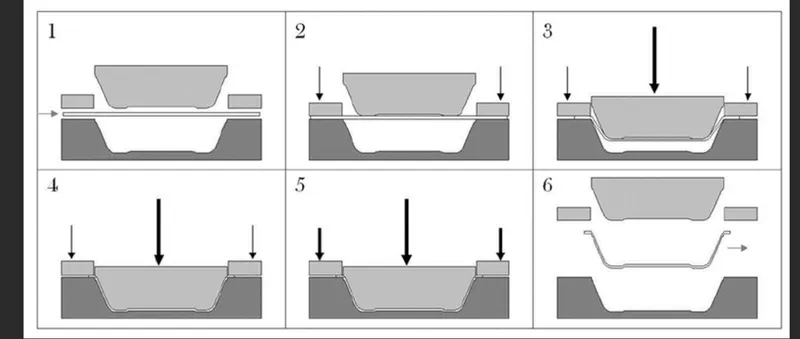
FIG:- DEEP-DRAWING
HEMMING
Hemming is a forming operation in which the edges of the sheets are folded or folded over the another part in order to achieve a tight fit. Normally hemming operations are used to connect parts togerher,to improve the appearance of a part and to reinforce the part edges.In this process the sheet metals are joined by bending it to 180 degree.
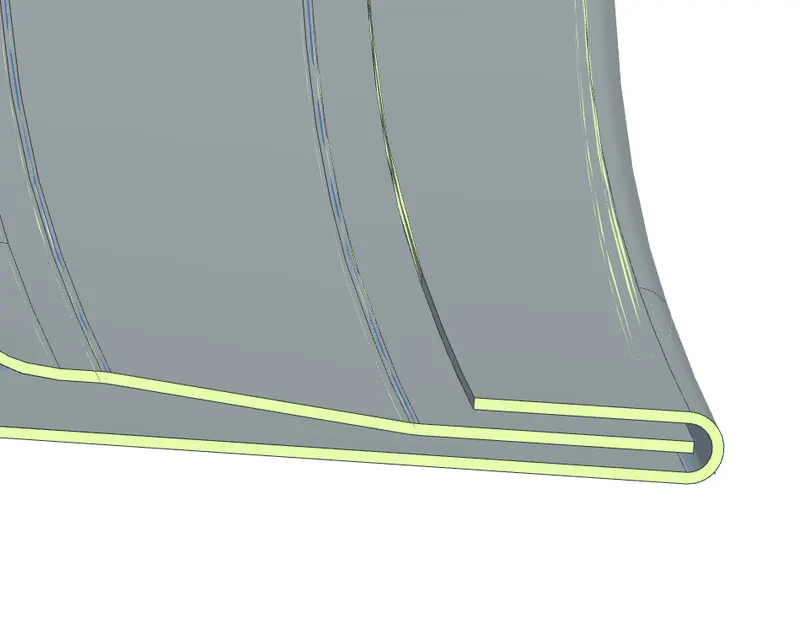
FIG:- HEMMING
During the designing of car, designer should be focus on the pedestrian safety
Pedestrian safety through vehicle design
In may 2013 the World Health Organization (WHO) reported that more than 2,70,000 pedestrian lose their lives on the world roads each year, accounting for 22% of the total 1.24 million road traffic deaths. Since the 1970s, crash ewngineers begun to use design principles that have proved succesful in protecting car ocupants to develop vehicle design concepts that reduce the likelihood of injuries to the pedestrian in the event of car-pedestrian crash. these involve the redesigning the bumper, hood(bonnet) and the windshield and pillar to be energy absorbing (softer) without compromising the structural integrity of the car.
PROTECTING THE HEAD BY DESIGNING OF HOOD
The hood of most vehicles fabricated from sheet metals, which is compliant energy absorbing structure which poses a comparatively small thread. Most serious head injuries occur when there is insufficient clearance between and the stiff underlying engine components. A gap of approximately 10cm is usually enough to allow the pedestrian's head to have controlled deceleration and significantly reduce the rsk of death. In 2012 and 2015 , the VOLVO and the LAND ROVER DISCOVERY SPORT have an under_ the hood airbag designed to operate if the hood senses a hit.The airbag also designed to cover the windshield pillars to help to protect the pedestrian head.
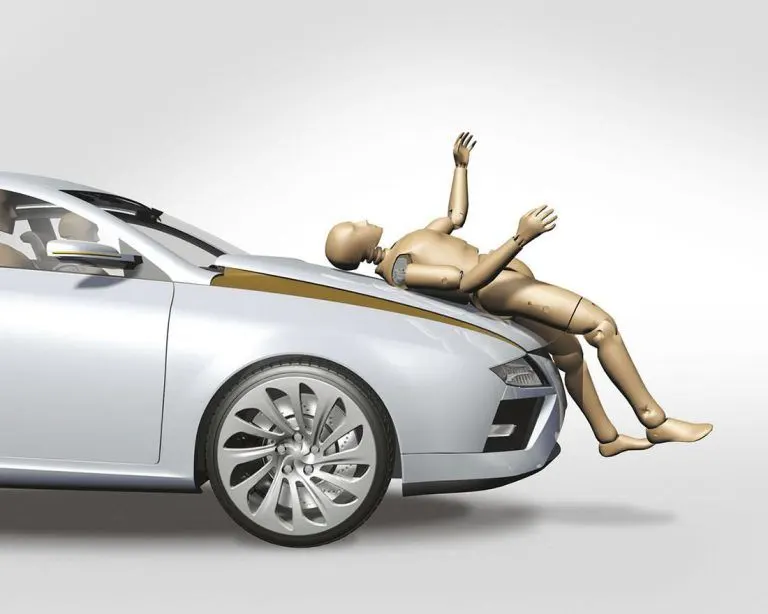
FIG:- PEDESTRIAN BODY STRIKES ON THE HOOD AREA
CONCLUSION
The hood and its components are designed as per the given data in the master section . And the hinge assemblies and striker is assembled to its correct position.