Hood design-Week 2
CAR HOOD DESIGN
AIM:
- To design the Hood or Bonet of the front driving car by using the master section and standard procedure which is used in the OEM Manufacturer's.
GIVEN MASTER SECTION:
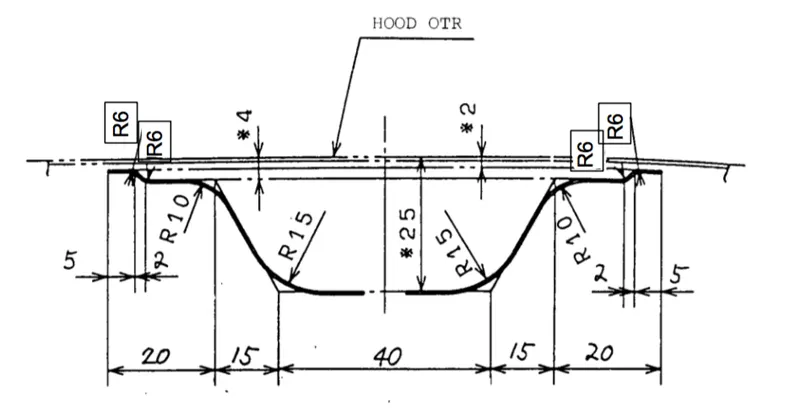
HOOD or BONET:
- Hood is the component which is placed over the engine compartment. The design of the hood is not only to enhance the look of the car, it also improves the aerodynamics of the car and the proper design which ensure the pedestrain safety.
- For Serviceability and maintanence of the car, hood is used to access the components like, engine, radiator, battery, etc.,
- Over the period of time, designers has continously improving the hood design inorder to minimize the injuries of the pedestrain when he/she hits the hood while accident occurs. So it depends upon the material, design and structure of the hood.
Design consideration
Car bonnet is the important component which is utilized for several purposes at the front. It gives access to the engine compartment which enable the repair and maintenance of many parts namely car engine, radiator etc. Therefore, bonnet must be designed in suitable manner, and it should minimize the hindrances from the disturbance caused by the external environment on the hood and its components below it. When the car is in running condition, the resisting forces from the air acting on the hood. Therefore, the design of the bonnet should be made aerodynamic to reduce the air resistance.
- Head Impact Zone – According to recent surveys lots of pedestrian losses their lives and are severely get their head damaged during the accident. The pedestrian are adults, children, cyclist, or others. So, to keep these things in mind the hood design is done in such a way that it injured the pedestrian as less as possible.
So, the hoods are designed in two ways –
1.Wrap around hood

2.Inlaid hood

According to different regions, head zones are defined by considering the average heights of pedestrians. The below image shows American, European, and Japanese head zone standards. The opening angle of the hood is also decided as per predefined standards.
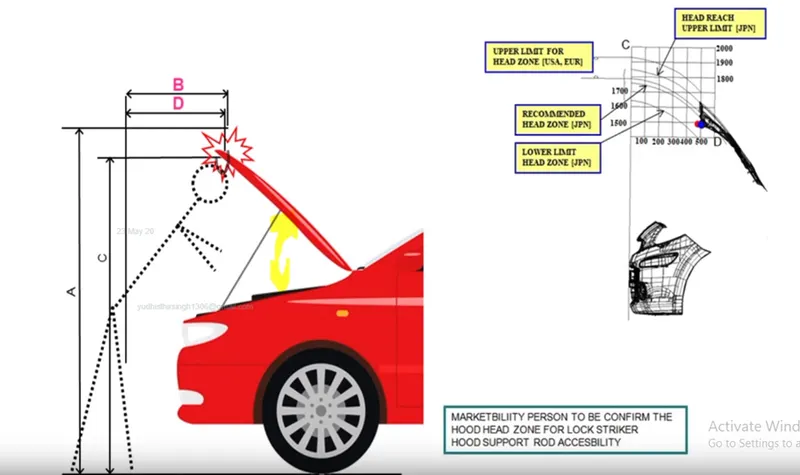
Wrap around distance is the trace of points received on the front structure when one end of the flexible tape of required length is held at the ground reference line and the other end in contact with the front structure.
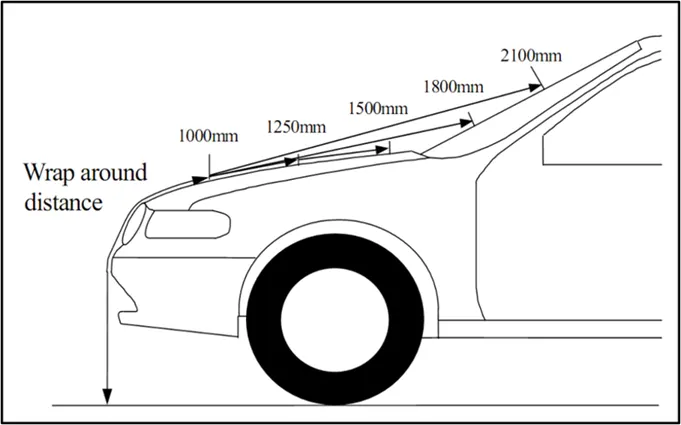
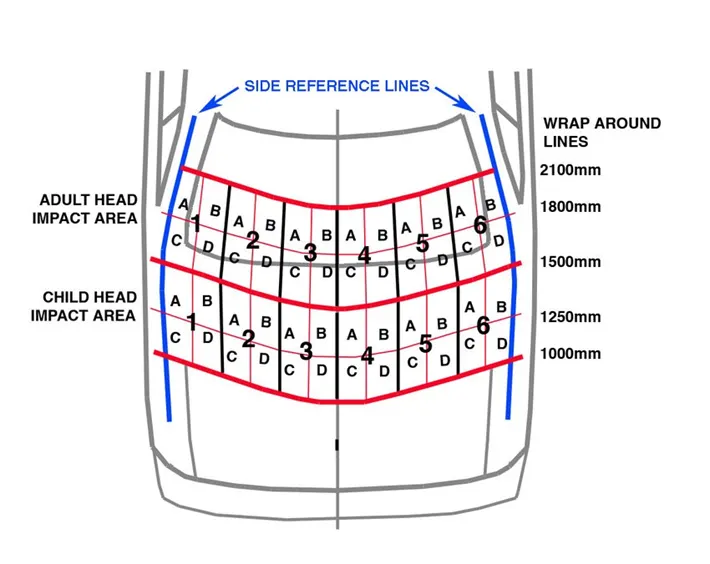
When a child hits on a hood his head will fall between 1000 to 1500 mm area whereas. When an adult hits on a hood his head will fall between 1500 to 2100 mm.
EURO NCAP Test
EURO NCAP Test is performed to check the safety of pedestrians by considering head impact, leg impact, etc.
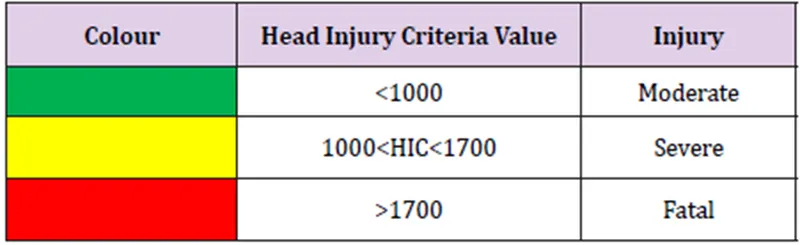
As per NCAP Head impact criteria should be below 1000 to have a moderate injury. The hood designer's aim is to develop a hood having a major green zone.
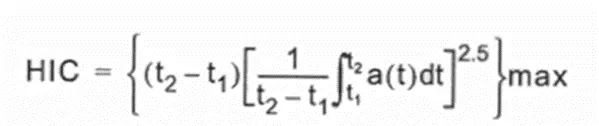
Where t1 and t2 are the initial and final times (expressed in seconds) of the interval during which the HIC attains a maximum value and a(t) is the resultant acceleration (expressed in G) measured at the head CG.
The time duration (t1-t2) used in the calculation should be taken as the contact time for the impact, however, this is often very difficult to ascertain in physical evaluations using crash test dummies or head form simulators. In using HIC for assessing the potential of concussion than a maximum time duration of 15 msec should be used, which was the maximum time duration for which the original tolerance curve was developed. Longer contact time durations can be used to predict skull fracture.
The highest acceleration, independent of location or direction, should be used in the Head Injury Criterion, which will therefore be the resultant acceleration measured at the head's centre of gravity.
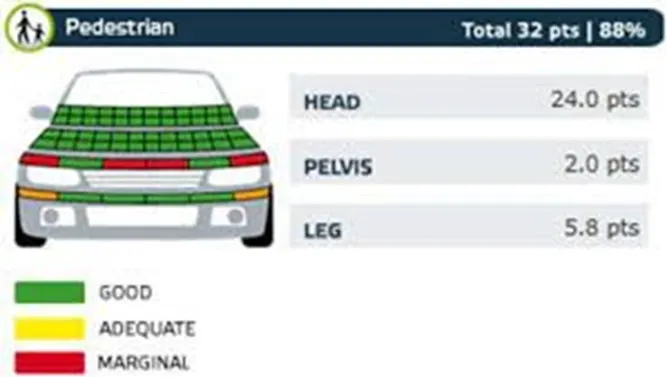
After a test, points are allocated to the impact portion (which shows the color code at impact areas), and accordingly, a pedestrian safety rating is assigned to the vehicle. The below Image shows different color zones for pedestrian safety.
Head Impact Injury Criteria
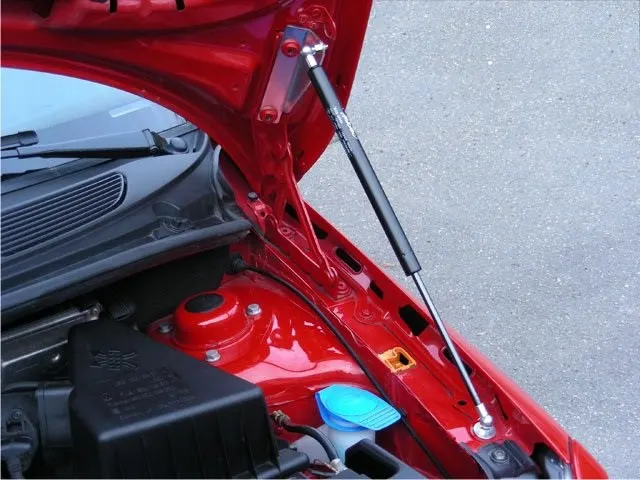
- Gas Stay or Support Rod – The gas stay, or support rod help to keep the hood open. While designing hood the position of support rod should be considered in both open and close position. While in close position the support rod should rest in such a way it doesn’t touch any other component, and if touches with any part, then vibration will be produced, and it will also create noise. And, in the open position it should be such that it can easily withstand the load of the hood.
- Opening of Hood – When the hood open there should be a space of 15 to 30 mm so that the fingers can place in that space to lift the hood.
- Other parameters –
- Thickness of hood
- Outer panel = .75mm
- Inner panel = .75mm
- Reinforcement = 1.5mm
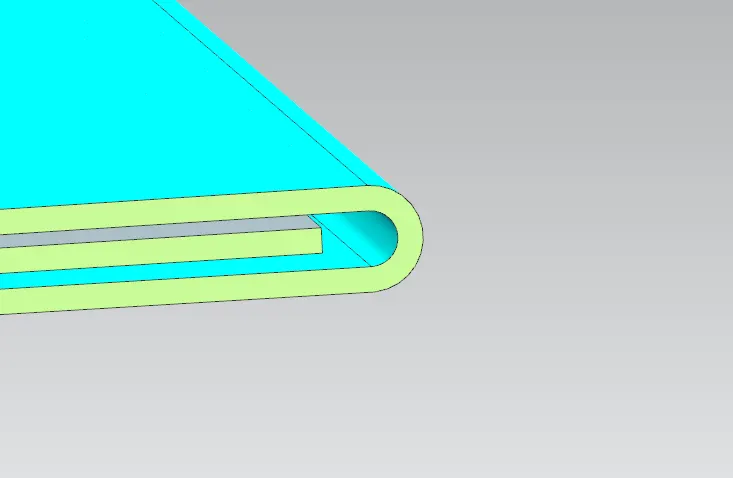
- Relief in rear and front section of the inner and outer panel for hemming.
- Gap between inner and outer panel for hemming.
- Thickness of hood
Car Hood has the following components:
- Outer Panel
- Inner Panel
- Striker and Hinge asm
- Reinforcement
- Hood Support
- Mastic's
Hood has designed by the process of using the following Sheet Metal Operations:
- Hemming
- Embossing
- Deep Drawing
- Piercing
Car Hood Components:
Outer Panel:
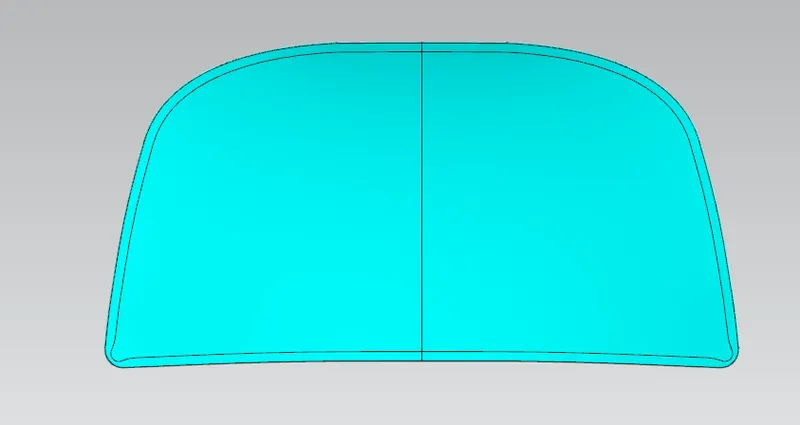
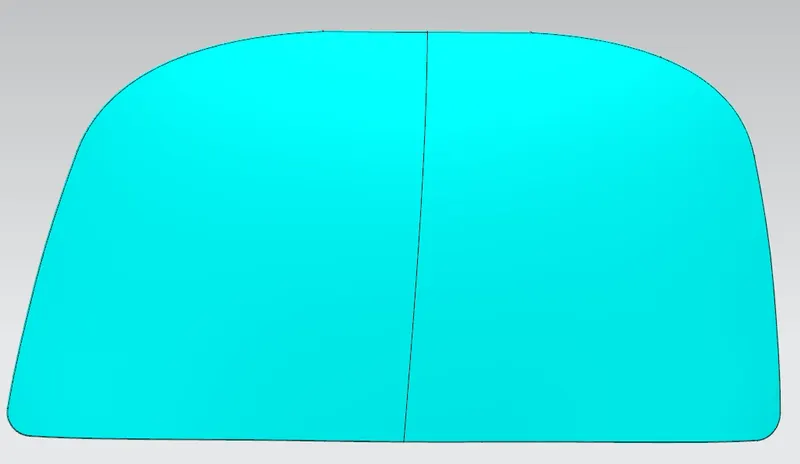
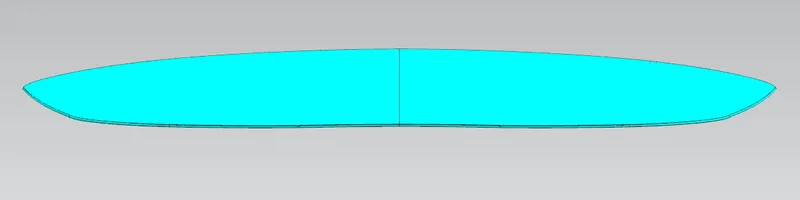
Outer Panel is the most important part of the hood to makes the car in a very good aesthetic proportion. So that the Outer panel is perfectly made insense to achieve the aesthatic requirement. So that, the sheet metal operation result which is visible on the outer panel or it reduces the aesthatic value means, those operations are strictly not to be followed to make the outer panel. That's why the hemming process is used to join the outer panel with the inner panel, instead of using welding methods.
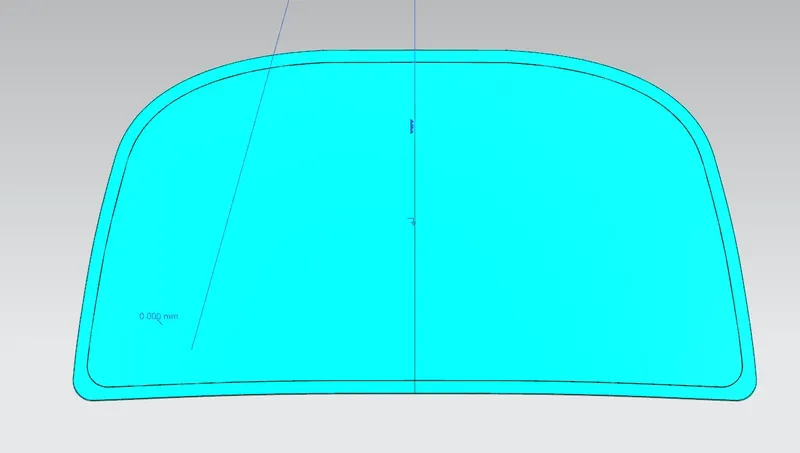
By considering the given Outer Panel thickness(0.75mm) and using the outer panel styling surface the outer panel has been made as below.
Inner Panel:
Inner Panel is the major part that ensures the rigidity of the hood and It is used to diverts the impact to outwards of the hood however possible when the collision occurs. It is can be achieved by the good inner panel design and the emboss direction in the inner panel.
Lot of design changes and researches are done and being carried out in the inner panel only to achieve the pedestrain safety and the passenger safety to make the standards.
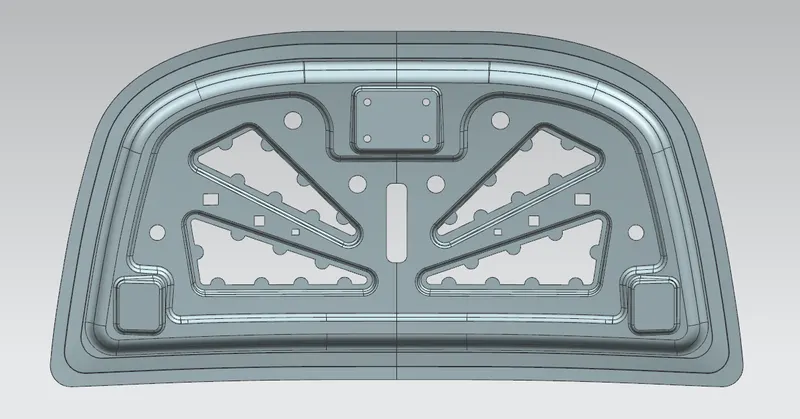
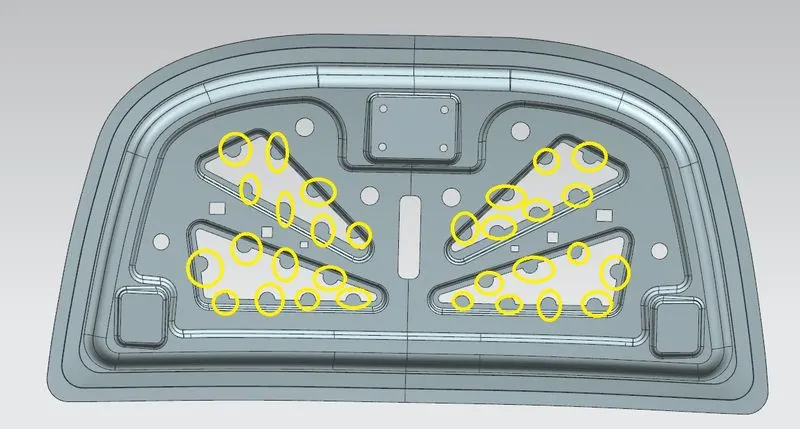
In this inner panel, the required holes are made to transport the hood from one station to other and fix the hood in fixture by using this hole as budding holes. Also the inner panel has the embosses and mastic points.
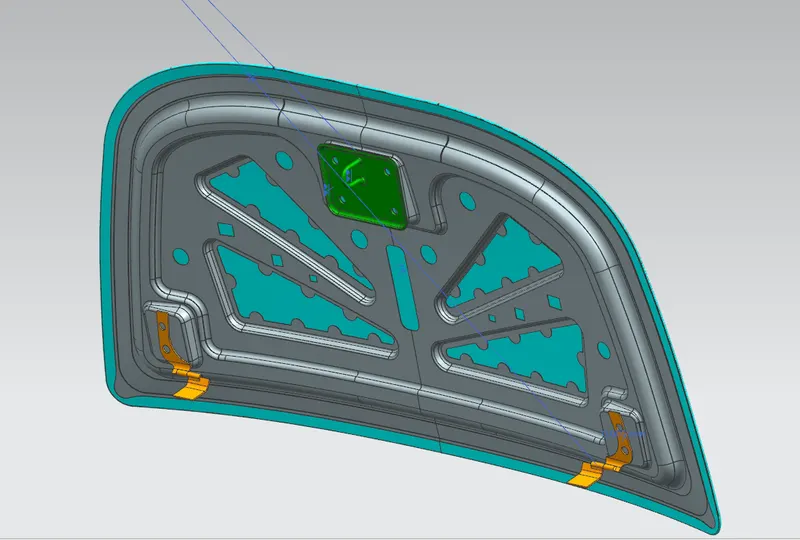
By considering the given Inner Panel thickness(0.75mm) and offseting the outer panel styling surface with the given offset data, the Inner Panel has been made with the embosses and mastic points as below,
Reinforcement:
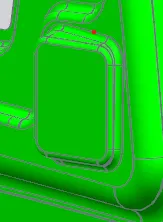
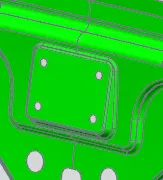
The Striker and Hinges are attached at the lower side of the inner panel. It it can be done by directly then more stress can act at the particular area in the inner panel, it may cause deformation of the inner panel at that particular region. So that the reinforcement comes in and placed between the striker and the hood, hinge and the hood. It can able to reduce to deformation and strengthening the inner panel at that particular region.
Striker-Latch and Hinge Asm:
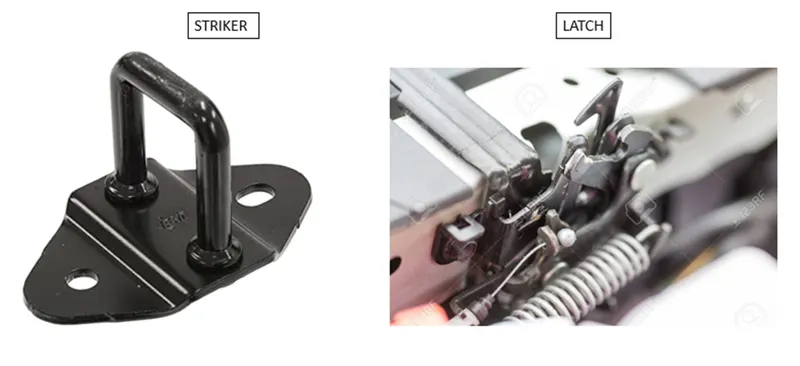
Striker-Latch
Striker is the part which is used to hold the hood with the engine compartment by using the latch which it is attached in the engine compartment, when the hood not require to open up. The striket is attached to the bottom of the inner panel and it hits the latch and locked with it, when the hood is dropped down.
There is lever which is provided inside the cabin to the driver to release the latch pressure. Once it can be done, the hood will opens up in a inch, then we can able to open the hood more.
Hinge Assembly
It is used to fix the hood to the engine compartment.
For any component has to be open and close with an axis, then hinge plays a major role. It has two simple parts(one is hood side hinge, another one is engine compartment side hinge) and assembled with the single axis.
Hinge Assembly is attached at the each Outwards end of the hood and the engine compartment.
Position of Striker and Hinge Assembly
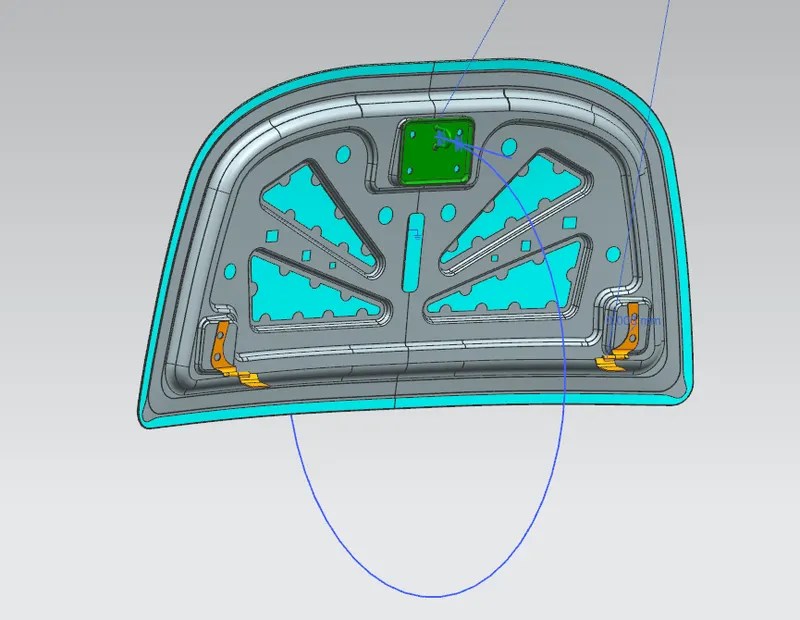
The attachment of striker to the inner panel of the hood is done by following the certain steps.
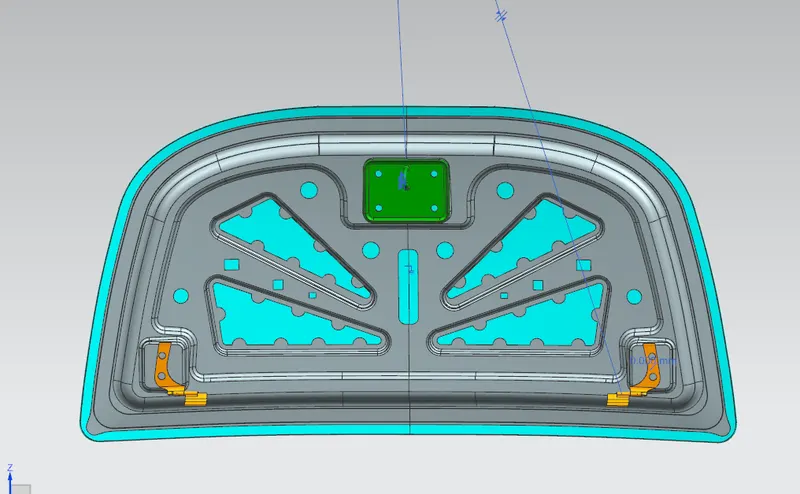
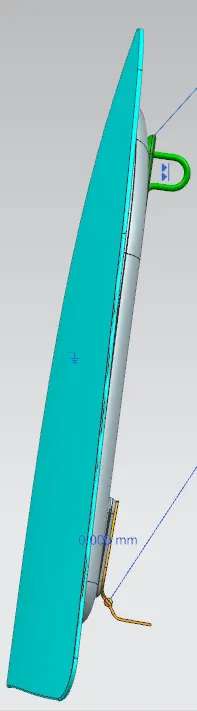
For that Initially the the hinge is roughly attached/assembled to the each outwards end of the inner panel throught the hinge reinforcement. Then a line is created along the axis of the two hinges.
A circle is created at the midpoint of that line and another line is created tangent to this circle and then the ref line has created within the circle with particular angle. After that based on the required striker position the circle diameter and the linge angle has been changed. Also an another line has been created parallel to the striker hook from the striking point of the striker.
Then the assemble the both lines and striker to the inner panel through striker reinforcement using the assembly constraints.
Mastic's:
Mastics are the kind of sealant which is used to combine the outer panel of the hood to the inner panel of the hood by applying between them. When in applying condition it is in the form of liquid substance with high viscosity like paste, then it is placed in worm condition, it turn into rubber like solid state. So that it can be the damping resistance and reduces the noises and all.
Sheet Metal Operations:
Hemming:
Hemming is used to fit the parts together. It can be done by the edges of one part is to be folded over the other part to fix within it. This operation is done by using the roller.
Hoods, Doors, Boot lids of the automobile components are made by the hemming operation.
There are two types of hemming process are there,
Conventional die hemming - In this method the hemming process is done by using the hemming die to fold the sheet metal edge by the entire length.
Roll Hemming - In this method Rollers are used to done the process and at the same time two or more rollers are fold the sheet metal from the different location of the sheet metal edge to achieve the hemming which is close to accurate. Most of the automobile manufacturer are following the Roll hemming method due to its easier method when compare to the conventional die hemming.
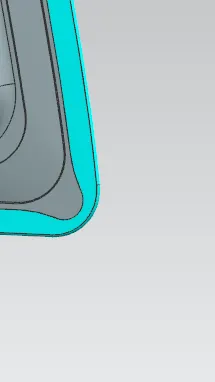
In Hood, the outer panel is subjected to the hemming operation which means that the outer panel edges is folded and roll it back to the underneath of the inner panel. The corner of the outer panel edge has to be trimmed, Because while hemming process the roller transfer pressure to the outer panel edge to fold it and roll it back, so that it may cause the problem that the sheet metal may break.
Hemming
Corner relief
Deep Drawing:
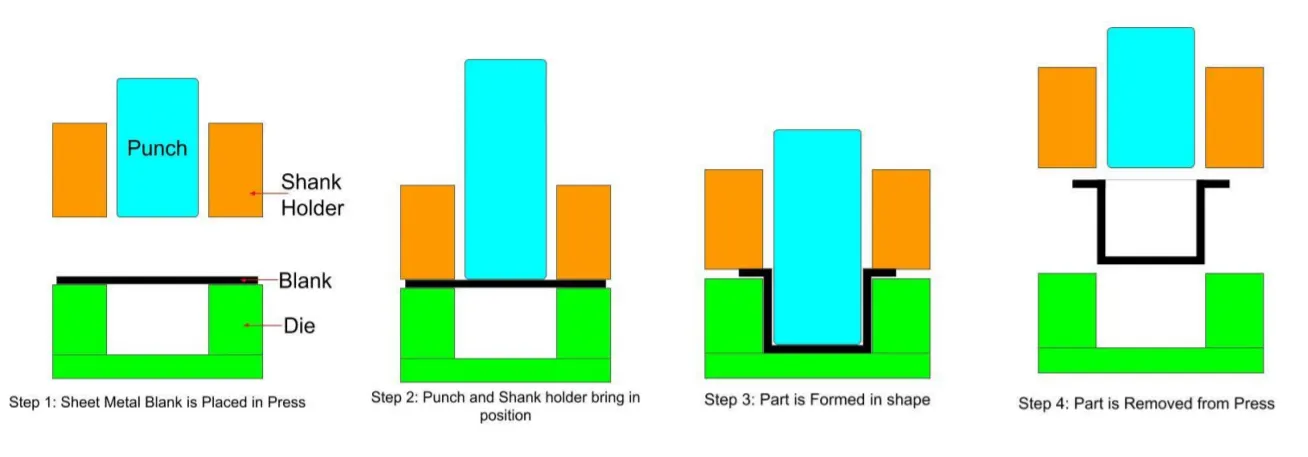
Deep Drawing is the sheet metal forming process. It is quite similar as punching process.
Deep Drawing - The required sheet metal is to be clamped and the die with the required shape has to be kept below the sheet metal, then the sheet metal blank is drawn into that forming die by the pressure applied by the punch.
Embossing:
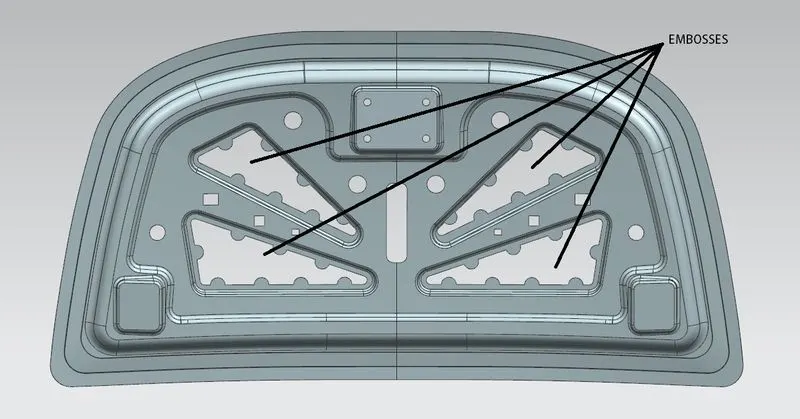
Emboosing is kind of stamping process. It is the process of appliying the pressure to the flat sheet metal by the forming tool to create the projection on that sheet metal wherever required.
In Hood design, the inner panel of the hood has more embosses to improving the strengthening of the panel. Based on the design structure, the embosses are created or we can say projected on the inner panel sheet metal.
Piercing:
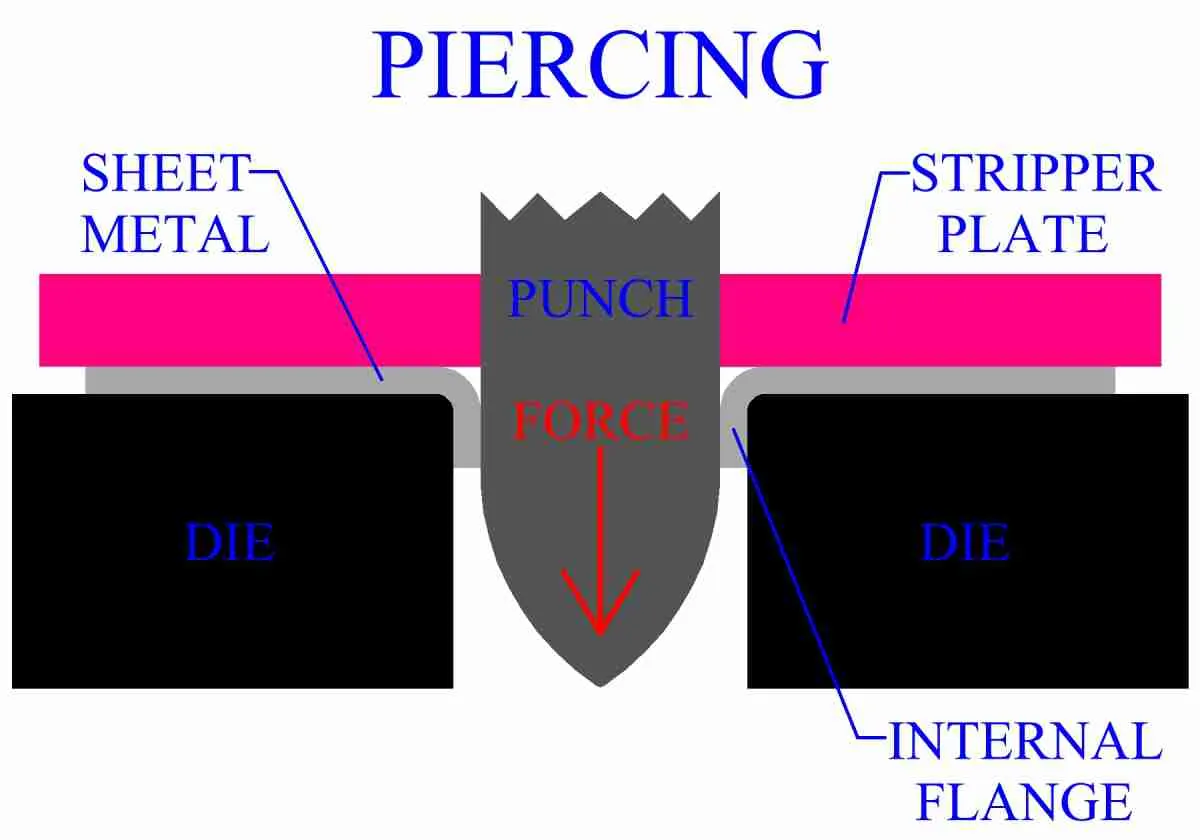
Piercing is the kind of shearing process in which the unwanted material with a particular shapes are removed from the sheet metal by using the blanking punch and dies.
Impact Force Distribution on Hood:
Embosses in the inner panel has ensure the inner panel as strengthen by try to distribute the impact force on outwards of the hood when collision occurs.
Hood Assembly views:
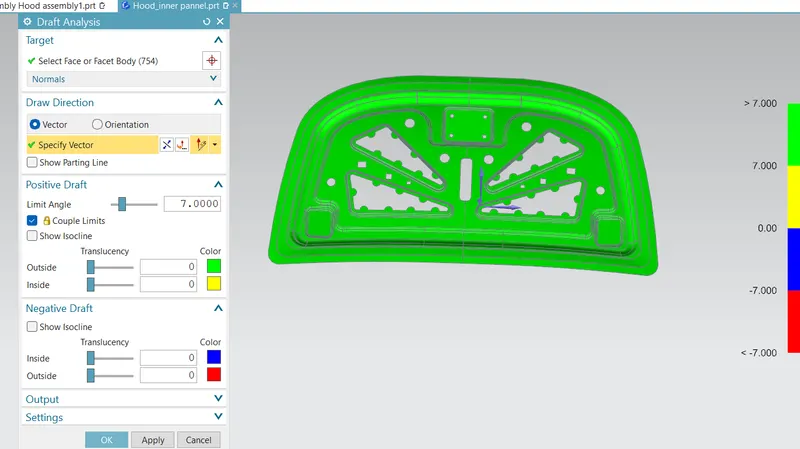
Draft Analysis:
Conclusion:
Finally, the hood design has been completed by considering the criteria, dimensions, procedures and standards. By the process of this design, have learnt about the hood mountings, sheet metal operations like hemming, embossing, deep drawing, piercing, Pedestrain safety and its ratings.