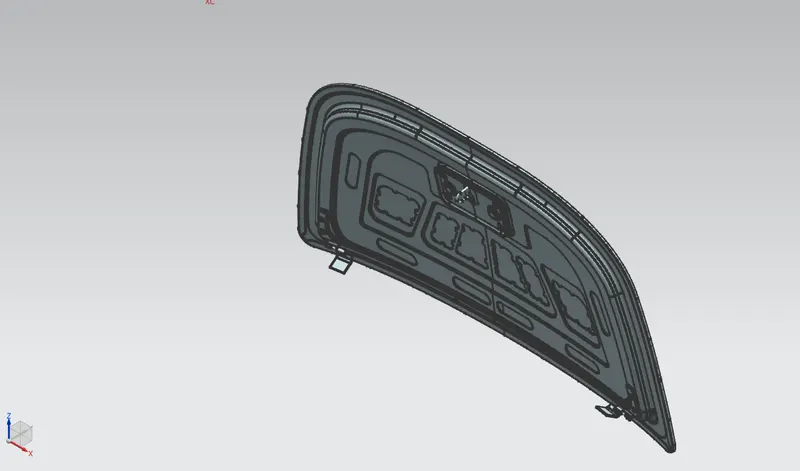
Hood design-Week 2
Objectives :-
Design Hood outer panel, inner panel and the necessary reinforcements by the Master section mentioned with the design parameter. Submit an assembly of Hood inner panel, outer panel, latch, hinge and the reinforcements.
Requirements :-
- A detailed report about the Hood Design which includes a detailed explanation about hood and its components, Latch trajectory, Mastic data, Emboss definitions, manufacturing process like deep drawing and hemming, and all the parameters followed in the design.
- The report should be well-formatted and should have a good flow of content. Add all the relevant images
Data to be used:
Hood Thickness Information
- Outer Panel Thickness = 0.75mm
- Inner Panel Thickness = 0.75mm
- Reinforcement Thickness = 1.5mm
Master sketch:
Hemming Data:
Relief rear section:
Front relief:
Introduction :-
Hood
This is the part of Automobile which acts as a cover which is hinged at the front portion of front-engine car. it functions as door which covers the engine compartment.
Type of Hood -
- Front hood
- Flip front hood
- Rear Hood

A Hood may contain a hood ornament, hood scoop , power bulge & wiper jets.
Some hood may need power bulge to fit over the engine and air filters or enhance the asthetic appearance of hte hood.
Hood Design Considered Points :-
- Opening Angle of Hood.
- NCAP Crash test Ratings for Strength.
- Wrap Arounf Distance (WAD) for Pedalstrain Safety.
- NVH ( Noise, Vibration , Hardness ) For Customer/Consumer/buyer/user
Hood Opening Angle :-
This is one of the main criteria in designing the hood. Opening angle varries from person to person and country to country.
This height standard is used in the determining opening angle of hood.
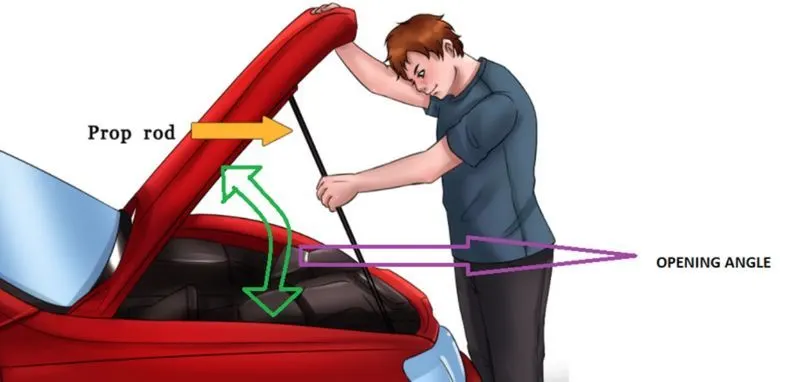
- The average height Indian people is 5ft 5inch and opening angle is close to 60 degrees. however in some other countries
- average height of people 6 ft and opening angle is close to 80 degrees.
- When the opening angle is less than required there are possibilities human head injury.
- The opening angle can be changed by predefining the length of the support rod or gas stay.
Type of Hood Support :-
A hood stay is an apparatus for an engine room of a car, which can safely keep an engine hood in an open state even if an external force is abruptly generated due to vibration , opening and closing operation of engine hood.
Gas Stay
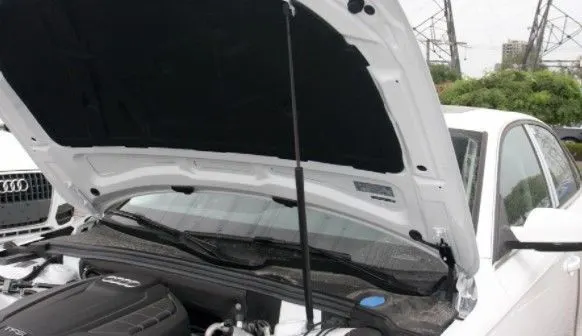
- Which is used for heavy weght hoods.
- In this gas stay rods, pressurized gas filled which help to hold the hood in open condition by means of an actuator
- Gas stay just need the initial force to open the hood.
- This are expensive compared to support rod.
- In this device no man power required and it is more convenient.
Support Rod
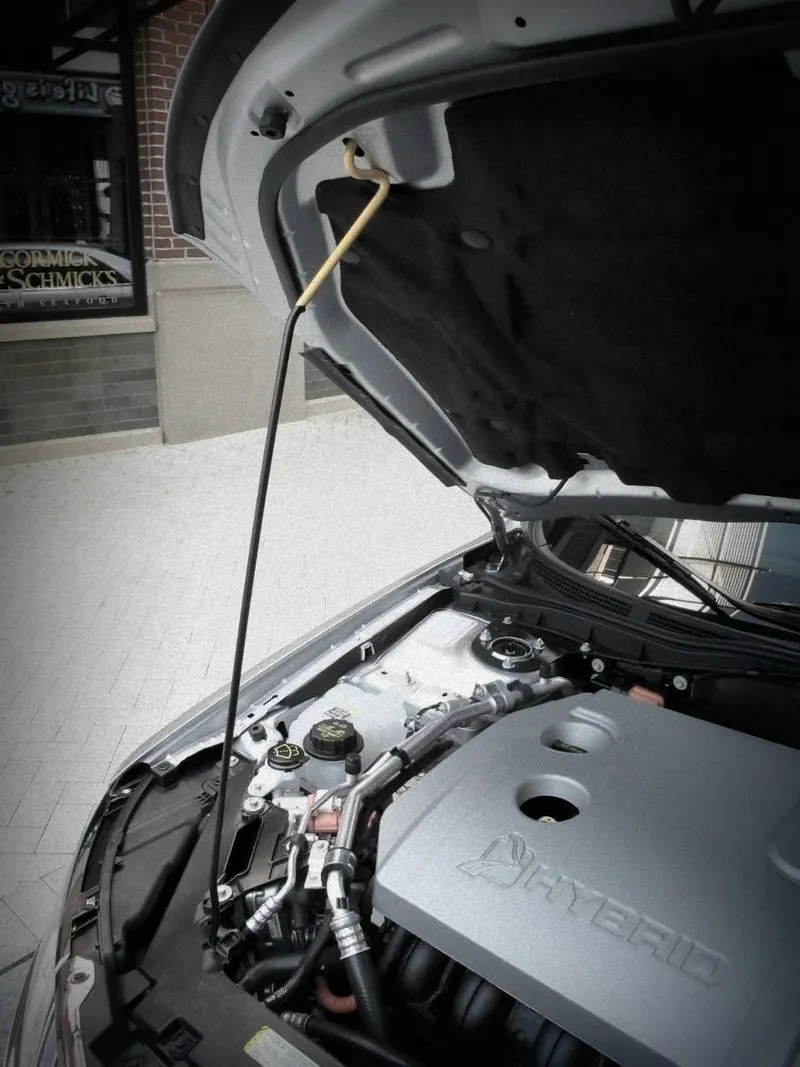
- This Support rod widely used in cars to hood open in condition.
- It can be hinge in engine compartment and held by the hood or it can be hinge at the hood and can be mounted on the engine comparment.
- This is simple and cost effective but human effort is required.
- The Support rod is purposely bent inorder to increase its stifness and to prevent wobbling.
- Length from the line connecting support rod retaining point with retaining point on the body side to maximum bending point can not be more than 35 mm to ensure the strength the rod.
NCAP Crah Test
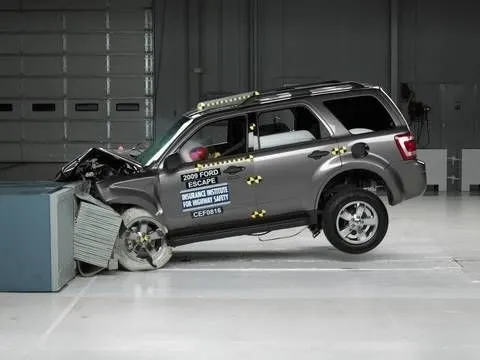
European New Car Assessment Programme to give its full name , is an idependent crash - test safety body, which rigorously assesses the safety of cars, and helps to furthe the advancement of car safety technology. with safety at the forefront os all car markers minds, and many firms and organisations signing up to the ' Vision Xero ' initative - which aims to eliminate all deaths ans serious injuries from our roads. THe current euro NCAP's test programme is an ever evolving one, with its architects periodically updating crash.
Pedestrain Safety
- It can be defined as a vulnerable road user that is at risk when it comes to roads. when it comes to roads.
- thus the safety of such being is essential.
- The pedestrain safety and protection norms are aimed to do so , it will ensure the new cars meer a minium requirement of safety Vehicle Assessment Program
- The mejor reason for pedestrain accident are distracted driving.
- In Japan and Europe regulations have come into effect that place a limit on the severity of pedestrain head injury when stuck by a motor vehicle.
Head Impact :
- Safety is the most important criteria in automobile design with concertrate both pedestrain occupant safety.
- This leads to the necessity of new inner hood panel which is less stiffer an pedestrain friendly.
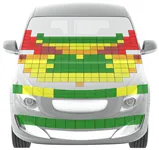
- The head impact analysis on the present hood assembly was done to observe the local and global stiffeness.
- In order to reduce the head injury of the pedestrain the local stiffness over the area of head impact has to be reduced the the design og hood panel ea foucused on that and the structural and model analysis was done for the new design.
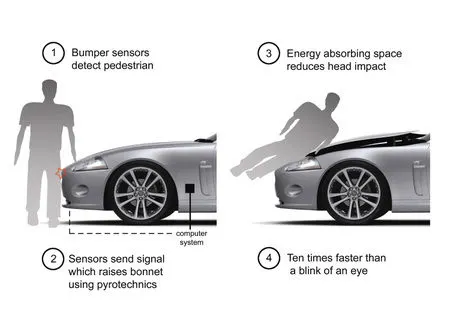
- Head impact test carried out for a vehicle speed of 40km/hr , its gives an estimate of the potential head injury in the fateful event of a vehicle striking an adult or child.
- The est will give essential information about the deformation clerence , energy-absorbing structures and deployable protection systems such as pop-up bonets and external air-bag in a vehicle.
Head Impact Criteria :
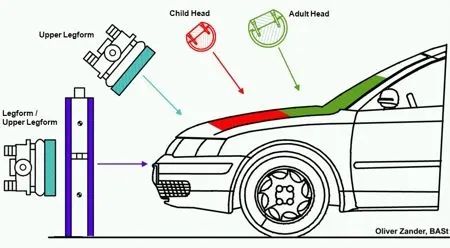
NCAP safety assesment Prgram includes a test protocol for pedestrain Protection. protocol covers lower leg, upper leg and head impact tests.
Wrap Around Disance :
When a car crashes on the pedestrain, the Whole human body wraps around the front ahape of the car, and the head impacts on the bonnet of the windscreen. The distance at which the head impacts on the car from the ground is mentioned as wrap arounf distance (WAD )
Severity of the injury caused by the frontal crash depends on the type and shape of the vehicle, the spee of the vehicle , and the movement of the pedestrain relative to the vehicle. in addtion to these parameters, the wrap around distance plays in a safety measures of a pedestrain.
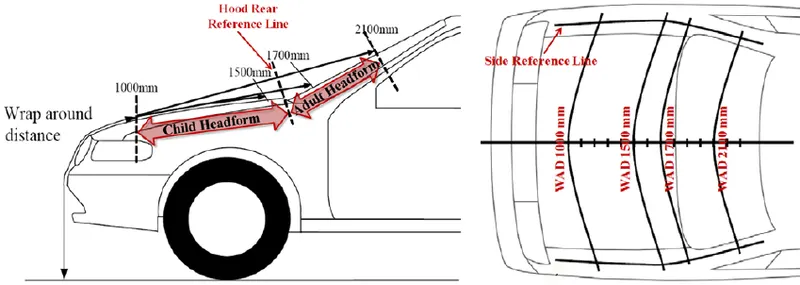
WAD Means the distance from the ground to the point on the hood along the vehicle front structure.
Test Area :
Front Test Area
The rear side line was chosen out of two lines to be assigned to the front test line.
where WAD was 1000mm. The other line located 165mm background from the bonnet leading edge.
Rear Test Line
The front side line was chosen out of two lines to be assigned to the rear test line.
where WAD was 2100mm. The other line located 82.5mm forward from the Line where impacted.
the wiper arms and other equipment are removed
Side Test Line
The line are located 82.5mm inside the bonnet side reference line.
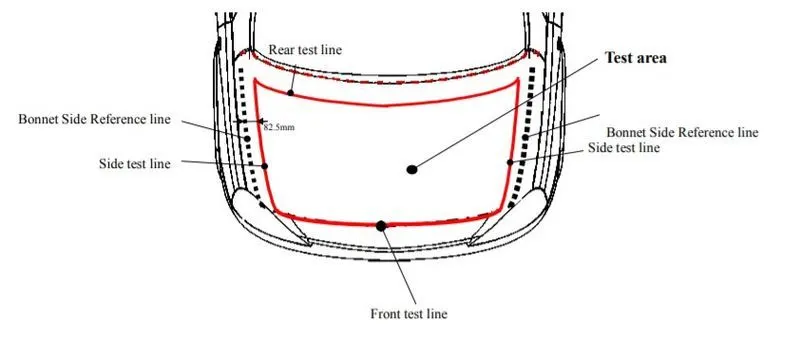
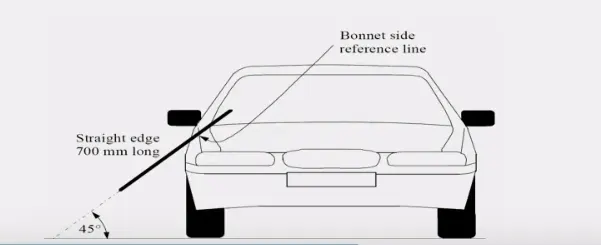
Bonnet Side reference Line :
The Geometric trace of the highest points of contact between a straight edge, held parallel to the lateral vertical plane of the vehicle and inclined 45 deg.
The measurment from the accelerometers mounted in the headforms are processed to calculated the corresponding HIC values , which are used in the evaluation according to the test protocol.
Noise , Vibration and Hardness :
Noise, Vibration and Hardness (NVH) is the study and modification of the noise and vibration charactaristics of vehicle.
particularly cars and trucks.
- To improve NVH mastic sealents were provided on the inner panel to attach with outer panel.
- mastic points on the inner panel plays a major role to avoid noise and vibration into the cabin.
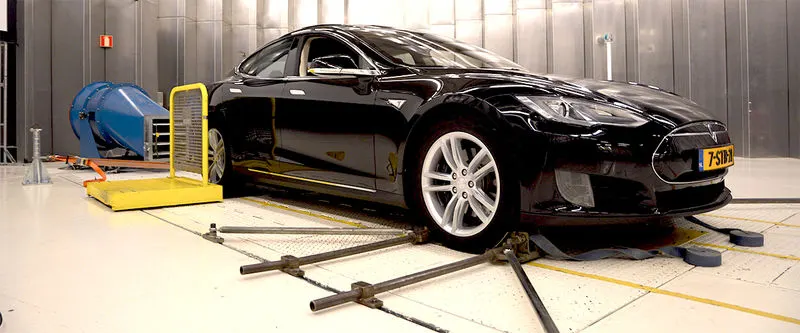
- NVH is measured by instruments , namely microphones, accelerometers, force gauges or load cells.
- Components and subassembly NVH test are commonly performed using a vibration shankar while entire vehicle usually on the test track.
Noise
Noise is unwanted sound or unwanted disturbance in an electronic signal. Acostic noise is energy transmitted to the air that causes an audible disturbance.
Vibration
Vibration is an oscillation that causes noise and disturbance. vibration is generally of concerns due to he physical effects which can cause disturbance to people, disruption in electrical systems and failure or breakdown in mechanical systems.
Hardness
Hardness is generally used to describes the severity and discofort associated with bothe vibration and noise. it is a qualitative system based on desired rather than on quantifiable measurments.
Reducing NVH
- Engine, exhaust and suspension noise components are mounted on rubber bushes rather than creating a metal to metal contact.
- To isolate the main structure of the car from the source.
- Using steering dampers to absorbs shocks.
Sheetmetal Operations
- Deep Drawing
- Embossing
- Hemming
Deep Drawing
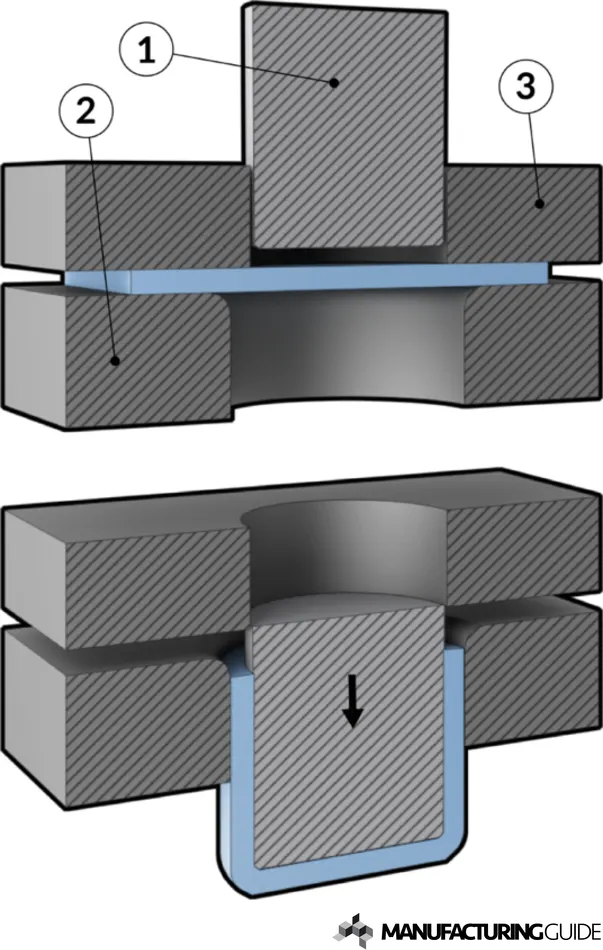
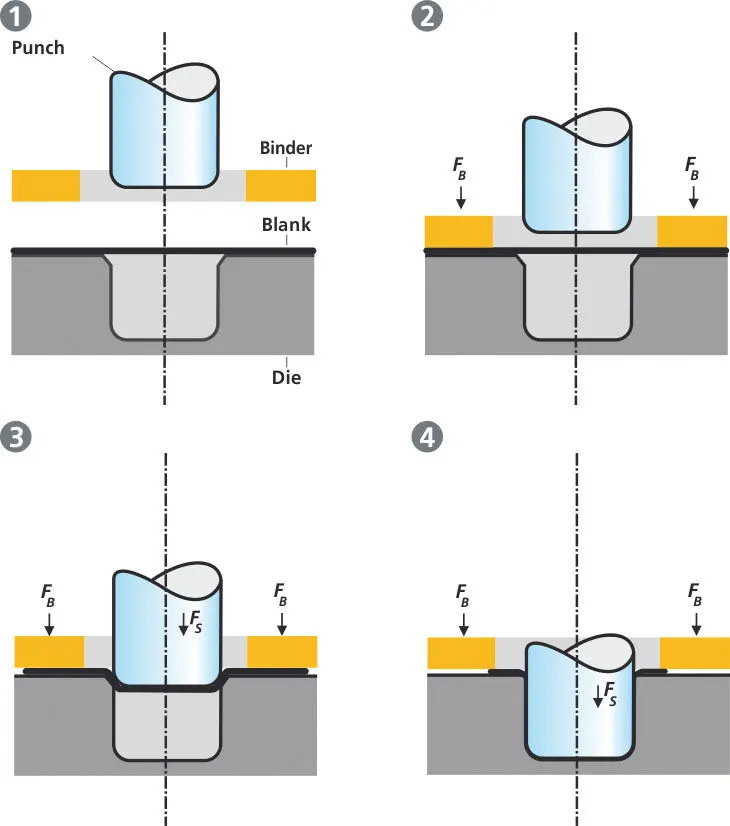
Deep Drawing is a sheet metal forming process in which a sheet metal blank is radially drawn into a forming die by the mechanical action of a punch. it is a shape transformation process with material retention. the process is considered ' deep drawing when the depth of drawn part exceeds its diameter. This is achieved by redraawing the part through a series of dies.
the comprehensive stresses result in flange wrinkles can be prevented by using a blank holder the function of which is to facilitate controlled material flow into the die radius.
Embossing
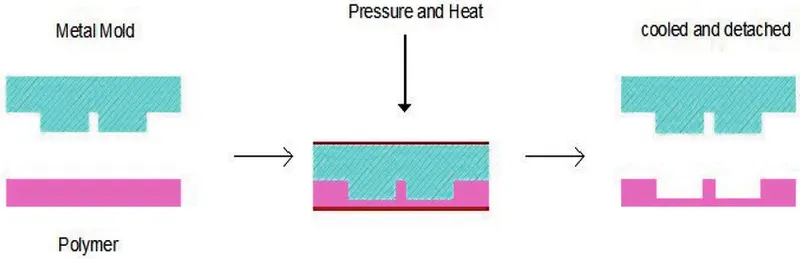
Embossing is a stamping process for producing raised or sunken designs or relif in sheet metal
this process can be by means of matched male and female roller dies, or by passing sheeet or a strip of metal between rolls of the desired pattern.
Emboss should be in 7 degree to 25 degree incline in angle and it should not be in 90 degree angle, why because when we do stamping in manufacturing the stamping tool fits the sheet metal hence it will not come out of that sheet metal.
- ability to form ductile metals.
- its use in medium to high production units.
- the ability to maintain the same metal thickness before and after embossing.
- the ability to reproduce product with no variation.
- ability yo produce unlimited patterns depends on the rools dies
Hemmimg :
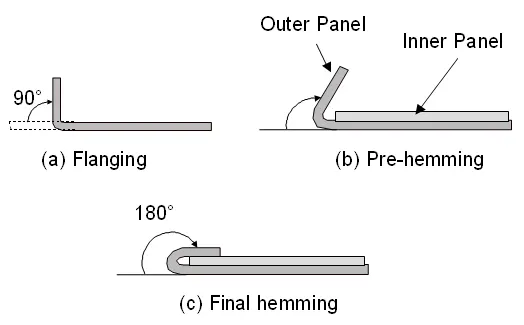
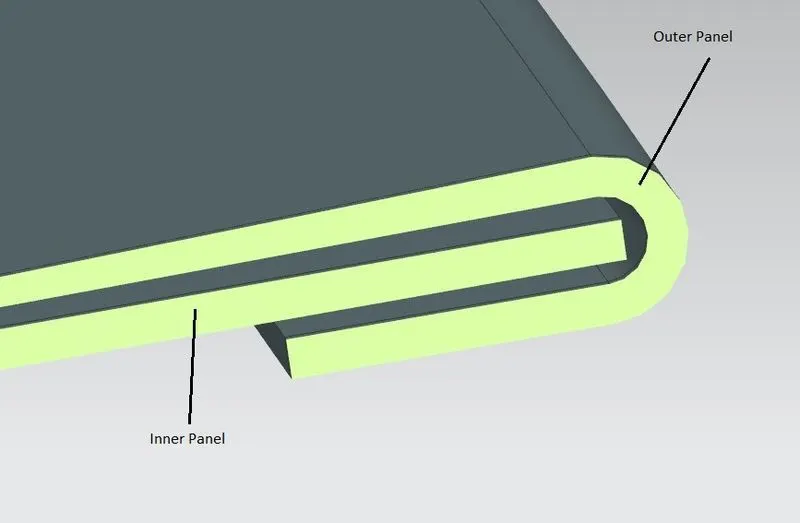
Hemming is a forming operation in which the edges of the sheet are folded or folded over another part in order to achieve a tight fit
Hemming is a technology used in the automotive industry t join inner and outer closure panels together. it is the process of bending / folding of the outer panel over the inner one.
hemming is used in assembly as a secondary operation after deep drawing.trimming and flanging operations of the cars outer surfaces and is therefore a critical factor in the final quality of a finished vehicle.
Hood Design
Hood Components Design in NX Cad Data
Mastic Sealant
A Mastic Sealant is a type of liquid sealant that cures in an elastic state, thus making it flexible while holding the bond of the surfaces that has attached together , it adheres to just about any material making an all-purpose type of sealant.
- The main purpose of the outer panel is for the asthetic looks. thus we cannot use bolts or welding. this has to be done with the help of the hemming andmastic sealant. Mastic sealants are elastic compound that behaves like the rubber.
- it is placed between the outer and inner panel , initially is it in paste form, but after the hot furnace bath it gets hardned thus joining the outer and inner panel.
- Surfaces do not have to be primed when using this type of sealant , and applied thick it adheres smoothly to any surface
- it is also favored for area s under high or low temperatures such as heater vents or drier vents and contains on rain ultravolet inhibitors to make sure that it is protected form damping effects.
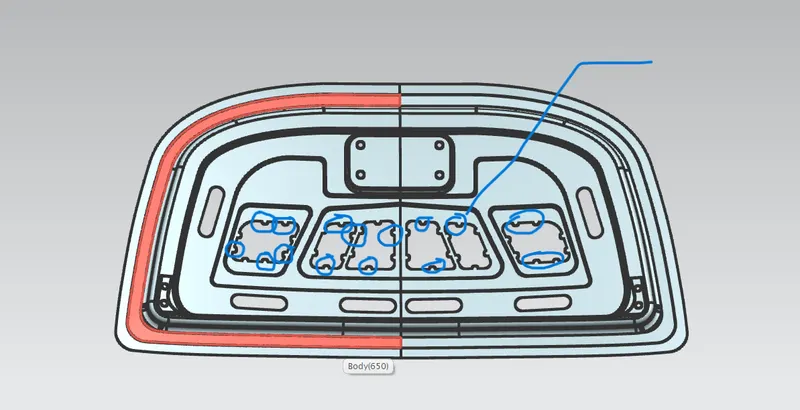
1) Inner Panel
This is the part of hood which situated between hood outer panel and engine Compartment.
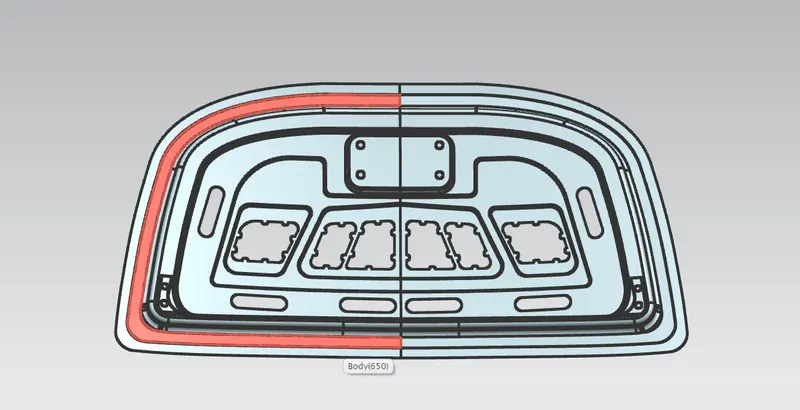
Outer Panel
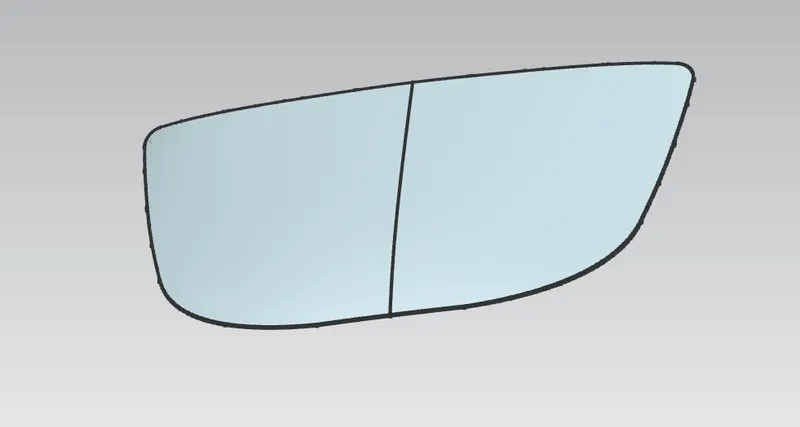
Latch Trajectory
It is the circle which specifies the path of the opening and the closing of the hood. First the hinges are placed at the lower extreme ends of the inner panels after mirroring the hinges assembly.
An axis connects the hinge axis of two hinges. this axis should be kept parellal to the X-axis of the assembly for proper placement of the hinges and opening/closing mechanism.
Isometric View