Hood design-Week 2
Project: Hood Design Challenge
Introduction:
This project report is about 3D modelling a Hood Assembly of automobile using Siemens NX 11.
Objective:
The aim of this Project is to model a Hood Assembly considering all design and safety factors which satisfies industry’s standards, manufacturing & functional requirements and engineering inputs using Siemens NX 11.
Introduction:
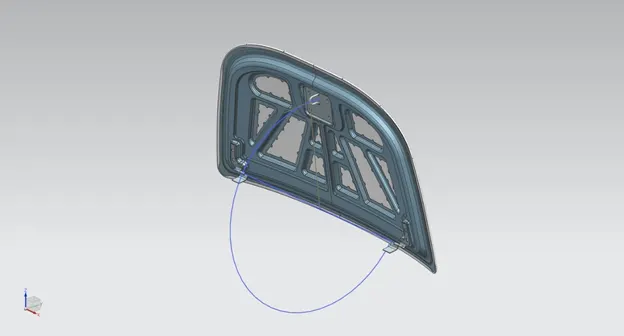
Hood or also called as bonnet is a hinged metal cover over the engine and it allow access to the engine compartment.
Hood assembly is common on most vehicles which consist of Inner panel, Outer panel and Latch. Hood is typically made out of materials like steel, aluminum, fiberglass or carbon fiber.
The hood release system is also common on many vehicles and it consists of a hood latch handle which is located below the steering wheel, hood release cable and hood latch assembly.
Hood Assembly:
Hood is a sheet metal assembly consisting inner panel, outer panel, latch and hinge. Outer panel is fixed on the inner panel by using hemming operation which is carried out using rollers rolling the outer panel over the inner panel.
The inner panel provides strength and it directs forces outwards in frontal collision. It also provides place to attach the latch and hinges.
The latch and striker are responsible for flush fitting of hood.
The hinge allows hood to swing along its axis which helps to open and close the hood.
Design inputs & Master Sketch:
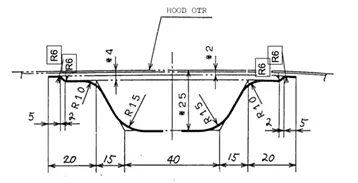
Hood thickness information
Outer panel thickness = 0.75 mm
Inner panel thickness = 0.75 mm
Reinforcement thickness = 1.5 mm
3D Modelling:
Inner panel:
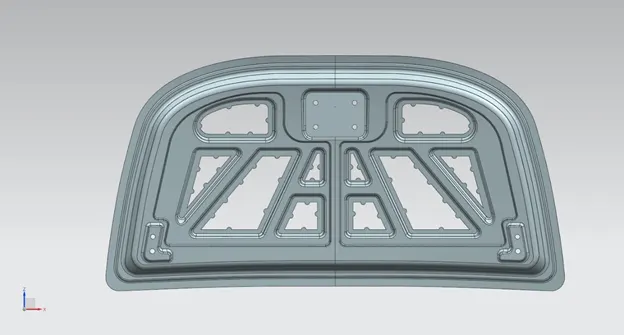
The inner panel is designed with the help of master sketch. The inner panel is important part of hood assembly which redirect the forces during frontal crash. It also reduces the damage to pedestrian by increasing spring back of hood assembly.
Commands used:
Offset Surface: This command is used to create a surface by offsetting a set of faces.
Offset Curve in Face: It is used to offset curves along a selected face or surface.
Trim Sheet: It is used to cut off a portion of surface.
Through curves: Creates a surface through multiple sections where the shape changes to pass through each section.
Face blend: Add tangent blend faces between selected set of faces with specified radius.
Projected curve: Using this command we can project curves, sketch or points on to the selected face or plane.
Law Extension: It creates a law-controlled extension from base sheet, dynamically or based on laws for distance and angle.
Extend Sheet: Extends the sheet body by distance or to the intersection with another body.
Edge blend: Rounds the sharp edges of the faces with specified radius.
Emboss: This command modifies the surface by projecting a section along a vector, with options for end cap location and shape.
Curve on Surface: It used for sketching a spline on face or surface.
Mirror Geometry: Copies the geometry and mirrors them across a plane.
Sew: Sew is used to combine sheet bodies by sewing their edges together.
Thicken: It gives thickness to the surface body.
Features of Hood Inner panel:
Embosses and Cutouts:
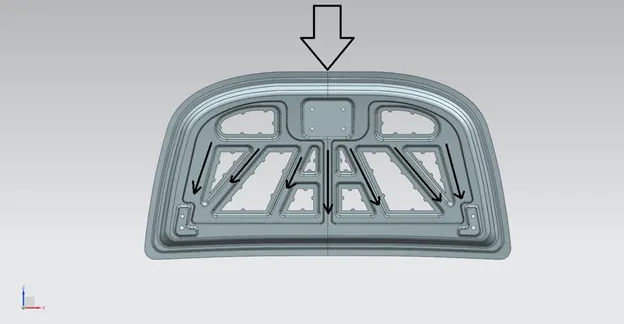
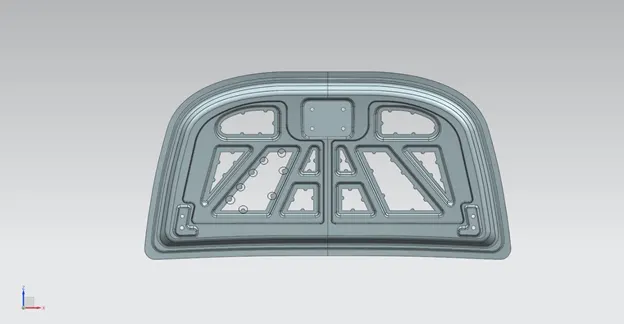
The embosses are projected section of inner panel which has cutouts to reduces the weight of the hood. Also, these embosses helps to dissipate or redirect the force away from center towards the corners to avoid damage to passengers.
Mastic Points:
The mastic seal is a kind of hard rubber glue added between inner and outer panel of hood to join them together at different points called mastic points.
Mastic sealant also helps to reduces noise and vibrations. The mastic sealant has an influence area of 80mm. Circles represents the mastic points.
Latch & Striker and Hinge Assembly:
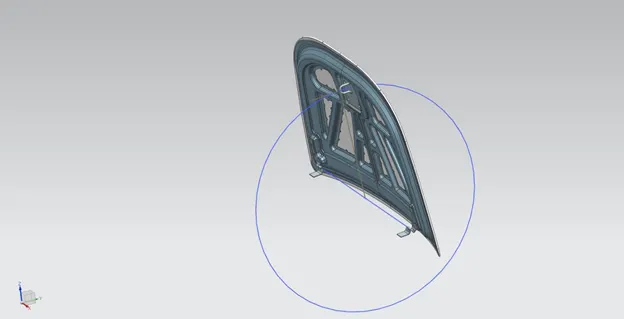
Latch & striker positioning and orientation is the critical stage in hood design.
The positioning done using sketching a circle with center as the axis of the hinge which passes through the center of the striker. The latch striker must be perpendicular to the circle to get the correct orientation of the latch which enables it to close the hood perfectly.
Hemming:
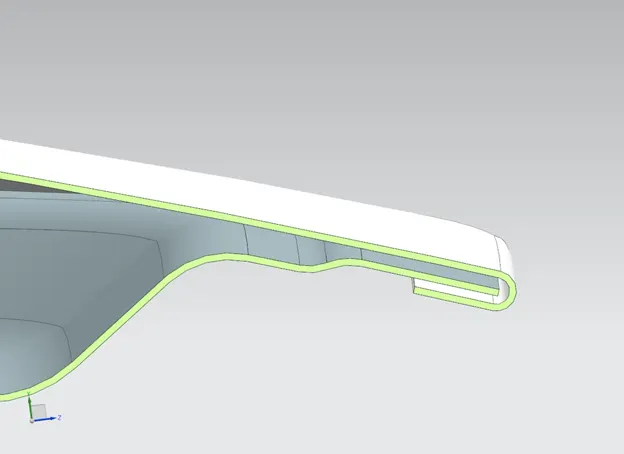
Hemming is a forming operation in which the edges of the sheet are folded over another sheet in order to achieve a tight fit.
In the Hood assembly outer panel is rolled over the inner panel joining it together.
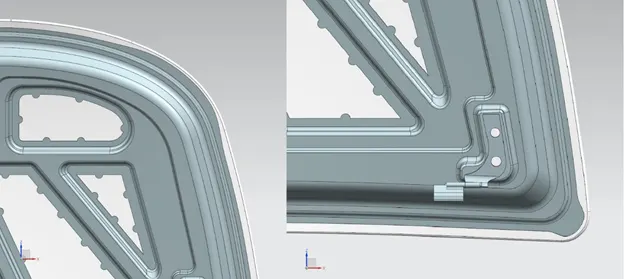
Relief given at front and rear:
Conclusion:
Thus, the hood of the car is modeled using the engineering inputs and it satisfies the industrial manufacturing and functional requirements using NX CAD.