Hood design-Week 2
HOOD DESIGN
Introduction:-
A car hood, also referred to as a bonnet in some other countries, is the hinged cover that rests over the engine of a front-engine vehicle. Its purpose is to provide access to the engine for repair and maintenance. A concealed latch is typically used to hold down the hood.
Hood is a hinged door that covers the compartment that houses the engine and transmission components. An
automotive hood also improves the aesthetics quotient of the car, so it is important for an automotive hood to be both functional and visually appealing. Car engine compartment is often accessed for service and maintenance activities; thus, it is important for the hood to be easy on its operator. Hood also is the component onto which the pedestrian crashes when the automobile undergoes an accident, thus it is critical to follow and implement design parameters that minimize impact to pedestrians as well as its occupants in case of any mishap.
Design considerations for automotive hood
Safety
The prime safety requirement to be considered while designing the hood is the Pedestrian Safety from frontal
collision. Euro NCAP, a European vehicle and road safety organisation has developed test specifications and rating systems for assessing pedestrian impact during impacts with the front of vehicles. Such tests include a series of tests using impactors designed to mimic a collision at a speed of 40 kmph.
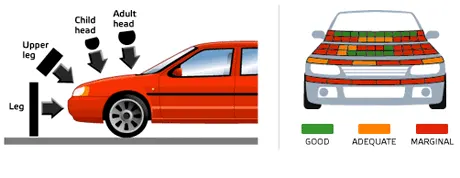
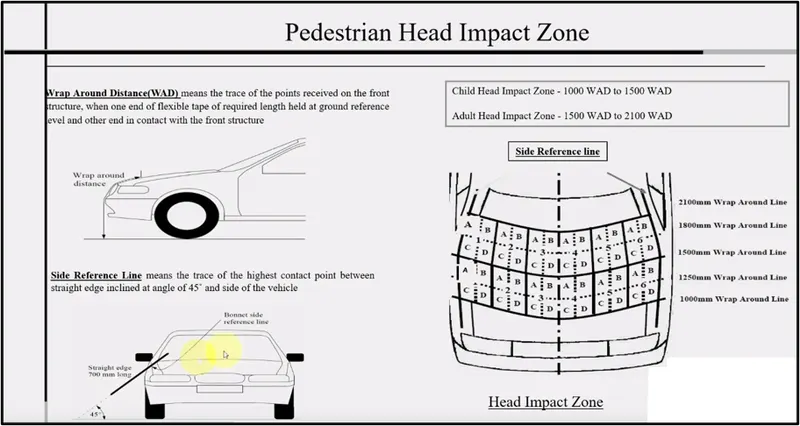
Vehicle safety factors should simultaneously consider occupant and pedestrian safety, given that pedestrians are the third largest category of traffic fatalities. Most pedestrian deaths occur due to traumatic brain injury, resulting from the hard impact of the human head against the vehicle's stiff hood or windshield. Therefore, how to design a pedestrian-friendly vehicle and propose a new hood structure is a matter of urgency for minimising pedestrian head injuries. In this study, three kinds of sandwich hood structures are proposed for reducing pedestrian head injuries, including carbon fibre-reinforced polycarbonate, carbon fibre-reinforced foam and aluminium-reinforced polycarbonate. In assessing the friendliness of vehicle hoods, this study adopts the EEVC/WG17 regulations on headforms for hood tests. The finite element method is used to simulate the impact between the vehicle's hood and the headform impactor. The software used in simulation is LS-DYNA. The results predicted by the headform-hood tests show that the hood structure with aluminium-reinforced polycarbonate material provides enough absorption capability to protect pedestrians from the impacts of accidents. It is also stiff enough to keep pedestrians' heads away from the inner parts of the engine cavity. The analysis models and sandwich materials proposed herein contribute to efforts to design vehicle hood structures and pave the way for developing pedestrian protection technologies.
Considerations for hood design:
1. Aesthetics
Design of hood adds to the looks of the car. Hoods completes the flow to a car's design; thus, it is important for the hood designer to work on aesthetic details of the hood.
2. Functionality
Hood is essentially a type of door that covers the powertrain and other vehicle propulsion system components such as drive belts, battery, fluid levels and lamp units in the frontal region of an automobile. As these components needed to be accessed often, so it is critical for the designer to work on hood's weight, ease of use and hood mounting systems.
Subcomponents of hood:
1. Outer panel
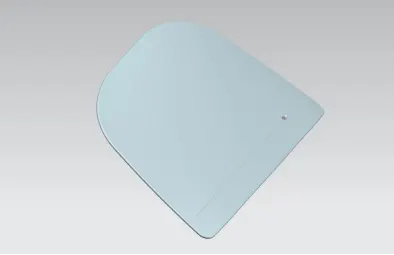
The outer panel is the external cover the wraps over the inner panel. This component is styled to enhance the overall visual appeal of the car.
2. Inner panel
The inner panel serves as a structure for the vehicle to dissipate and channel shock waves at the event of a crash. Hence this part is designed with utmost precision to confirm to road and pedestrian safety norms.
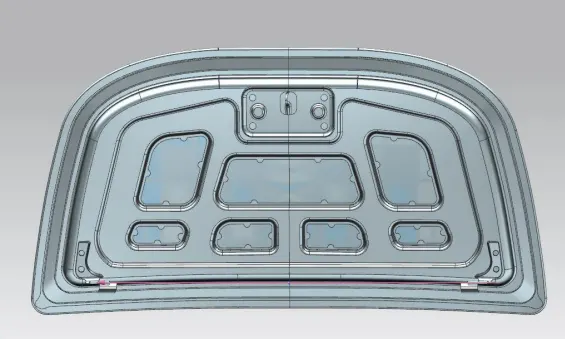
3. Striker reinforcement
The striker is mounted onto to the car's hood and latch is installed in the engine compartment. A striker
reinforcement is designed onto the hood's inner panel for enabling latching of hood to the engine compartment.
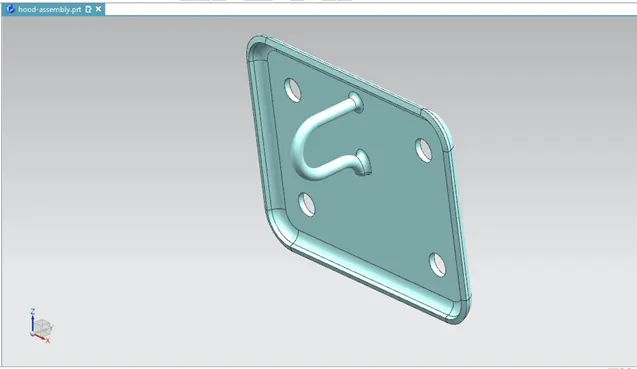
4. Hood stay reinforcement
A hood stay is an apparatus for an engine room of a car which can safely keep an engine hood in an open state. The support rod used is slightly bent intentionally, so that it adds strength & rigidity to the rod which can hold the hood. The positioning and type of hood stay differs from manufacturer to manufacturer.
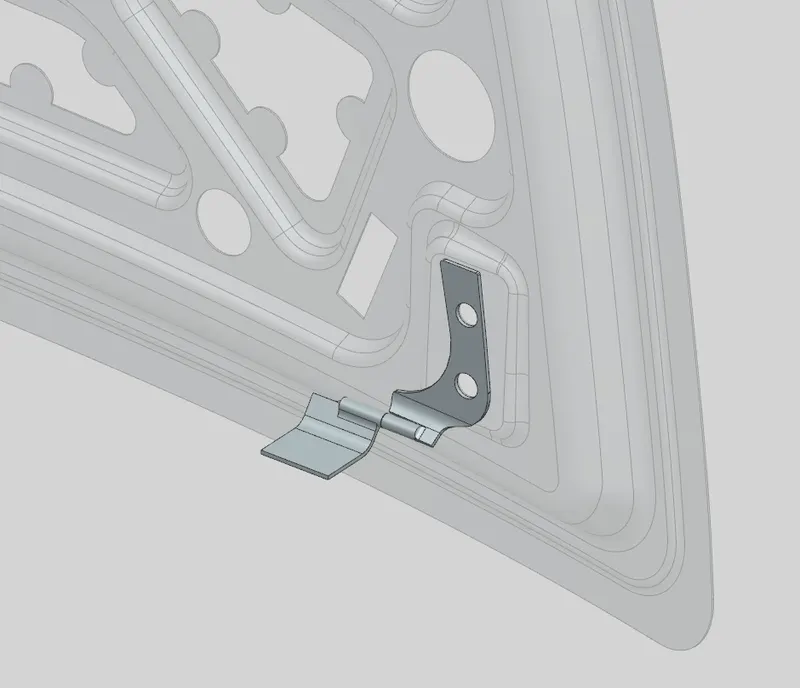
5. Hinge reinforcement
The trajectory for opening and closing is maintained by proper positioning of hinges. Hinges are placed at the ends of the hood and are installed onto the reinforcements embossed in the inner hood.
Design procedure:
1. Master sketch
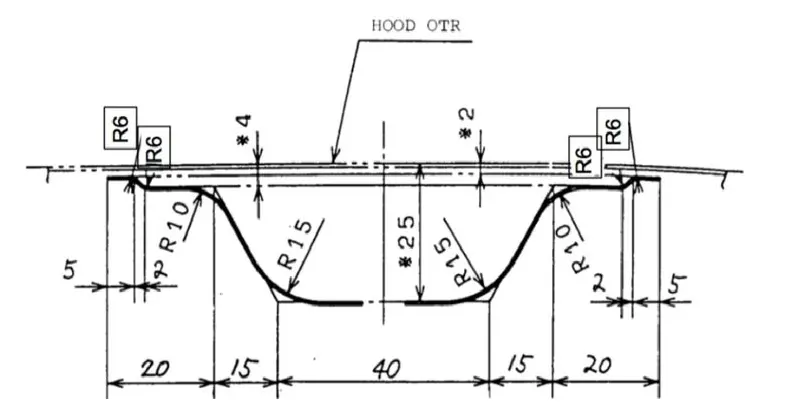
2. Hood Thickness Information
- Outer Panel Thickness = 0.75mm
- Inner Panel Thickness = 0.75mm
- Reinforcement Thickness = 1.5mm
3. Hemming Data
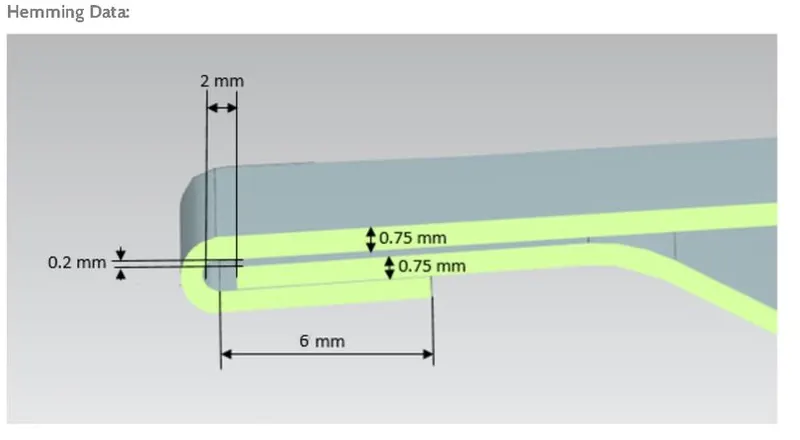
4. Corner Reliefs Data
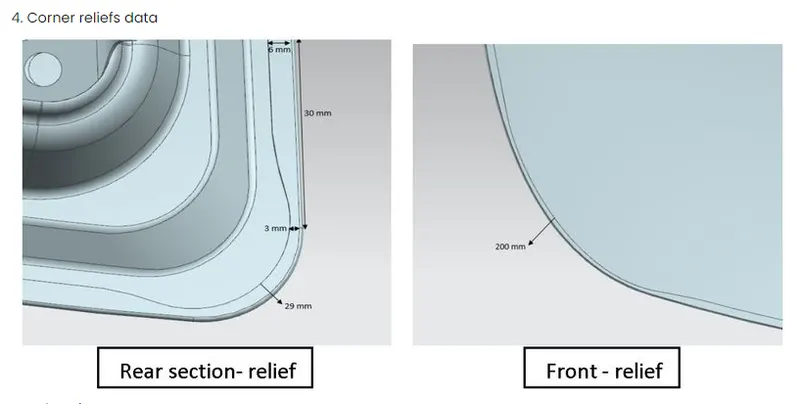
Major tools used while designing:
• Offset Surface
• Offset Curve on Face
• Trim Sheet
• Law Extension
• Face blend
• Edge Blend
• Emboss
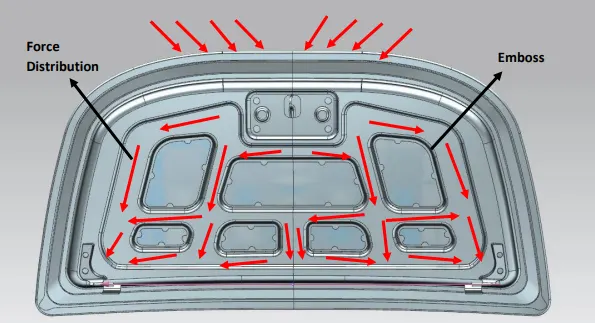
Embosses
The design of embosses are done in accordance with the force distribution of frontal impact, it is designed in such a way that the reduction of force starts when it is directed till the corner i.e. up to the hinges and loses maximum amount (of force) till the end.
Latch
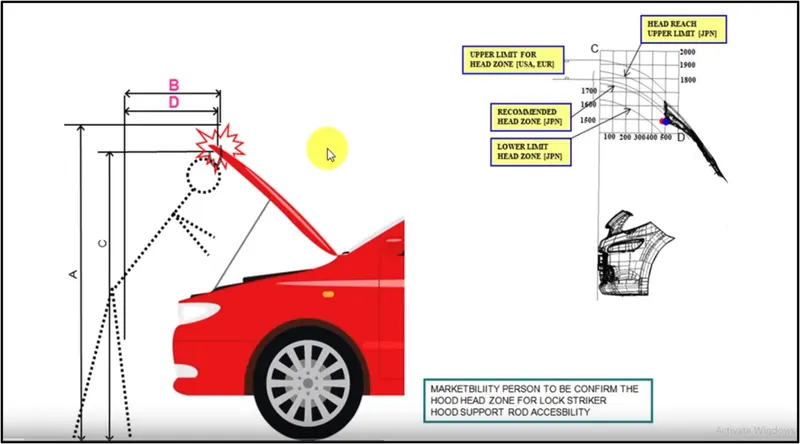
Latch is the part which locks the hood after closing it through its striker, the height of the striker point is determined keeping the average height of the person in a particular country. This prevents the head impact of a person.
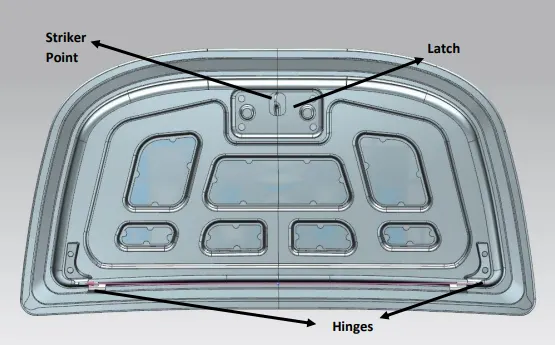
Hinge
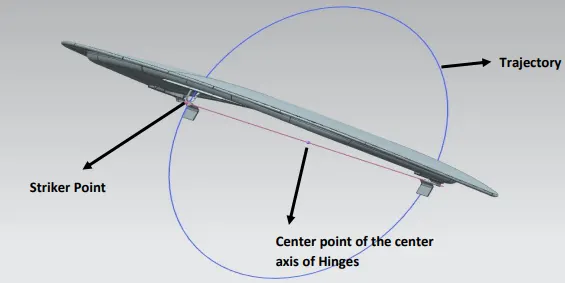
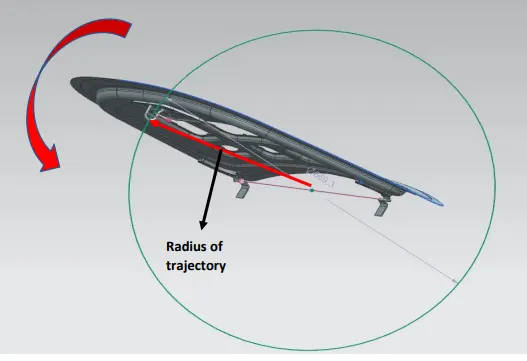
To formulate the opening and closing of the hood, The center axis of the hinge plays an important role for the determination of trajectory for the movement of hood.
• Latch Trajectory:
It is the trajectory on which the movement of the hood (opening and closing is dependent ). This circular trajectory has the radius equal to the length from the center point of the center axis of the hinge to the striker point on Latch. The striker point is also tangent to the trajectory.
Mastic Points
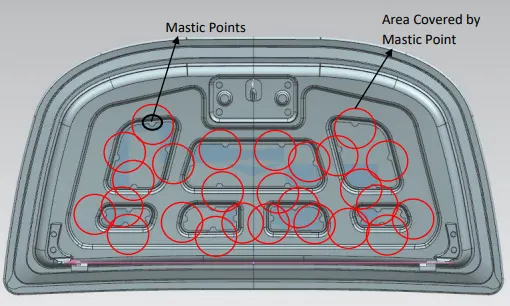
Mastic points are the region closer to the outer panel. Every Mastic point has the tendency to increase the strength of its local surrounding for up to 50-80mm. Thus they are positioned in way to cover the maximum area of hood. They are also important for reducing the vibration reaching from bottom body to the upper parts.
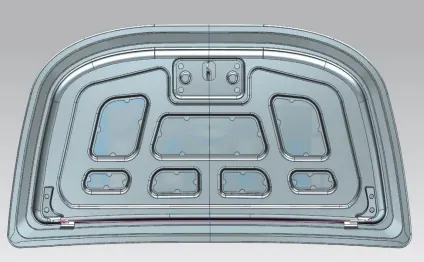
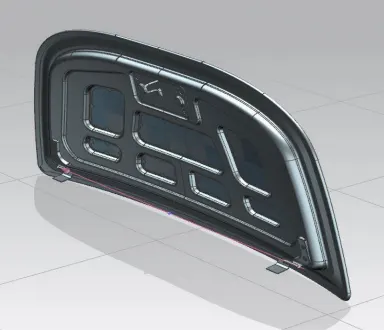
Images of the Final Model:
Conclusion:-
I designed the car hood along with its components and assembled the same, using NX CAD, under given
parameters.