Hood design-Week 2
AIM:-To design the HOOD using TOP-DOWN assembly approach using NX.CAD software.
1-HOOD INTRODUCTION
Hood is an opening and closing body panel that covers the engine and it easily provide access for maintenance and repair of the engine and other components like power train, drive belts, battery, fluid levels and lamp units when needed.
It is fundamentally a reinforced skin panel with many safety and quality requirements.
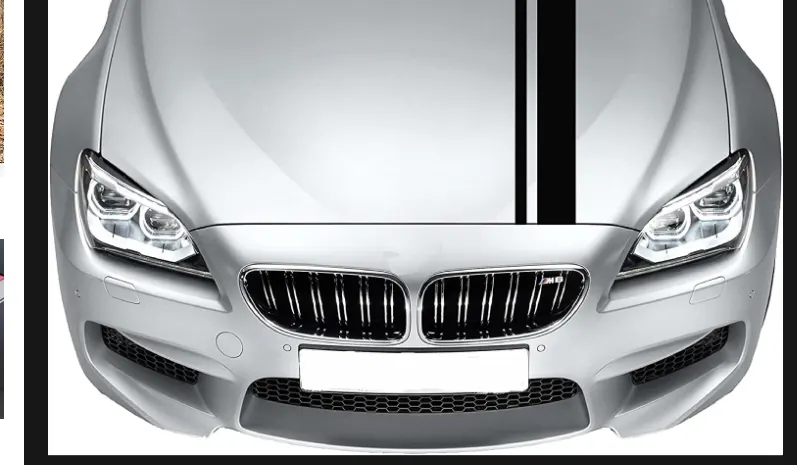
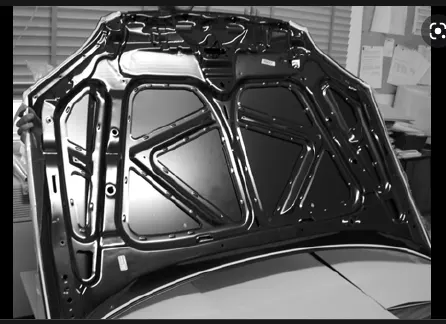
SOURCE-GOOGLE IMAGES
2-COMPONENTS OF HOOD
- OUTER PANEL OR (SKIN)
- INNER PANEL OR (FRAME)
- HINGE.
- LATCH OR (STRIKER).
3-DESIGN CONSIDERATIONS OF HOOD
We have to design the hood by keeping following points in minds as per industry standards.
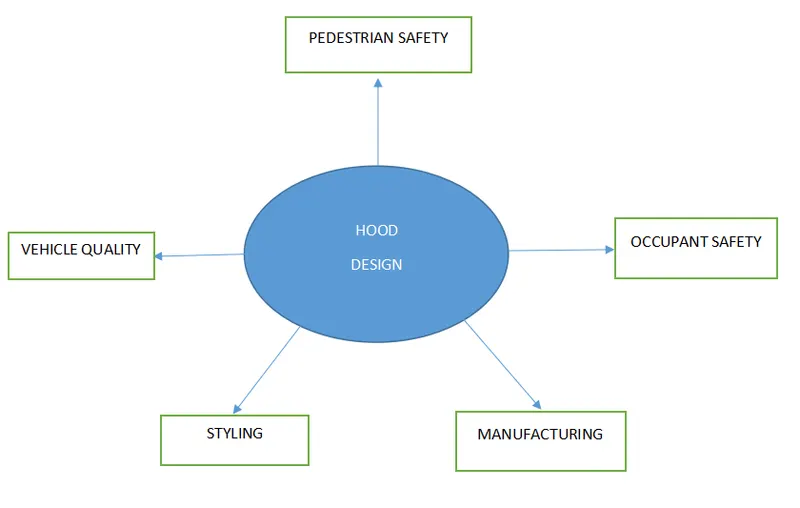
a)-Pedestrian Safety: Under this criterion we have the following parameters as per industry standards that are based on Wrap around distance (WAD) for dividing hood, some part of windshield and A- pillar into grids for analyzing the safe and dangerous region and Head impact criterion (HIC) Quantitative measurement for the safety of pedestrian such that higher the value of HIC lower will be the safety of the vehicle.
Child head impact criterion.
Adult head impact criterion.
Bonnet/Hood Leading Edge geometry.
WRAP AROUND DISTANCE: When a car crashes on a pedestrian, the whole human body wraps around the front shape of the car and the head impacts on the bonnet or the windshield so the distance on which the head impacts on the car from the ground is called as WAD.
Wrap around distance measured longitudinally in the centre of the vehicle from the ground.
By the technique of crash analysis that are based on WAD we divide the hood into two zones
| Child head impact zone | Adult head impact zone |
| (1000 to 1700 mm WAD). | (1700 to 2100 mm WAD) |
| Child head impactor- 3.5 kg | Adult head impactor- 4.5 kg |
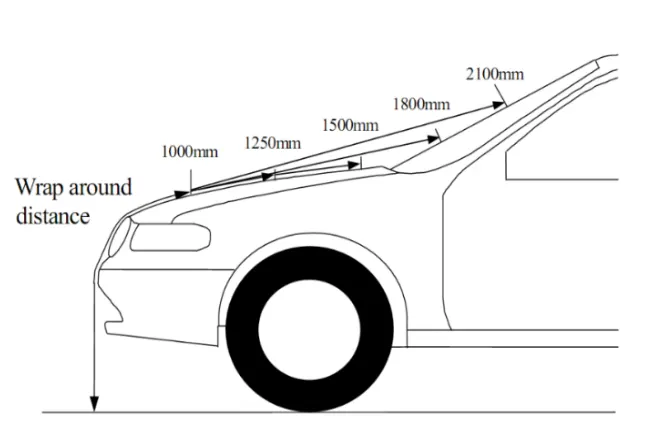
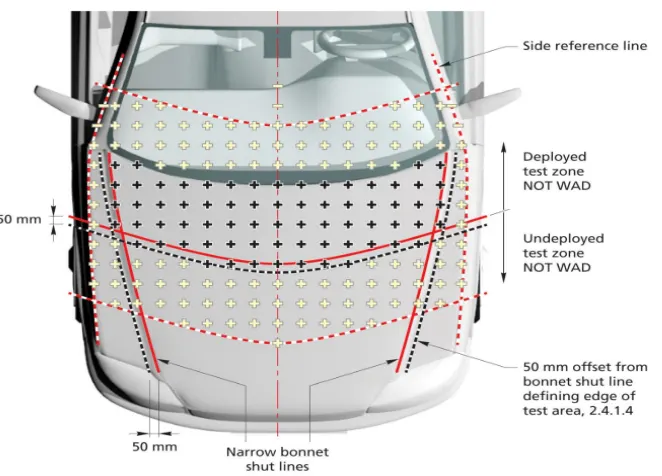
In this manner we divide the hood region into number of grids for analysis of safety region.
HEAD INJURY CRITERIA (HIC) : As we discussed earlier that HIC is the quantitative measure of safety and as higher the value of HIC lower will be the safety of the pedestrian
HIC expression is based on impulse-momentum theorem as given below but we conduct experiment to get the following equation as:

Where
i) R (t) is the resulting acceleration, in g, measured in the gravity center of the head.
ii) T0 the simulation start time in seconds.
iii) TE the simulation end time in seconds.
iv) t1 and t2 represent respectively the initial and final instant of a time interval, expressed in seconds, during which the HIC assumes the maximum value; the width of this interval is conventionally equal to 36ms.
HIC value should be lower than 1000 for the safety of the pedestrian based on the data of EURO N-CAP.
b)-Vehicle Quality: Physical quality of the car including hood should have
- Torsional stiffness.
- Flutter resistance (Bending stiffness).
- Dent resistance (Palm print).
- Dent resistance (Hail Stone and Stone Chip).
- Corrosion Resistance.
- Low mass (Ease of opening).
- Low mass (Weight distribution).
- Low mass Vehicle Centre of Gravity.
- Noise Attenuation.
c)-Occupant Safety: It consists of safety of the person inside the car, it has following tests like
- Frontal Crash (Collapse)
- Frontal Crash (Maintain integrity with hinges etc.)
- Frontal Crash (Retention of loosed components)
d)-Styling: It consists of the aesthetic look for the hood, we have to keep following points in minds regarding like
- Tight radii on hemmed panel edges.
- Excellent painted surface quality.
- Stretch flanges.
- Good shape: low strain doubly curved surface.
e)-Manufacturing: We have to adopt those processes that will give the following output feature to the hood
- Paint drain features.
- Outer panel (Dent resistance during assembly).
- Outer panel (Clean sheared edges).
- No Lüders lines or other visual defects resulting from stretch forming.
- Inner panel (Galling resistance).
Mostly we use Deep drawing, Punching, Piercing, Stamping, Embossing etc. for the manufacturing of the hood and to join outer panel to inner panel we use Hemming operations.
f)-Materials: Steel, Aluminium, Fibre glass, Carbon fibre.
4- Design Procedure of hood using NX CAD
Master Sketch :
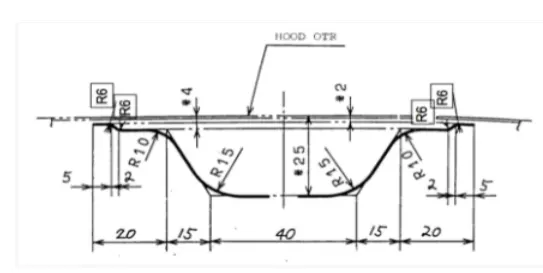
We have to design the hood according to the master sketch as shown above
Thickness Information
- Outer panel thickness = 0.75mm
- Inner panel thickness = 0.75mm
- Reinforcement thickness = 1.5mm
Hemming data
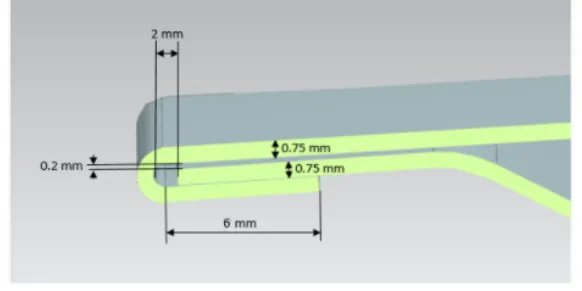
Relief rear section
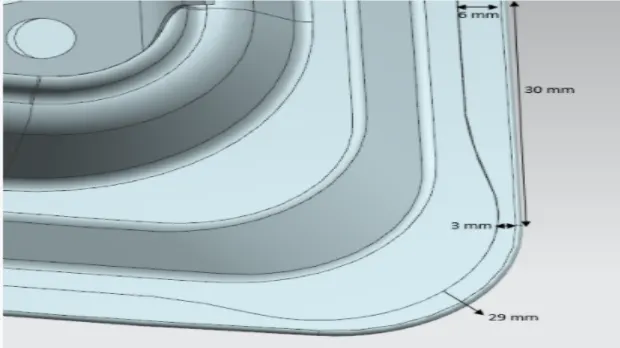
Front relief section
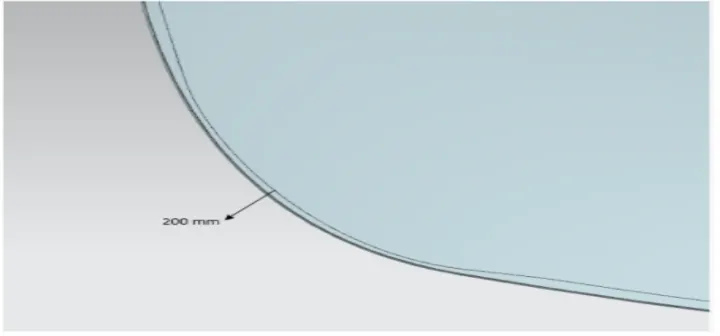
Commands used for designing of hood
- Offset surface
- Offsetcurve on surface
- Trim sheet
- Through curve
- Law extension
- Emboss
- Face blend
- Edge blend
Special features of hood inner panel
- Emboss: It is used to increase the stiffness of the inner panel technically increase the section modulus and also dissipate force towards hinges we primarily choose the polygon shape of emboss to get better control over the collapsibility of hood.
- Cut out: This gives the ability of collapsibility of Hood so that the impulse does not transfer to the pedestrian and occupants.
- Reinforcement: This is used to give the strength locally, here it is used for striker and hinge portion.
5-DISPLAY OF THE DIFFERENT COMPONENTS OF HOOD
HOOD INNER PANEL: Its’ purpose is to provide strength to an outer panel known as the skeleton of outer panel here all kind of operation is involved like embosing, cut outs etc. to improve the quality of hood.
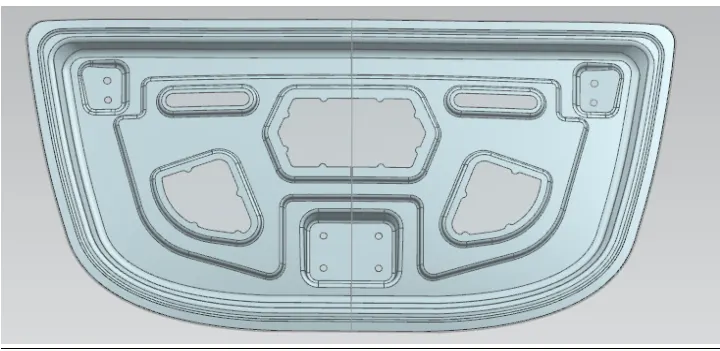
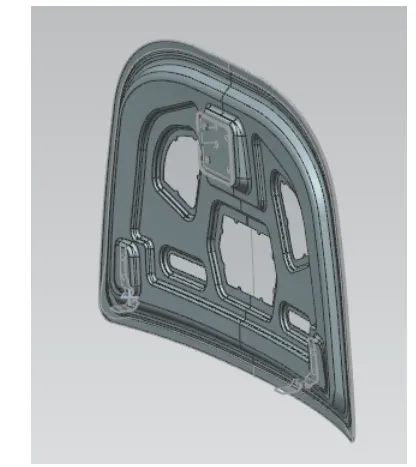
TOP VIEW ISOMETRIC VIEW
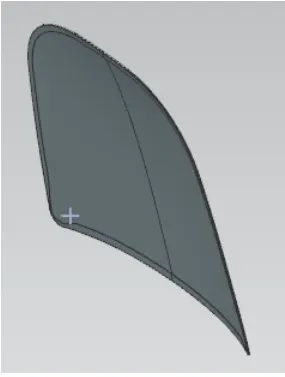
HOOD OUTER PANEL: It's purpose is to give asethetic look as well as the shape and inclination with respect to the windshield of outer hood is such that the aerodynamic drag is minimun as possible.
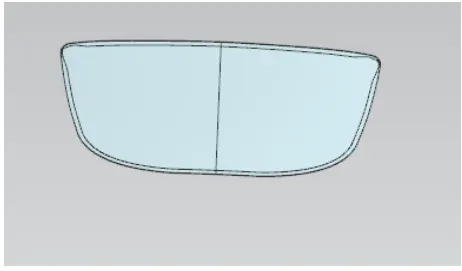
TOP VIEW ISOMETRIC VIEW
STRIKER: It's purpose is to lock the hood to the latch that is available in engine compartment.
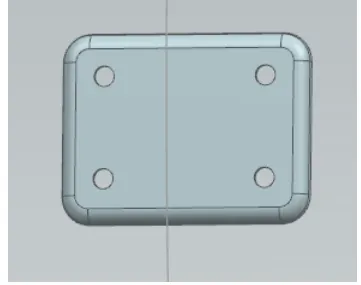
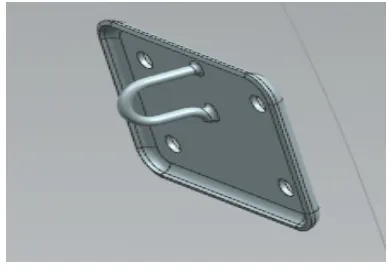
TOP BACK VIEW ISOMETRIC VIEW
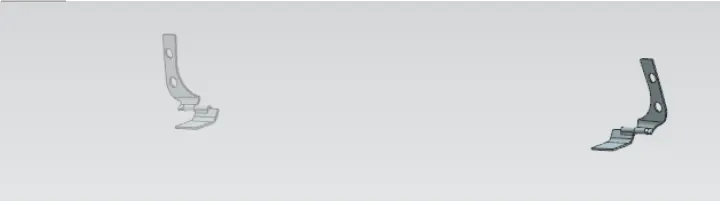
HINGE: Its’ purpose is to provide proper 1 degree of freedom (rotation clockwise and counter clockwise) to the hood.
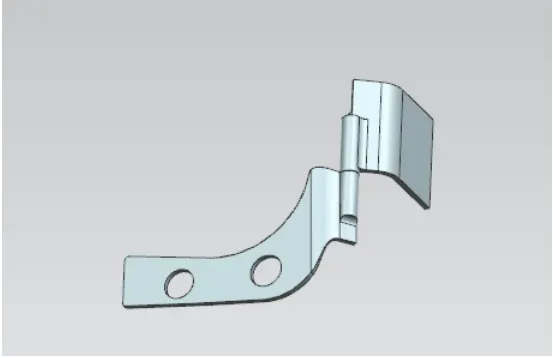
ISOMETRIC VIEW TOP VIEW
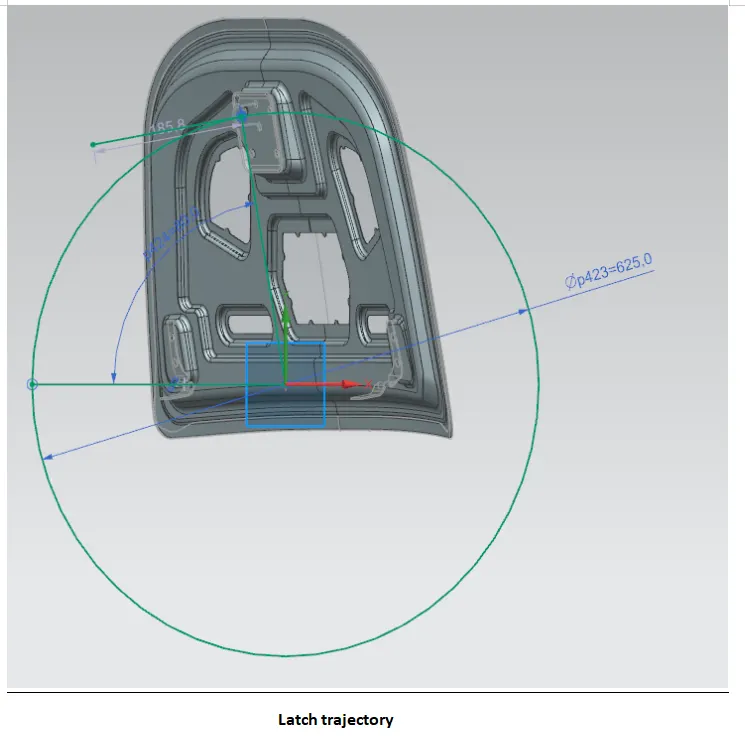
LATCH TRAJECTORY: We have to lock the hood in the proper way so to ensure the proper locking we have to apply the constraints for the rotation of the hood about the Hinge axis such that the striker should follow circular path and point on it should be tangential about that circular path at all the instant.
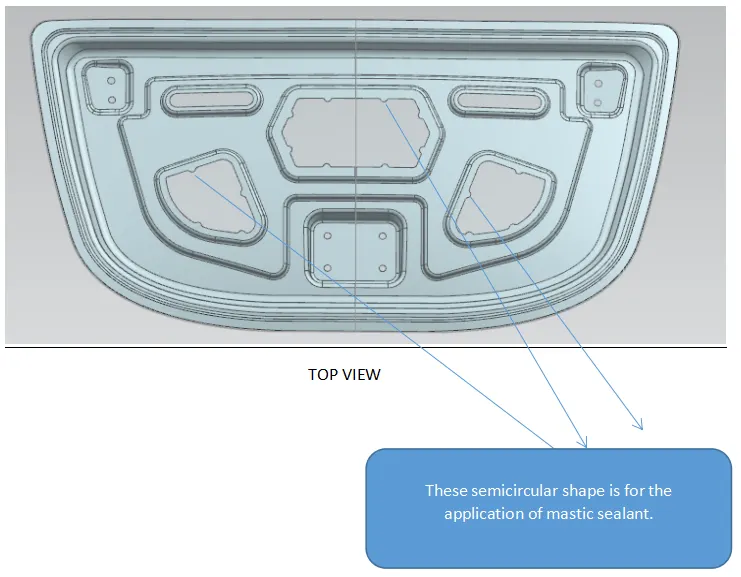
Mastic sealant: It is used for joining of the outer panel with the inner panel other than hemming joining is done without ruin the aesthetic look of the outer panel also prevent vibration due to this NVH also reduces, one spot of mastic sealant cover 80 mm
dia of circular region.
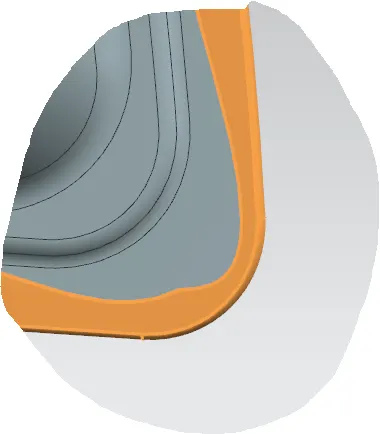
Relief: This is given to reduce the stress concentration during hemming operation orange part is outer panel and inner part is grey in color.
6-Conclusion: Here we complete all the basics of hood design as per industry standards and complete the hood design challenge as per the given input data.
Link - https://drive.google.com/file/d/15akWSJCsm1KwCv8vNcmLuaR8EIhT1xjR/view?usp=sharing
Thanks,
Tushar