Hood design-Week 2
2/18/2022
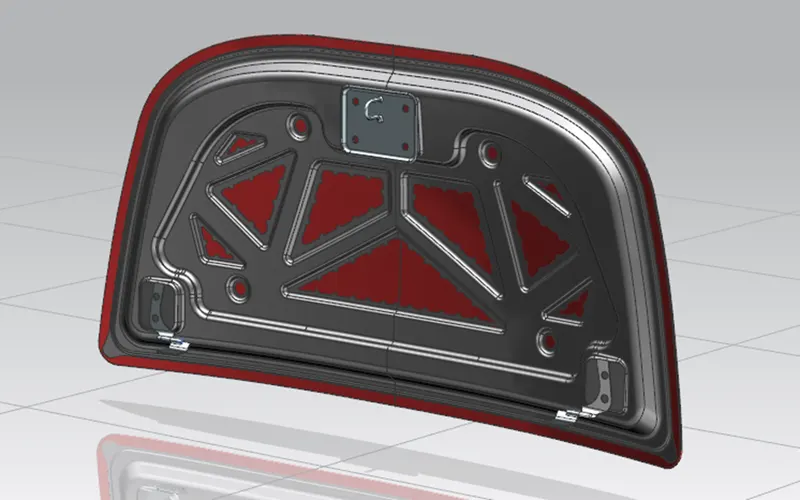
|
BIW DESIGN |
HOOD OUTER & INNER PANNEL DEVELOPMENT USING NX CAD |
Automotive sheet metal design using NX CAD.11 / SWAROOP S THAKUR
OBJECTIVE
To develop the hood inner & outer panel considering the safety, functionality and manufacturability, following the industrial standards.
ABSTRACT
Body in white (BIW) is the stage in automobile manufacturing in which a car body frame has been joined together , that is before painting and before the motor, chassis sub-assemblies or trim have been integrated into the structure. Assembly involves different techniques such as welding, riveting, clinching, bonding and laser brazing. In car body are worked out, in preparation for the ordering of the expensive production stamping die.
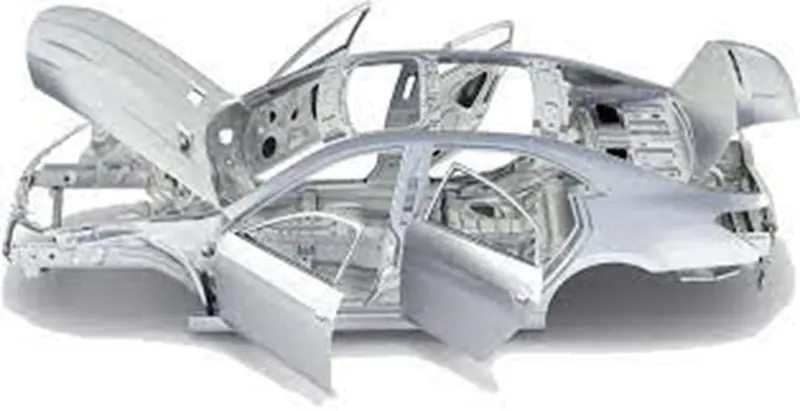
Body in White ( BIW)
The Hood ( North American English) or bonnet ( commonwealth English) is the hinged cover over the engine of the motor vehicles. Hoods can open to allow access to the engine compartment, or trunk on rear engine and some mid-engines vehicles, for maintenance and repair. Hood are typically made out of the same material as the rest of the body work. This may included steel, aluminum, fiberglass or carbon fiber to make the vehicle lighter. Hood consists of an outer panel and an inner panel.
The inner panel provides strength and support, where the outer panel is a metal cover which have styling factors.
HOOD – TYPES
There are two major types of hoods;
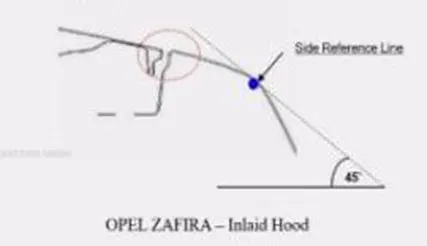
- Inlaid hood
- Wrap around hood Inlaid hood
It is lightest among all types of hoods. But it is easily subjected to border defects and body unevenness during manufacturing. Here I am designing an inlaid hood
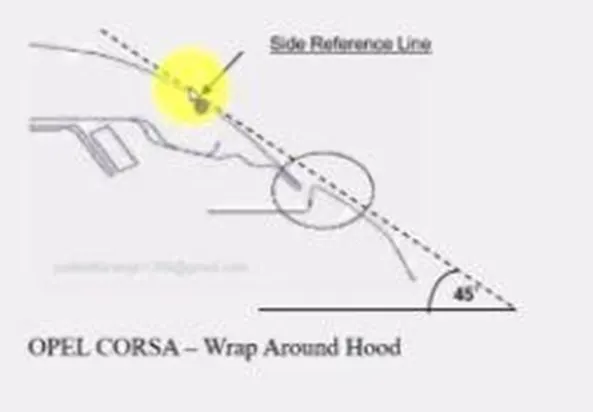
- Wrap around hood
As name itself it wrap around the car body. It can mask the geometrical defects and provide adequate stiffness. It is relatively safer than other types as it provides more safer areas for the pedestrian during impact.
Hood - Design requirements:
- Pedestrian safety
- Occupant safety
- Vehicle quality
- Styling
- Ability to manufacture Pedestrian safety
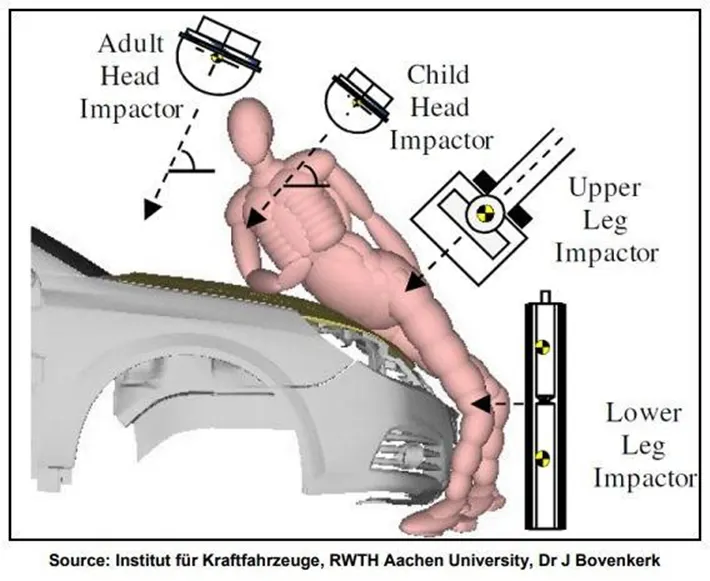
Vehicle designers usually focus on understanding the car-pedestrian interaction, which is characterized by the following sequence of events: the vehicle bumper first contacts the lower limbs of the pedestrian, the leading edge of the hood hits the upper thigh or pelvis, and the head and upper torso are struck by the top
surface of the hood and/or windshield. Most pedestrian deaths occur due to thetraumatic brain injury resultingfrom the hard impactof the headagainstthestiff hood or windshield. In addition, although usually non-fatal, injuries to thelower limb (usually to the knee joint and long bones) are the most commoncause of disabilities. The hood of most vehicles is usually fabricated from sheetmetal,whichisacompliantenergyabsorbingstructurewhichposesacomparativelysmallthreat.
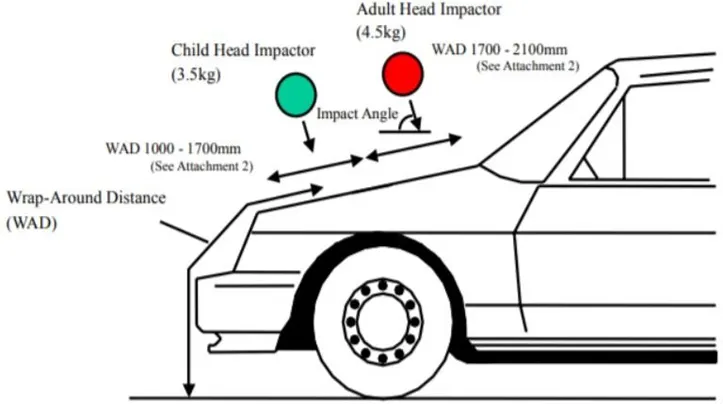
Wrap Around Distance (WAD) is the distance from the ground level to the end of the hood as shown in the image
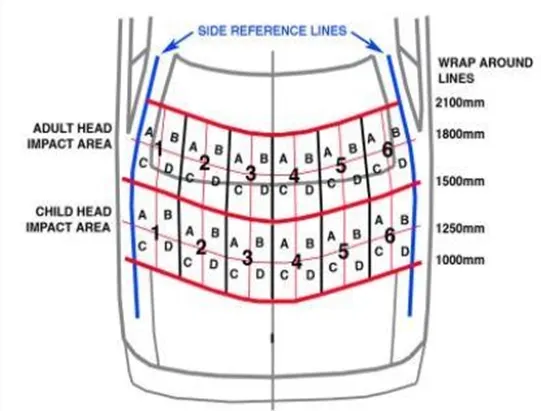
There are two main zones that are considered while designing stage; Child head impact zone (1000mm to 1700mm WAD) and Adult head impact zone. (1700mm to 2100mm WAD). . If the side reference line is on the fender, the WAD will be more and impact zone will be less and vice versa.
- Occupant safety
The hood panels should be designed in such a way that it diverge the impact forces during a collision away from the occupants inside the cabin. The forces should be damped properly to avoid or reduce the risk of injuries and death.
- Vehicle quality
Here the factors such as torsional stiffness, dent resistance, corrosion resistance, weight distribution, and noise attenuation etc. are considered.
4). Styling
It is a major factor that often influence the vehicle sales in the market. The outer panel is the main consideration here as it is the only component that is visible outside. The factors such as surface quality, tight radii on hemmed panel edges aesthetic design etc. are crucial factors. Other than styling, aerodynamic factors are important while designing the outer panel.
- Ability to manufacture
Here various sheet metal operations such as blanking, piercing, embossing, hemming etc are used for manufacturing the hood components. Minimum 7 degree draft angle is maintained respective to the tooling direction considering the stamping process. Mastic points were implemented to join the outer and inner panels as we cannot apply spot welding process here. The materials used are typically steel or aluminium based.
Here,
- Outer panel thickness = 75mm
- Inner panel thickness = 75mm
- Reinforcement thickness = 5mm
Design Methodology
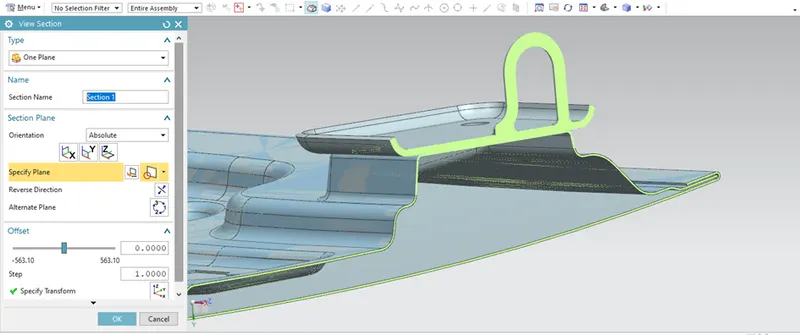
The master section of the hood inner panel is shown in the image below. It provides information such as distance between various layers (emboss), fillet radii, width, clearances etc.
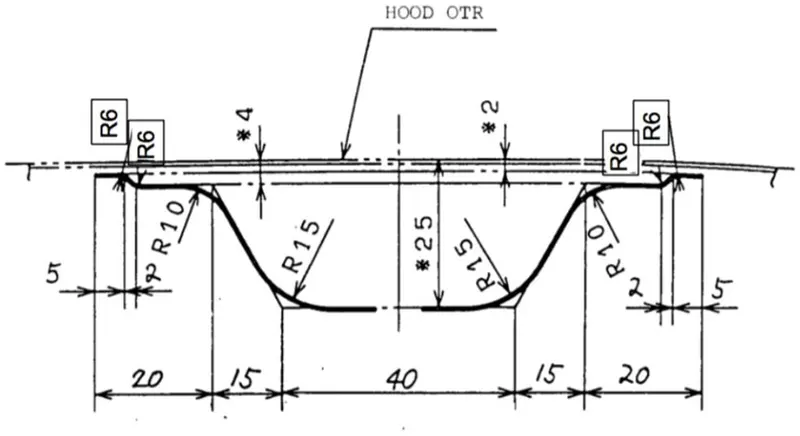
Master section of hood
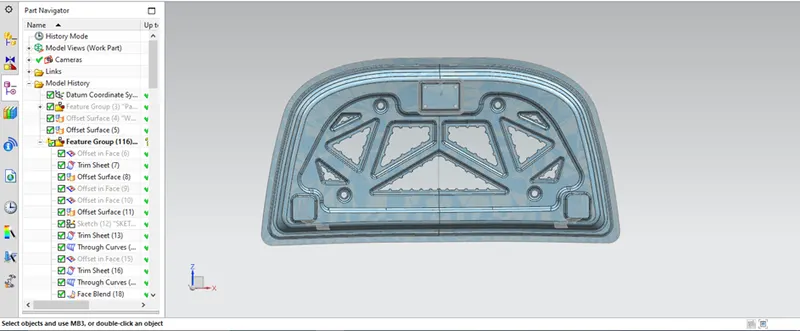
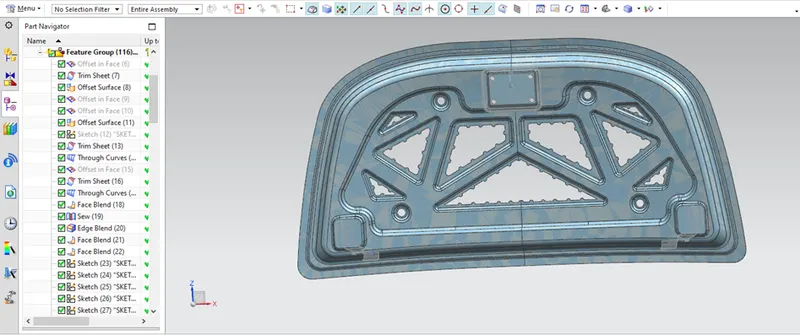
Hood inner panel was designed at first. The various stages of inner panel development, the embossings were created. The main design consideration is to diverge any impact forces away from the passenger cabin.
Necessary cuts were provided for sufficient deformation of the outer panel without any restrictions caused by the inner panel in case of pedestrian impact. This also helps to reduce the overall weight of the hood. Also mastic sealant points were created on the inner panel. Provisions for attaching the fixtures, various holes for supplying viper fluid and ED bath drain holes, hinge and striker attachment holes etc. were designed. Diabolo embosses for fixing the hinges and striker on the inner panel were also created as shown below.
Impact forces diverging away from the passenger cabin
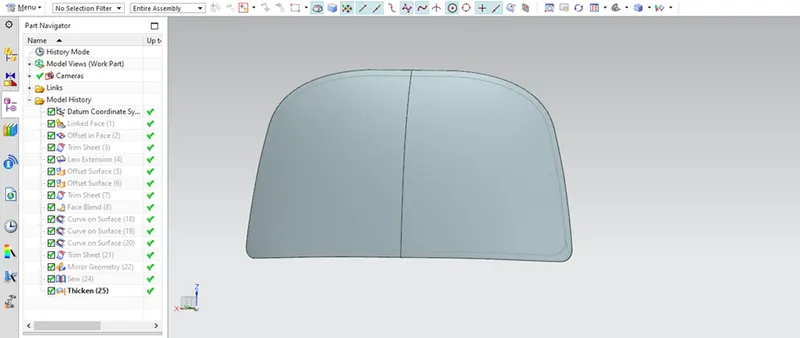
Development of the hood outer panel was the next step. Thickness of the sheet metal used is 0.75mm. The hood outer panel and inner panel have a clearance of about 5mm at mastic sealant application points. Hemming is a sheet metal working process in which the edges are rolled over onto itself. 0.2mm clearance provided between the surfaces of inner panel and hemmed edges of outer panel for application of structural adhesives. Necessary corner reliefs were also provided.
Outer panel of hood
Hood inner panel, outer panel, hinges, striker and assembled together.
Hinge and striker
Hemming
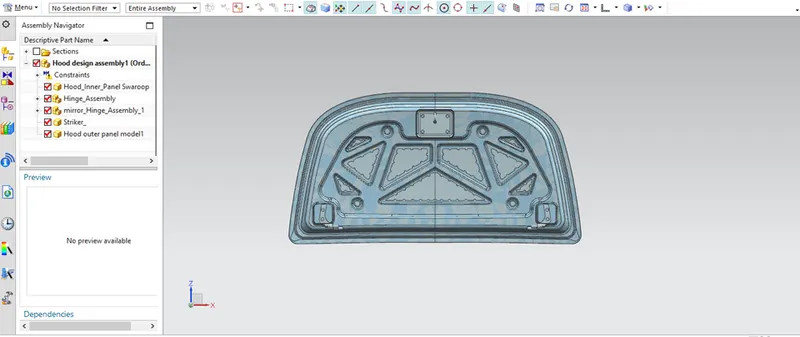
Full assembly
Conclusion
Thus the hood was successfully designed by following the procedures. The model is passed to the CAE team for further analysis for optimizing the design. Hood inner and outer panels are usually manufactured through metal stamping processes. Metal stamping is a manufacturing process used to convert flat metal sheets into specific shapes. It is a complex process that can include a number of metal forming techniques — blanking, punching, bending and piercing, to name a few. Stamping — also called pressing — involves placing flat sheet metal, in either coil or blank form, into a stamping press. In the press, a tool and die surface form the metal into the desired shape. Punching, blanking, bending, coining, embossing, and flanging are all stamping techniques used to shape the metal.
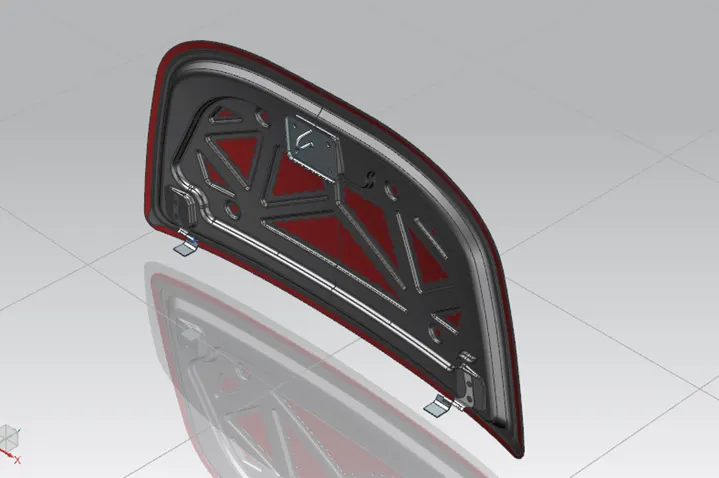
Final rendering