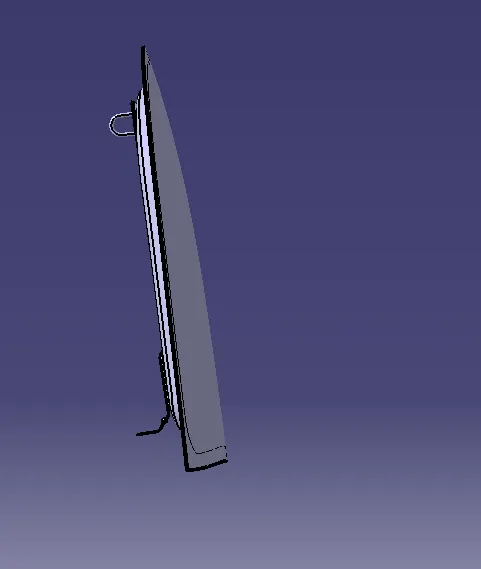
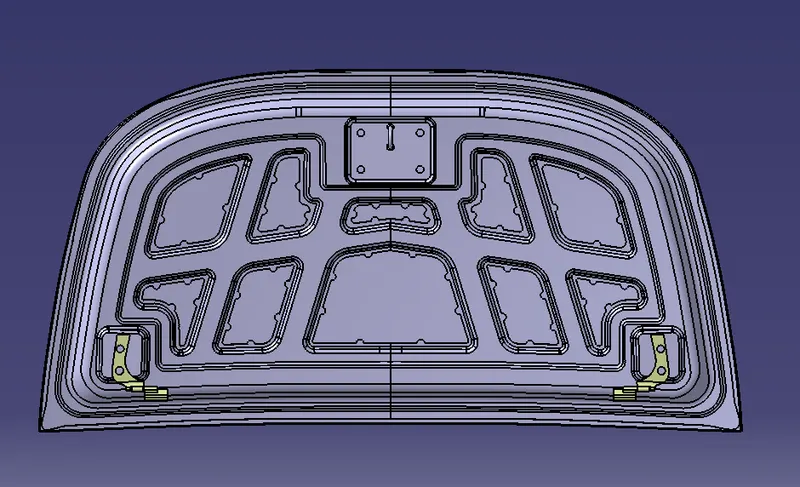
Hood design-Week 2
Objective:
Design Hood outer panel, inner panel and the necessary reinforcements by following the Master section mentioned with the design parameter explained in the videos. Submit an assembly of Hood inner panel, outer panel, latch, hinge and the reinforcements
Introduction :
A car hood also referred to as a bonnet in some other countries is the hinged cover that rests over the engine of a front-engine vehicle. Its purpose is to provide access to the engine for repair and maintenance. Car hoods are typically constructed from steel and sometimes from aluminum.
On front-engined cars, the hood may be hinged at either the front or the rear edge, or in earlier models (e.g. the Ford Model T) it may be split into two sections, one on each side, each hinged along the centerline. A further variant combines the bonnet and wheel arches into one section and allows the entire front bodywork to tilt forwards around a pivot near the front of the vehicle.
Hoods are usually made from the same material as the rest of the body. This can be steel, aluminum, fiberglass, or carbon fiber. However, some aftermarket companies produce fiberglass or carbon fiber steel hood replacements to make the vehicle lighter.
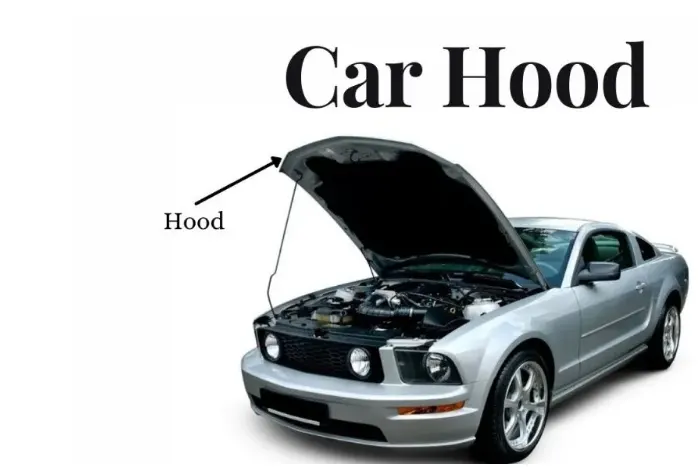
The hood consists of hood outer panel , hood inner panel , hinges and striker assembly.
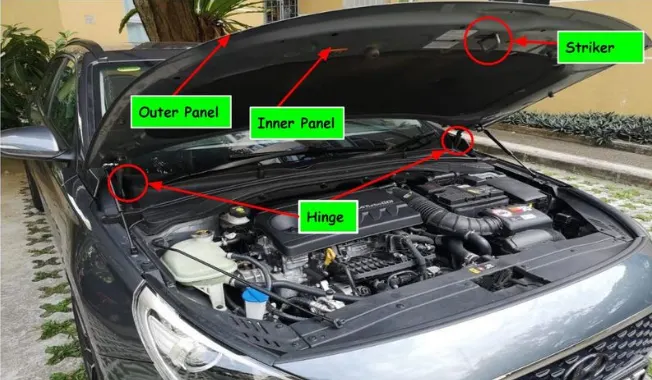
Design Considerations for Hood
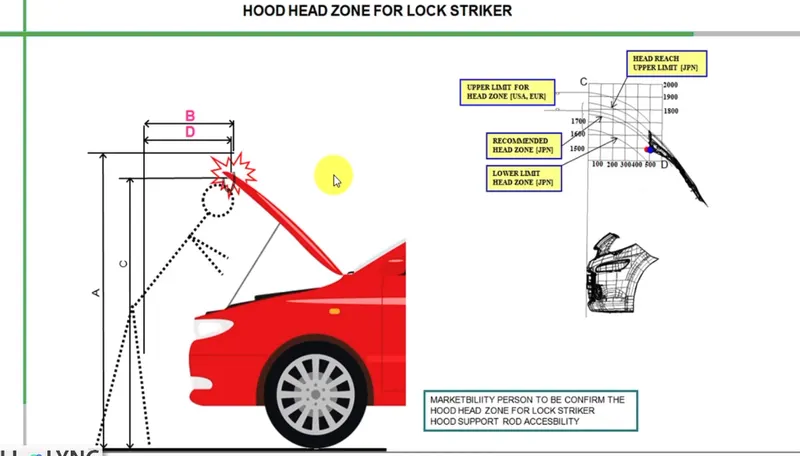
a) Head Clearance
Head clearance is the height from the ground to the front end of the hood . This distance varies from continents as the average height of humans varies in several continents. We need to take this into consideration while designing a hood .
b) Latch trajectory
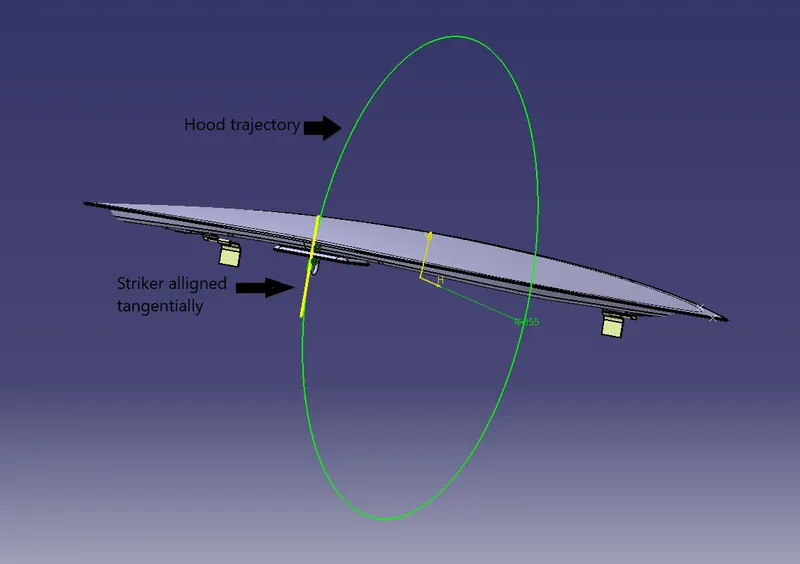
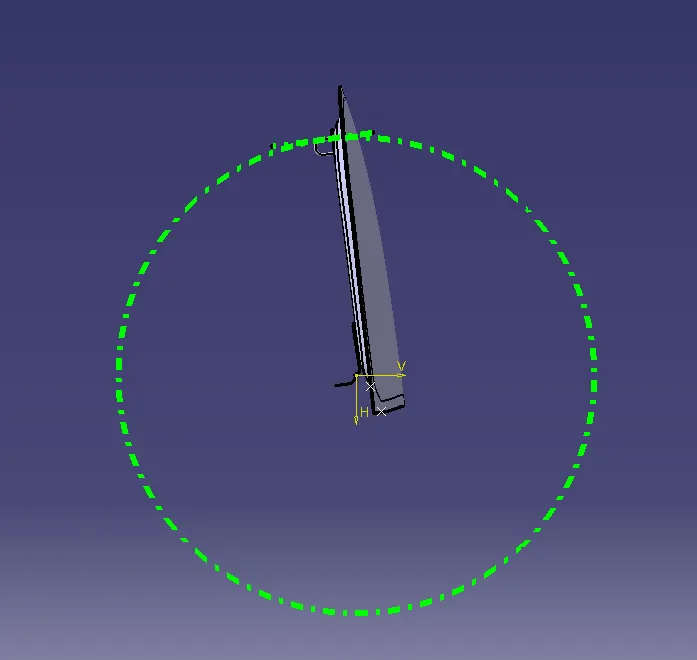
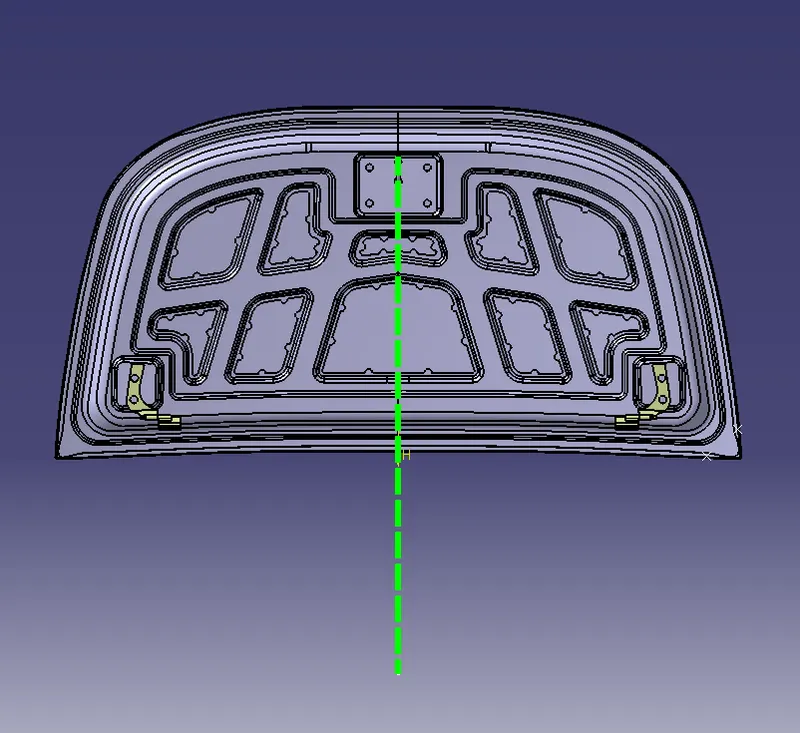
We need to ensure that when the hood is closed , the striker alligns with the locking mechanism . Hence the condition that striker lies tangential to the hinge closing axis circle has to be met while designing inorder to ensure the proper closing of hood .
c) Mastic Data
Mastics are adhesive sealants used to join outer and inner panel . They ensure the joining of these outer and innet panels without using welds. Each mastic point has an area of effect of 80mm diameter. We need to provide areas on inner panel for application of masitcs while designing the component .
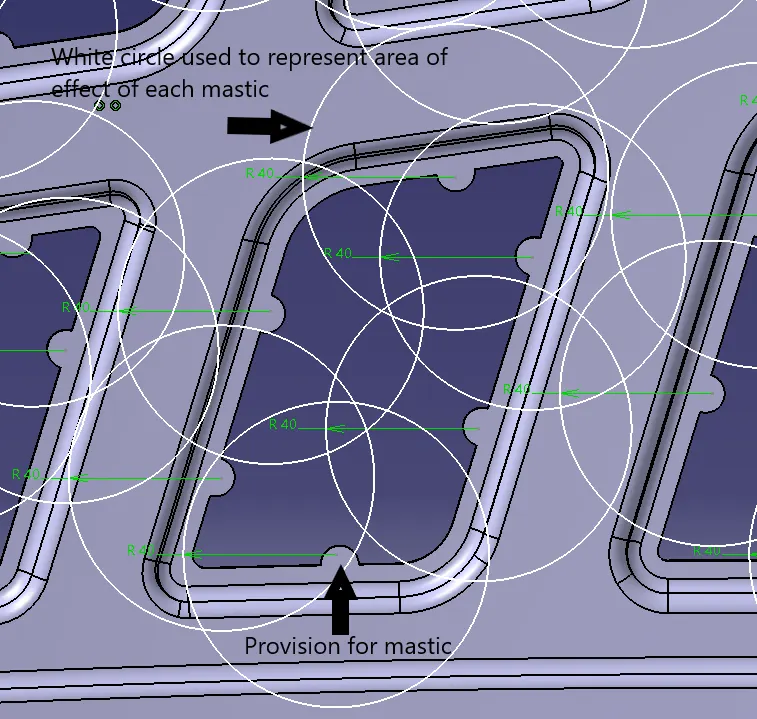
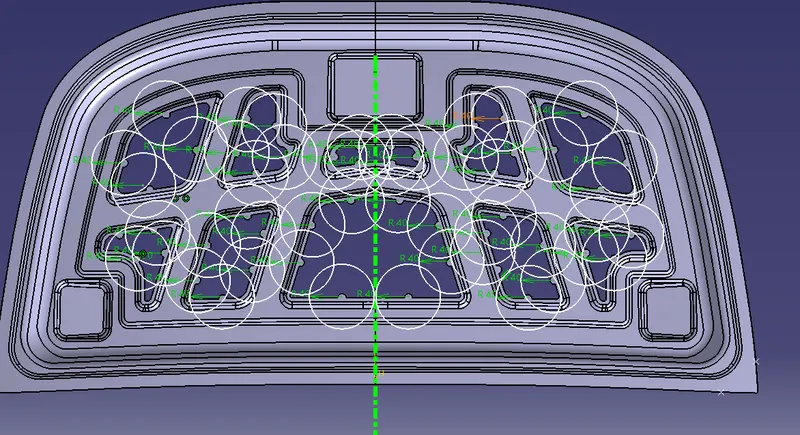
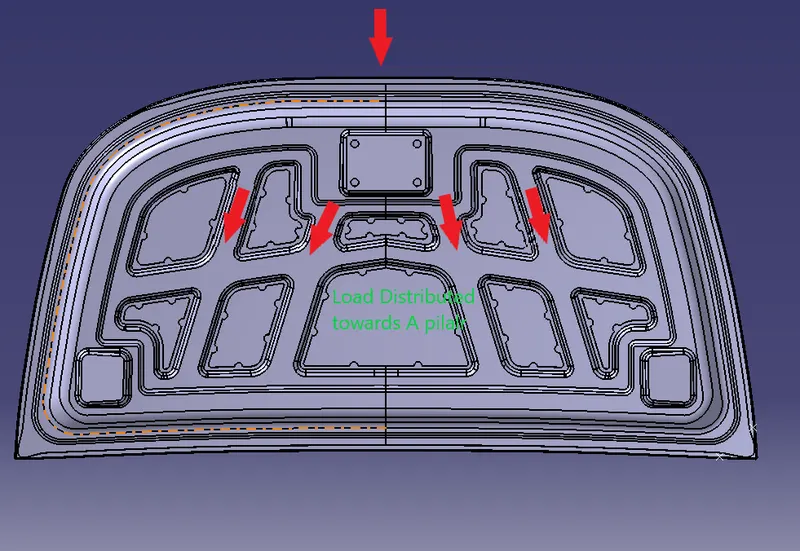
d) Emboss definitions
Embosses are used to give stiffness to a component without significant addition in weght . We need to crate embosses in such a way that
i) It provides certain pedestrian crash safety
ii) it ensures that in case of frontal crash, the forces are distributed to the vehicle A pillars and not into paseenger cabin .
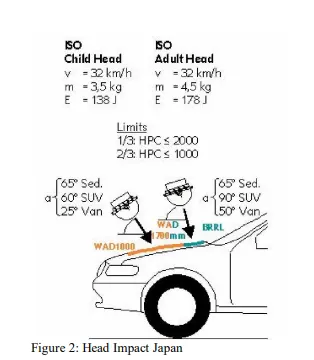
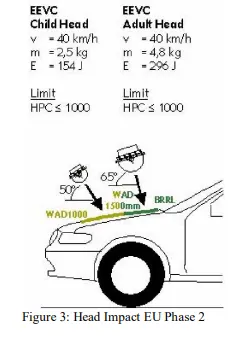
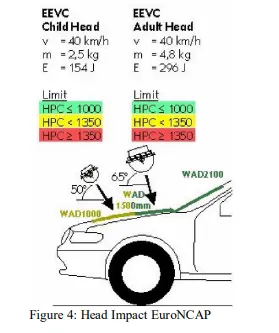
Head Performance Criteria(HPC) and Wrap around distance(WAD)
HPC is used by manufacturers to meet ceratin vehicle standards . It is measured using a head form impactor having 3 dimensional accelerometers
Head performance criteria is given by equation:
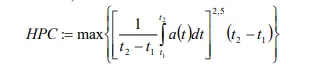
In order to clear NCAP , there are various standards HPC value has to achieve.
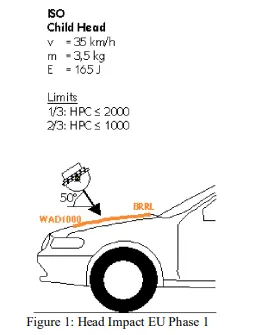
Wrap around distance is the trace of points recieved on the front end of a structure when one end of a flexible tape of required length is held at ground and the other end is at the structure.
Given below are images for HPC values for various WAD .
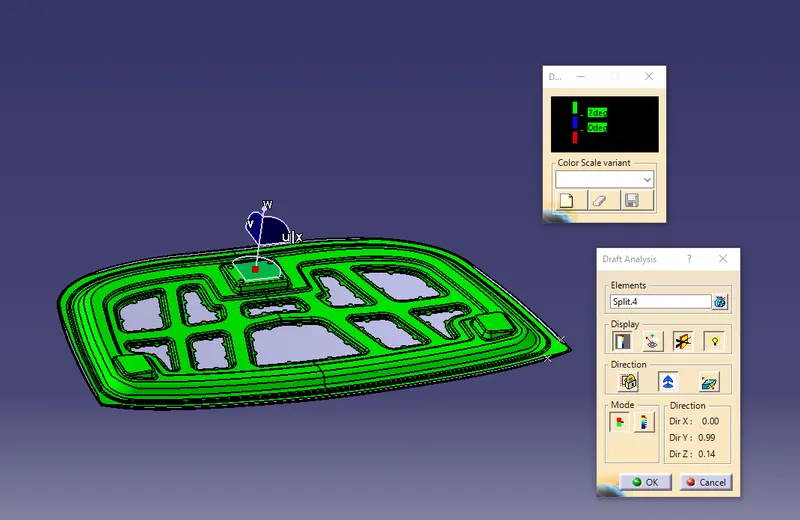
e)Draft
Draft
is given so that the component is manufacturable and tool is able to move in and out without restricitions . Sheet metal manufacturing tools have a minimum draft of 7 degrees for their proper movement . While designing , we need to ensure that this criteria is met for the design .
f) Deep drawing and Hemming
Deep drawing is a sheet metal forming process in which a sheet metal blank is radially drawn into a forming die by the mechanical action of a punch. It is thus a shape transformation process with material retention. The process is considered "deep" drawing when the depth of the drawn part exceeds its diameter. This is achieved by redrawing the part through a series of dies. The flange region (sheet metal in the die shoulder area) experiences a radial drawing stress and a tangential compressive stress due to the material retention property. These compressive stresses result in flange wrinkles (wrinkles of the first order). Wrinkles can be prevented by using a blank holder, the function of which is to facilitate controlled material flow into the die radius.
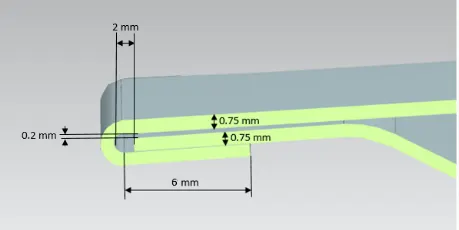
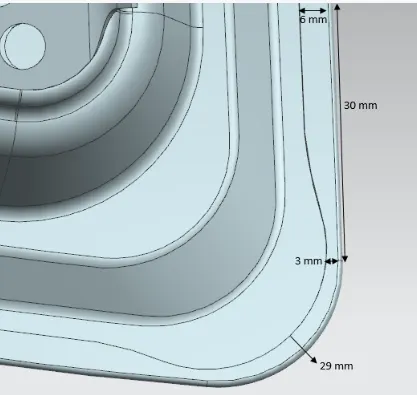
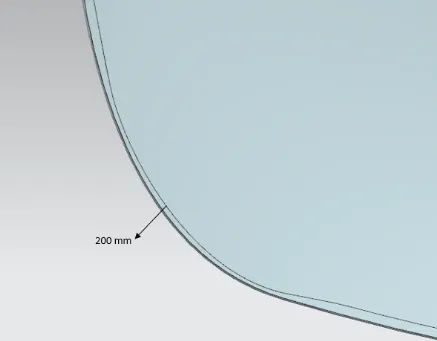
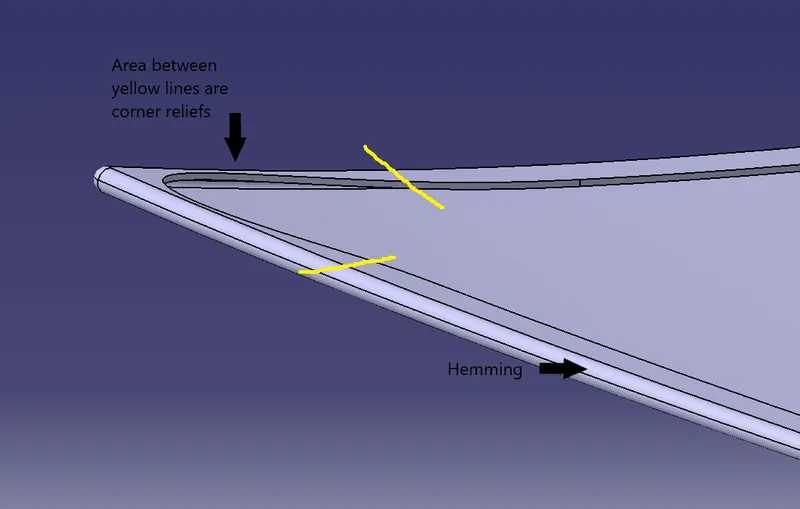
Hemming is the process in which the edge is rolled flush to itself, while a seam joins the edges of two materials.Hems are commonly used to reinforce an edge, hide burrs and rough edges, and improve appearance. Here we provide hems to the outer panel so that inner panel can be attached without hindering the appearance of the hood .
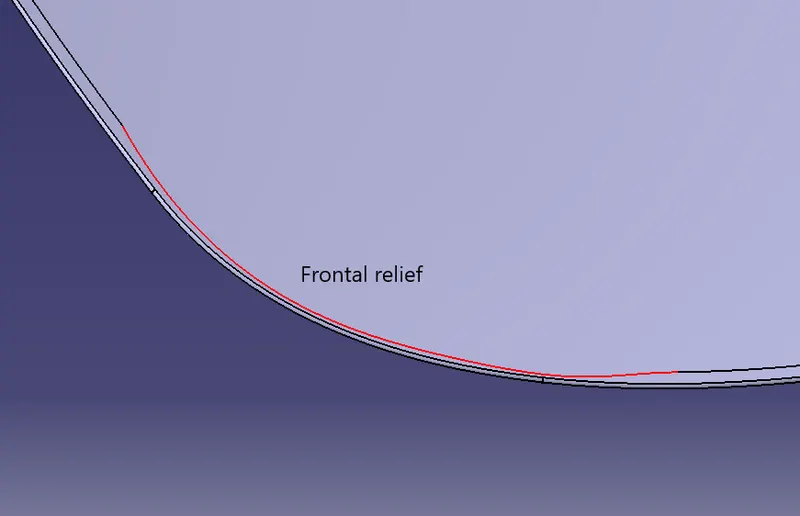
Criteria for hemming and corner relief
Final Assembly images