Hood design-Week 2
Design and modelling of Hood using NX-CAD:
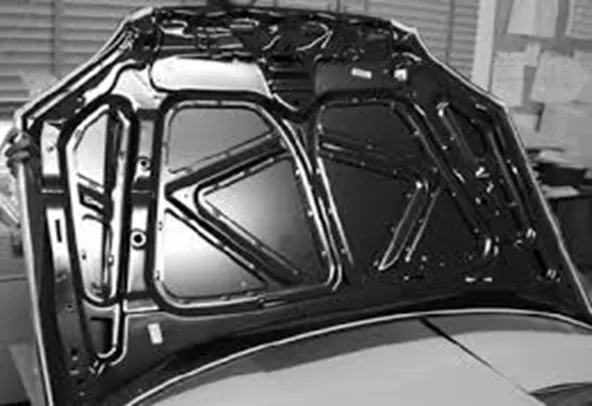
Hood is the component of BIW. The main function of hood is to allow the access of the engine compartment and other sub systems to occupant like regular services like maintenance. Also, it absorbs most of the frontal impact and transfer or simulate across body pillar to provide safety to occupant of the vehicle.
Designing a hood is always a challenge as it is the first portion that comes in the contact of force of air. Aerodynamic shape is always preferred for front portion of car because it gives benefits like less area of contact so less resistance to motion. Further aesthetic design of hood is also the factor of consideration as user preference of luxurious views of car are increasing day by day.
Hood Design considerations:
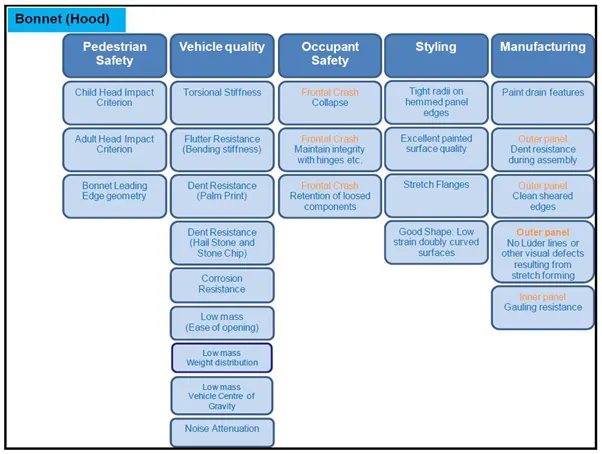
The important safety requirement to be considered while designing the bonnet is the pedestrian safety from frontal collision. The European New Car Assessment Program is a European car safety assessment which has developed test specification and rating system for assessing pedestrian injuries during impact with the front of vehicles such test includes a series of tests using impactors designed to mimic a collision at a speed of 40km/hr. They describe a situation in which pedestrian is situated laterally and a car is first hits one of his legs. Tests are conducted on the leg and most importantly on the head, as head trauma is most commonly responsible for casualties.
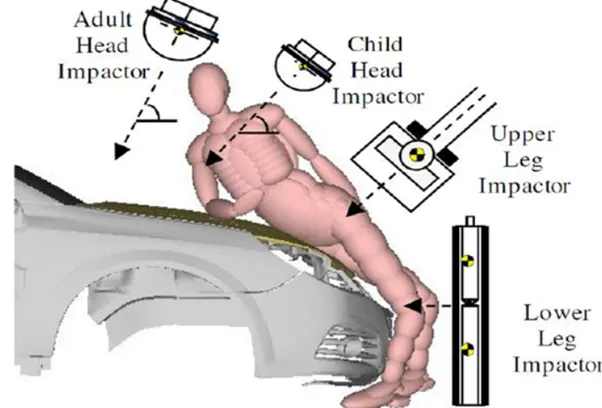
Thus, to avoid severe injuries to the head the high impact area for adults and children are subjected to less thickness. Also, no reinforcement should be provided in that area as during the head collision, the hood will absorb the head impact energy leading to collapse of the hood and thus protecting severe head injury. Another important criterion for the hood design is the protection of the occupant inside the car during the front collision. The design of the hood should be in such a way that during the collision, the force should travel in the upward direction through the embosses and directed toward the car body. Thus, protecting the occupants inside.
WAD: Wrap Around Distance is the geometrically traced distance from the contact point with the Ground Reference Plan, vertically below the front face of the bumper, to any on the vehicle front structure.
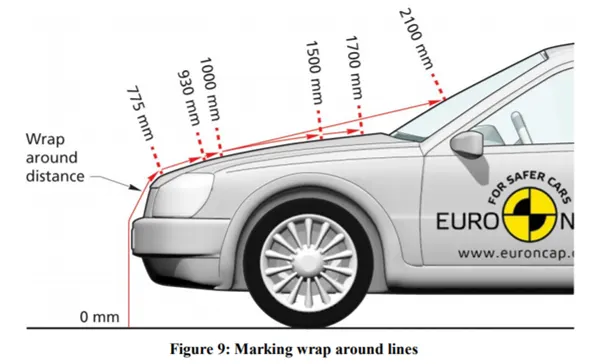
Bonnet Side reference line: The geometric trace of the highest points of contact between straight edge, held parallel to the lateral vertical plane of the vehicle and inclined 45 deg. Is traversed down the side of the front structure, and the side of the front structure.
Design of Inner Panel:
Designing and modelling of the inner hood panel is done using the class A surface. The given class A surface,
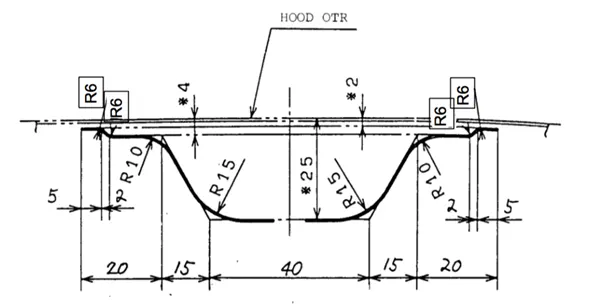
Inner Panel
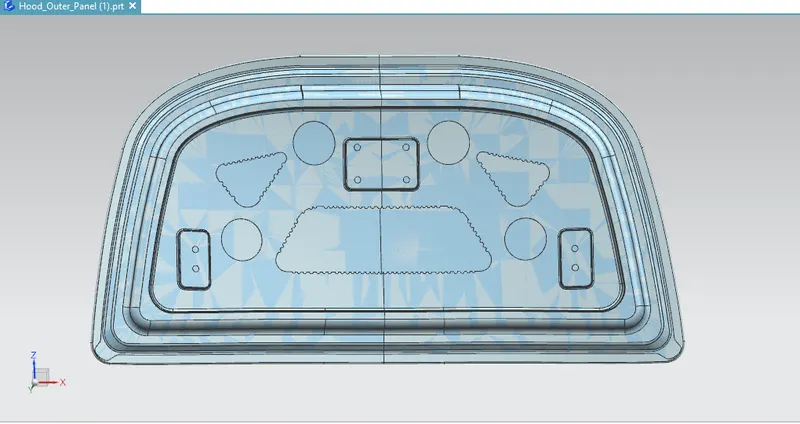
The cut outs in the panel are given so that the stress is divided properly throughout the panel. Embossing provides more strength and to direct the forces from the front collision towards the hinge and the body car. The depth of the emboss is about 5mm.
Design of Outer Panel:
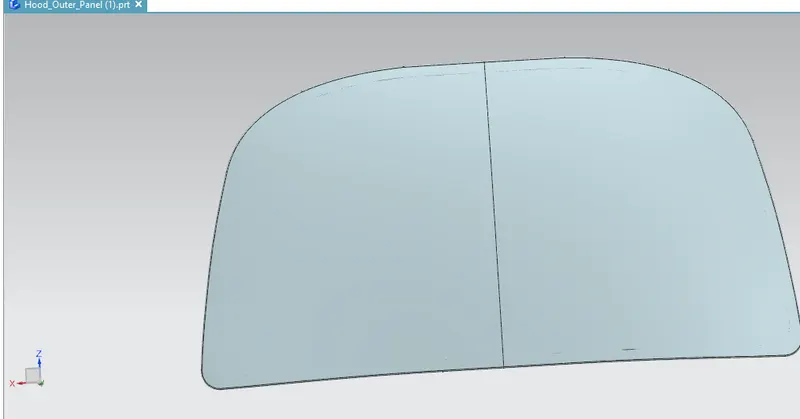
Hemming: Hemming is the process in which the edge is rolled flush to itself, while a seam joins edge of two material. Normally, hemming operations are used to connect parts together, to improve the appearance of a part and to reinforce part edges. Hemming is the secondary operation that is carried out after deep drawing, trimming and flanging operations to join two sheet metal parts together.