Hood design-Week 2
HOOD DESIGN
AIM
The aim of this project is to create a complete hood assembly from the given Master sketch and skin data of the Hood outer panel using Siemens NX-CAD.
THEORY
Car Hood or Bonnet is one of the important BIW parts of the car. It is the hinged cover that rests over the engine of a front-engine vehicle. There are two different types of hoods, they are Inlaid/ Built-in hood and wrap around hood. In Inlaid type the hood spreads only on the engine compartment whereas in wrap around type the hood spreads furthermore pushing the fender downwards and taking its space. Wrap around hood is better in terms of pedestrian safety. Apart from covering the engine and battery and other components hood also serves an important role safety of both passenger and pedestrian. So, a well-designed hood will get you good ratings in Euro N-CAP rating. In most cars Latch and striker mechanism is used to close the hood. The hood is usually supported either by Support rod or a Gas stay when it is lifted. Generally, support rod is used when the hood is lighter and for a heavier hood gas stay is used. Hood is one of the critical BIW part of a car body since, it is subjected to constant engine heat, climatic changes and vibrations.
There are mainly 4 components that constitute a car hood. They are:
1.Hood outer panel- It gives the aesthetic and stylish look to the car.
2.Hood Inner panel- It provides the necessary strength and rigidity to the outer panel.
3.Latch striker- It is the mechanism used to close the hood.
4.Hinges- They provide the support for the hood while opening and closing
and in some cases, Support rod is also mounted on the car hood itself.
IMPORTANT CONSIDERATIONS WHILE DESIGNING A HOOD
Important considerations that an engineer must keep in mind while designing a hood are:
1.Pedestrian Safety:
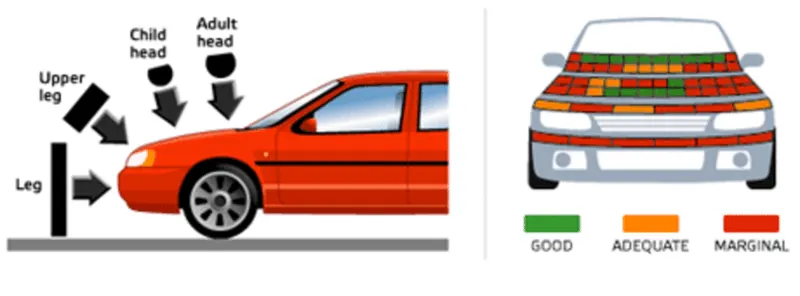
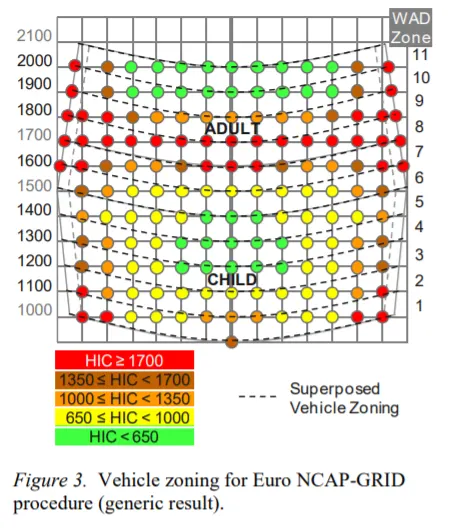
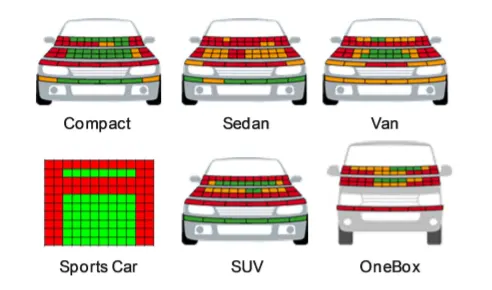
It is the most important factor that decides whether the hood you design is a good one or a bad one. Euro NCAP safety assessment program in which the pedestrian safety is tested while the car is moving at a standard speed of 40kmph and side reference line which is at an angle of 45 degrees to the ground level is projected up to where it touches the car hood or the fender on the both sides and the whole area from left to right is marked and a thread which is fixed on the ground is taken and wrapped around the impact area of the hood and the child head impact and adult head impact areas are marked so we have to make sure that in these areas the hood thickness is as less as possible and no reinforcements are given so that during collision the hood absorbs the most of the energy and breaks thus preventing the pedestrians from severe head injuries.
2.Occupant Safety:
Another important criterion that a good hood must satisfy is the good occupant safety because hood will be the one of the first one to hit in an accident/collision. So, we as an engineer must make sure that the forces that impact the hood are not transmitted to the passenger compartment. We can achieve this by giving the appropriate embosses while designing the inner panel of the hood and we also provide a pre-defined line along which the hood collapses during the time of frontal crash.
3.Latch trajectory:
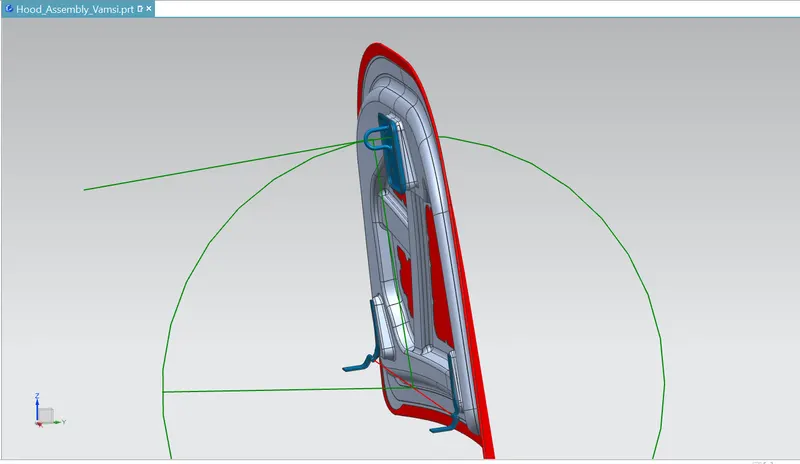
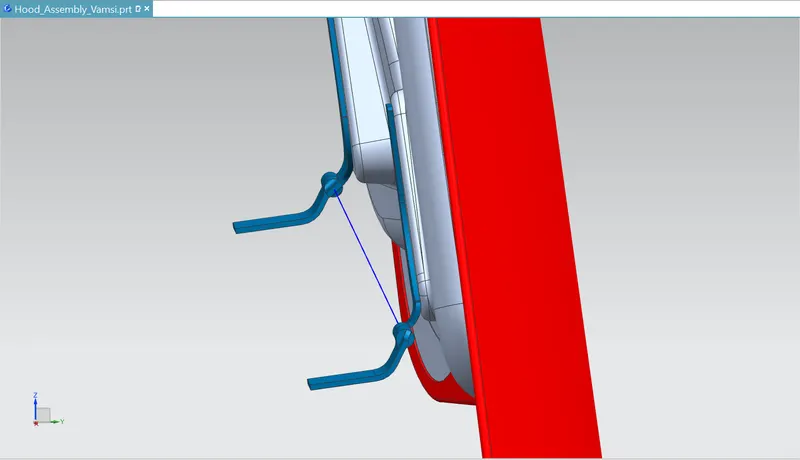
It is important to consider this while placing your striker at the time of hood assembly. what it says is that for the latch and striker mechanism to lock properly while closing the hood, when a circle is drawn with the midpoint of the line joining the two hinge axes as its center and connecting the striker that the latch must be tangent to this circle.
4.Deep drawing:
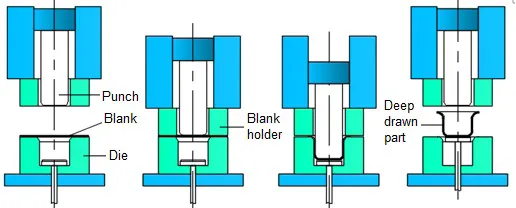
Hood of a car is manufactured using a sheet metal operation known as Deep drawing. It is a sheet metal forming operation in which a sheet blank is radially drawn into required shape by the mechanical action of punch. So for a hood design to manufacturable all the embosses that are created on the inner panel must be made with a positive draft angle.
4.Vehicle quality:
It involves all other factors that decide how good a hood is like torsional stiffness, dent resistance (Chipping due to stones in the road), corrosion resistance and noise and vibration attenuation.
GIVEN PARAMETERS FOR DESIGNING THE HOOD:
- Outer panel thickness= 0.75mm
- Inner panel thickness= 0.75mm
- Reinforcement thickness= 1.5mm
Master section
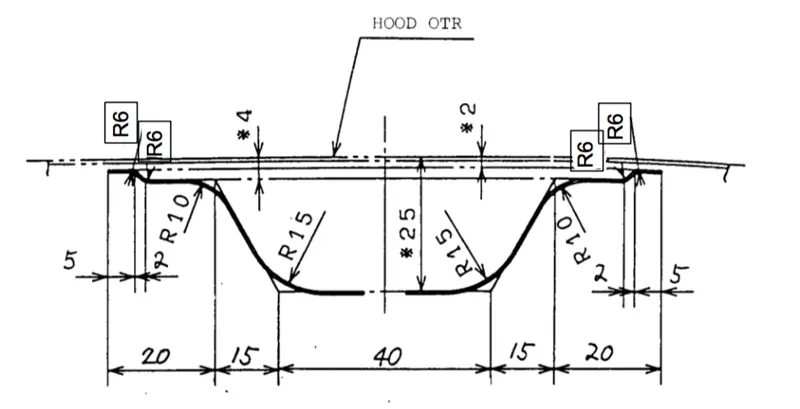
Hemming data
Front relief section
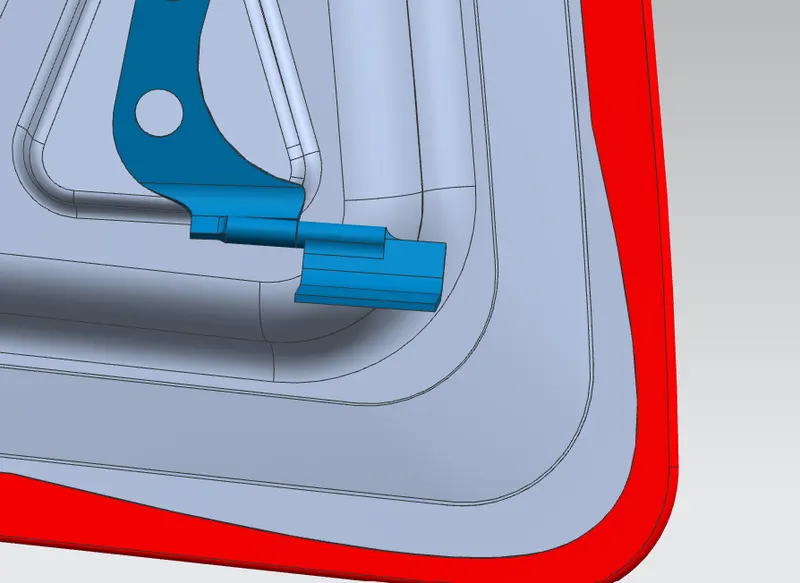
PROCEDURE
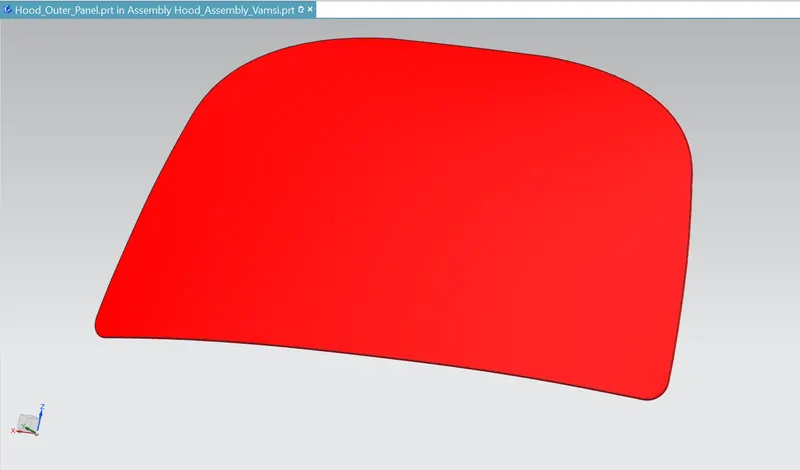
HOOD OUTER PANEL:
This is the part that is visible to us when hood is completely covered over the front part and is closed. Outer panel is mostly about the appearance and satisfying the required dimensions.
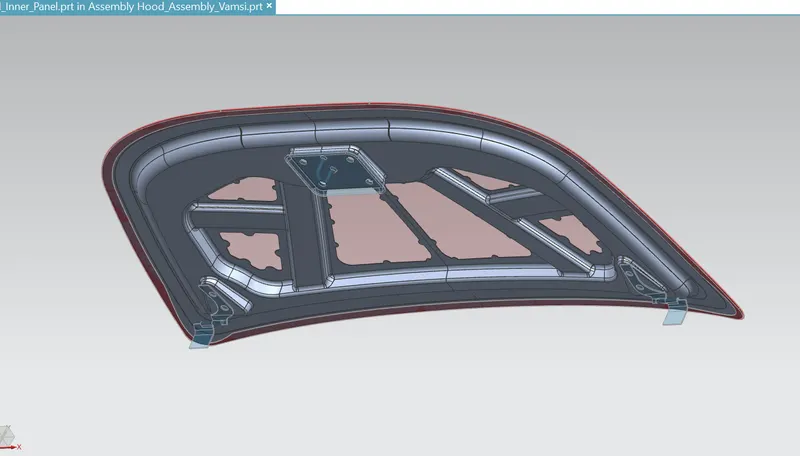
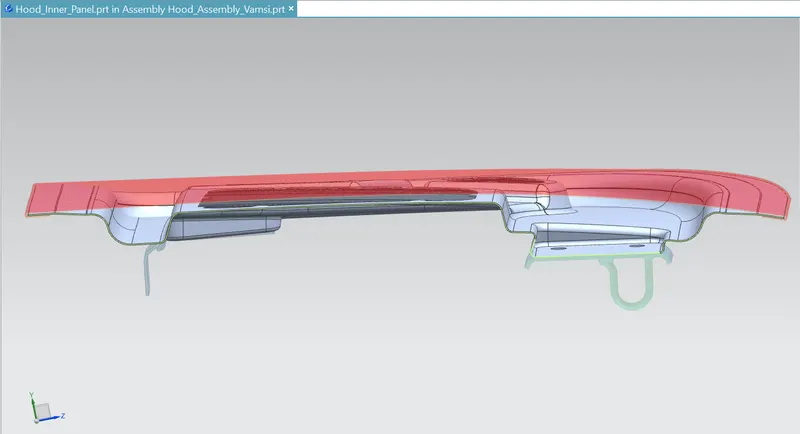
HOOD INNER PANEL:
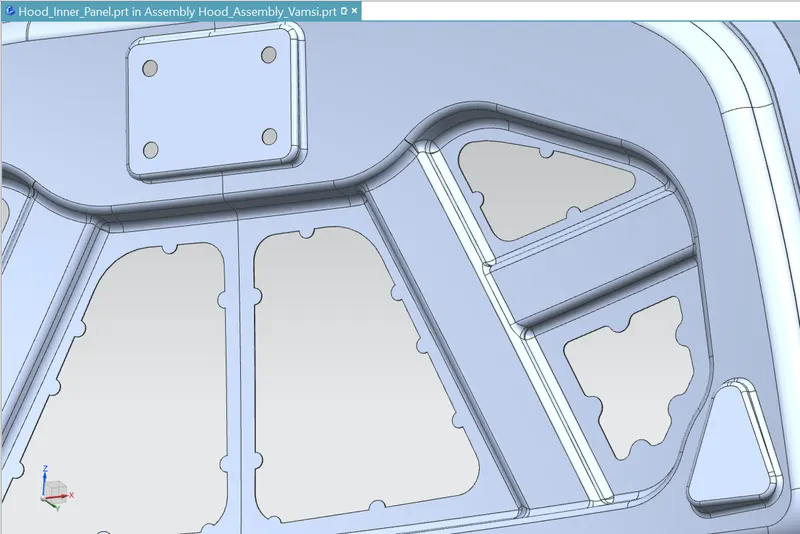
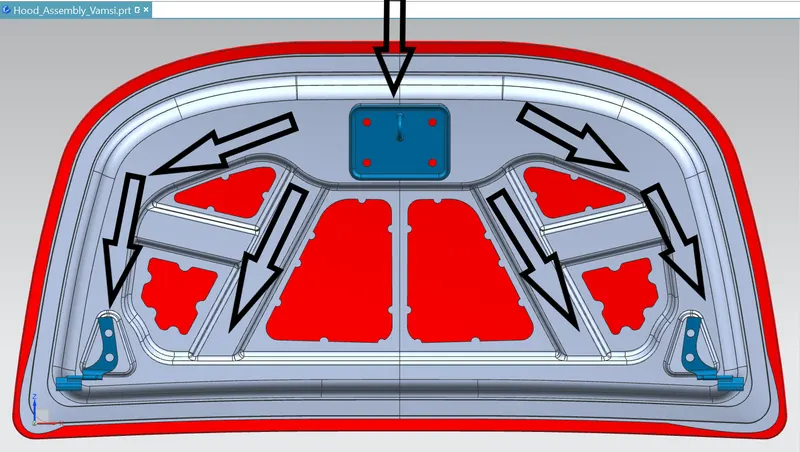
Inner panel gives the necessary strength to the hood assembly. It houses embosses and hinge reinforcements and striker reinforcements.
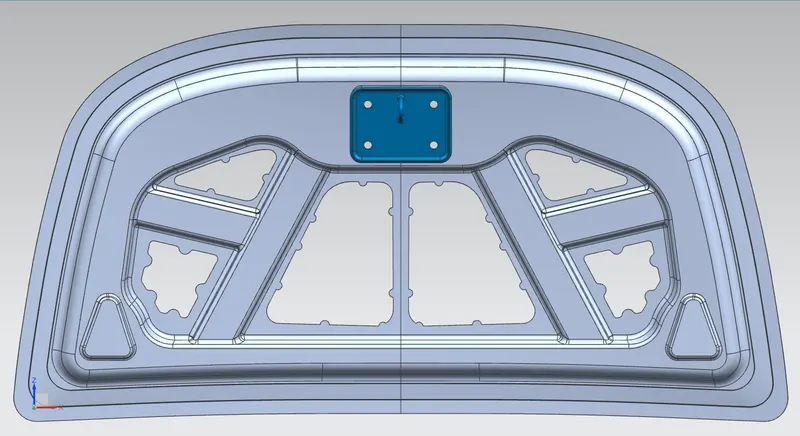
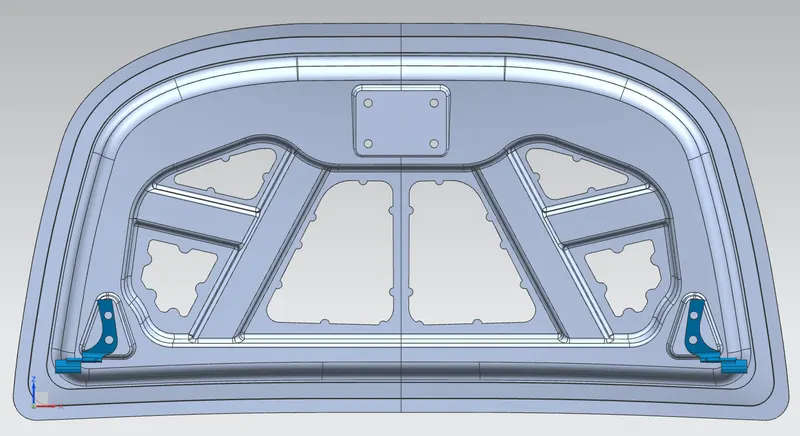
REINFORCEMENTS:
Reinforcements are produced to restore the strength locally when we add weight in a local area. These are mainly given for hinges and striker. The thickness of reinforcements is usually more than that of inner panel generally lying around 1.5mm.
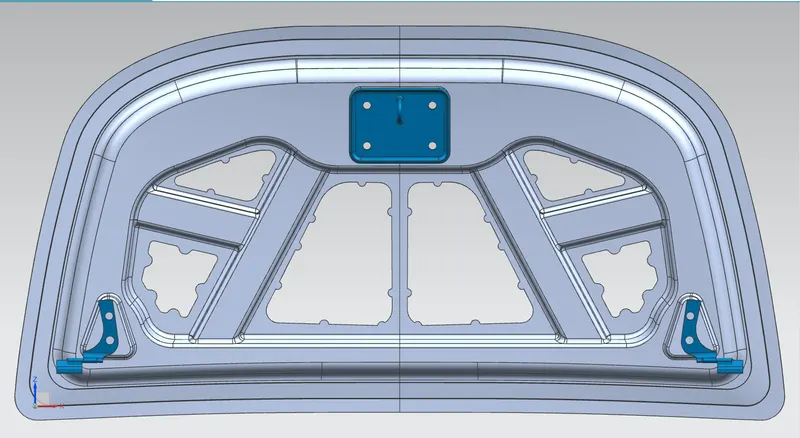
EMBOSSES:
Embosses are given to the inner panel to provide stiffness and these are designed in such a way that during a frontal collision the force is distributed.
LATCH TRAJECTORY:
Latch trajectory can be observed as a circle drawn from center of the hinge axis line to the striker area. It is important to consider if we want to ensure proper locking of latch and striker while closing the hood.
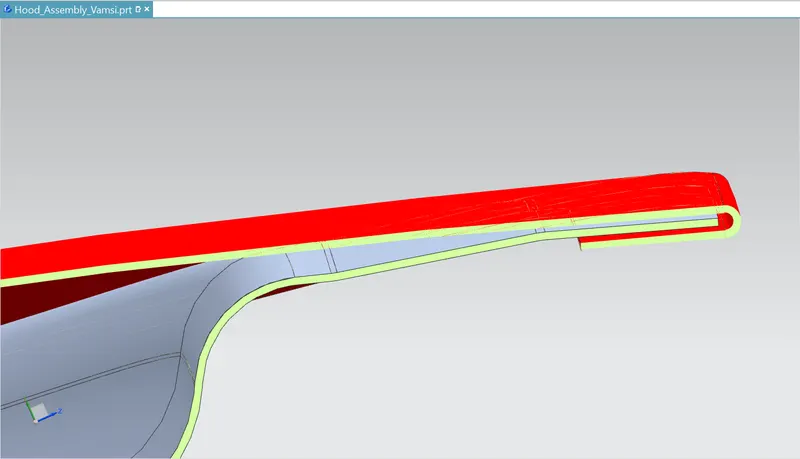
HEMMING:
Hemming is the process used to join the Inner and outer panels of hood. Generally, there are four types of hems used in sheet metal operation. They are:
1.Open hem
2.Rolled hem
- Tear drop hem
- Closed hem
We use open hem to join the Inner and Outer panels.
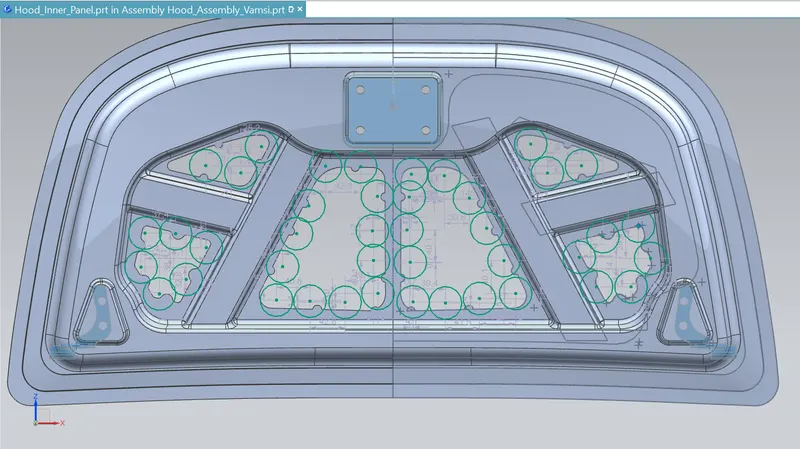
MASTIC SEALANT DATA:
Even though we use hemming to join the panels across the boundary there is so much surface that we must make sure is not loosely joined. So, we use mastic sealant to ensure this, and mastic sealant also gives strength to the part locally this will restore the strength that we lost while removing the material for improving pedestrian safety.
FINAL ASSEMBLY:
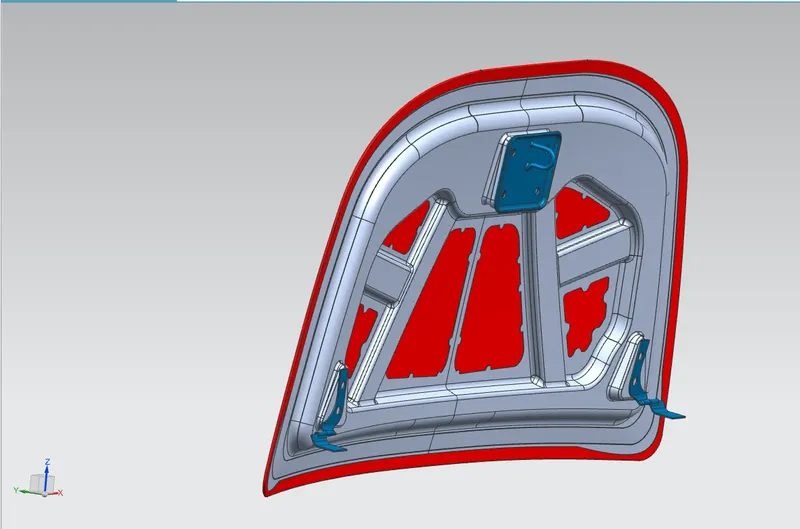
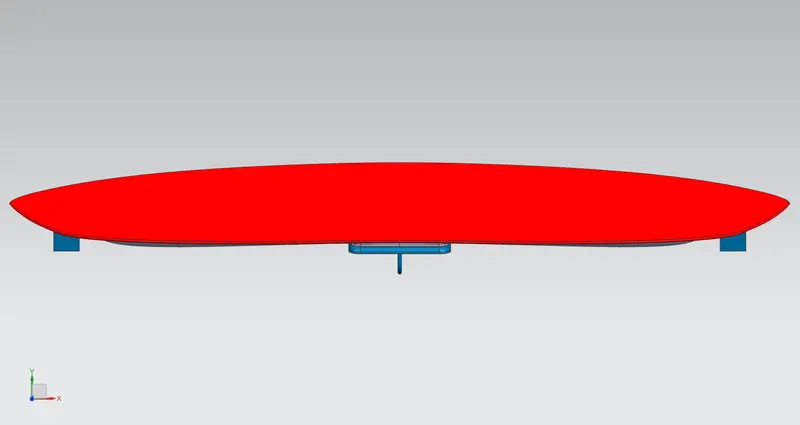
HOOD ASSEMBLY:
https://drive.google.com/drive/folders/1QqaQ64jAy32OFZB47NmP093q1YLyg7A-?usp=sharing
- Mukesh Pbro . how to work nx cad from hood outer panel, inner panel, hinges