Hood design-Week 2
AIM:
The objective of this project is,
- To design the hood assembly of the car in siemens NX CAD as per the design regulations.
- To gain the knowledge on hood of the car.
INTRODUCTION:
- The hood or bonnet of a car which is located in the front of car,it protects the engine compartment and other essential parts.
- Hood or bonnet adds a aesthetic and luxurious look to the car.
- The hood assembly is attached to the car by hinges one on the hood and other on the engine compartment.
- The purpose of the hood in the car is to safeguard the sensitive parts and to access the engine parts for servicing,repairing,cleaning,battery,power train,checking the oil levels etc.,
- It is made up of different materials like steel,aluminium,carbon fibre usually the hood follows the material which is used for remainig parts of the car.
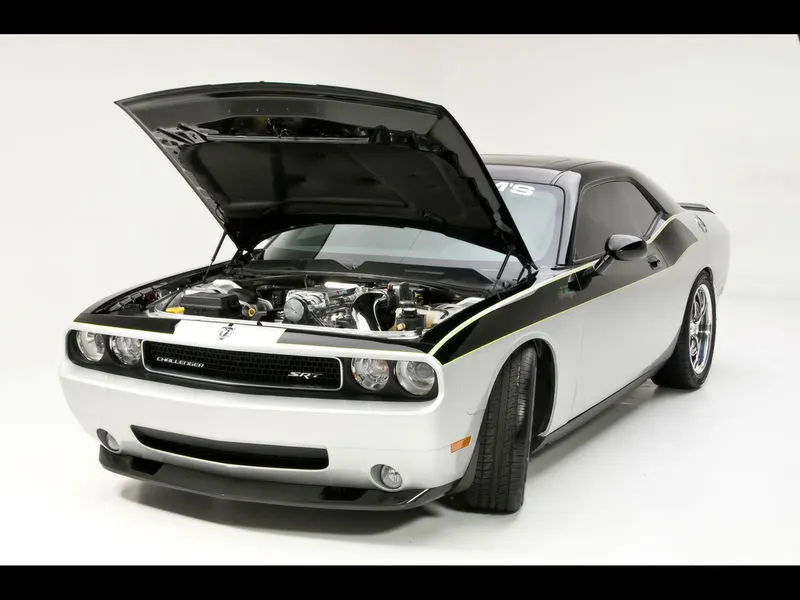
DESIGNING OF HOOD:
- The hood design should meet the design requirements need by customer,company and the international safety assessing organizations.
- Bonnet shape is of aerodynamic which is used to mnimize the air drag effect and improves the car performances.
- The hood is designed in a manner in order to reduce the injuries to pedestrian when they met with pedestrian vehicle collision.
- At the same time the hood of the car should not compromise the strength of car as it may cause injuries to passengers in the car while accident.so material selection plays a vital role in hood producton
- It is a reinforced skin with safety and quality requirements.
i)Material selection:
- Material selection plays a vital role in hood production which is influenced by factors such as cost,weight and structural performance.
- The material which is used to manufacture hood is mainly of steel,aluminium,composite and in some case for weight reduction carbin fiber is also used.
- Analysis should be done on different materials to improve the hood strength parameters.
- In a study, they compared steel,aluminium and composite for the hood assembly their results are,
- The aluminium bonnet is comparatively lesser in energy absorption than steel and composite.In order to improve this we have to incerase its thickness.
- Oil canning analysis,torsional stiffness analysis,lateral stiffness analysis are done to compare those materials.
ii)Design requirements:
- Thickness of the hood assembly is considered in designing where the hood outer panel and inner panel has most of the mass distribution. Recommended panel thickness is around 0.7mm
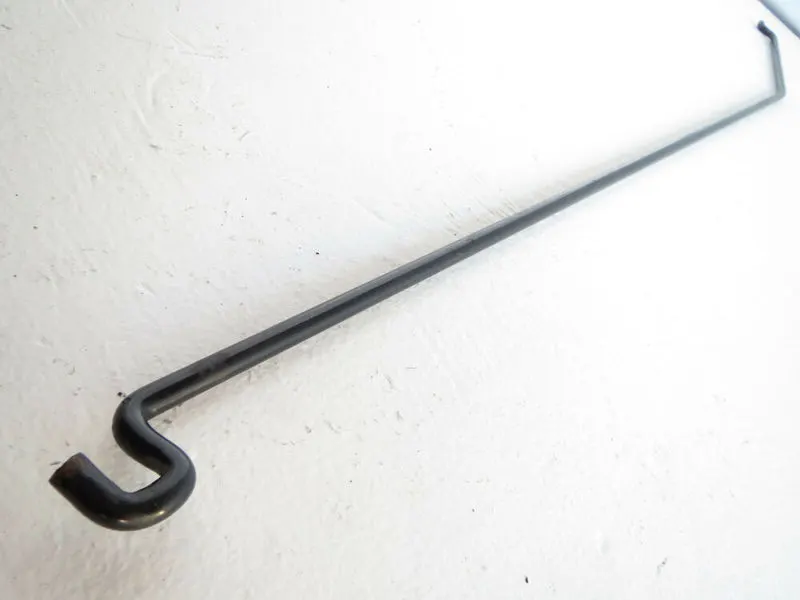
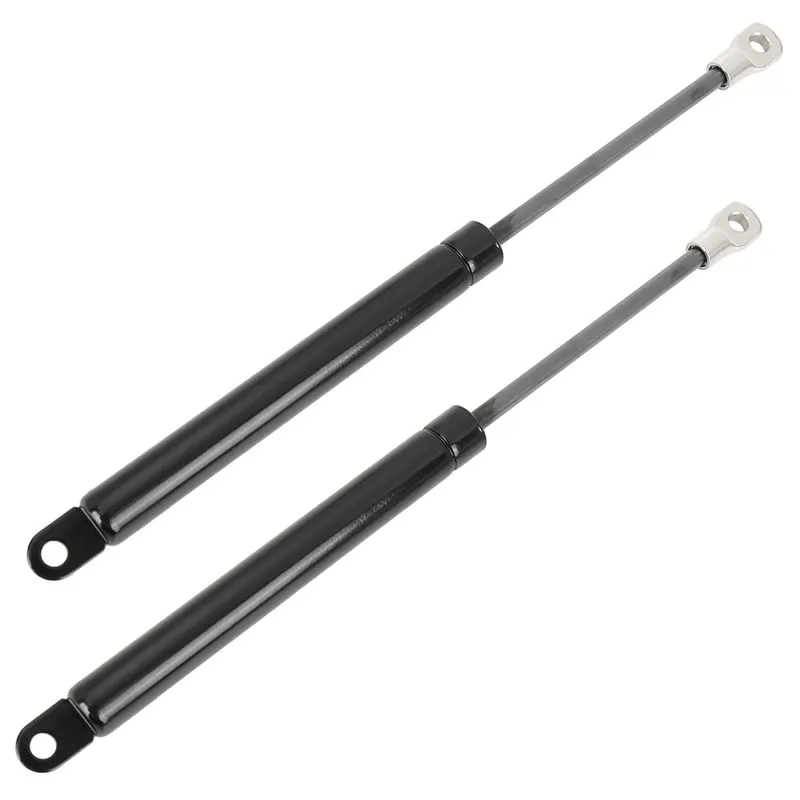
- Opening angle of the hood is taken to note while designing,it may varies from region to region.The length and type of support rod which is used to hold the opened hood in a position is noted
TYPES OF SUPPORT ROD:
Regular rod:
Gas stay rod:
PEDESTRIAN SAFETY:
- Safety regulation for pedestrian who may be adult or child is one of the consideration taken now-a-days to reduce the impact to the pedestrian after they met with an accident.
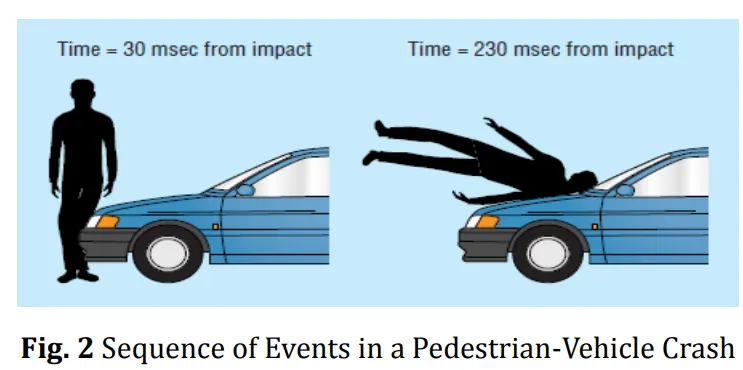
- While designing hood it(pedestrian safety) should be taken to account because study shows 85% of pedestrian vehicle collision took as frontal crash.
- The pedestrian vehicle crash scenario is documented and it will be like: the vehicle bumper contacts the leg,the hood's leading edge meets the lower limb or pelvis,the head position will hit the top position of hood or windscreen.
- The euro NCAP,global NCAP are organization that concerns human safety who done several safety test and give the result as rating,it is notable score that a car manufacture must taken into consideration.
PARAMETERS TAKEN TO REDUCE THE INJURIES TO PEDESTRIAN:
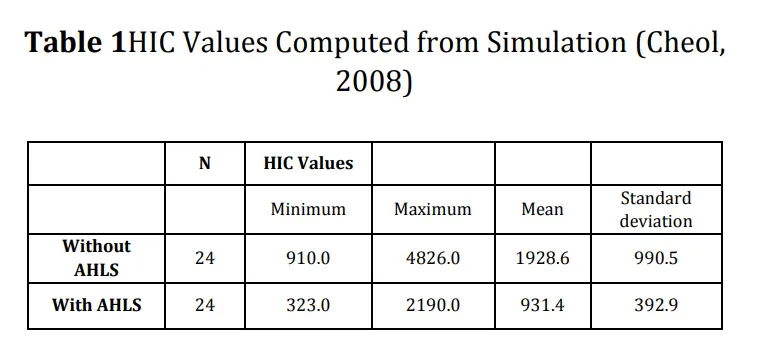
- Head Injury Criterion: The severity of head injury when a pedestrian strikes a car hood is described by head injury criterion which is usually HIC score.The threshold value for HIC regulated by euroNCAP is 1000.The formula used to assess the HIC score would look like the below one. `{[1/(t2-t1)inta(t).dt]^2.5(t2-t1)}`
- Active Hood Lift System: Active Hood Lift System works by lifting up the vehicle’s hood to obtain the space to absorb the impact energy.A study shows that pedestrian head hits the bonnet when they collide with 30-40 kmph.
The system is composed of a module to detect a pedestrian or for that matter any impact over a threshold which may be harmful to the hit subject.Further, a hinge is provided on the front side of the hood, allowing to open up from the windscreen side and an actuator module that –deploys the lifting of the hood, as well as an electrical control unit (ECU)module to control the process from detection to deployment .
- Energy absorbers under the hood: The energy absorbers is used below the hood which helps in reducing the impact when there is no energy absorbers.
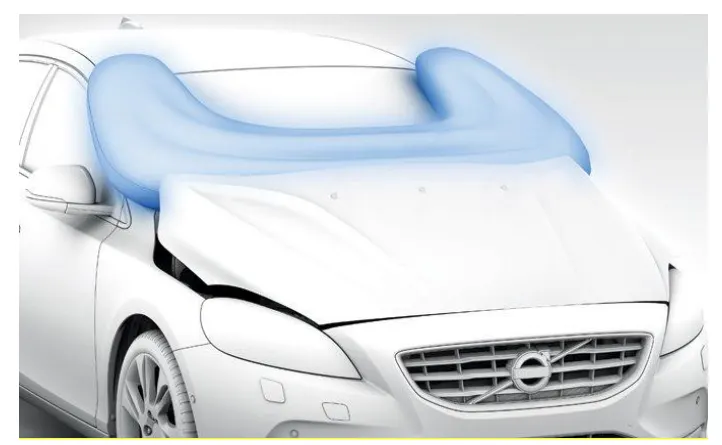
- Pedestrian airbag Technology: This may sound different an airbag is provided inside the car body to prevent the passenger who are inside likewise an airbag for pedestrian which cushions them from having severe injuries.It requires sensors,electrical control unit to lift the hood from the windscreen side and considerations of hood lift height.
LATCH TRAJECTORY:
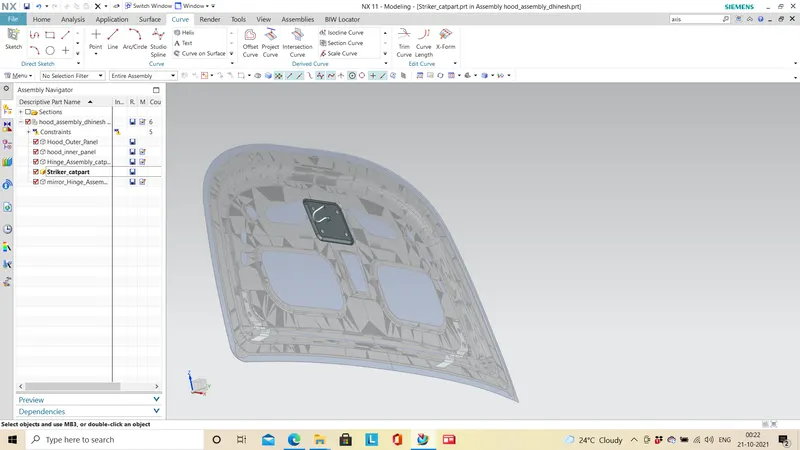
The latch is used to lock the hood with the help of striker in the hood assembly.This trajectory make sure the closing of latch and striker .It also reduces the withering of hood in motion of the car.
MASTIC DATA:
The mastic sealants are nothing but a rubber like substance which aids in joining the outer panel with the inner panel which is placed in inner panel it gets hardened as it enter as the hot furnace bath.why it is used ,because the outer panel requires a attractive look so it is not feasible to get by welding methods and any other mode.So it is joined by hemming and mastic sealants.This mastic sealant is durable for many years.It is excellent in corrosion resistanve and spot weldability.It is also compatible with steel panels.
EMBOSS: The definition for emboss in cambridge english dictionary says carving or stamping a design on the surface.The same is done on the NX this feature is used to stiffen the component by creating a depression or projection of sheet body by following the curve drawn.
DESIGNING STEPS:
- The hood data ,parts like outer panel,striker,hinge assembly which is given as input is arranged in the single assembly folder.
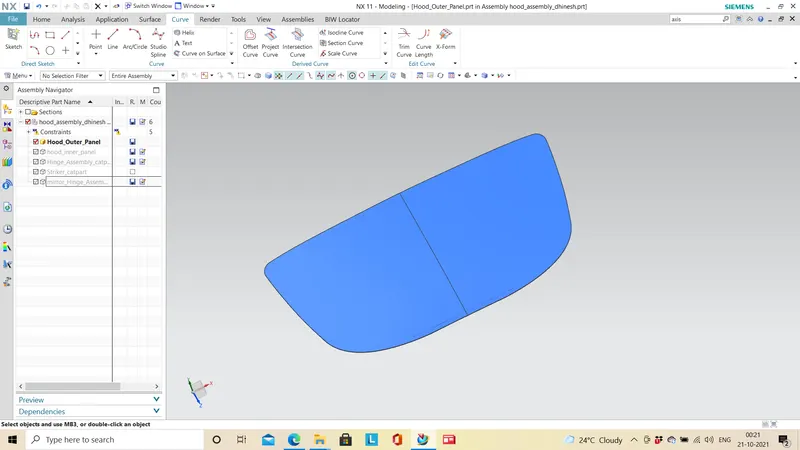
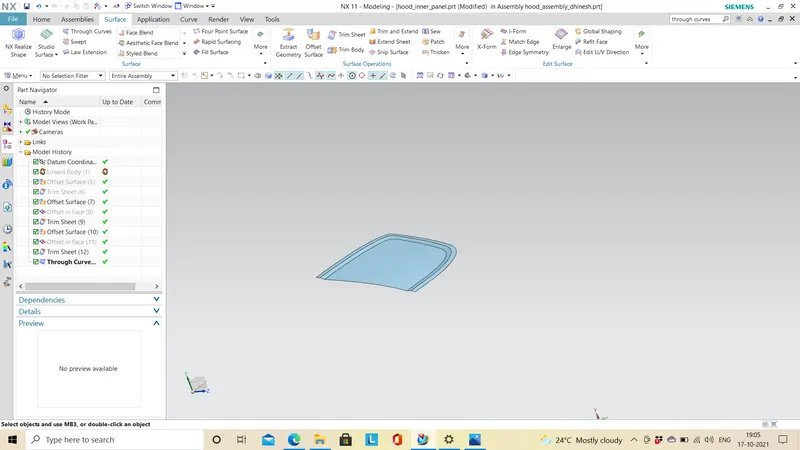
- We are going to design the inner panel ,we get the skin data from the outer panel.
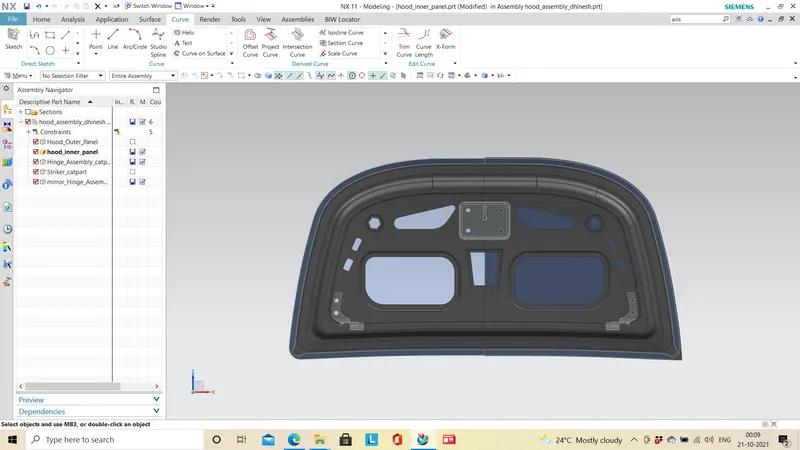
- Follow the master section to design the inner panel,here we use one half of the panel to design the features.
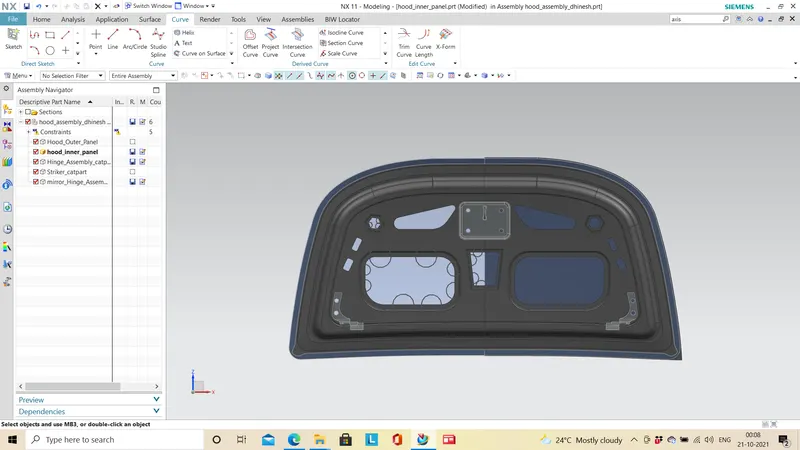
- Create embosses wherever you need to increase the stiffness of the sheet body.we take offset curve on surface command get emboss boundary use trim sheet to remove the undesired parts which helps in achieving reduction of weight and the pedestrian safety.
- Holes are created in the inner panel to drain the primer coating in the panel.A hole for support rod is also provided.Mirror geometry is used to mirror the half.
- After mirroring the component chect the sheet metal using examine geometry.The examine geometry is used to identify the flaws in the geometry by highlighting the results.Then sew the two geometry and make them a single one.
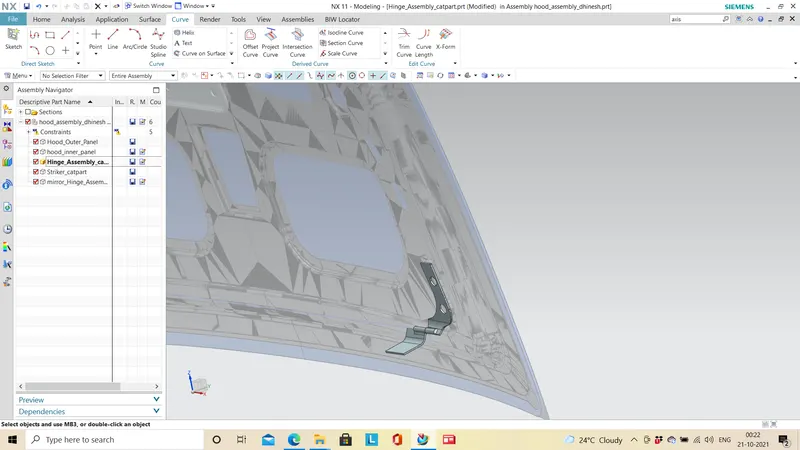
- Now create reinforcement for striker and hinge assembly ,when we add any parts into sheet body it reduce its strength in order to compromise that reinforcements are done here we make emboss.
- Use wave geometry linker for extracting the curve of the striker and hinge assembly and project the curve on the surface to form embosses.
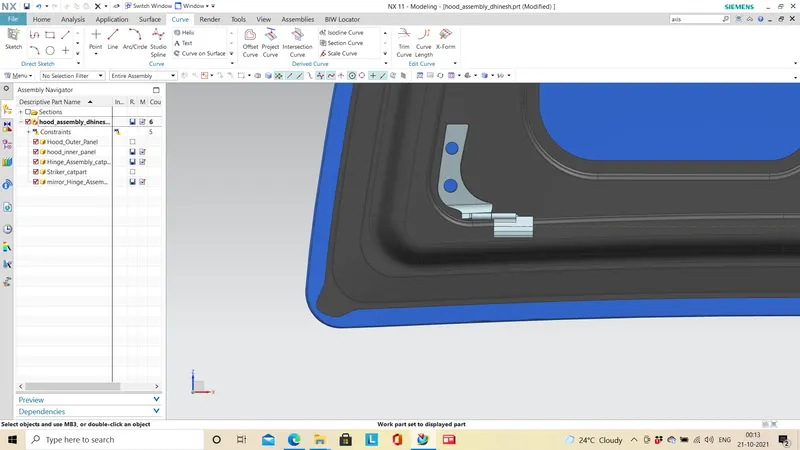
- Then do hemming process in the outer panel for joining make sure you provide corner relief .
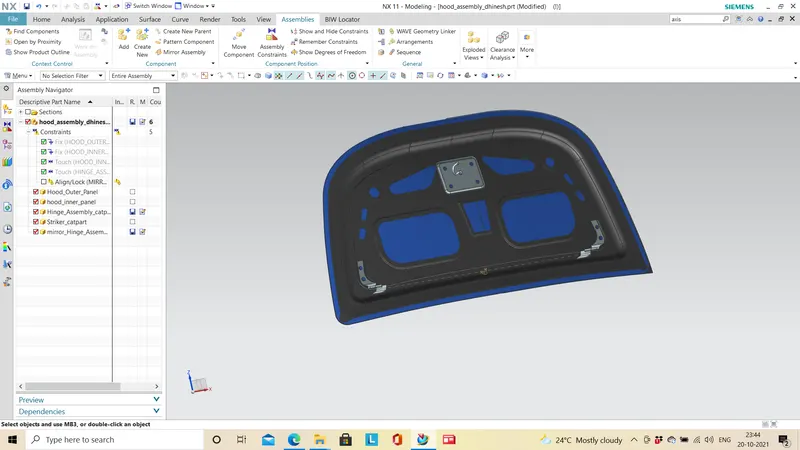
- Make the assemply of parts using assembly constraints.
COMMANDS USED IN THIS PROJECT:
|
Curve Commands: Project curve,curve on surface,offset curve on surface,bridge cuve,point,line. Surface Commands: Offset surface,Trim sheet,Trim body,Trim and extend,Law extension,Emboss,Face blend,Edge blend,Mirror geometry,Sew,Thicken,Extract body. Assembly commands:Move component,assembly constraints(touch, align, parallel),WAVE geometry linker,add,mirror assembly |
IMAGES OF HOOD ASSEMBLY:
HOOD OUTER PANEL:
HOOD INNER PANEL AFTER DESIGNED:
STRIKER:
HINGE ASSEMBLY:
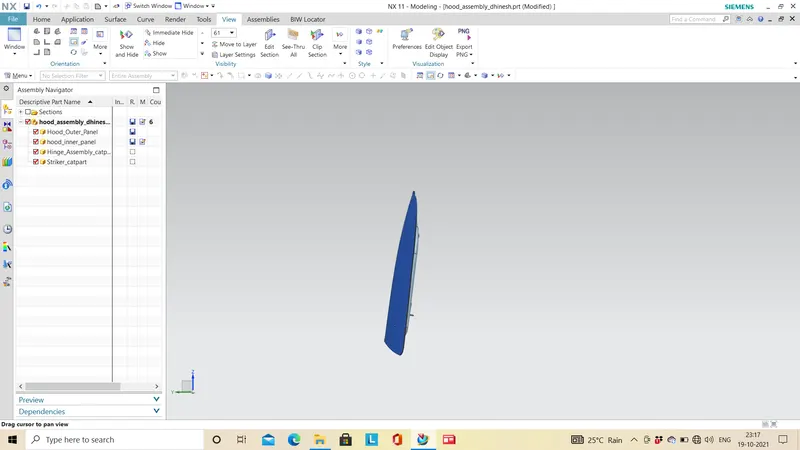
make sure give corner relief for the hem flange
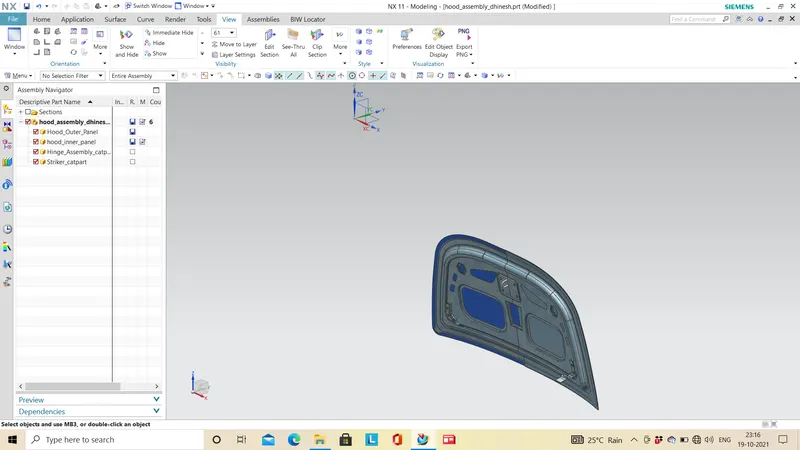
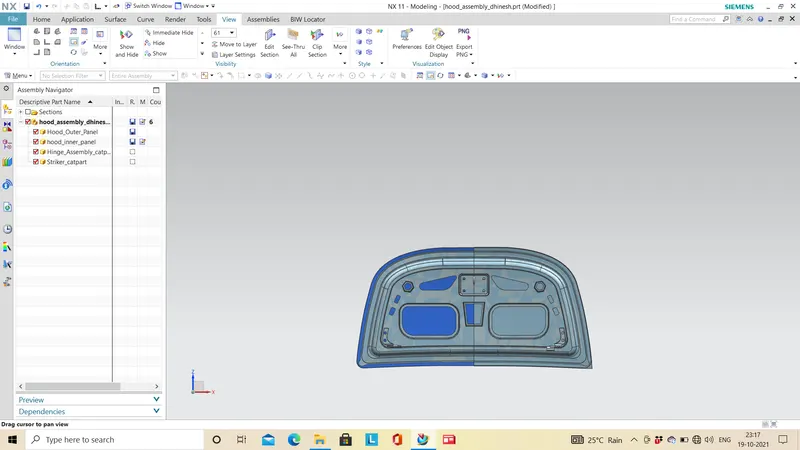
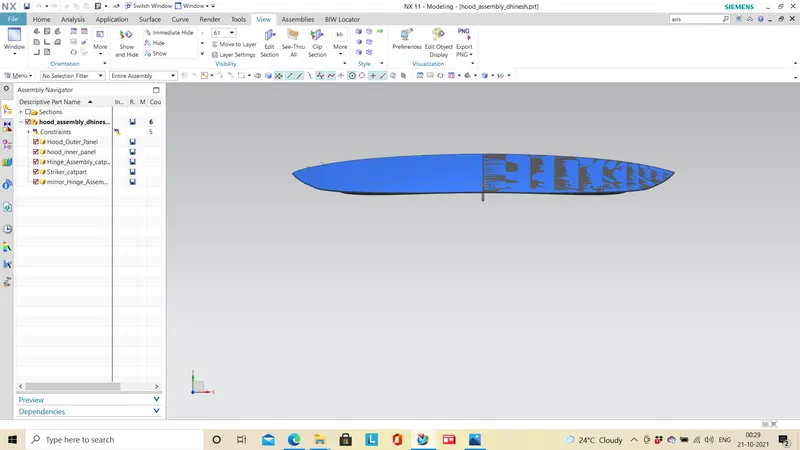
MULTI VIEWS:
|
ISOMETRIC VIEW |
FRONT VIEW |
|
TOP VIEW |
SIDE VIEW: |
HEMMING:
Hemming is a sheet metal forming process in which sheets are joined by bending it usually to 180°. Automotive body panels and automotive parts such as deck-lids, trunk-lids, doors, hoods and tailgates are formed by hemming process.Hemming is used in assembly as a secondary operation after deep drawing, trimming and flanging operations to join two sheet metal parts (outer and inner) together.
TYPES:
DIE HEMMING: In die hemming, the flange is folded over the entire length with a hemming tool.
ROLL HEMMING: Roll hemming is carried out incrementally with a hemming roller. An industrial robot guides the hemming roller and forms the flange
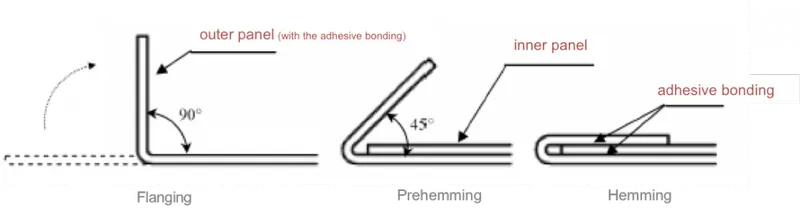
The outer panel is hemmed to connect it with the inner panel following the regulations.
DEEP DRAWING:
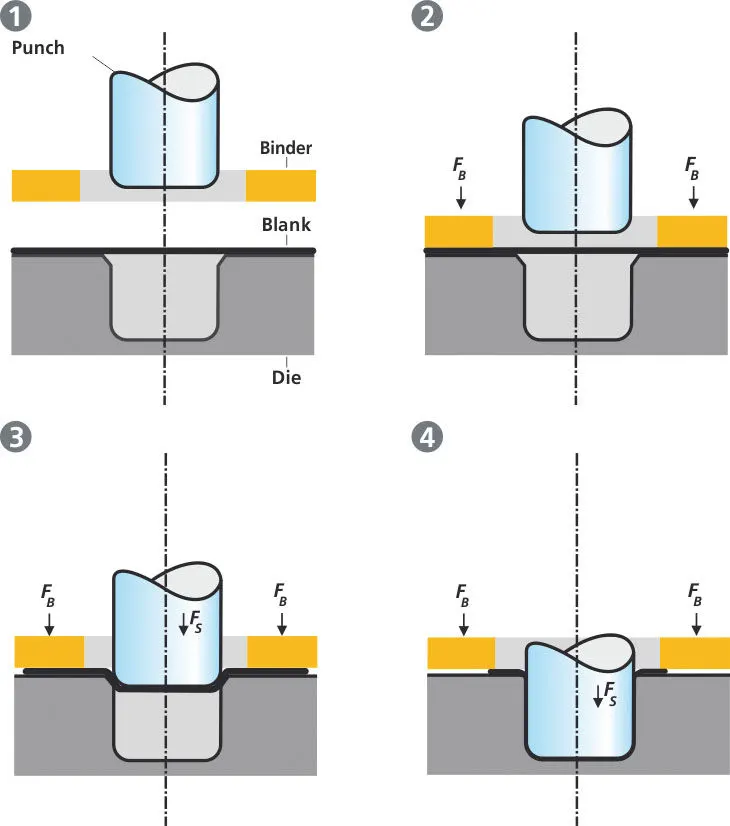
The deep drawing process is a sheet metal forming process . A flat sheet metal blank is formed into a hollow body open on one side or a hollow body is formed into a hollow body with a smaller cross-section.In the automotive industry, deep drawing is usually carried out using rigid tools.
SECTION VIEW:
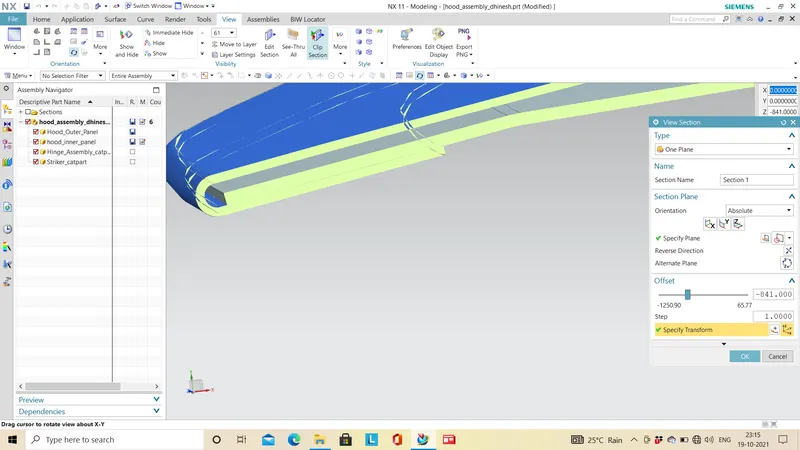
This section is created along z axis
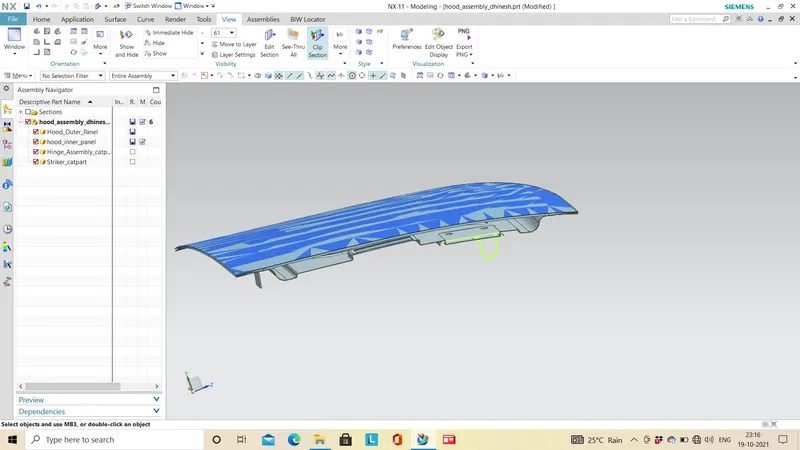
FINAL HOOD ASSEMBLY:
CONCLUSION:
The design of hood assembly,inner part is done successfully as per the requirements.
knowledge on hood designing is gained through this project.
References:
International Journal of Current Engineering and Technology - Inpressco
Unitech | Industrial Adhesives for Automotive, Shipbuilding and Electronics (unitechcorp.com)