Hood design-Week 2
Objective : To design a hood inner panel and outer panel.
Data to be used:
Hood Thickness Information
- Outer Panel Thickness = 0.75mm
- Inner Panel Thickness = 0.75mm
- Reinforcement Thickness = 1.5mm
Pedestrian Safety :
Earlier in October 2018, the Government of India regulated all new cars to comply with these norms, including a new design of bonnet, to reduce the impact of accidents on pedestrians and saving precious lives. As per a report by the Ministry of Road Transport and Highways (MoRTH), of 1.5 lakh people killed in road accidents every year in the country, 60 per cent are pedestrians. Legal requirements and consumer protection tests for pedestrian protection have become significantly stricter in recent years across the world.Vehicle manufacturers face technical challenges associated with the investigation of optimal hood panel configuration to meet the requirements of ANCAP while retaining or maximising styling flexibility with minimal modifications to the general architecture of the design.The Head Injury Criterion (HIC) indicates a measure of head injury arising from an impact, which is evaluated by the impactor in terms of the simulation of child head.
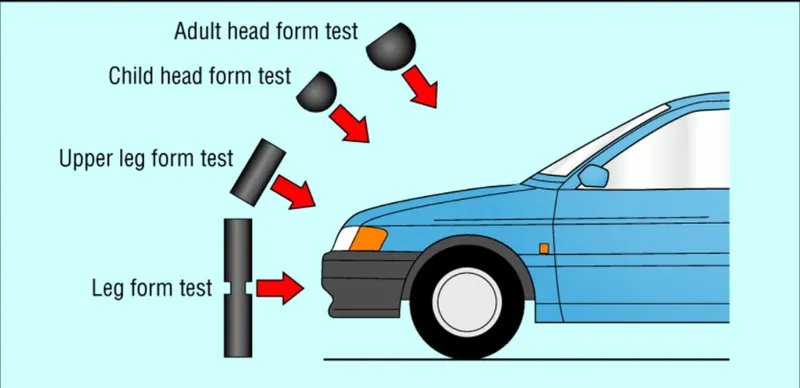
Fig.1
At first, the development and validation of numerical child headform impactors based on ANCAP standards are discussed. Subsequently this impactor was used for head to hood impact analysis.ANCAP provides measures for the assessment of pedestrian protection performance of a passenger car experimentally by firing subsystem impactors representing a child head, adult head, upper leg and lower leg at a specified angle and speed to the front end of a stationary vehicle.According to the requirements of the Australian New Car Assessment Program (ANCAP) for pedestrian protection, it needs to define zones of car hood for analysis. It can be noted that when the collision projection point is located between (Wrap Around Distance) WAD 1000 and WAD 1500, the head type will use the children's head type. The adult head type will be used while the collision projection point is located between WAD 1700 and WAD 2100. In the current study, the collision projection point is located at WAD 1000 when the children's head type will be used.
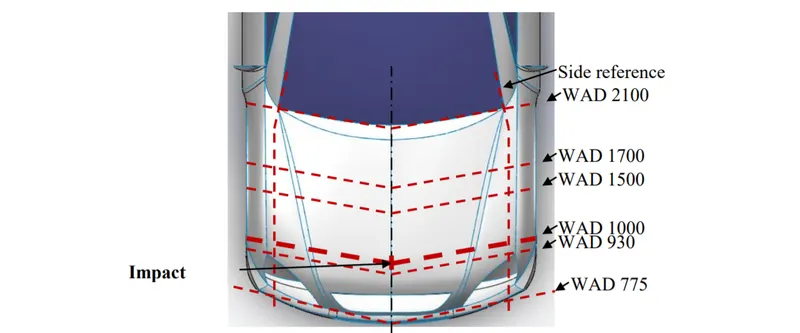
Fig.2
Hood :
A car hood, also referred to as a bonnet. It also the hinged cover that rests over the engine of a front-engine vehicle. Hood is generally found in a four wheel vehicle in the front side as a covering to its engine. Another feature is that it also increases its looks. A car hood is meant to protect the performance parts of your vehicle, including the engine, while also providing easy access for repairs and maintenance. It is possible for the hood to incur damage as well. One of the most common types of damage is to the hinge, which is the device that connects the hood to the body of the vehicle. Over time, the hinge can become loose or may fall off completely. The hood is also prone to receiving scratches and dents. Although this might appear to be a minor problem, dents and scratches can lead to depreciation in the value of your vehicle. Scratches and dents can also lead to exposure to the elements that can result in rust and corrosion.Car hoods are typically constructed from steel and sometimes from aluminum.Concerns regarding the severity of a potential pedestrian head injury during a collision with a motor vehicle have led to advanced hood designs on many models. Such designs may include a multi-cone inner hood panel design. An active structure that is capable of pushing the surface of the hood away from the vehicle's hard motor components in the event of a pedestrian crash is also in use.
Hinge :
A hinge is a mechanical bearing that connects two solid objects, typically allowing only a limited angle of rotation between them. Two objects connected by an ideal hinge rotate relative to each other about a fixed axis of rotation, thus a hinge has one degree of freedom. Usually for greater strength two hinges are added to the end of the hood so in case one loses its alignment after the collision another hinge holds the hood.
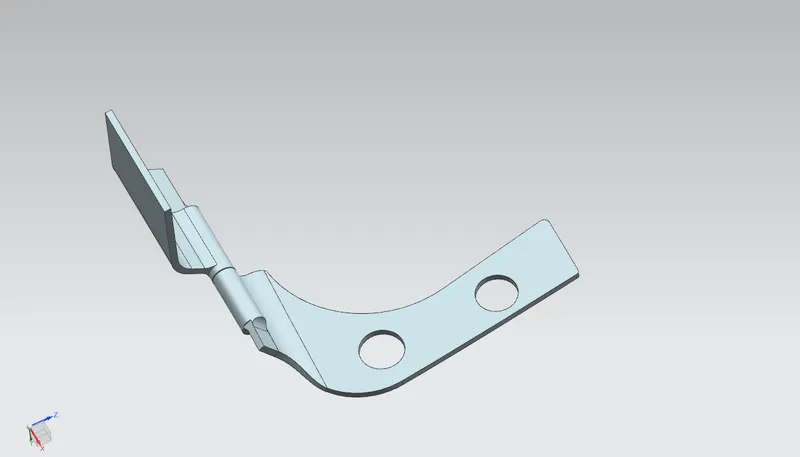
Fig.3
Striker :
The striker is part that helps to lock the hood to engine components so that while riding the hood won't be able to open by some jerks or speed bumps. The striker is usually placed in the middle of the hood so that it fits perfectly with the engine component.
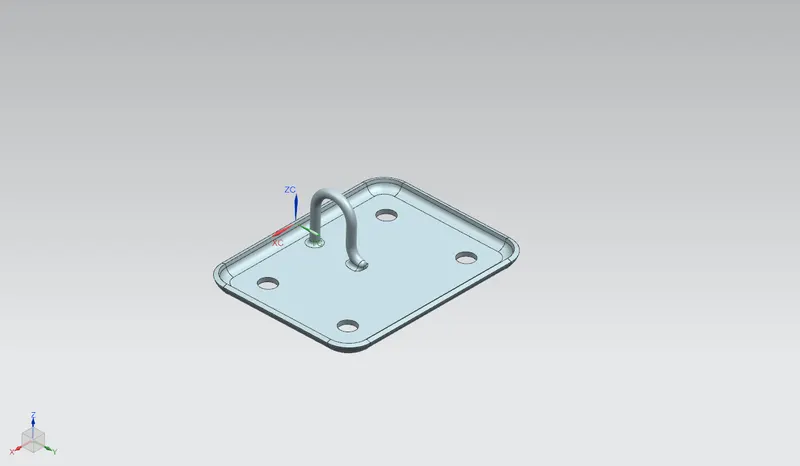
Fig.4
Latch Trajectory :
It can be defined as the imaginary path at which the latch(Striker) coming from the hood opens and closes. The trajectory depends upon the centre of the hinge, therefore if it's wrong then the striker will not be fixed with the lock.
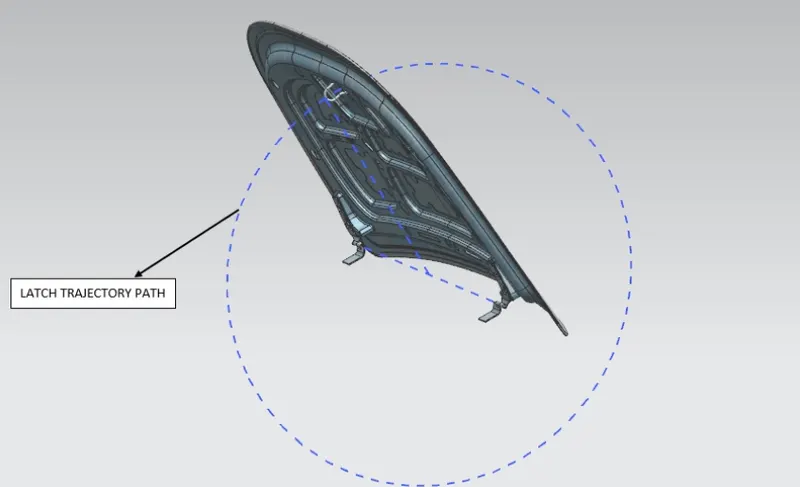
Fig.5
Type of support :
- Gas Stay
- Support Rod
- Gas Stay :
It is designed to lift the hood upwards, once the small force is applied to the unlocking mechanism the hood will open up instantly with the help of piston and cylinders. These are widely used in the type of cars where the hood is heavy or sometimes is being used in premium cars too.
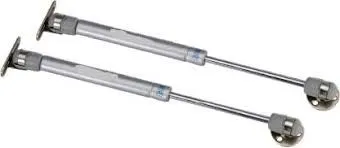
Fig.6
- Support Rod :
These are widely used in budget cars or that type of cars which we often see on the roads because it's easy to install and they are very cheap. In these we have to manually lift the hood and fix the rod in between so that there is no need to keep holding the hood up.
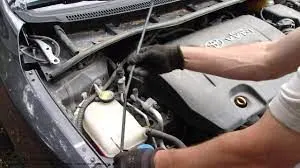
Fig.7
Matic Data :
Embossed surfaces play an important role in car hood panels while crashing or in a car accident. Because during the collision, the hood is the most affected part which sustains all the impact forces while crashing. most of the impact forces are directly flows in the direction of collision & thus can harm the driver sitting under the car, thus to overcome this problem generally, V or Y shaped embossed are given on inner panel of the hood so that, the impact forces coming in the direction of collision is diverted towards the corner point of the hood & driver couldn't be harmed.
Manufacturing Processes are :
- DEEP DRAWING
- HEMMING
1.) DEEP DRAWING :
Deep drawing is a sheet metal forming process in which a sheet metal blank is radially drawn into a forming die by the mechanical action of a punch. It is thus a shape transformation process with material retention. The process is considered "deep" drawing when the depth of the drawn part exceeds its diameter.
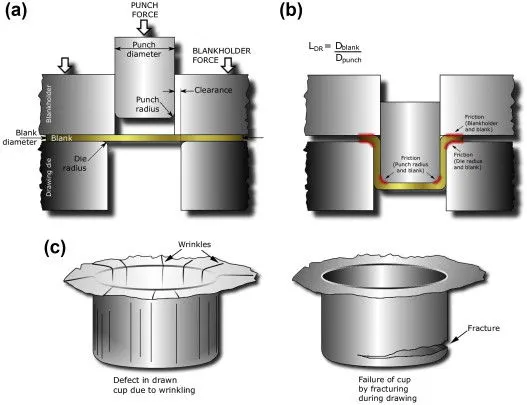
Fig.8
2.) HEMMING :
Hemming process is basically used to join the inner hood panel & outer hood panel together. Hemming metalworking process in which a sheet metal edge is rolled over onto itself. Hemming is the process in which the edge is rolled flush to itself, while a seam joins the edges of two materials. Hems are commonly used to reinforce an edge, hide burrs and rough edges, and improve appearance.
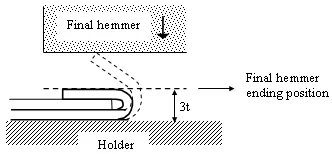
Fig.9
EMBOSSED SURFACE :
Embossed surfaces play an important role in car hood panels during a crash or accident of a car. Because during the collision, the hood is the most affected part which sustains all the impact forces while crashing. Most of the impact forces are directly flowing in the direction of collision & thus can harm the driver sitting under the car, thus to overcome this problem generally, V or Y shaped emboss are given in the inner hood panel. so that the impact forces coming in the direction of collision are diverted towards the corner point of the hood & driver couldn't be harmed.
Assembly of Hood :
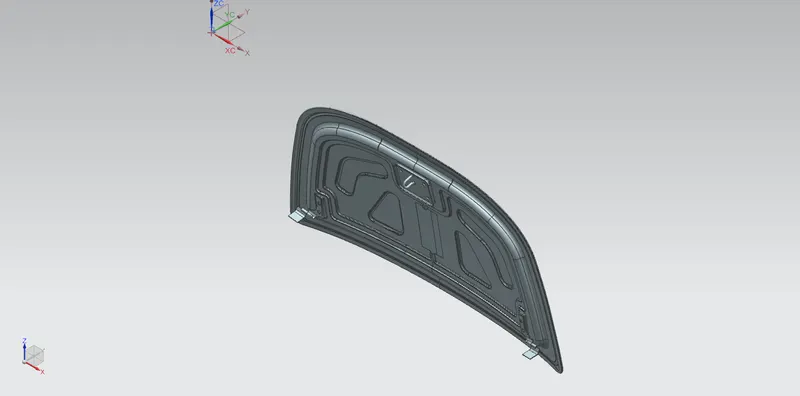
Fig.10