Hood design-Week 2
Title- design of a hood using nx cad.
Objective- To design 3Dmodel of hood from given class-A surface to a part model considering the design aspects, latch and hinge mounting parameters of an existing system using NX CAD software.
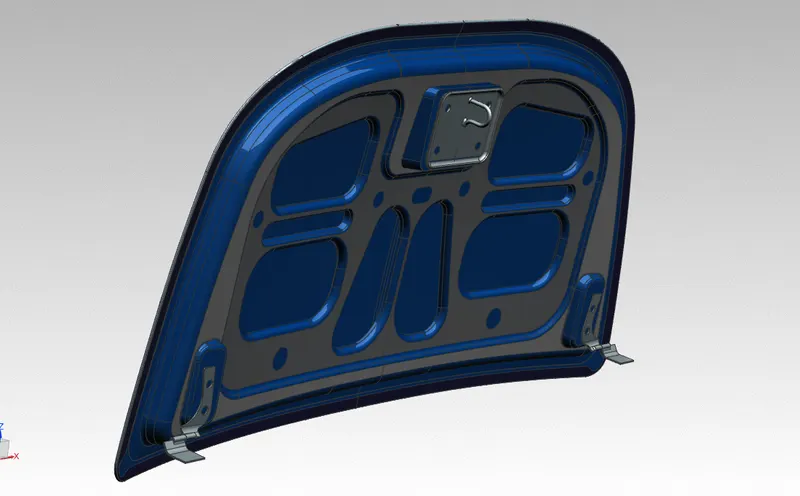
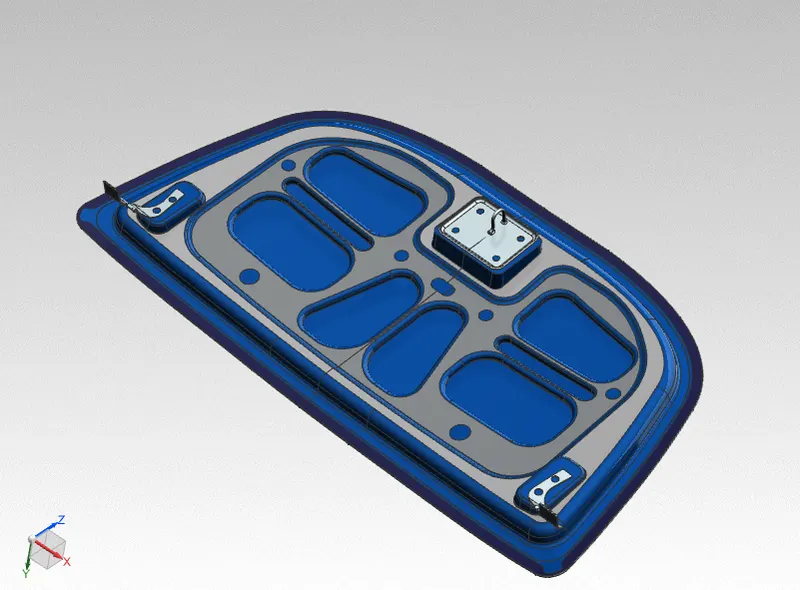
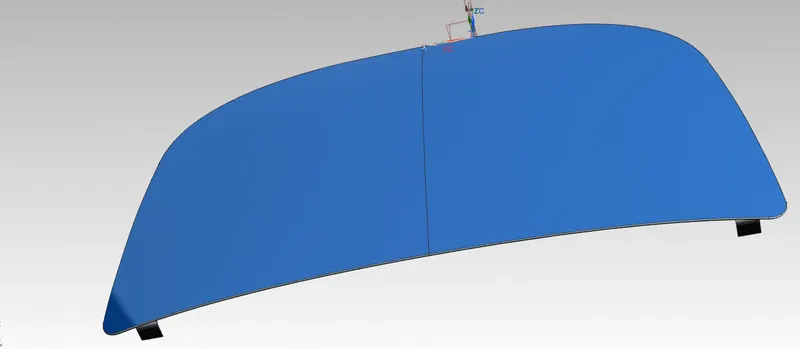
About software- NX, formerly known as "unigraphics", is an advanced high-end CAD/CAM/CAE, which has been owned since 2007 by Siemens PLM Software. In 2000, Unigraphics purchased SDRC I-DEAS and began an effort to integrate aspects of both software packages into a single product which became Unigraphics NX or NX.
BODY IN WHITE –
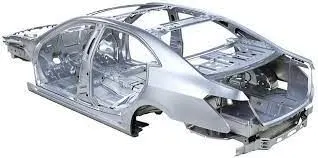
- The term derives from manufacturing practices before steel unibody monocoques — when automobile bodies weremade by outside firms on a separate chassis with an engine, suspension, and fenders attached.
- Body in white(BIW) refers to the stage in automobile manufacturing in which the sheet metal components have been welded together.
- Body-in-white(BiW) is the name given to a car body's sheet when all its components—barring moving parts (e.g., hoods, fenders, etc.), trims (e.g., glass, seats, etc.), or chassis subassemblies—have been welded together. ... Also, it should be easy to weld and form, as well as be highly paintable and easy to design.
IMPORTANCE OF BIW FIXTURES-
Body in white , they help ensure that the welding process meets the pre-defined standards of high-quality. They provide the necessary support and stability to avoid distortions in the welding process, which can often lead to expensive iterations.
HOOD-
- The hood is an acess panel to the engine compartment to enable maintainence of power train, drive belts , battery , fluid levels and lamp units.
- Hood protect the car from environmental damage like corrosion and gives the car better aerodynamics and a good look with styling.
- The main function for hood is to protect the under hood engine compartment and works for pedestrian safety.
- HOOD CONSISTS OF OUTER PANEL , INNER PANEL , STRIKER , HINGES AND SUPPORTED BY STAY .
- the hood is a design element and is a part of the body that borders to the front fenders,front light , bumper and the pelenum cover.
TYPES Of HOOD
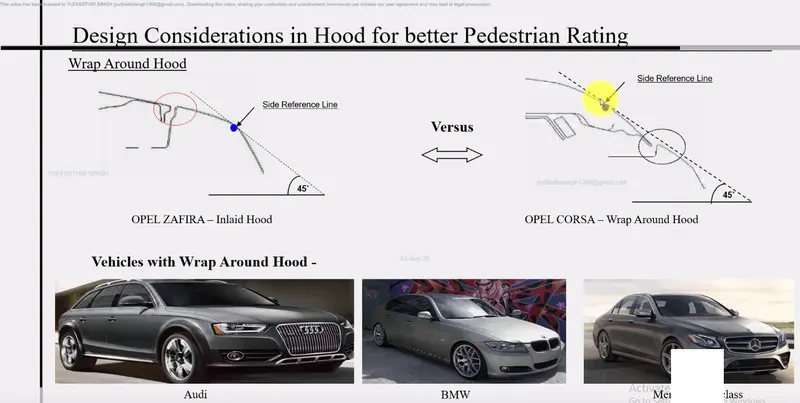
- Inlaid hood- there is a gap between the hood and the car body . in this type the end point or the side refrence line of the car lies on the fender, which uses more damage to the pedestrians affecting their EURO NCAP ratings.
- Wrap around hood-this type tends to wrap around the car body .The end point or the side refrence line of the car lies on the hood itself. This type reduce the head impact zone and hence can be able higher EURO NCAP ratings.
TYPES OF SUPPORT STAY FOR HOOD
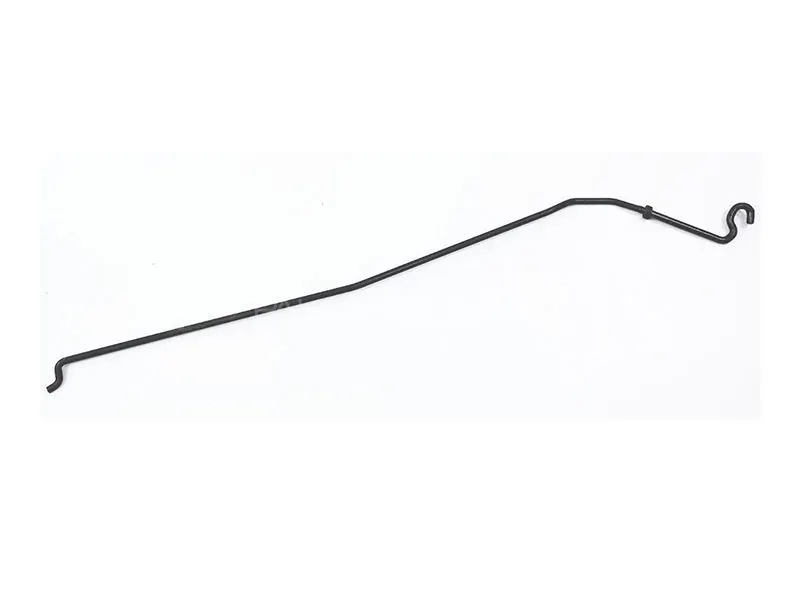
Rod stay support
- rod stay are basically long cylindrical steel rod either fixed to hood inner panel or engine chasiss . other end is hooked during operating condition.
- To open hood , rods need to be engaged manually to keep the hood supported .
- Its cheap and used for smaller hood body.
Gas stay support
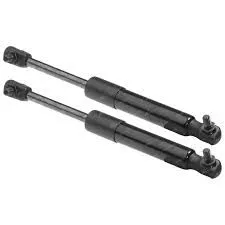
- It is a gas filled cylinders with sliding shaft which are fixed at both the ends of hood inner panel and engine chassis with stud balls.
- To open hood only initial force needs to be applied after specified angle. It actuate to push the hood to its maximum open angle and saty uright.
- It is expensive and genrally preffered for long hood having heavy weight.
Pedestrian safety
Traffic accidents are terrible scourge that occurs in many countries specially for developing countries like tangled yarn . besides functioning as engine compartment cover , the hood of modern compact SUV can also help to manage the impact energy of a pedestrian head in a vehicle pedestrian impact.
Vehicle safety factors should simultaneously consider occupant and pedestrian safety, given that pedestrian are third largest category of traffic fatalities. Most pedestrian death occurs due to traumatic brain injury , resulting from the hard impact of the human head against the vehicle stiff hood or windshield. Therefore , how to design a pedestrian friendly vehicle and propose a new hood structure is a matter of urgency for minimising pedestrian head injuries.
Head clearance is decided upon the zone or country . so same car if its is made for different country will have different opening angle depending on the country.
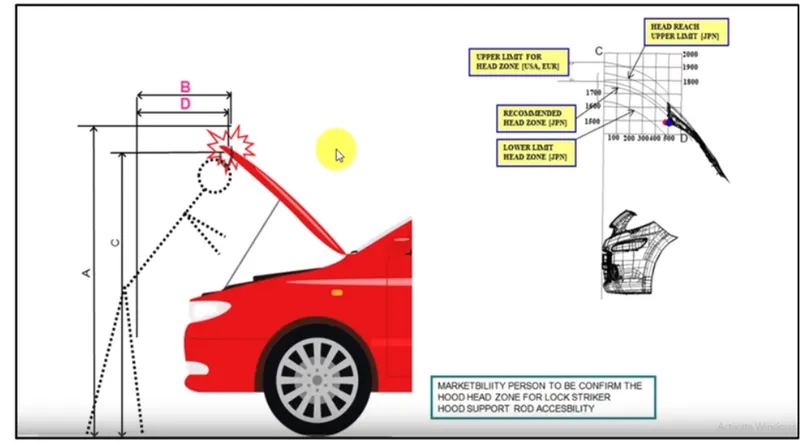
The distance c and d shown in the image is represented as graph in the upper right corner of the image. Choosing the right head zone position will decide upon the angle of hood opening.
Product engineers will also get input from the marketing team for deciding head zone.
When a car crashes on the pedestrian , the whole human body wraps around the front shape of the car and the head impacts on the bonnet or the windscreen. The distance on which the head impacts on the car from the ground is called as the wrap around distance (WAD).
To be specific the wrap arround distance is a measurement of the distance from the ground to the head impact zone over the outer surface of car. The wrap arround distance is measured longitudinally in the centre of the vehichle from the ground.
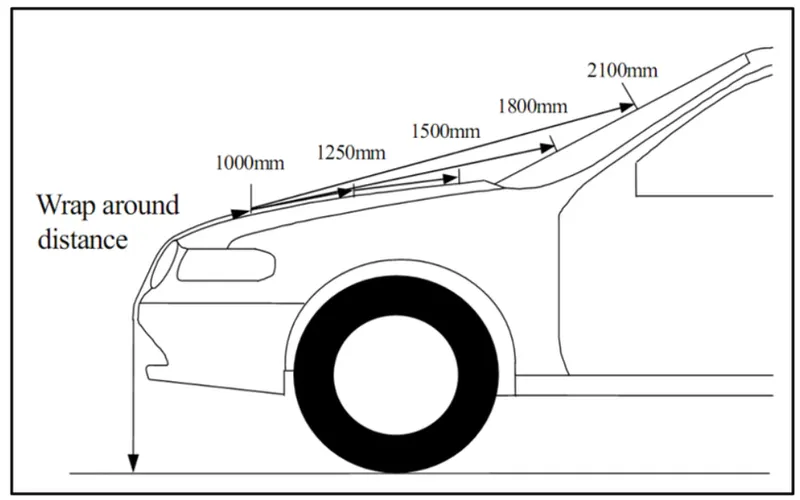
The severity of the injury caused by the fontal crash depends on the type and shape of vehicle , speed of vehicle and the movement of the pedestrian relative to the vehicle. In addition to these parameters, the wrap around distance plays a major role in safety measurement of pedestrian. During the crash analysis based on wrap around distance , two test areas i.e. child head impact zone , adult impact zone. The child head impact zone is between 1000 to 1700 mm WAD and the adult head impact zone ranges between 1700 to 2100 mm WAD.
PEDESTRIAN SAFETY MEASURES
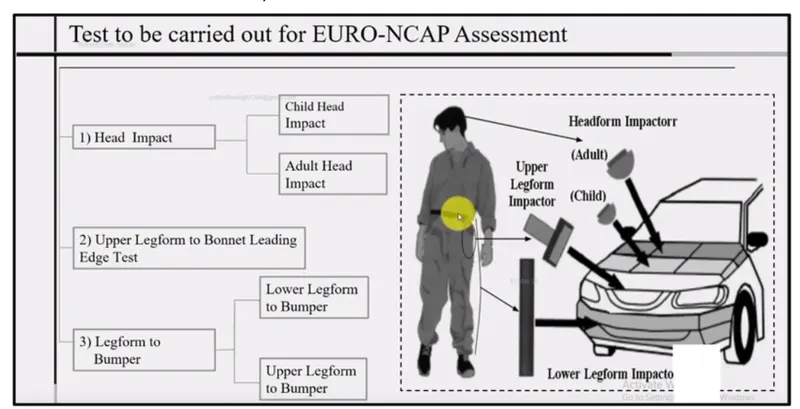
Euro NCAP the European car assessment program in European car safety performance assessment program based in leuven and founded in 1997.
They published safety reports on new cars and awards star ratings based on the performance of the vehicle in a variety of crash test including front side and pole impacts and impacts with pedestrian . the top rating is 5 star .
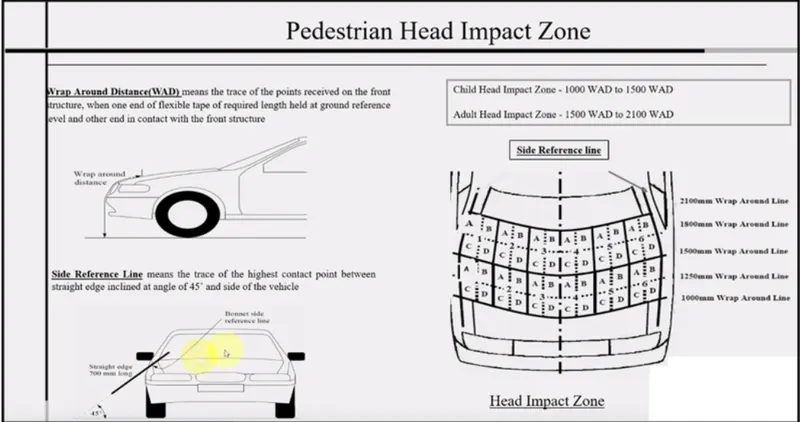
So here is hood we seprate the whole area of hood into several small part during frontal crash . hood is the major portion a person is gonna come in contact with . so EURO NCAP specified some guidelines under which we distribute hood region into several parts and try to get out more green regions.
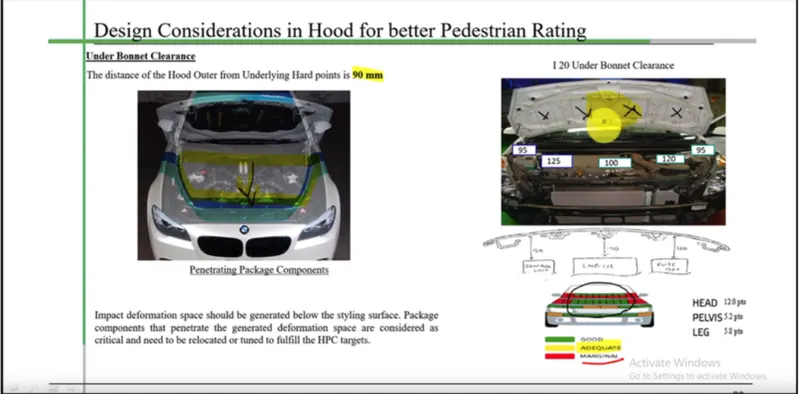
This region basically distributed in relation to the height of children and adults who come in contact from front while accident. So here is the main goal to achieve more green region and for that we provide splits in embosses so that during head impact the consequences of collision come less effective.
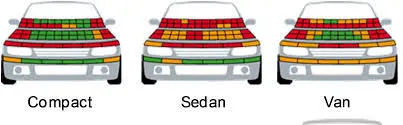
It seems that compact shape 4 wheelers are much safer than sedan and van.
KEY POINTS ON PEDESTRIAN SAFETY
- Priority area for action with positive progress being made in developing new technologies to migrate pedestrian injury.
- Effectiveness of pedestrian detection and automated braking systems looks promising.
- Strong potential gains from the integration design and technology for pedestrian crash protection and crash avoidance.
- The UN degrade provides a strong impetus to promote GTR 9 and stimulate consumer demand for vehicles that feature pedestrian safety system.
HOW A FRONTAL CRASH TEST DONE?
You are heading south on a two-lane road, while another vehicle is driving north on that street . The driver in the other vehicle starts to fall asleep at the wheel and veers into your lane. Suddenly, you collide head-on with the northbound vehicle.
- An average-size adult male in driver seat.
- A small-size adult female in front passenger seat.
- All dummies are secured with a seat belt.
- Represents crashes between two similar vehicles with same weight.
- A vehicle crashes into a fixed barrier at 35 mph.
- Evaluation of injury to the head, neck, chest, and femur (leg).
- Frontal crash ratings must only be compared between vehicles from the same weight class (+/– 250lbs).
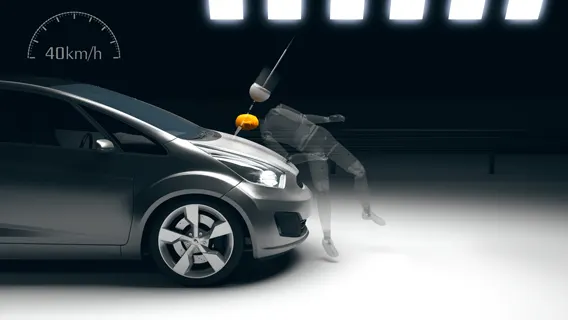
HOOD DESIGN METHODOLOGIES
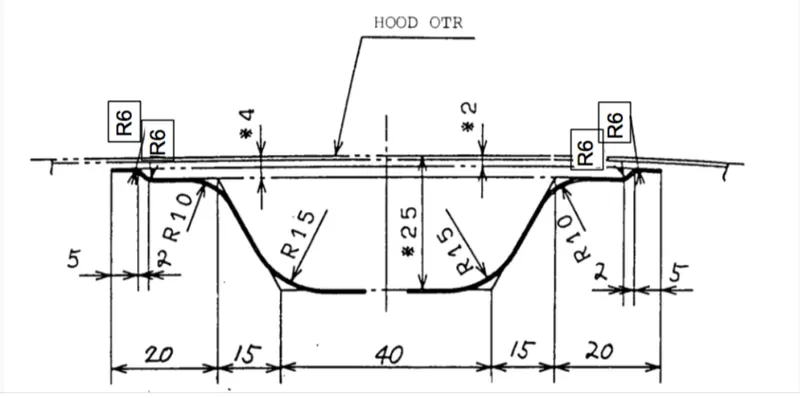
- Understand the requirements and prepare the master section.
- Concept and approach for making final design.
- Tools and commands goint to use for creating inner panel.
MASTER SECTION
CONCEPT METHOD FOR MAKING FINAL DESIGN AND ASSEMBLY-
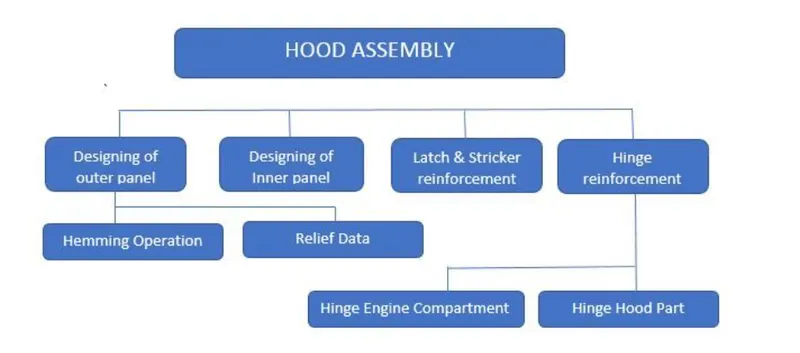
COMMANDS USED FOR CREATING HOOD
- Offset surface
- Offset curve on surface
- Trim sheet
- Through curves
- Law extension
- Emboss
- Face blend
- Edge blend
Detail explanation of every command used in creating hood
OFFSET SURFACE- the Offset Surface command to create an offset of one or more existing faces. The result is a new body (or bodies) with an offset relation to the chosen faces. The software creates a true offset surface by offsetting points along surface normals of the selected face.
OFFSET CURVE ON SURFACE- Offsets curve along the selected face. Offset adopts surface even if the surface blended or face has sharp corners.
TRIMS SHEET-this command help to trim sheet through a slelected curve , surface , plane .
THROUGH CURVES-we can create a sheet body through curves by using the “Through Curves” command. If the curves do not have closed contours, the created body will be a surface body. To create a surface by using the “Through Curves” command. Activate the “Through Curves” command.
LAW EXTENSION- The “Law Extension” command extends the curve or edge on the surface to create a sheet body. You can create different types of extensions by changing the rules in the Length Law and Angle Law in the command dialog box.
EMBOSS- Emboss Body now addresses cases where a solid tool body intersects the boundary of a sheet target body.
FACE AND EDGE BLEND- Edge blend command creates smooth tangent faces between faces which connected on edge.
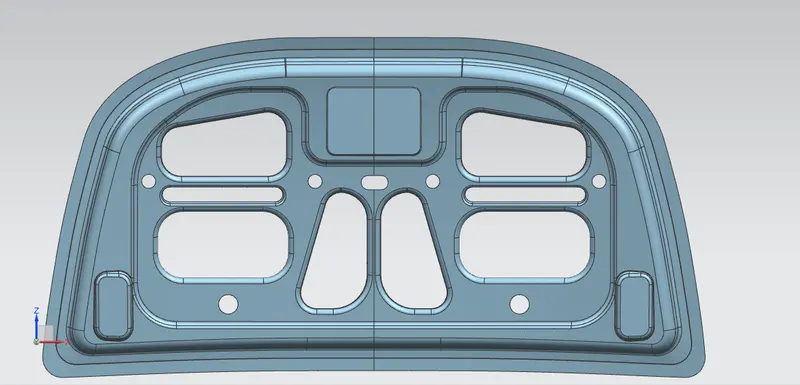
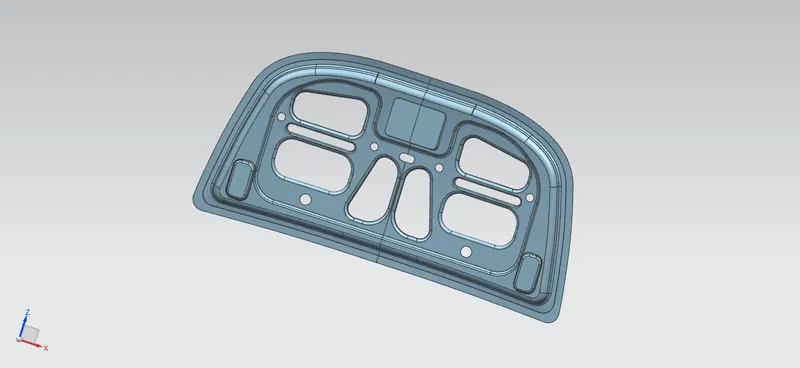
SCREENSHOT OF INNER PANEL AND STEPS
- Extract the dump solid body creating inner panel from that extracted one.
- Save as inner panel and trim the half of the portion.
- Create a offset surface and then use offset curve and then trim the unwanted portion.
- Use through curve commands which usually creates a body through each section.
- Create one more surface using offset surface and connect it with the previous surface with the help of law extensions.
- Blend the faces.
- Create emboss as per drawn sketches.
- Create hinge emboss by creating a another datum plane.
LATCH AND STRIKER POSITIONING
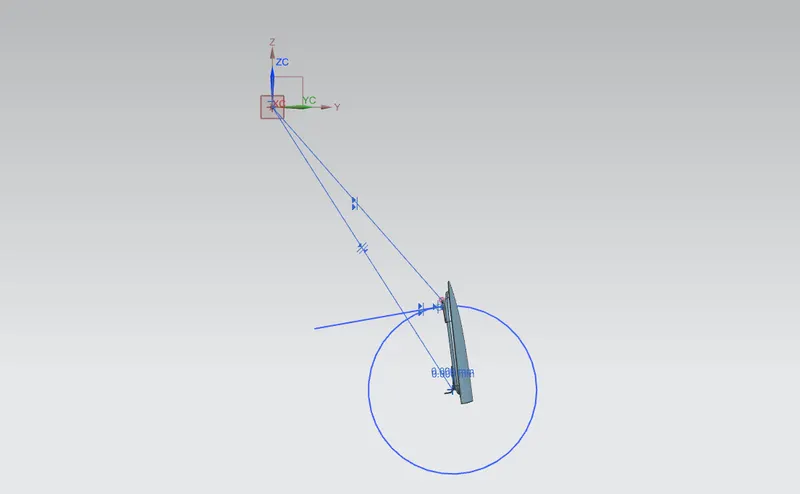
- Position the hinge assembly and also mirror it to the next side.
- Then from both two points of hinge create a straight line.
- From the midpoint of line draw acircle.
- The line will act as an axis along which the hinge will move or we can open or close the hood.
- The circle will infer trajectory of hood and position of striker.
- The striker should be exact perpendicular to the trajectory for positioning the hinge.
- And the we wiil create embosss for striker.
MASTIC POINT- it is hard rubber material having the tendenancy to increase the strength locally at around 80mm diameter. It purpose it to joining the inner panel and outside panel.
HEMMING-it is created on the outer panel of the hood . hems are fold to the edge of apart to create a rounded safe edge.
Hemming is performed in order to:
- Achieve a better final geometry in the vehicle´s part.
- Add resistance and rigidity to the part.
- Allow a safe handling of the part.
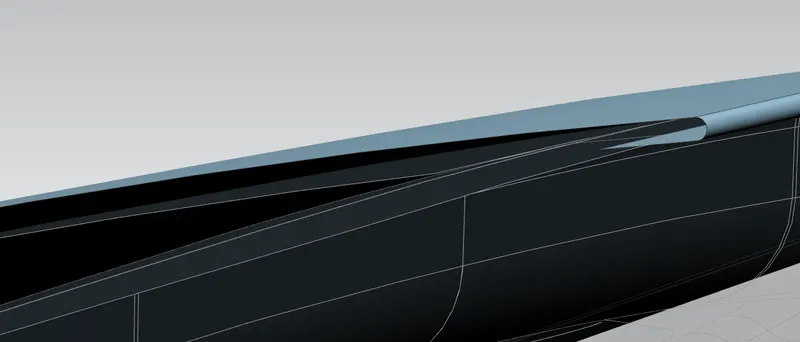
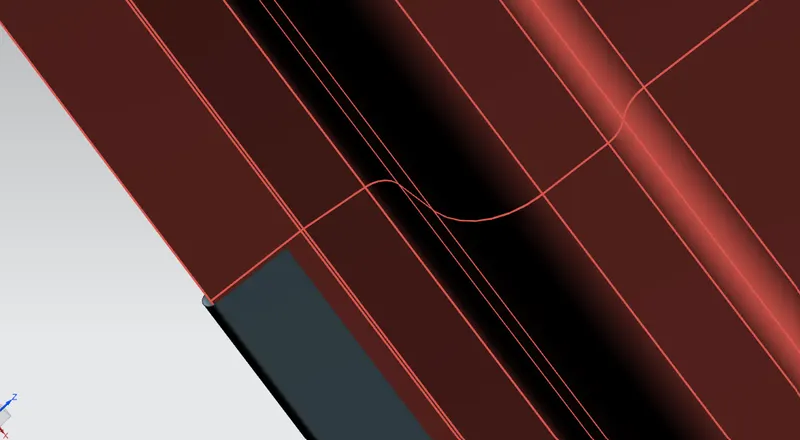
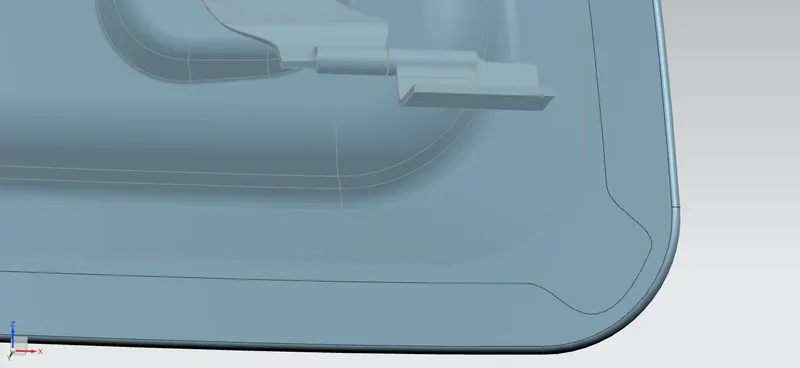
RELIEF CORNER- it is provided onto the part component in order to remove any stress developed in a particular area i.e. sharp corners that takes place during the hemming process is carried out. Thus corners are round and chamfered.
Deep drawing
Deep drawing is one of the most widely used processes in sheet metal forming. Apart from its use in many other sectors, it is applied in the automotive industry for the manufacturing of car body parts.
Process definition:
The deep drawing process is a forming process which occurs under a combination of tensile and compressive conditions. A flat sheet metal blank is formed into a hollow body open on one side or a hollow body is formed into a hollow body with a smaller cross-section. [DIN 8584]
Deep drawing processes are divided into three types:
- Deep drawing with tools
- Deep drawing with active means
- Deep drawing with active energy
In the automotive industry, deep drawing is usually carried out using rigid tools.
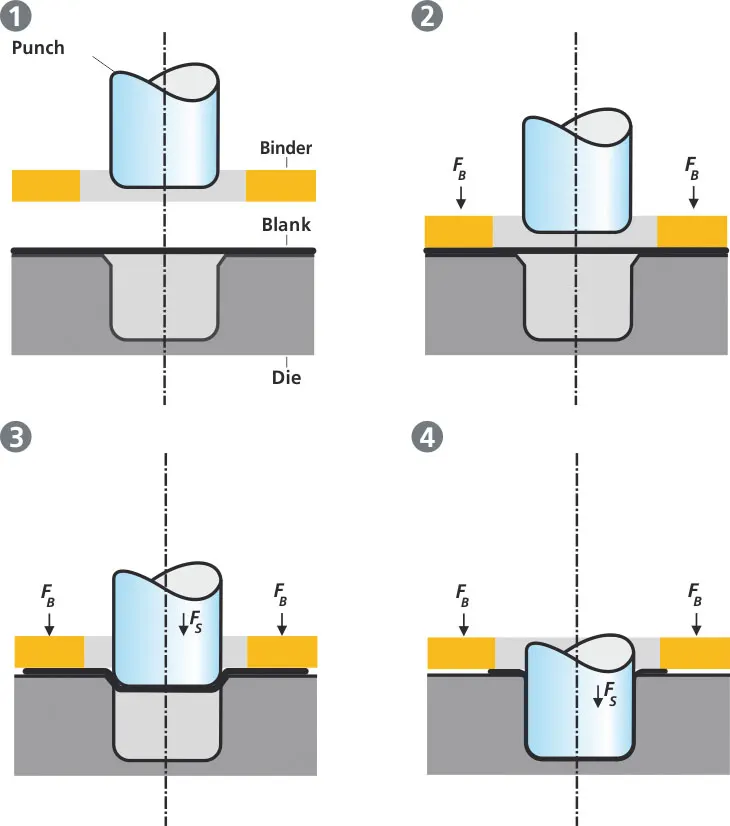
The figure illustrates the deep drawing process. The rigid tools consist of a punch, die and binder. In deep drawing, the plate holder closes after the metal sheet blank has been inserted.
Next the sheet is clamped between the die and the binder. This process slows down the flow of the sheet while it is being drawn and thereby prevents wrinkles from forming under the binder. The punch stretches the sheet over the die radius and forms it in the die. The amount of punch force necessary for forming is thereby continually increased up to the lower dead center of the punch.
Whereas in pure deep drawing there is no reduction of sheet metal thickness, forming is achieved in stretch forming purely as a result of a decrease in sheet metal thickness. Stretch forming is extensively used for the forming of only slightly curved parts with low depth of draw (e.g. roofs, doors).
When drawing complex car body parts in practice, there is usually a combination of stretch and deep drawing involved. It is necessary that the sheet metal is stretched as well as possible without reaching the material’s limits (e.g. splits, wrinkles).
There are approximately 300 to 400 sheet metal parts which fit together to form the body of a car. In order to manufacture high quality sheet metal parts optimally for their particular use, specialized software simulates the complete deep drawing process.
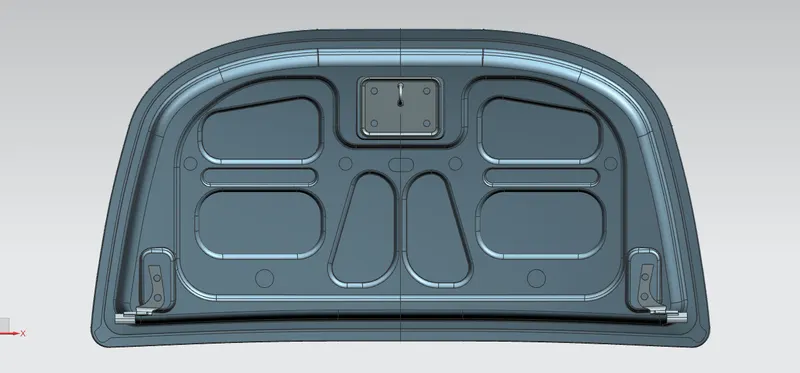
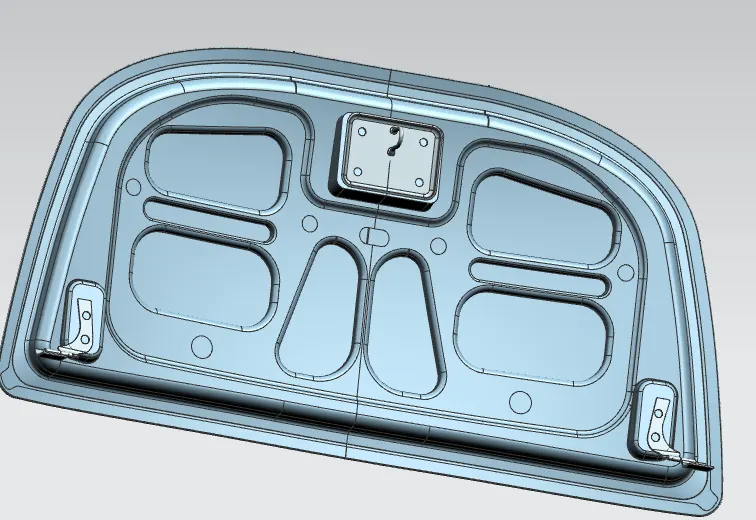
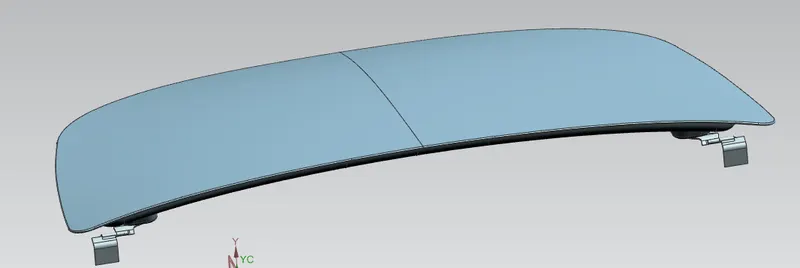
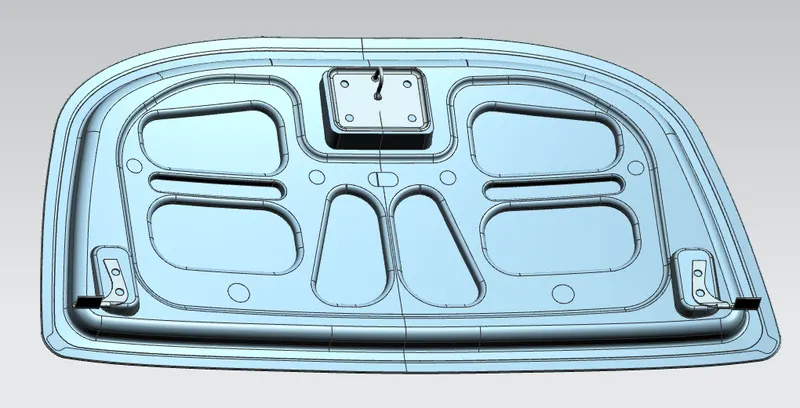
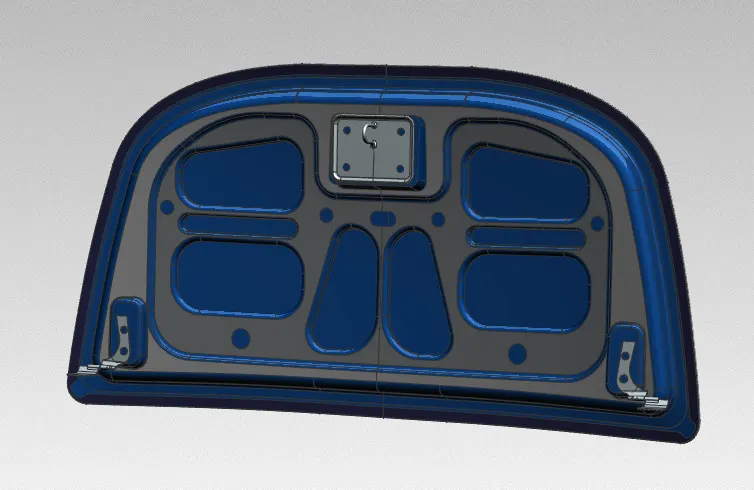
ASSEMBLY OF HOOD-
It consist adding component
- Outer panel
- Inner panel
- Hinge assembly
- Striker
CONCLUSION
WE GET TO KNOW ABOUT VARIOUS TOOL AND COMMANDS FOR CREATING OUTER PANEL, INNER PANEL AND HOODASSSEMBLY WITH THE HELP OF MASTER SECTION WITH DESIGN PARAMETERS.